

Is Data Fragmentation the Real Cause Behind 'Signed but Not Served' in Family Doctor Programs?
If the keyword for family doctor contract signing in 2017 was “signing,” then the keyword for 2018 is undoubtedly “fulfillment.” Although community hospitals across China are promoting contract-based services, it has become commonplace that contracts are signed but not honored. Where exactly does the problem lie? Some answers may be found in the latest documents issued by the National Health Commission.
On April 2, the National Health Commission released the "Notice on Doing a Good Job in Family Doctor Contracted Services in 2018" (hereinafter referred to as the "Notice"). The Notice sets forth explicit requirements for informatization, stating that close contact with contracted residents should be maintained through information technology means, and the construction and application of intelligent information platforms for contracted services should be accelerated. Relying on websites, mobile client applications, and other channels, an interactive communication platform between family doctors and contracted residents should be established to provide services such as online contracting, appointment scheduling, consultations, health management, follow-up visits for chronic diseases, and report inquiries.
This means that informatization will become a key focus in the deepening of family doctor contract services.
The proliferation of fragmented and regionally siloed hospital information systems has become a widespread phenomenon. Even within a single hospital, staff must operate multiple disparate systems to complete corresponding tasks. The lack of unified planning and design has led to data fragmentation and interoperability failures among these systems, creating “information silos” within the institution. This results in cumbersome workflows and low efficiency for physicians, as well as diminished patient satisfaction with the healthcare experience.
The inefficiency caused by poor hospital data flow is severely hindering the implementation of family doctor contract services.
One-Click Triage: The “Integrated Platform” of Community Hospitals
To address the issue of information interoperability in community hospitals, the Xinshi Street Community Health Service Center in Baiyun District, Guangzhou, has recently partnered with Shequ 580 to launch a one-click triage service.
Built upon the family physician service management system and the electronic health record (EHR) management system, this business solution aggregates operational data from various systems onto a single interface. It establishes a unified patient view for physicians, thereby facilitating rapid clinical decision-making regarding appropriate medical services.
When residents seek medical care, they can simply scan or enter their ID number and click “Search” to instantly retrieve information such as their contract signing status, health records, follow-up visits, and physical examination results. This one-click operation reduces the system processing time from five minutes to just ten seconds, significantly improving physicians’ work efficiency while shortening patients’ waiting times. As a result, patient satisfaction is enhanced, creating a healthcare experience that satisfies both doctors and residents.
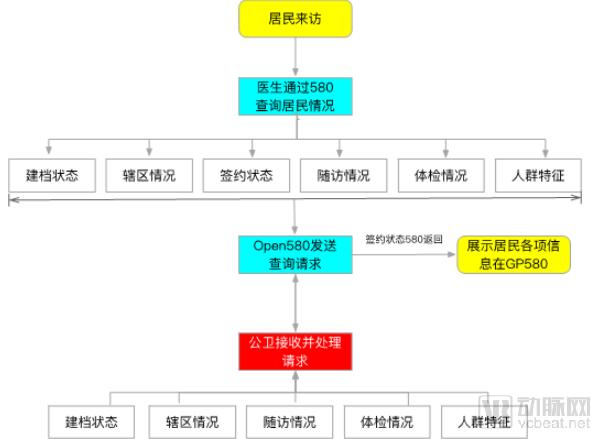
Director Huang Jianzhong of the Xinshi Street Community Health Service Center stated that the essence of “One-Click Triage” is to enable family doctors to quickly determine whether a resident falls under the management of the community hospital, whether a health record has been previously established, whether the resident has signed up with a family doctor, whether they belong to key populations such as the elderly or individuals with hyperglycemia, whether they have undergone a physical examination in the past year, and whether follow-up visits have been conducted. Physicians can rapidly access this information through the One-Click Triage system. The hospital’s existing health record system and Hospital Information System (HIS) were unable to achieve this functionality due to lack of data integration, which is why the hospital partnered with Community 580.
The functions of community hospitals are relatively fragmented, encompassing clinical diagnosis and treatment, public health services, contracted family doctor services, as well as child healthcare and chronic disease management. These services are managed through disparate information systems, such as Hospital Information Systems (HIS), Laboratory Information Systems (LIS), Public Health Management Systems, immunization planning systems, child healthcare systems, and chronic disease management platforms. The proliferation of systems leads to increasing data fragmentation, a challenge that community hospitals face just as tertiary hospitals do.
From a system category perspective, the One-Click Triage system is analogous to the integration platforms used in Grade 3A hospitals. An integration platform effectively consolidates independent hospital application systems, such as HIS, EMR, PACS, LIS, and CIS. It functions like a “power strip,” establishing standardized interface protocols so that any system compatible with these protocols can be connected, thereby enabling efficient data exchange among various applications. In contrast, the One-Click Triage system connects with the various service systems of community hospitals.
One-Click Triage is an integrated platform that empowers family doctor contracting services and requires integration with multiple information systems in community hospitals. Currently, the information systems used by community hospitals rely on different systems for different functions, developed by various IT vendors. This results in a cumbersome process of resource data integration and consolidation, which nonetheless holds significant practical value. Driven by a sense of responsibility to empower community family physicians, Community 580 Company has implemented this solution.
In the view of Liu Bo, CEO of Shequ 580, the relationship between Shequ 580 and health IT vendors is more complementary. B-Soft excels in hospital-based systems, while Shequ 580 specializes in out-of-hospital solutions such as family doctor contracting and online pharmacies. Through collaboration, the two parties jointly advance the informatization of primary healthcare, achieving interoperability among various systems.
"Enhance Physician Efficiency, Improve Patient Satisfaction"
“One-click triage is by no means an arbitrary invention; rather, it reflects the genuine needs of primary care physicians at community health service centers. ‘In 2018, the key focus for community health service centers was not on signing up patients, but on fulfilling contractual obligations. Patient enrollment expands coverage breadth, whereas service fulfillment requires deeper implementation,’ said Director Huang.”
According to him, in addition to clinical consultations, public health services consume a significant amount of family doctors’ time. These services include establishing health records, health management, physical examinations for the elderly, follow-up visits for patients with chronic diseases, and child and maternal health management. Within these services, there is considerable repetitive and mechanical documentation work, which places an additional burden on family doctors who are already under immense pressure.
If calculated by percentage, clinical services account for 50% of physicians’ working hours, while public health services consume approximately 40% of the time for primary care physicians. The remaining 10% is dedicated to family doctor contract services. The time saved through One-Click Clinic Guidance enables physicians to significantly refocus on their core responsibilities, including clinical care, health management, and follow-up visits.
Community hospitals aim not only to provide residents with relatively comprehensive services but also to increase the rate of health record establishment, thereby helping physicians identify service gaps in health management, follow-up care, and contracted services.
In the past, the work of family doctors typically began with establishing health records, followed by subsequent activities such as follow-up visits, chronic disease management, and examinations. Over time, this approach inevitably led residents to perceive the care as fragmented. The frequent follow-up visits gradually fostered a sense of resistance toward services provided by community hospitals.
Take a 65-year-old senior as an example. Under standard community hospital services, the hospital must first establish a health record for him. If the senior suffers from hypertension, the physician is also required to conduct four follow-up visits for hypertension management annually. Furthermore, in accordance with national regulations, individuals aged 65 and above are entitled to one free comprehensive health examination per year. When routine consultations and medication dispensing are added to these obligations, physicians invest a significant amount of time even for a single resident. Consequently, due to the inefficiency and burden of frequent visits, the resident may opt to seek care directly at large tertiary hospitals.
The value of one-click triage lies in its ability to enable family doctors to clearly understand the remaining services due for a resident within the current year, regardless of the specific service requested. It provides a one-stop solution that completes contracting, clinical consultation, health record establishment, and follow-up in a single interaction.
Since the one-click triage system is fully integrated with data from systems such as the Hospital Information System (HIS), information on all registered residents can be accessed synchronously across various platforms, thereby eliminating the cumbersome need for physicians to switch between multiple systems for queries. For residents without established health records, physicians can click to create a record and complete the process rapidly through templated operations, thus eradicating redundant manual data entry.
Director Huang told reporters that, at present, the depth of family doctor contract services in most community hospitals is insufficient. The fundamental cause is the shortage of physicians in primary care institutions. With the time saved by one-click triage, family doctors can deliver more in-depth health management and assume greater responsibilities in community health services.
For residents, what previously required multiple trips can now be completed in a single visit, significantly enhancing satisfaction with contract signing. This approach not only reduces the need for repeated visits but also ensures higher quality of care for residents.
According to Liu Bo, the interoperability achieved through hospital information integration enables healthcare institutions to optimize service processes for residents. In the past, due to data being scattered across disparate systems, community hospitals could only provide single, isolated services to residents. The core of one-click triage lies in integrating all systems within community hospitals, transforming them into a comprehensive, resident-centric workflow.
Based on One-Click Triage, Promoting Service Extension
“Given the data integration capabilities of one-click triage, it facilitates the implementation of other services in community hospitals, including cloud pharmacies, artificial intelligence, and telemedicine,” said Director Huang when discussing integration with other business operations.
Taking the “Air Pharmacy” as an example, the Xinshi Street Community Health Service Center launched its “580 Air Pharmacy” service in February this year. Family doctors can leverage the over 1,000 medications available through the “580 Air Pharmacy” to supplement shortages at the community health center, thereby meeting residents’ needs. Moreover, long-term prescriptions for chronic diseases are delivered free of charge directly to patients’ homes. The launch of the one-click triage feature enables physicians to manage the Air Pharmacy more efficiently within a single interface.
In addition, the Xinshi Street Community Health Service Center has recently launched a GDS service. By analyzing data obtained through one-click triage, such as public health follow-up records, this service generates personalized reports, assessment summaries, individualized control targets, lifestyle recommendations, and physician advice for follow-up subjects. It automates and intelligently completes extensive analytical tasks, stratifies residents’ health conditions into high, medium, and low risk levels based on the analysis results, and formulates targeted intervention measures.
Ultimately, it aims to assist in enhancing physicians’ clinical analysis capabilities, improve the efficiency of chronic disease management in community hospitals, reduce the risk of major adverse health events, significantly boost prevention and treatment efficiency, and establish a sustainable healthcare service model.
“One-Click Triage” Is Becoming the Core Clinical Guide for Physicians at Xinshijie Community Health Service Center.
One-Click Triage: The Origin of the Resident Health Profile
“The mission of Community 580 is to comprehensively empower primary healthcare; any work that helps improve service efficiency and optimize service delivery processes in primary healthcare falls within the responsibilities of Community 580.”
Liu Bo stated that the “One-Click Triage” system has fully integrated nearly all operational services of community hospitals, including medical care, public health, child healthcare, and chronic disease management, thereby providing a unified one-stop service. For Shequ 580, this system has also achieved the integration of its existing services, such as the cloud pharmacy, family doctor contract signing, and mobile follow-up visits.
The ultimate value lies in the ability of community hospitals to leverage one-click triage to construct health profiles for residents.
Analogous to the integration platforms of tertiary hospitals, a key advantage of one-click triage is its ability to consolidate historical business process data around patient-specific information, ultimately creating comprehensive health profiles for residents.
From a physician’s perspective, access to residents’ health profiles enables comprehensive visibility into their disease history and healthcare utilization across all time points, thereby facilitating more precise clinical diagnoses.
“It is essentially a CRM (Customer Relationship Management) system tailored for community hospitals. Enterprises often leverage corresponding information and internet technologies to coordinate interactions with customers across sales, marketing, and service, thereby enhancing their core competitiveness and delivering personalized services. The relationship between community hospitals and residents is no different from that between enterprises and their customers,” said Liu Bo.
The integration of community hospital systems ultimately aims to establish a resident-centric dataset. By leveraging historical data, the system assists physicians in making rapid assessments for upcoming services. This involves transforming the legacy service-item-oriented information system into a resident-centric information system.
There is no doubt that this is the ultimate purpose of family doctor contract services.