

Tencent Launches WeChat Smart Hospital 3.0, Integrating AI and Blockchain to Streamline End-to-End Healthcare Services
On April 13, VCBeat learned that at the Smart Hospital Sub-forum of the 2018 China “Internet+” Digital Economy Summit held in Chongqing, Tencent officially released WeChat Smart Hospital 3.0, achieving four major upgrades in connectivity, payment, security assurance, and ecosystem collaboration.
Meanwhile, the new version of WeChat Smart Hospital has integrated emerging technologies such as AI and blockchain into its existing foundation of big data, payment solutions, cloud computing, and security. Its six core capabilities span the entire patient journey, from pre-consultation to post-consultation care.
On April 12, Premier Li Keqiang of the State Council presided over an executive meeting of the State Council, where measures to develop “Internet Plus Healthcare” were established to alleviate difficulties in accessing medical care and improve public health. The new launch of WeChat Smart Hospital 3.0 reflects a comprehensive upgrade of “Internet Plus Healthcare” solutions.

Deputy Director of the Statistical Information Center, National Health Commission: Zhou Gongwei
Zhou Gongwei, Deputy Director of the Statistical Information Center of the National Health Commission, stated at the Smart Hospital Sub-Forum: “Through the joint efforts of relevant enterprises across China’s health and family planning system and all sectors of society, certain regions have achieved digitization of medical services, time-slot-based appointment scheduling, patient autonomy in seeking care, structuring of clinical information, mobilization of medical activities, intelligent clinical treatment, and refined hospital management.”
Tencent Vice President Chen Guangyu pointed out that WeChat Smart Hospital is a key component of Tencent’s healthcare initiatives. The newly released version 3.0 exemplifies the major trend in the development of “Internet + Healthcare”: by addressing pain points in current medical care processes, it achieves integration between online and offline services, thereby better supporting governments and healthcare institutions in advancing digital healthcare.

Tencent Vice President Chen Guangyu
From 1.0 to 3.0: Streamlining the Entire Patient Care Journey
In recent years, “Internet Plus” has been accelerating innovation across various sectors of society, enabling the deep integration of internet technologies with diverse industries. This trend is particularly prominent in the healthcare sector. At the Smart Hospital Sub-Forum, Chen Guangyu stated that the evolution of WeChat Smart Hospital from version 1.0 to 3.0 reflects the developmental stages of the healthcare industry:
In the era of mobile internet, smartphones have become the central platform connecting online and offline services. Leveraging foundational capabilities such as Tencent Cloud, payment systems, big data, and security, WeChat Smart Hospital 1.0 was launched. It facilitated basic online-to-offline connectivity through WeChat Official Accounts, enabling functions such as online appointment registration, payment, and inquiry. WeChat Smart Hospital 2.0 further optimized the management of internal hospital resources, enhancing operational efficiency within hospitals. For instance, it improved patient experience through smart hardware integrations, including LBS-based location reminders and WeChat navigation.

WeChat Smart Hospital 3.0 Launch Ceremony
Huang Li, Deputy General Manager of the Joint Product Department at WeChat Pay, introduced the newly launched WeChat Smart Hospital 3.0 at the forum. She stated that the new version fully integrates the previously fragmented and disjointed healthcare journey, covering all stages including triage (online AI triage and intelligent customer service consultations), appointment scheduling (online registration), consultation (online consultations and offline AI-assisted diagnosis), examinations (offline AI imaging and AI pathology), payment (online payment via medical insurance/commercial insurance and offline QR code payment for medical insurance), treatment (online medication delivery and offline prescription circulation), and post-consultation care (AI follow-ups and online prescription renewals), thereby streamlining the entire healthcare process.
National Policy Sets the Tone for “Internet + Healthcare” Initiatives
On April 12, Premier Li Keqiang presided over an executive meeting of the State Council to determine measures for developing “Internet + Healthcare,” aiming to alleviate difficulties in accessing medical care and improve public health. The meeting pointed out that, in accordance with the deployments of the CPC Central Committee and the State Council, accelerating the development of “Internet + Healthcare” can enhance the efficiency of medical services, reduce the need for patients to make multiple trips, provide greater convenience, and enable more people to benefit from high-quality medical resources.
The meeting determined the following: First, accelerate the widespread provision of online services by hospitals at Level II and above, such as appointment scheduling and inquiry of laboratory and imaging test results. Permit medical institutions to deliver certain internet-based medical services, including follow-up consultations for common and chronic diseases. Second, promote the coverage of telemedicine across all medical consortia and county-level hospitals throughout China, facilitating the alignment of high-quality medical resources in the eastern regions with the needs of the central and western regions. Support the extension of high-speed broadband networks to urban and rural medical institutions and establish dedicated internet lines to safeguard telemedicine requirements. Third, explore the sharing of information between medical institution prescriptions and pharmaceutical retail data. Implement intelligent health insurance audits and “one-stop” settlement systems. Improve the standard system for “Internet + Healthcare,” accelerate interoperability and information sharing, and strengthen supervision of medical quality and protection of information security.
Zhou Gongwei, Deputy Director of the Statistical Information Center of the National Health Commission, pointed out that implementing the concept of “Grand Hygiene and Grand Health” and improving national health policies is a rigorous long-term task. “To accomplish this task effectively, we must leverage the power of the Internet, vigorously strengthen ‘Internet+ Healthcare’ initiatives, and promote the decentralization of high-quality healthcare resources.” He introduced that the nationwide healthcare system is currently enhancing hospital medical service standards through the application of unified card systems and related platforms across China. These efforts aim to facilitate patients by optimizing medical processes, improving the healthcare experience, reducing waiting times, and increasing patient satisfaction. Furthermore, the adoption of electronic medical records and mobile healthcare systems is comprehensively improving the quality of medical care in hospitals. Meanwhile, the implementation of operational and decision-support systems is elevating overall hospital management standards, enabling refined management. “However, there is still a long road ahead, requiring sustained collective effort.”
Four Major Upgrades, Delivering Innovative Solutions
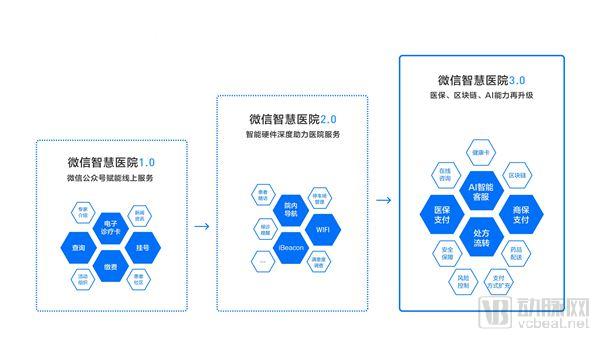
WeChat Smart Hospital 3.0 Features Numerous Highlights: It Not Only Achieves Four Major Upgrades in Connectivity, Payment, Security, and Ecosystem Collaboration, but Also Integrates Cutting-Edge Technologies Such as AI and Blockchain, Fully Unlocking Tencent’s Core Capabilities.
Connection Upgrade:By integrating resources from human resources and social security departments, hospitals, pharmaceutical companies, and insurance providers to enable coordinated collaboration, we offer services such as online consultations, prescription circulation, and direct settlement with commercial health insurance. Taking prescription circulation as an example, against the backdrop of the zero-markup policy for pharmaceuticals, we leverage core technological capabilities—including Tencent Pay, AI-based facial recognition, and blockchain—to connect hospitals, pharmaceutical distributors, and patients. This facilitates the secure circulation of electronic prescriptions with end-to-end traceability, thereby supporting the separation of prescribing and dispensing. Patients can choose from various medication procurement options, including pickup at pharmacies or home delivery.
Payment Upgrade:Payment Scenario Upgrade: WeChat Pay Now Supported Across Hospitals, Pharmacies, Community Health Centers, and Insurance PlatformsThe payment ecosystem has been upgraded to support WeChat Pay across a broader range of scenarios, including hospitals, pharmacies, community health centers, and insurance services. For instance, in hospitals, users can leverage official WeChat accounts for online payments, scan QR codes on prescription slips for payment, or use self-service kiosks for quick transactions. In the insurance sector, individuals can use their personal social security account balances to purchase health insurance online. At pharmacies and community health centers, customers can enjoy convenient, card-free medication purchases through online QR code scanning. Furthermore, the payment system seamlessly integrates medical insurance, commercial insurance, and out-of-pocket expenses, enabling a frictionless payment experience for consumers.
Safety Upgrade:WeChat Smart Hospital 3.0 provides comprehensive safeguards for real-name authentication security, payment security, data security, and risk control security. For instance, medical data security and patient privacy protection have long been core concerns in the healthcare industry. Blockchain’s advantages—including multi-party consensus, immutability, multi-party evidence storage, and real-time auditability—make it an optimal solution for medical data custody. Smart Hospital 3.0 leverages blockchain technology to establish a consortium chain connecting regulators, hospitals, and pharmaceutical distribution companies, thereby ensuring data and privacy security while preventing tampering with on-chain data.
Ecosystem Collaboration Upgrade:Beyond enhancing its own capabilities, WeChat Smart Hospital 3.0 places greater emphasis on collaborative win-win outcomes across the entire ecosystem. By joining forces with partners across four key dimensions—capital, resources, technology, and products—it aims to upgrade collaborations, facilitate effective business implementation, and collectively advance the development of “Internet+” smart hospitals.
Smart Hospitals Accelerate Implementation, Unlocking New Value in the Healthcare Ecosystem
At the Smart Hospital Sub-Forum, guests from various healthcare-related fields shared case studies and achievements in smart hospital development. Liu Jiaming, Chairman of WeSure, introduced innovative applications of individual account health insurance and commercial insurance claims settlement. It is reported that WeSure, a joint initiative by the Tencent team, the National Healthcare Security Administration, and insurance companies, has been exploring supplementary health insurance that integrates social security with commercial insurance. This collaboration has enabled an innovative service allowing individuals to purchase insurance using their social security card’s personal medical account online, thereby further advancing innovation in human resources and social security medical insurance service models, improving service quality, and enhancing service efficiency.
Chi Hui, Director of the Institute of Medical Information at the Chinese Academy of Medical Sciences, shared insights on the application of WeChat Pay in cross-provincial medical settlement; Mu Weinong, Director of the Information and Statistics Division of the Chongqing Municipal Health and Family Planning Commission, introduced Chongqing’s planning and construction of smart hospitals; Ye Lishan, Director of the Information Center of Zhongshan Hospital Affiliated to Xiamen University, provided a detailed overview of the achievements made in Xiamen through the effective integration of medical insurance with family doctor contract services.
Li Bing, President of Liuzhou Workers’ Hospital, shared typical cases of the implementation and application of WeChat Smart Hospitals in Liuzhou. Liuzhou Workers’ Hospital has established a strategic partnership with Tencent and Liuzhou Pharmaceutical Company, creating China’s first “in-hospital prescription circulation to out-of-hospital pharmacies” model based on the WeChat Official Account. Now, patients visiting Liuzhou Workers’ Hospital can simply follow the hospital’s official account and complete real-name authentication to access convenient medical services, including appointment registration, full-process payment, examination scheduling, report inquiries, and online consultations. They can also choose to pick up their medications at partner pharmacies outside the hospital, significantly reducing waiting times for medication collection.
Chen Guangyu pointed out that the current acceleration of the "Digital China" initiative provides historical opportunities and technical conditions for the balanced and comprehensive development of healthcare. WeChat Smart Hospital 3.0 is a product of this opportunity: as an important component of Tencent Healthcare, it also represents the trend of digital medical development. In the future, driven by strong policy support, continuous scientific breakthroughs, expanding demand, and active industrial investment, digital technology will undoubtedly enhance the development level of China's healthcare sector. Digital technologies such as big data, cloud computing, blockchain, and artificial intelligence have effectively improved the informatization, networking, intelligence, and human-centricity of the healthcare industry, enabling inclusive and precision medicine. These advancements support the implementation of the Healthy China strategy, enhance people’s sense of gain, and lay a solid health foundation for building a moderately prosperous society in all respects.