

WeChat Smart Hospital 3.0: Empowering End-to-End Healthcare with AI and Blockchain for Over 1 Billion Users
From April 12 to 13, the 2018 China “Internet+” Digital Economy Summit was held in Chongqing. Themed “Empowering the New Ecosystem, Sharing New Opportunities,” the summit was guided by the Chongqing Municipal People’s Government and jointly organized by the National Party Media Information Public Platform of the People’s Daily, the Chongqing Municipal Commission of Economy and Information Technology, and Tencent.
At the Smart Hospital Sub-forum held on the morning of the 13th, Huang Li, Deputy General Manager of WeChat Pay’s Industry Center, shared the development journey of WeChat Smart Hospital Version 3.0 and discussed the functions and roles that smart hospitals are expected to play across the broader healthcare sector in the future. VCBeat (WeChat ID: vcbeat) has compiled the guest’s insights.

Huang Li, Deputy General Manager of WeChat Pay Industry Center
Guest Perspectives
From 1.0 to 3.0: The Evolution of WeChat Smart Hospitals
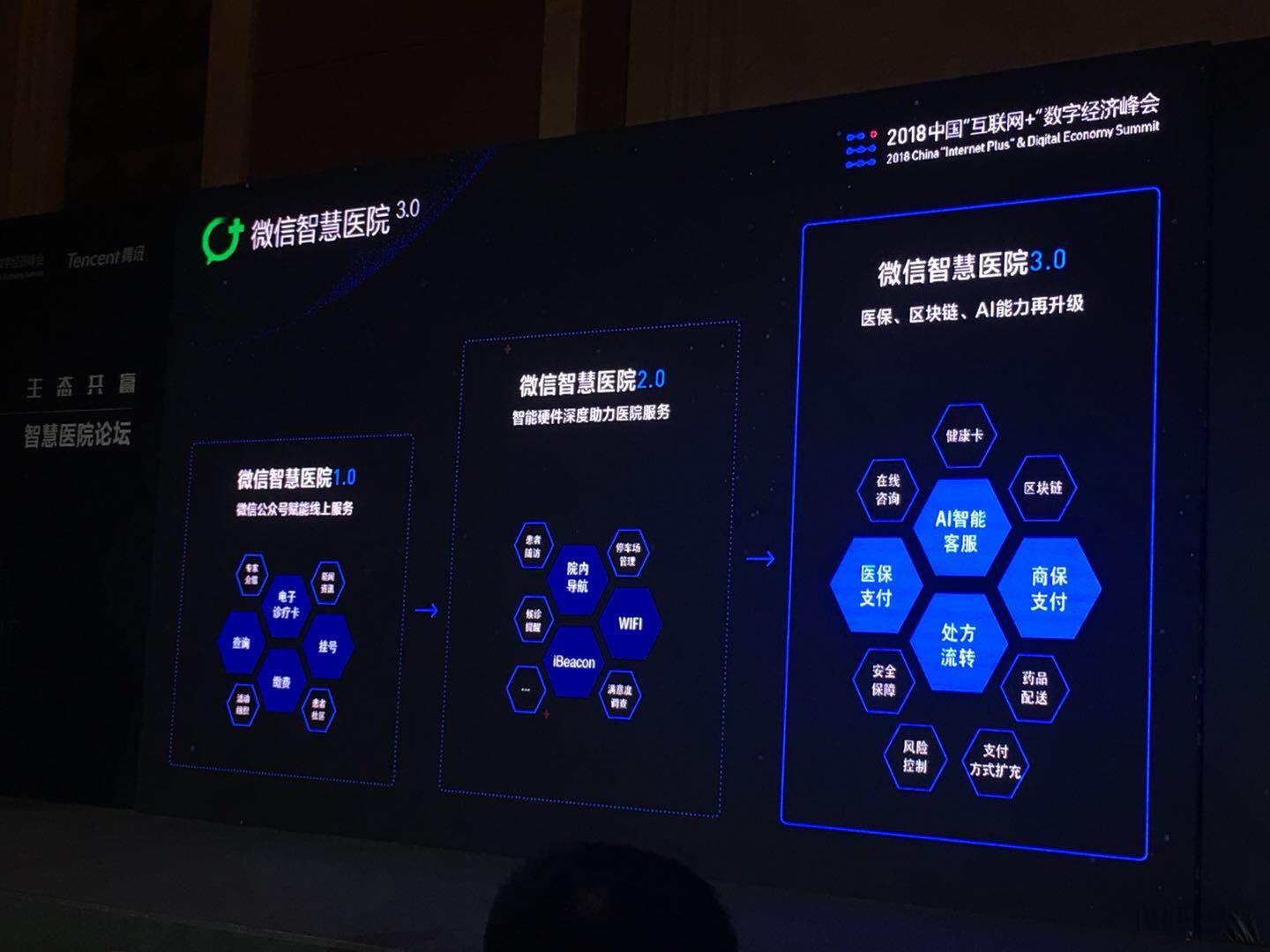
The concept of “WeChat Smart Hospital” was first proposed by Tencent as early as 2013. The initial version 1.0 of WeChat Smart Hospital leveraged the online capabilities of WeChat Official Accounts, with core functional modules centered on content, community engagement, Official Account connectivity, appointment registration, and information service workflows. Its primary applications included query services, basic payments via Official Accounts, and the aggregation of patient community information.ThereforeThe on-site service system provided to hospitals is centered around official account content services and basic medical care.
By 2015 and 2016, WeChat Smart Hospital had ushered in its Version 2.0. During this phase, Tencent proposed a relatively hospital-centric system, aiming to unlock the hospital’s capabilities in online informatization, digitalization, and internet-based transformation across the entire care process.
First, we established a module centered on enhancing offline basic service capabilities as a core competency. In Version 2.0, leveraging substantial hardware capabilities, we implemented solutions such as Wi-Fi connectivity, intelligent parking payment and management services, and in-hospital navigation. These initiatives were designed to optimize the overall spatial services of hospitals, free up more service areas, and improve the patient experience within medical facilities.
Following the comprehensive spatial services, we initiated a preliminary integration of the hospital’s online and offline services. Online activities include patient follow-ups, satisfaction surveys, and timely informational reminders.Further enhance the hospital's overall online and offline service capabilities and its internet-based capabilities.
By 2017 and 2018, mini-programs and official accounts had become the primary entry points for integrated services.We are witnessing the explosive growth of Smart Hospital 3.0, with comprehensive implementation of medical insurance, commercial insurance, blockchain technology, and AI (artificial intelligence) across hospitals.It is evident that the entire hospital-centric service system has witnessed an explosive enhancement in its overall capability modules. Core features, such as AI-powered intelligent customer service, enable the front-loading of hospital services. This spans from initial triage to in-depth engagement at key medical touchpoints within the hospital, ultimately extending the patient’s health management lifecycle.
In-Depth Analysis of WeChat Smart Hospital 3.0: Four Major Upgrades in Connectivity, Payment, Security, and Ecosystem Collaboration
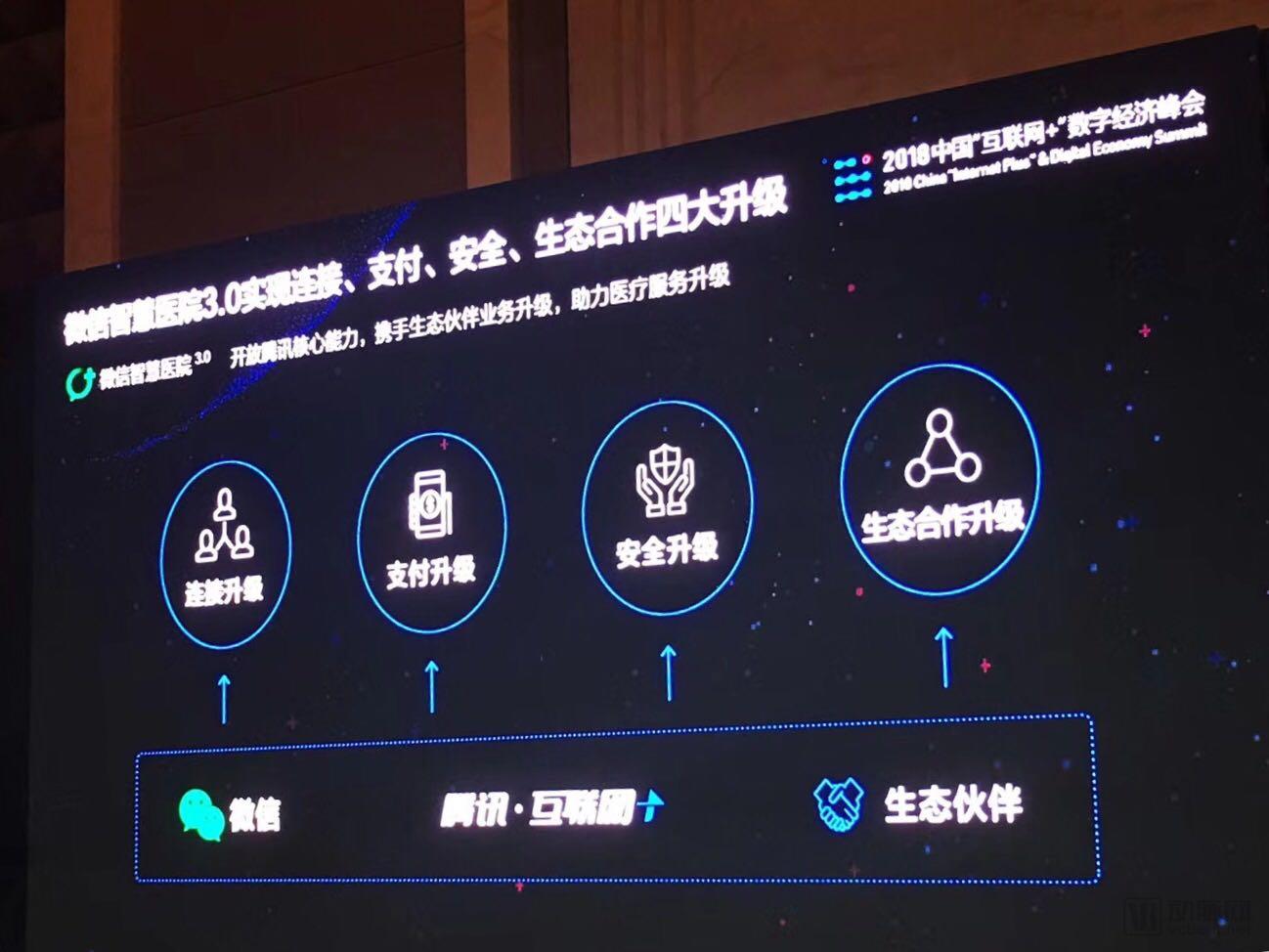
WeChat Smart Hospital 3.0 Achieves Four Major Upgrades in Connectivity, Payment, Security, and Ecosystem CollaborationIn fact, as Tencent continues to open up more of its core capabilities, we are primarily collaborating with hospitals and partners within the Tencent ecosystem to comprehensively empower these partners with all the core capabilities Tencent can offer, thereby driving an overall upgrade of medical services.
Refinement of Connected Roles
As I just mentioned, the role of connectivity is evolving. Building on a more granular understanding of these roles, we now present a detailed breakdown of connectivity nodes.
From simply connecting hospitals to users, from basic information push services to AI-powered intelligence, to appointment registration and online consultations with physicians, there will be a flow of information and actions between online and offline channels. Most importantly, this includes the circulation of prescriptions, such as electronic prescriptions.
Overall, we focus on the front-loading of the holistic health management lifecycle for patients and users. This encompasses early-stage awareness and insights, followed by the complex processes involved after hospital admission—such as triage, consultation, registration, and hospitalization—as well as potential referrals. It further extends to post-discharge follow-up and chronic disease management, covering not only the individual user but also their entire household, thereby supporting health management across the full life cycle. Thus, this constitutes a comprehensive connectivity upgrade system.
In the context of Smart Hospitals 3.0, we believe that implementation is centered around the hospital itself. In this regard, Tencent Healthcare’s foundational internet tools provide significant support to hospitals.
Comprehensive Payment Integration
Payment upgrade, first and foremost, involves comprehensive integration; the simplest aspect isTransition from Fixed Payments to On-Demand Payments。
Now, when we visit various hospitals—for instance, I recently sought medical care at a hospital in Shenzhen—I find that, upon leaving the doctor’s consulting room,Physicians’ prescription forms, including test requisitions and medication purchase orders, already feature QR codes for scanning.I hadn’t even left the doctor’s office,Scan the QR code to pay the medical bill at any time,So it becomesPay anytime, anywhere—a liberation in time., of course, it is actually very good for the patient's psychological comfort.
Fully integrated payment systems, ranging from initial medical insurance payments and hybrid payment models to comprehensive commercial insurance settlements post-treatment, are being vigorously promoted in the Smart Hospital 3.0 version.
The diversification of payment methods offers multiple entry points, including mini-programs, scan-to-pay, official accounts, and QR codes. In terms of scenarios, within hospital settings—as previously mentioned—payments can be made at service counters, via self-service terminals, or by scanning the QR code on prescription slips.
We also offer a wide range of payment options at the counter, including card payments and facial recognition payments. For instance, we currently partner with pharmacies for facial recognition-based payments, and plan to extend this service to certain hospitals in the future. This means that after verifying real-name identity and matching it with the user’s facial features,In the future, medical payments may be processed without even needing a mobile phone—simply being present in person could suffice.。
Another area is payment within insurance scenarios, which also falls under direct commercial health insurance. This is a key focus for future development, as it offers users a highly seamless experience.
Security Upgrades Based on Real-Name Verification, Blockchain Technology, and Big Data Risk Control
Security in the healthcare sector, including user data security, payment transaction security, and personal information security, is of paramount importance. There are four key measures to address this.
First is real-name verification,WeChat has over 600 million real-name verified users. Beyond patient identity verification, the platform includes electronic credential verification for physicians, representing a deeper-level module that integrates real-name authentication into the healthcare delivery process., thus ensuring payment security.
Supported by robust backend data from WeChat Pay, we have seen a massive increase compared to the figures announced last year. WeChat’s capability in ensuring fund security has reached a globally leading position.
Yesterday, Ma Huateng also mentioned the application of blockchain in security.Blockchain prioritizes security first, and then achieves verifiability and supervisory capability through commercial enterprises. Nodes on the chain share resources, enabling multi-party evidence storage and information traceability, thereby ensuring the security of the blockchain.
Additionally, throughRisk Control Big Datasecurity assurance, the identification of big data risks is also conducted based on Tencent’s overall security risk control and management system.
Tencent possesses top-tier blockchain capabilities. As an initiator and formulator of national blockchain standards, as well as a practitioner applying blockchain in foundational application scenarios, Tencent has consistently focused on identifying viable use cases that can deliver real value growth in the future.
Building on blockchain technology, Tencent’s “Internet+” initiative will leverage this capability to deliver a tailored solution for smart hospitals and the broader healthcare sector.
This solution, when implemented in smart hospitals, reveals that the simplest examples include, for instance,PrescriptionVCBeat's Blockchain, after prescriptions are released from the hospital during the diagnosis and treatment process, if they are recorded on the blockchain, it is possible to achieve comprehensive traceability and monitoring of both the prescriptions and their users even after circulation. In the future, this information will still return to the hospital, forming an informational closed loop for the hospital when needed. Because the hospital is on the blockchain, there is a consensus mechanism, access control, and a defined role within the smart contract system.
Therefore, within the prescription blockchain, the circulation of prescriptions provides hospitals with traceability, enabling them to maintain a certain degree of control. This also offers endorsement and assurance for inherent security management.
For regulatory authorities, it is possible to comprehensively prevent data tampering, and in the event of medical dispute litigation, integrity supervision can be implemented.
In the blockchain-based prescription outflow process, the direct impact perceived by users is minimal. However, as the aforementioned three elements provide a secure, holistic protection mechanism and a standardized circulation framework, users experience a more convenient, seamless, and secure journey in medical consultations and prescription medication purchases.
Ecological Cooperation Upgrade
Our earliest partners likely assisted us with supervision, facilitated payment processing, and managed basic hospital information workflows. In the future, as hospitals themselves become more deeply involved in digitalization and informatization, they will be able to participate more extensively.
Throughout the entire diagnosis and treatment process, this potential can be deeply tapped from both the user side and within clinical workflows. Therefore, our ecosystem partners will also engage in the full spectrum of diagnostic and therapeutic activities, including the artificial intelligence and blockchain technologies mentioned earlier, as well as peripheral support capabilities such as big data security.
Therefore, the model of ecosystem collaboration has been upgraded, its coverage has expanded, and its capabilities have been decentralized. As a result, there will be significant opportunities for future collaboration between our ecosystem partners and us.
From this perspective, Tencent is adopting an all-encompassing and comprehensive approach, ranging from core technologies to products, capital, resource sharing, and preferential support. This strategy ensures that our ecosystem partners in hospitals, regulatory bodies, and users can all benefit from the conveniences brought about by the upgrading of ecosystem collaboration.
In short, we will leverage our open capabilities and technologies to channel greater funding and resources toward our ecosystem partners, including hospitals and core service providers. This support aims to enhance their capabilities and provide additional financial backing for mutual growth. This commitment serves as the foundation for our role as a healthcare connector and represents the core focus of our future investments in connecting the entire healthcare industry and building smart hospitals.