

China's National Health Commission Overhauls Medical Device Licensing with New Large Equipment Management Catalog
Recently, the newly established National Health Commission (NHC) has ignited the “first fire” in the medical device industry, directly targeting the configuration management of large-scale medical equipment.
On April 9, to further deepen the reform of streamlining administration, delegating power, strengthening regulation, and improving services, and to promote the scientific allocation and rational use of large-scale medical equipment,The National Health Commission issued a notice on the release of the "Catalogue for the Administration of Licensing for the Allocation of Large Medical Equipment (2018)," officially announcing the latest catalogue for the administration of Class A and Class B large medical equipment (the 2018 edition)., to regulate the allocation of Class A and Class B large-scale medical equipment that requires licensing.

In the "Catalog"Class A Management Catalog Reduced from 12 to 5 Items, the minimum price threshold for large medical equipment included in the Class A management catalog was adjusted from RMB 5 million to above RMB 30 million;The Class B Management Catalog has been adjusted from 5 to 7 items., large-scale medical devices with an initial configuration cost between RMB 10 million and RMB 30 million are included in the Class B management catalog. The specific catalog is as follows:
Catalog for the Administration of Licensing for the Allocation of Large-Scale Medical Equipment
(2018)
Class A (Configuration management under the responsibility of the National Health Commission)
I. Heavy Ion Radiotherapy System
II. Proton Radiotherapy System
III. Positron Emission Tomography/Magnetic Resonance Imaging System (abbreviated as PET/MR)
4. High-end Radiotherapy Equipment. This refers to radiotherapy equipment that integrates precise radiotherapy technologies such as multimodal imaging, artificial intelligence, complex dynamic intensity-modulated radiation therapy (IMRT), and high-precision high dose rates. Currently, this includes X-ray stereotactic radiosurgery systems (commonly known as CyberKnife), Helical Tomotherapy systems (commonly known as Tomo) in HD and HDA models, and linear accelerators such as Edge and Versa HD.
V. Large-scale medical devices with a unit price of RMB 30 million (or USD 4 million) or more for the initial configuration
Category B (under the allocation and management responsibility of the provincial health and family planning commission)
I. X-ray Positron Emission Tomography Scanner (abbreviated as PET/CT in English, including PET)
II. Endoscopic Surgical Instrument Control System (Surgical Robot)
III. 64-slice and above X-ray computed tomography scanners (64-slice and above CT)
IV. 1.5T and Above Magnetic Resonance Imaging Systems (1.5T and Above MR)
5. Linear accelerators (including X-knife systems, excluding radiotherapy equipment listed in the Class A management catalog)
VI. Gamma Ray Stereotactic Radiosurgery System (Including for Head, Body, and Whole-Body Applications)
7. Large-scale medical devices with a unit (set) price of RMB 10 million to 30 million yuan for initial configuration
China implements strict licensing management for the allocation of large medical equipment. Class A large medical equipment is administered by the health administrative department under the State Council, while Class B large medical equipment is managed by provincial-level health administrative departments. Medical institutions are prohibited from independently acquiring such equipment without prior approval.
The national classification of management categories for Class A and Class B large-scale medical equipment has undergone several changes. Prior to the 2018 edition of the catalog, the 2005 edition was in use.
Effective March 1, 2005, the Measures for the Allocation and Use Management of Large-Scale Medical Equipment, jointly issued by the former Ministry of Health, the National Development and Reform Commission, and the Ministry of Finance, officially came into force, while the Interim Measures for the Allocation and Application Management of Large-Scale Medical Equipment, issued by Order No. 43 of the Ministry of Health in 1995, was simultaneously repealed.
The 2005 edition of the Catalog defines large-scale medical equipment as “medical devices included in the management items administered by the health administrative department of the State Council, as well as complete sets of medical devices not yet included in the management items that are configured for the first time within a provincial-level region and have a unit price exceeding RMB 5 million.”
From 2005 until the release of the 2018 edition of the catalog, the former Ministry of Health/National Health and Family Planning Commission designated the management items for Class A and Class B large medical equipment in three batches. There were a total of 12 items for Class A equipment and 5 items for Class B equipment.
In May 2017, the State Council promulgated the Decision on Amending the Regulations on the Supervision and Administration of Medical Devices (State Council Decree No. 680), redefining large medical equipment as “It refers to large-scale medical devices that are characterized by technical complexity, substantial capital investment, high operational costs, and a significant impact on medical expenses, and are subject to catalog management.”
Class A large-scale medical equipment is also redefined as “large-scale equipment with particularly stringent technical requirements, exceptionally high clinical risks, substantial capital investment, and high usage costs, which currently lacks the conditions for widespread promotion and application or is in the early stages of technological development, and whose safety and effectiveness still require ongoing monitoring and evaluation.”
The 2018 edition of the catalog was issued by the National Health Commission to implement State Council Decree No. 680.
Changes Resulting from the New Policy
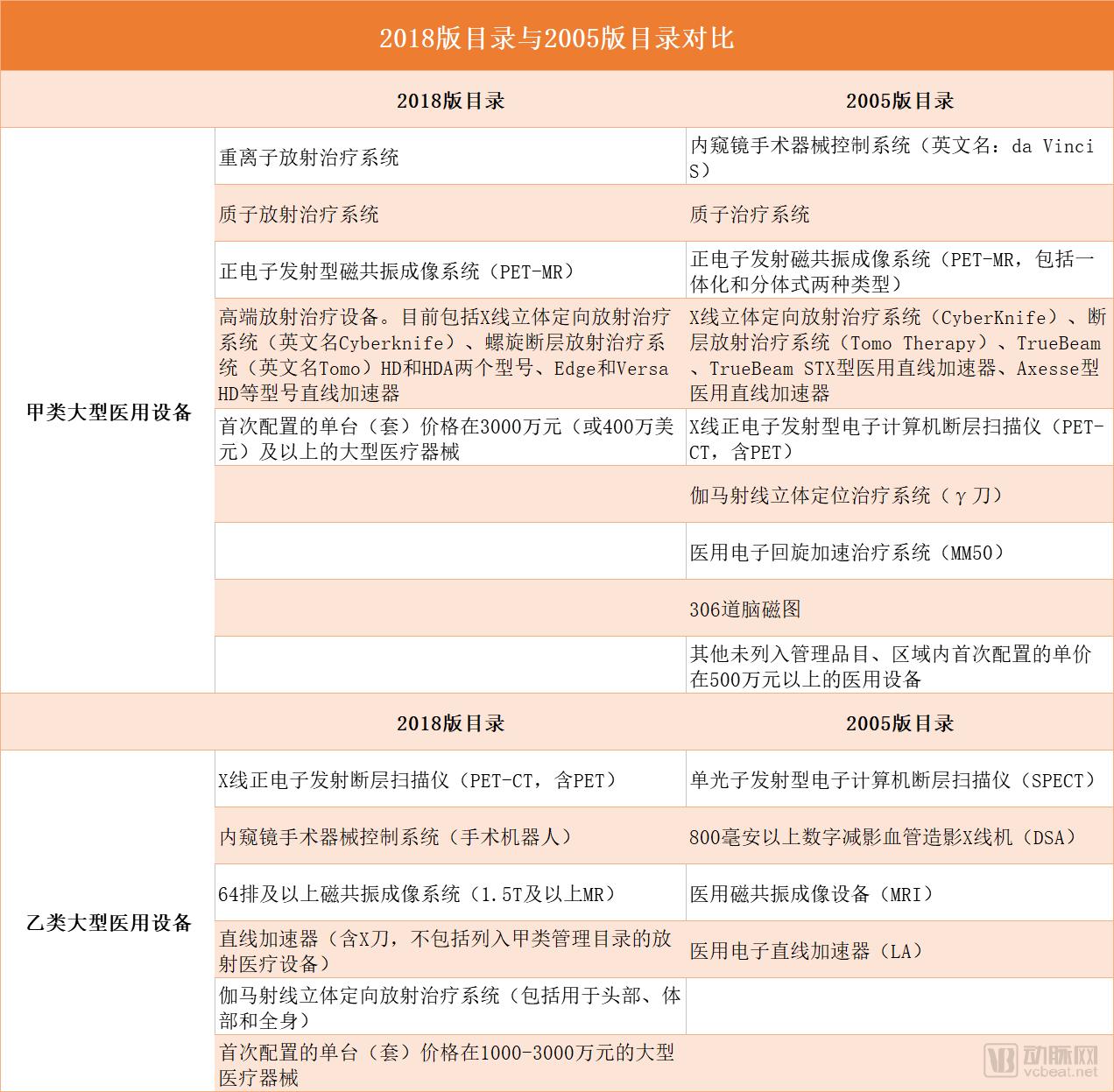
Data source: Compiled by CBI Medical Devices
The 2018 edition of the catalog differs significantly from the 2005 edition.
Change 1: The scope of large-scale medical equipment has been narrowed!
Under the 2018 edition of the catalog, the scope of Class A large medical equipment was significantly reduced, leaving only PET-MR systems and high-end and ultra-high-end radiotherapy equipment. Class B large medical equipment now includes most of the former Class A large medical equipment from the previous catalog.
Change 2: The Threshold for Large-Scale Medical Equipment Has Been Raised!
The eligibility threshold for Class A large-scale medical equipment was abruptly raised from a unit price of RMB 5 million to RMB 30 million. The threshold for Class B equipment was also significantly increased to RMB 10 million.
The scope of Class B large-scale medical equipment has expanded, but this is primarily due to the reclassification of devices from Class A.
Change 3: The authority for configuring large-scale medical equipment has been decentralized!
In the new catalog, low-end CT and MR scanners are no longer managed as Class B large medical equipment, meaning that configuration licensing is no longer implemented; medical institutions can independently decide whether to configure such equipment without approval from the provincial Health Commission (formerly the Health and Family Planning Commission).
Some items originally listed in Category A have been moved to Category B. This means that the approval authority for the allocation of equipment such as PET-CT, Gamma Knife, and surgical robots will no longer rest with the National Health Commission, but will be delegated to provincial-level health commissions (formerly known as Health and Family Planning Commissions).
The Impact of the New Policy on the Healthcare Industry
The changes to the catalog are significant, and their impact on companies within the industry will also be substantial.
The implementation of the new policy, which delegates approval authority for the configuration of certain medical devices and exempts some from mandatory approval, will serve as a positive incentive for healthcare institutions to acquire large-scale medical equipment. High-end devices such as PET-CT scanners and surgical robots are expected to accelerate their adoption in major domestic hospitals, while equipment like CT and MRI scanners may also see accelerated deployment in primary healthcare facilities, including township health centers.
In fact, since last year, the state has taken continuous actions in the configuration management of large-scale medical equipment.
In May 2017, the Regulations on the Supervision and Administration of Medical Devices were amended to incorporate numerous new provisions concerning the allocation and use management of large-scale medical equipment, and the approval for the allocation of large-scale medical equipment was reclassified from a non-administrative licensing item to an administrative licensing item.
In August 2017, the National Health and Family Planning Commission issued the "Notice on Deepening the Reform of 'Streamlining Administration, Delegating Power, Improving Regulation, and Upgrading Services' to Stimulate Investment Vitality in the Medical Field," proposing to explore the implementation of a notification and commitment system for the allocation of Class B large-scale medical equipment by privately-run medical institutions within free trade zones approved by the State Council. For instance, the Shanghai Pudong Free Trade Zone has already launched a pilot program, significantly relaxing approval requirements for private medical institutions to allocate Class B large-scale medical equipment.
Additionally,The National Health Commission’s centralized procurement and management platform for large-scale medical equipment is reportedly under intensive preparation, signaling that reforms in the centralized procurement of major medical devices are imminent.
The release of the 2018 edition catalog marks another significant move. The introduction of this catalog signifies that,“13th Five-Year Plan for the Allocation of Large Medical Equipment”The release is also expected to be imminent. According to previous reports, both Class A and Class B medical equipment, as well as public and private healthcare institutions, will be included in the “13th Five-Year Plan” allocation plan, which aims to promote the procurement of domestically produced large-scale medical equipment.
The management of the allocation and use of large-scale medical equipment is ushering in a new era, characterized by a balanced approach that combines flexibility with stringency.
Detailed Interpretation of the “Catalogue for the Administration of Licensing for the Allocation of Large-Scale Medical Equipment (2018)”
I. What is the background for formulating the Catalogue for the Administration of Licensing for the Allocation of Large-Scale Medical Equipment (2018) (hereinafter referred to as the "Catalogue")?
Large-scale medical equipment refers to a category of specialized medical resources characterized by complex technology, substantial capital investment, high operational costs, and significant impact on medical expenses. It is directly related to the quality and safety of medical care, healthcare costs, and the health rights and interests of the public.
To promote the scientific allocation and rational use of large-scale medical equipment, since 2005, China has implemented planning-based allocation management for such equipment in accordance with the Notice of the General Office of the State Council on Retaining Certain Non-Administrative Licensing Approval Items (Guo Ban Fa [2004] No. 62). Pursuant to the opinions on the cleanup of non-administrative licensing approval items reviewed and approved at the 91st Executive Meeting of the State Council in 2015, it was clarified that the allocation of large-scale medical equipment would be transitioned from a non-administrative licensing item to an administrative licensing item through the fulfillment of statutory procedures.
In May 2017, the Decision of the State Council on Amending the Regulations on the Supervision and Administration of Medical Devices (State Council Decree No. 680) was promulgated and implemented, establishing a licensing system for the allocation of large-scale medical equipment and stipulating requirements for its allocation, use, and supervision.
In accordance with the provisions of State Council Decree No. 680, the National Health Commission conducted a thorough review of the management of the allocation and use of large-scale medical equipment, commissioned third-party research institutions to carry out item-by-item assessments of the Catalogue for the Management of Large-Scale Medical Equipment during the 12th Five-Year Plan period, and extensively solicited opinions from relevant departments, industry associations and societies, experts, medical institutions, and related domestic and foreign enterprises. On this basis, the Catalogue was formulated and submitted to the State Council for approval in conjunction with relevant departments.
II. What are the basic principles for formulating the Catalogue?
During the development of the Catalogue, the following principles were primarily adhered to: Upholding the policy of “streamlining administration, delegating power, and improving services,” while fully considering factors such as the advancement of healthcare reform, progress in medical technology, needs for disease diagnosis and treatment, as well as equipment-related technical risks, capital investment, operational costs, and usage fees. Guided by the principles of problem orientation, minimum necessity, dynamic adjustment, and consistency between authority and responsibility, the process closely focused on the objectives of ensuring medical quality and safety, promoting resource sharing, and controlling medical expenses. Priority was given to equipment with high clinical application risks and high procurement costs as well as high prices for inspection and treatment services. Equipment that is not closely related to management objectives or has no direct impact on management outcomes was excluded from the Catalogue.
Make timely and dynamic adjustments based on economic and social development, changes in health needs, and comprehensive assessments of equipment in use, so as to promote application and reduce medical costs. Meanwhile, reasonably delineate the boundaries of authority and responsibility between the central and local governments, and minimize the number of items subject to approval by central departments to the greatest extent possible.
III. What are the main principles guiding the classification in the Catalog?
In accordance with State Council Decree No. 680, the Catalog is divided into Category A and Category B, which are respectively managed by the central government and provincial-level authorities.
(I) Class A large-scale medical equipment.Large-scale medical devices characterized by substantial capital investment, high operational costs, and stringent technical requirements; these devices are available in limited quantities and are typically allocated at the provincial or cross-regional level.
Procurement price exceeds RMB 30 million (or the equivalent in US dollars, currently USD 4 million, taking into account exchange rate fluctuations and actual management conditions); the fee for a single examination or treatment exceeds RMB 10,000, with relatively broad application and high utilization rate; there is very high clinical risk, with particularly stringent requirements for the qualifications and competencies of users and for supporting facilities and equipment, where improper use may significantly impact medical quality and safety, or the technology has been introduced into clinical practice for a short period and remains immature, requiring cautious use to accumulate experience. If two or more of these three conditions are met, the item shall, in principle, be included in Class A management.
In consideration of the needs for new equipment configuration management, large medical devices with newly obtained medical device registration certificates and a unit price of RMB 30 million or USD 4 million or more for the first-time configured complete set are temporarily classified as Class A equipment as a catch-all condition. The specific management category will be determined based on the results of usage evaluation.
(II) Class B Large-Scale Medical Equipment.Large medical devices characterized by substantial capital investment, high operational and usage costs, and stringent technical requirements, typically planned and allocated at the provincial level or below.
Procurement prices range from RMB 5 million to RMB 30 million (or the equivalent in US dollars); fees for a single examination or treatment range from hundreds to thousands of yuan or more, with relatively broad application and high utilization rates; the technology is mature, and the qualifications and competencies of personnel, as well as the supporting facilities and equipment, must meet specific requirements to ensure medical quality and safety. In principle, items meeting two or more of these three criteria shall be classified under Category B management.
Large medical devices that have newly obtained a medical device registration certificate and are being configured for the first time, with a unit price per complete set ranging from RMB 10 million to RMB 30 million (or the equivalent in US dollars), shall be provisionally classified as Class B equipment. The specific management category shall be determined based on the results of usage evaluation.
Compared with other countries and regions, the principles and rationale for establishing management catalogs are largely similar, all taking into account factors such as capital investment, usage costs, and clinical application risks.
IV. What Devices Are Included in the Catalog?
(I) Class A Management Catalog. Including:
1、Heavy-ion radiotherapy system and proton radiotherapy system.A large-scale facility that utilizes particle beams (protons or carbon ions) generated by accelerators for tumor radiotherapy. Characterized by substantial capital investment and high operational costs, it is currently the most expensive medical equipment. Clinical application experience remains limited, with technologies and methodologies still under exploration and refinement. The system demands exceptionally high technical proficiency and multidisciplinary coordination; healthcare institutions must possess robust capabilities in clinical oncology diagnosis and treatment as well as scientific research, along with strong professional expertise and supporting infrastructure in radiotherapy, medical physics, radiation protection, and engineering maintenance to ensure safe operation. Countries worldwide maintain a prudent stance on the allocation and use of proton/heavy-ion radiotherapy systems, implementing strict management controls over their configuration and utilization.
2、Positron Emission Tomography/Magnetic Resonance Imaging System (abbreviated as PET/MR).It is a large-scale functional metabolic and molecular imaging diagnostic device formed by the integration of Positron Emission Tomography (PET) and Magnetic Resonance Imaging (MRI). It is used for tumor diagnosis, staging and restaging, treatment response assessment, prognosis evaluation, as well as the diagnosis of neurological and cardiac diseases. The technology involved is complex and still in its early stages of development; key technical issues remain to be further refined, and its unique clinical advantages require validation through a substantial accumulation of clinical cases. Therefore, it is not yet ready for widespread promotion and application.
3. High-end radiotherapy equipment.Radiotherapy equipment integrating multiple precision radiotherapy technologies, including image guidance, artificial intelligence control, high precision, and high dose rate. Due to its high technical complexity and significant clinical risks, it imposes stringent requirements on multidisciplinary capabilities. Healthcare institutions must possess a strong foundation in radiotherapy and employ highly qualified radiation oncologists and medical physicists to ensure medical quality and patient safety.
4. Large-scale medical devices with a unit price exceeding RMB 30 million per set for initial configuration.
(II) Category B Management Catalog. Including:
1. Positron Emission Tomography/Computed Tomography Scanner (abbreviated as PET/CT, including PET). A large-scale functional metabolic and molecular imaging diagnostic device formed by the integration of a Positron Emission Tomography (PET) scanner and an X-ray Computed Tomography (CT) scanner, primarily used for the diagnosis, staging, restaging, and treatment efficacy assessment of tumors, as well as for the diagnosis of coronary heart disease and neuropsychiatric disorders.
2. Endoscopic Surgical Instrument Control System (Surgical Robot). A class of minimally invasive automated surgical devices, primarily used for delicate surgical procedures in the thoracic cavity, abdominal cavity, pelvic cavity, and cardiopulmonary regions. Compared with open surgery and conventional laparoscopic surgery, it requires dedicated, high-cost consumables and demands advanced technical expertise.
3. 64-slice or higher computed tomography (CT) scanners. Primarily used for imaging examinations of various body systems, they offer high diagnostic value for diseases of the chest, abdomen, and pelvis, as well as intracranial space-occupying lesions. There are significant differences in performance, price, and other aspects among devices of different specifications and models.
4. 1.5T and above magnetic resonance imaging systems (MR). Mainly used for imaging examinations of various systems in the body, with advantages in diagnosing diseases of the brain, spinal cord, heart and major blood vessels, joints, bones, soft tissues, abdominal and pelvic solid organs. There are significant differences in performance, price, etc., among different specifications and models of equipment.
5. Gamma Ray Stereotactic Radiosurgery System (Including Systems for Head, Body, and Whole-Body Applications). A class of equipment utilizing gamma rays for tumor radiotherapy, employing hypofractionated dosing regimens. These systems are associated with high clinical risk, present significant technical challenges in application, have strict indications, and require medical institutions and operators to possess corresponding qualifications, capabilities, and conditions. Prices vary significantly across devices of different origins and specifications.
6. Linear Accelerator. A large-scale device that utilizes X-rays for radiation therapy of tumors, featuring complex applied technology and certain clinical risks; medical institutions and operating personnel must possess the corresponding qualifications, capabilities, and conditions. There are significant differences in performance and price among equipment from different origins and specifications.
7. Large medical devices with a unit price of RMB 10 million to 30 million per set, configured for the first time.
V. What adjustments have been made to the Catalog?
Compared with the management catalog of the “12th Five-Year Plan” period prior to the adjustment in configuration management methods, the Class A management catalog in the Catalog has been reduced from 12 items to 5. Among these, two items (medical electron cyclotron acceleration therapy systems and 306-channel magnetoencephalography) have been removed from the management catalog due to factors such as narrow application scope, limited clinical demand, and technological obsolescence.
Considering factors such as technological maturity, price reductions, clinical demand, and substitution by similar products, six devices—namely, X-ray positron emission tomography scanners, endoscopic surgical instrument control systems, gamma ray stereotactic radiosurgery systems, the popular models of helical tomotherapy radiation therapy systems, and TrueBeam/TrueBeam STX and Axesse linear accelerators—are reclassified into Category B for management purposes;
Considering factors such as high technology, high risk, high price, and the promotion of competition, five items (the X-ray stereotactic radiotherapy system; two models of helical tomotherapy systems, HD and HDA; and two new models of linear accelerators, Edge and Versa HD) are consolidated into one.
Meanwhile, the minimum price threshold for including large-scale medical devices in the Class A management catalog for initial configuration has been adjusted from RMB 5 million to above RMB 30 million.
The Class B management catalog has been expanded from 5 to 7 items. Specifically, three items previously listed in the Class A catalog—namely, X-ray Positron Emission Tomography (PET/CT) scanners, endoscopic surgical instrument control systems, and gamma ray stereotactic radiotherapy systems—have been reclassified into the Class B management catalog. Additionally, popular models of helical tomotherapy systems and TrueBeam/TrueBeam STX and Axesse linear accelerators have been incorporated into the linear accelerator category within the Class B management catalog.
Taking into account factors such as technological advancements, pricing, clinical demand, and the development and substitution of similar products, X-ray computed tomography (CT) scanners are adjusted to include only 64-slice and above CT systems, and magnetic resonance imaging (MRI) systems are adjusted to include only 1.5T and above MRI systems. Considering factors such as standardized clinical applications, low configuration demand, and clinical diagnosis and treatment needs, two items—single-photon emission computed tomography (SPECT) scanners and X-ray digital subtraction angiography (DSA) systems—are removed from the management catalog.
Large medical devices with an initial configuration cost between RMB 10 million and RMB 30 million are also included in the Category B management catalog.
Overall, the catalog of licensed equipment was reduced by 30%, and based on the allocation targets of the 12th Five-Year Plan, the number of devices requiring licensing decreased by 65%.
VI. What other supporting policy measures are there?
To implement State Council Decree No. 680 and promote the scientific allocation and rational use of large medical equipment, the National Health Commission has proposed a “1+5” management framework for improving the allocation and use of such equipment. This framework comprises one regulation (State Council Decree No. 680) plus five supporting institutional measures: one management catalog, one administrative measure for allocation and use, one detailed implementation rule for allocation, one allocation plan for the 13th Five-Year Plan period, and one platform for allocation approval and supervision. These provisions establish an institutional framework for managing large medical equipment in a manner that aligns with China’s national conditions and meets the requirements of healthcare system reform during the coming period. By focusing on key areas and refining measures, the framework aims to effectively address critical issues such as “what to regulate,” “how to regulate,” “how much to allocate,” and “where to allocate.”
Currently, other supporting management documents are undergoing approval procedures.
Source:
Official website of the National Health Commission, Cielan Medical Devices, Yiliao Koubei, etc.
1、http://www.moh.gov.cn/guihuaxxs/s3585/201804/7a698cead5524960bcf5f435fba33eee.shtml
2、http://www.moh.gov.cn/guihuaxxs/s3586/201804/da87c8aa190e4620bab727b88d39cc00.shtml
3、http://mp.weixin.qq.com/s/SqGK1FkZRjqu8sogUqkXQg
4、http://mp.weixin.qq.com/s/WK2P0YCiw_gJws803qP2Kg