

Tencent and Alibaba Accelerate Strategic Moves in the 'Internet + Healthcare' Era
Recently, the State Council held an executive meeting to study and discuss the “Opinions on Promoting the Development of ‘Internet Plus Medical Health.’” This move signifies, to a certain extent, the State Council’s endorsement of the “Internet Plus Healthcare” sector. It is anticipated that with the release of the official document, enterprises in the “Internet Plus Healthcare” field will enter a golden period of development.
Beyond policy measures, China’s two internet giants, Tencent and Alibaba, have also made significant inroads into the “Internet + Healthcare” sector: Tencent unveiled its “WeChat Smart Hospital 3.0” initiative and officially launched the National Next-Generation Artificial Intelligence Open Innovation Platform for Medical Imaging; Alibaba Health, an affiliate of Alibaba, partnered with Xi’an International Medical Center to create a new “Internet +” healthcare model.
Beyond their recent moves, Tencent and Alibaba have extended their reach into every segment of the healthcare sector under the “Internet + Healthcare” initiative, including internet hospitals, pharmaceutical retail, medical AI, and healthcare informatization. It is fair to say that both companies have gone “all-in” in the “Internet + Healthcare” space.
So, what are Tencent and Alibaba’s strategic layouts in the “Internet + Healthcare” sector? What are the similarities and differences in their strategic logic? How will they leverage internet technologies to “empower” the healthcare industry? What goals do they aim to achieve, and what impact will they have on the future development of healthcare? VCBeat (WeChat ID: vcbeat) aims to answer these questions.
One Chart to Understand Tencent and Alibaba’s Healthcare Layouts
We categorize Tencent and Alibaba’s healthcare sector strategies into two segments: “proprietary” and “invested.” Let us first examine Tencent’s healthcare layout. The “proprietary” segment includes WeChat, WeSure, Tencent Miying, Penguin Medical Encyclopedia, Tencent Cloud, TengAi Doctor, and TengAi Tang Daifu.
Tencent’s “Proprietary” Healthcare Layout
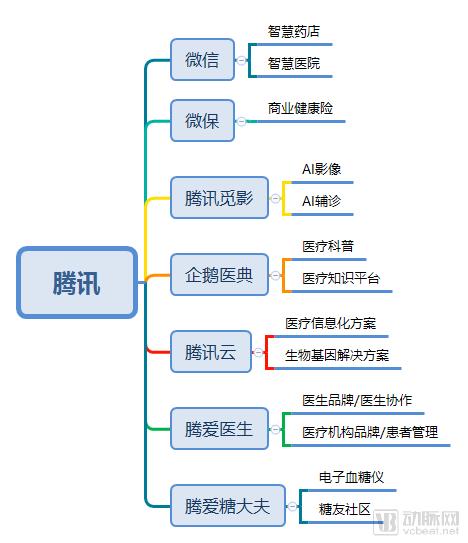
At the recently held “Internet Plus” Digital Economy Summit, Tencent provided a detailed overview of its strategic initiatives in the healthcare sector, with a particular focus on the WeChat platform and Tencent Miying.
Tencent Miying: National New Generation Artificial Intelligence Open Innovation Platform for Medical Imaging
In November last year, the Ministry of Science and Technology announced the first batch of national next-generation artificial intelligence open innovation platforms, and clearly stated that Tencent would be responsible for building the national next-generation AI open innovation platform for medical imaging.
As planned, the platform will promote the implementation of the national artificial intelligence strategy in the healthcare sector across four dimensions: innovation and entrepreneurship, whole-industry-chain collaboration, academic research, and inclusive public welfare. It aims to build an open platform with multi-party participation—including medical institutions, research communities, medical device manufacturers, AI startups, health IT vendors, higher education institutions, and public welfare organizations—to jointly advance the exploration and application of AI technologies in numerous healthcare scenarios, such as medical imaging, computer-aided diagnosis, and medical robotics.
From the perspective of commercially deployed products, Tencent Miying currently offers two major AI-based solutions: AI Medical Imaging and AI-Assisted Diagnosis. The former includes systems for early screening of esophageal cancer, lung cancer, and breast cancer, as well as an intelligent system for diabetic retinopathy. The latter is built upon Tencent’s industry-leading deep learning models, aiming to help reduce diagnostic and treatment risks for physicians while providing reasonable, and often superior, medication and therapeutic recommendations, thereby facilitating the efficient sharing of expert knowledge and experience.
According to official data, Tencent Miying’s product series has been deployed in more than 100 Grade IIIA hospitals across China.
WeChat: The Nation’s Communication Tool Brings “Smart” Solutions to Hospitals and Pharmacies
As a national-level communication tool and social platform, WeChat is transitioning into a service platform, a shift reflected in its “integration” of various services, with healthcare being a key sector. WeChat has primarily launched “Smart Pharmacy” and “Smart Hospital” solutions.
WeChat Smart Hospital 3.0 will span the entire patient journey, including triage (online AI triage, intelligent customer service consultations), registration (online appointment booking), consultation (online consultations, offline AI-assisted diagnosis), examinations (offline AI imaging, AI pathology), payment (online payment via medical insurance/commercial insurance, offline QR code payment for medical insurance), treatment (online medication delivery, offline prescription circulation), and post-consultation care (AI follow-ups, online prescription renewals), thereby streamlining the complete healthcare process.
From the perspective of application cases, the smart hospital system has been successfully implemented at Liuzhou Workers' Hospital. Last May, Liuzhou Workers' Hospital established a strategic partnership with Tencent and Liuzhou Pharmaceutical Company, creating China's first "in-hospital prescription circulation to out-of-hospital pharmacies" model based on WeChat Official Accounts. Nowadays, patients visiting Liuzhou Workers' Hospital need only follow the hospital’s official account and complete real-name authentication to access convenient medical services, including appointment registration, end-to-end payment, examination scheduling, report inquiries, and online consultations. Furthermore, patients can choose to pick up their medications at partnered off-site pharmacies, significantly reducing waiting times for prescription collection.
Earlier, WeChat unveiled its “Smart Pharmacy” solution. Leveraging WeChat’s robust connectivity capabilities, the solution connects medication purchasers with pharmacies, enabling pharmacies to better deliver professional services to users. By employing internet-based membership management and marketing strategies, it aims to achieve true seamless integration of online and offline operations, while creating new commercial growth opportunities for pharmacies.
WeSure: Commercial Health Insurance Platform
WeSure (hereinafter referred to as “WeSure”) is the first insurance platform controlled by Tencent. It serves as a crucial component of Tencent’s “Internet + Finance” ecosystem. In October 2017, WeSure obtained approval from the China Insurance Regulatory Commission (CIRC) to operate insurance agency business and officially launched the following month. Users can purchase insurance policies, check policy details, and file claims through WeChat and QQ—two widely used lifestyle service platforms in China—making insurance more accessible than ever before.
Penguin Medical Encyclopedia
Penguin Medical Encyclopedia can be regarded as a medical “encyclopedia” and is Tencent’s consumer-facing product. It is dedicated to translating complex and abstruse medical expertise into content accessible to the general public, thereby providing more reasonable and effective care guidance for individuals and their families. It also helps patients communicate more effectively with physicians, fostering better doctor-patient collaboration.
Tencent Cloud
Tencent Cloud offers numerous application scenarios for the healthcare industry, including telemedicine communication architectures, remote collaboration platforms, medical imaging data management systems, and live surgical broadcasting for educational purposes. Additionally, it helps genetic enterprises process massive datasets efficiently and cost-effectively, thereby supporting the development of the biogenetics industry.
Tengai Doctor & Tengai Sugar Doctor
Both business lines operate under the “Teng Ai” brand. Among them, Teng Ai Doctor is a social networking platform and toolkit for physicians that also serves consumer users; it helps doctors build their professional brands and manage patient relationships, while assisting patients in finding suitable physicians. Teng Ai Tang Da Fu is an intelligent, portable blood glucose meter launched by Tencent, which is accompanied by diabetes rehabilitation advice and guidance services.
Alibaba’s “Proprietary” Medical Business Layout
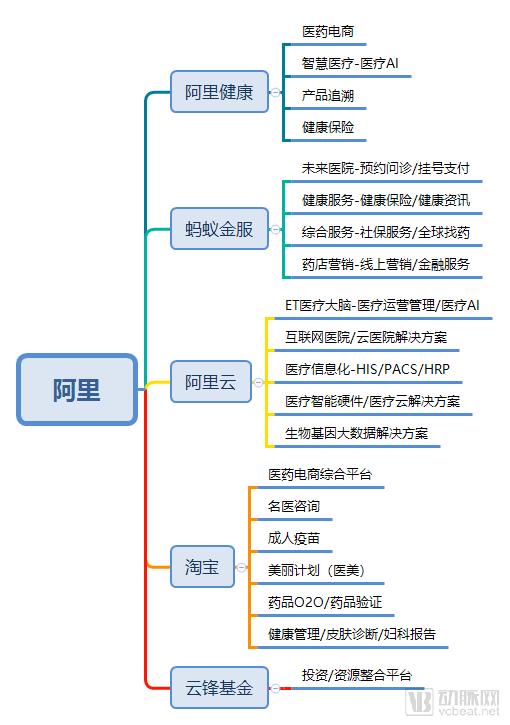
Alibaba’s “in-house” healthcare strategy encompasses four major pillars: Alibaba Health, Ant Financial, Alibaba Cloud, and Taobao. Additionally, Yunfeng Capital frequently serves as a platform for investment and resource integration.
Alibaba Health: Alibaba’s Flagship Platform for Its Medical Layout
Alibaba Health is the flagship platform of Alibaba Group’s “Double H” strategy (Health and Happiness) in the healthcare sector. It primarily operates four core business segments: pharmaceutical e-commerce, smart healthcare (medical AI), product traceability, and health insurance.
Pharmaceutical e-commerce and smart healthcare have been the key focus areas for Alibaba Health in recent years. In August 2016, Alibaba Health completed its acquisition of Guangzhou Wunianqian Pharmaceutical Chain Co., Ltd. (later renamed Alibaba Health Pharmacy), thereby launching its B2C pharmacy business. In September, Alibaba Health officially began providing comprehensive outsourcing and value-added services for pharmaceutical-related categories on Tmall’s Medical Pavilion, assisting Tmall in developing its pharmaceutical e-commerce operations in exchange for service fees. In July 2017, Tmall’s “Blue Hat” health supplement business was fully injected into Alibaba Health. As a result, Alibaba Health’s pharmaceutical and healthcare retail platform has become increasingly comprehensive.
In its smart healthcare business line, Alibaba Health has successively launched online hospitals and introduced medical AI products to comprehensively “empower” medical institutions. Alibaba Health’s medical AI product suite, “Doctor You,” includes clinical diagnosis, medical imaging, and a physician competency training platform. In terms of implementation, Alibaba Health has established a “Medical Artificial Intelligence Laboratory” with the First Affiliated Hospital of Zhejiang University School of Medicine, set up an “Intelligent Medical Talent Training Base” with the Second Affiliated Hospital of Zhejiang University School of Medicine, and collaborated with Xinhua Hospital affiliated with Shanghai Jiao Tong University to build a hospital hybrid cloud platform and a cloud-based pediatric medical consortium platform, as well as to develop intelligent physician training systems and medical research data platforms.
Recently, Alibaba Health and Xi’an International Medical Center have joined forces to create a new “Internet Plus” healthcare model. Under the plan, Alibaba Health will implement “Internet Plus” technological upgrades at Xi’an Gaoxin Hospital, a tertiary Grade A hospital under Xi’an International Medical Center, transforming it into the “Alibaba Health Xi’an Gaoxin Internet Hospital.”
Ant Financial: The “Future Hospital” Hidden Within Alipay
Ant Financial’s presence in the healthcare sector is primarily manifested through Alipay. Alipay’s “Future Hospital” initiative integrates online and offline services to optimize the allocation of existing medical resources, improve the healthcare service system, facilitate patient access to care, enhance internal management efficiency of hospitals, and support the upgrading of services across the healthcare industry.
As of May 2017, more than 1,500 public hospitals had joined Alipay’s “Future Hospital” initiative, covering 30 provinces, autonomous regions, and municipalities across China, as well as nearly 200 cities. Cumulatively, over 300 million user interactions have been recorded for convenient services such as real-name appointment registration, mobile payments, and medical report inquiries via Alipay. Additionally, more than 80,000 pharmacies now support Alipay payments.
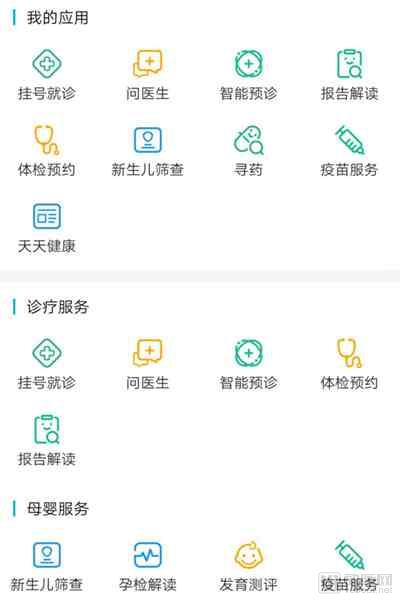
Additionally, as a major payment tool, the Alipay mobile app integrates nearly 30 healthcare and medical applications, including appointment registration and consultation, maternal and infant services, health information, and drug verification.
Selected Applications in Alipay’s “Medical & Healthcare” Channel
Meanwhile, Ant Financial recently announced that it will integrate and open up its multi-dimensional capabilities in marketing, finance, and credit to the pharmacy industry.
Alibaba Cloud: Empowering Healthcare with a Powerful Brain
As China’s most successful cloud computing company, Alibaba Cloud holds nearly half of the cloud services market share, with the healthcare industry being a key focus area. Alibaba Cloud has launched a variety of products and solutions for the healthcare sector, including Internet Hospital/Cloud Hospital solutions, healthcare informatization solutions, and smart medical hardware/medical cloud solutions.
In March 2017, the ET Medical Brain was officially launched at the Apsara Conference·Shenzhen Summit. Equipped with a range of medical capabilities, ET serves as a “physician’s assistant” across multiple domains, including disease risk prediction, medical imaging diagnosis, precision treatment planning, drug efficacy mining, new drug research and development, disease surveillance, and health management.
Taobao: From One-Stop Shopping to One-Stop Service
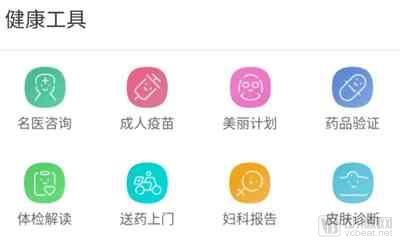
Taobao has launched the “My Health” card in its user center, where users can access a variety of services including consultations with renowned physicians, adult vaccinations, beauty programs, and home medication delivery. Taobao has thus become a key gateway for health services.
Health Tools under the "My Health" Card on Taobao
From a service logic perspective, Taobao itself commands massive traffic and is simultaneously launching various services and content to enhance user stickiness, shifting user behavior from merely “shopping” to “browsing Taobao.” This creates an opportunity for Taobao to provide healthcare services to its users. In other words, transactional functionality is no longer the primary driver of user attraction; rather, it is the diversification of services offered. We have observed functional overlaps between the Alipay Healthcare channel and the “My Health” card on Taobao, which will further accelerate the integration of their account systems, enabling a deeper understanding of users and the delivery of more precise services.
Comparison of Tencent’s and Alibaba’s “In-House” Healthcare Businesses
The above outlines the “in-house” healthcare businesses of Tencent and Alibaba. It is evident that their strategic logics differ significantly: Tencent adopts a relatively “asset-light” approach, whereas Alibaba pursues a more “asset-heavy” model. The distinction between “light” and “heavy” lies in factors such as capital investment, operational costs, and service delivery models.
We believe that this difference is closely related to their distinct product logics and business models. Tencent’s core characteristic is “connectivity,” encompassing connections between people, between people and information, and between businesses and consumers. In the healthcare sector, Tencent aims to serve as a “connector” rather than directly engaging in service provision; for instance, its WeChat-based “Smart Hospital” and “Smart Pharmacy” solutions are more tool-oriented in nature.
Alibaba’s keyword is “operations.” Having established itself as a B2B trade platform and achieved remarkable success in the B2C consumer sector, Alibaba has always emphasized its operational capabilities. Even its slogan, “to make it easy to do business anywhere,” underscores its focus on serving business clients (B-side). Consequently, Alibaba’s proprietary healthcare ventures are more “asset-heavy,” as they require an intermediary to enhance the operational efficiency of the healthcare system, thereby better serving business clients and attracting consumers (C-side). A simple analogy would be to compare Alibaba’s healthcare operations to Cainiao Logistics: acting as a middle layer within the entire transaction ecosystem, it boosts efficiency and revitalizes the system.
What Healthcare Investments Have Tencent and Alibaba Made?
The preceding section has broadly outlined Tencent and Alibaba’s “in-house” healthcare layouts. In reality, as the two most successful internet companies in China, Tencent and Alibaba have primarily expanded their businesses and positioned themselves in this sector through investments. Below, we examine their investments in the healthcare field:
Tencent Healthcare Investment Review
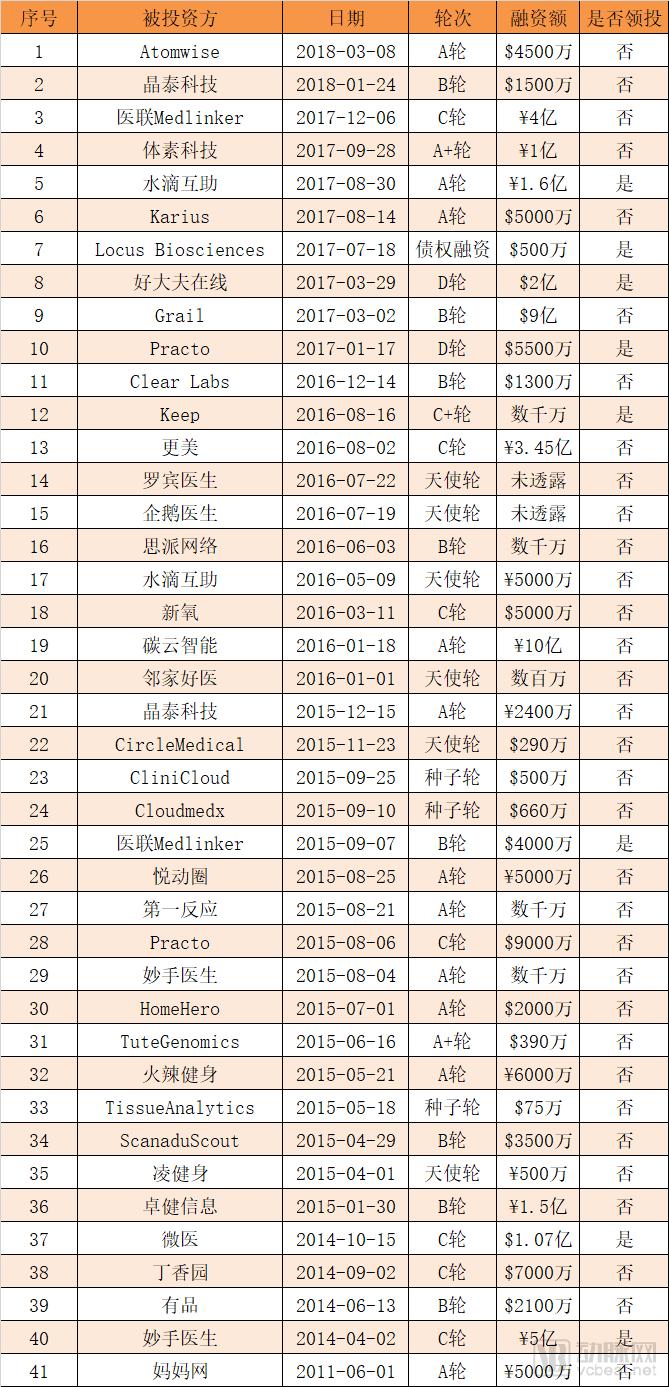
According to statistics from the VCBeat knowledge base, Tencent has made a total of 41 investments in the healthcare sector to date. Tencent’s investment strategy focuses on “backing entire sectors,” meaning it invests in multiple companies within each sub-sector of “Internet + Healthcare.” Examples include WeDoctor and Haodf Online, which both started as appointment registration and consultation platforms; aesthetic medicine platforms So-Young and Gengmei; and medical AI companies XtalPi and VoxelCloud.
Tencent’s current healthcare investments have achieved a “closed-loop” ecosystem; however, the company does not appear to be in a hurry to pursue synergies with its portfolio companies. Furthermore, Tencent continues to incubate its invested firms, with companies such as XtalPi, Miaoshou Doctor, and Medlinker having secured multiple rounds of financing from Tencent.
Alibaba Healthcare Investment Overview
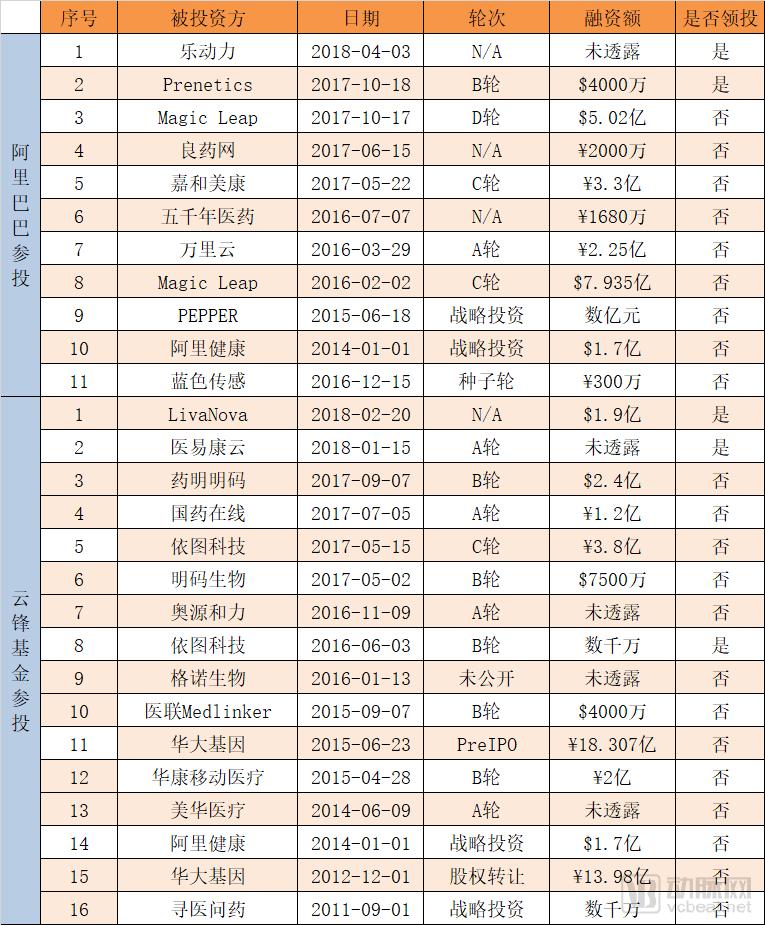
To date, Alibaba and Yunfeng Capital have jointly invested in 27 healthcare projects, covering a diverse range of sectors including pharmaceutical e-commerce, medical AI, online consultation services, and biopharmaceuticals. Since its establishment in 2010, Yunfeng Capital has also achieved remarkable success in investments and acquisitions within the healthcare sector.
How Will Tencent and Alibaba’s Healthcare Strategies Evolve in the Future?
This issue requires comprehensive consideration of healthcare industry policies, current market conditions, and the company’s own willingness.
From a policy perspective, encouraging pharmaceutical innovation, advancing the “three-medical linkage,” promoting “Internet + Healthcare,” and facilitating the application of new technologies such as the Internet, the Internet of Things (IoT), and artificial intelligence in the healthcare sector are inevitable trends. The strategic healthcare layouts of Tencent and Alibaba are also aligned with these policy directions.
From the perspective of the future direction of healthcare strategies adopted by these two companies, Tencent demonstrates greater openness. This is because Tencent has become increasingly “investment-bank-like,” prioritizing the industry’s future growth potential and making early strategic investments. In contrast, Alibaba’s strategy focuses on progressively enriching specific segments of the industrial chain, aiming to secure a dominant position at these key “entry points” to revitalize and leverage its overall resources.
Currently, Tencent and Alibaba are not engaged in direct confrontation in the healthcare sector. Even in areas with high similarity, such as “Future Hospital” and “Smart Hospital” initiatives, as well as medical AI businesses, they have yet to reach a stage of head-to-head competition. The vast market of the healthcare industry provides a broad platform for companies like Tencent and Alibaba, which possess substantial capital, technological expertise, and industrial resource advantages. The two giants may ultimately drive the development of the healthcare industry through their competitive dynamics.