

How Remote Healthcare Benefits from 5G in the 'Internet + Medical Health' Era
On April 11, Premier Li Keqiang inspected the Remote Consultation Center at Huashan Hospital in Shanghai. Via internet-based video conferencing, patients in Qinghai, Yunnan, and Xinjiang were able to receive remote consultations from distinguished Shanghai-based physicians while remaining at their local hospitals.
On April 12, Premier Li Keqiang presided over the State Council’s executive meeting, where measures to develop “Internet + Healthcare” were approved. These initiatives aim to alleviate difficulties in accessing medical care, improve public health outcomes, respond to public expectations, and deliver greater benefits to patients.
On April 13, guided by the Ministry of Industry and Information Technology, and hosted by the China Academy of Information and Communications Technology and the IMT-2020 (5G) Promotion Group, the High-Level Forum on the Integrated Development of Wireless Networks and the Healthcare Industry—a series of forums under the “Blooming Cup” 5G Application Collection Competition—was successfully held in Beijing. This event was convened to implement the directives issued at the State Council’s Executive Meeting on April 12 regarding the development of “Internet + Healthcare,” and to promote the deep integration of 5G networks with the healthcare sector.
At the conference, Director Sun Ji of the Information and Communication Development Department of the Ministry of Industry and Information Technology (MIIT) and Director Zhao Jing of the Medical Administration Center of the National Health Commission (NHC) attended and delivered opening remarks. More than 200 representatives from the MIIT, the NHC, telecommunications operators, medical equipment manufacturers, healthcare institutions, and research institutes participated in the event.
VCBeat attended the conference and has summarized the key points regarding “5G Networks + Telemedicine” as follows.
Telemedicine services refer to medical activities in which a healthcare institution invites other hospitals or medical institutions to provide technical support for the diagnosis and treatment of its patients, utilizing communication, computer, and network technologies. According to the regulations of the National Health and Family Planning Commission, current telemedicine services include: remote pathological diagnosis; remote medical imaging diagnosis (covering radiology, ultrasound, nuclear medicine, electrocardiography [ECG], electromyography [EMG], electroencephalography [EEG], etc.); remote monitoring; remote consultation; remote outpatient services; and remote case discussions.
"Although the National Health Commission has issued corresponding regulations, many issues still persist in practice."
Due to the specific requirements of telemedicine for image transmission, excessively low video and image quality can make it difficult for physicians to accurately assess patients' conditions. Generally, remote consultations require real-time video with a resolution of at least 1080p and a frame rate of 30 fps or higher, which places stringent demands on network quality. In practice, however, few hospitals operate their own private networks; the vast majority rely on public networks for remote consultations. This often results in poor video quality, increasing the risk of misdiagnosis.
Regarding remote consultations, Dr. Yang Ye, Director at Huashan Hospital Affiliated to Fudan University, shared his experience: “An overseas Chinese individual residing in the United States once contacted me and connected to Huashan Hospital’s telemedicine system. This presented an excellent experimental opportunity; however, due to our video transmission equipment failing to meet the required standards, we hesitated to proceed with the consultation. After careful consideration, we ultimately decided to forgo this valuable cross-border consultation.”
Remote surgery faces the same challenges. According to Wang Yufeng, President of Huawei X Labs, the United States already met the technical requirements for remote surgery as early as 2001 and conducted corresponding public experiments. Furthermore, while the U.S. has deployed 2,500 da Vinci surgical robots that have played a significant role in practice, their performance still falls short of hospital standards. The crux of these issues lies in the fact that contemporary internet infrastructure cannot meet the data transmission requirements of telemedicine.
The situation in health management is equally severe. According to a World Health Organization report, more than 3 million Chinese people die “prematurely” before the age of 70 from non-communicable diseases such as heart disease, lung disease, stroke, cancer, and diabetes.
Based on 2017 data, the probability of death from cardiovascular diseases, cancer, diabetes, and chronic lung diseases among China’s population aged 30–70 was 18.1%. It is projected that after 2035, China will join European countries such as the United Kingdom in entering a super-aged society, defined as one where individuals aged 65 and older account for more than 20% of the total population.
In economic terms, according to World Bank estimates, China could generate $1.07 billion in economic benefits between 2010 and 2040 by reducing the mortality rate of cardiovascular and cerebrovascular diseases by just 1%.
Unlike previous generations of network communications, which were characterized by singular services, clear demands, and a focus on communication technologies themselves, 5G networks will deeply explore the information technology needs of various industries, integrate extensively with these sectors, explore new business models for mutual benefit with vertical industries, and achieve cross-industry convergence.
5G networks will deliver faster user experience rates, with actual download speeds reaching up to 1.25 GB/s. In the future, a large number of small cells will be deployed, enabling network coverage even in remote areas. Full-duplex technology refers to the capability of a device’s transmitter and receiver to operate simultaneously on the same frequency resources, which is key to achieving high throughput and low latency in 5G networks.
With 5G technology, doctors can access imaging data more rapidly, conduct remote consultations, and perform remote surgeries. Hospitals in remote areas can engage in real-time video conferences with physicians at tertiary A hospitals, eliminating the need for patients to travel long distances over difficult terrain for minor ailments.
There are three main application scenarios for wireless technology in the medical field:
1. Medical monitoring and nursing applications based on continuous data acquisition from medical devices, such as wireless patient monitoring, wireless infusion therapy, mobile nursing, real-time patient location tracking and monitoring, and remote wireless device monitoring and maintenance.
2. Medical diagnosis and guidance applications based on video and image interaction, such as mobile ward rounds with real-time access to patient imaging diagnostic information, remote ward rounds using medical service robots, remote real-time conferencing, emergency rescue guidance, wireless surgical demonstration, and wireless specialized diagnosis.
3. Video- and haptic feedback-based remote monitoring applications, such as remote robotic ultrasound, remote robotic endoscopy, and remote robotic surgery.
Although some telemedicine technologies have already been implemented in hospitals, leveraging 5G networks is essential to unlocking their full potential. To address the aforementioned pain points, a network environment with high bandwidth and low latency is indispensable.
Qu Yunkai, Director of the National Engineering Laboratory for Internet Medical Systems and Applications, used Henan Province as an example to introduce the practical application of telemedicine, which can be summarized as “one network, two platforms, three strategic positions, and four major institutions.”
“One Network” refers to a private network based on the VPNs of China Mobile and China Telecom. “Two Platforms” refer to the inter-institutional data exchange and integration platform, which relies on 3+22 dedicated telemedicine server rooms, and the professional video conferencing system; together, they support various business applications (such as remote consultations, remote imaging diagnosis, and remote education). “Three Positionings” indicate that the National Telemedicine Center aims to be “the setter of industry standards,” “the leader in clinical applications,” and “the explorer of cutting-edge technologies.” “Four Institutions” refer to the organizations involved in the development of telemedicine, including the “National Telemedicine Center,” the “National Engineering Laboratory for Internet Hospital Systems and Applications,” the “Telemedicine Professional Committee of the Chinese Health Information Association,” and the “Telemedicine and Clinical Application Standards Committee of the Chinese Health Information Association.”
This year, Henan Province will achieve full coverage of telemedicine across provincial, municipal, and county levels, with the goal of managing 150 common diseases at the primary care level.
Current telemedicine services remain predominantly patient-centric, positioning themselves as a substitute for and extension of existing healthcare delivery. While this approach aligns with long-term trends in medical development, significant challenges persist in terms of business models.
Urgent
We are entering the era of the Internet of Everything (IoE). In 2017, cellular IoT connections will reach 270 million, nearly three times the figure in 2016. According to data from the China Academy of Information and Communications Technology (CAICT), mobile service traffic will increase by tens of thousands of times between 2010 and 2030. By 2030, the total number of devices connected via mobile networks will exceed 100 billion.
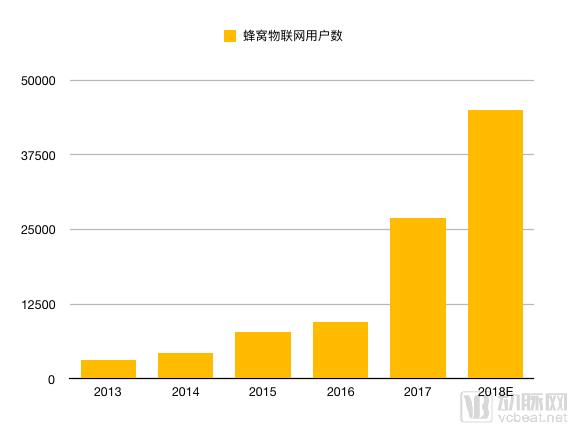
Number of Cellular IoT Users (Source: VCBeat)
Fields such as the monitoring and management of medical devices and pharmaceuticals, digital hospitals, and remote medical monitoring are closely intertwined with Internet of Things (IoT) technology. In particular, IoT endpoints directly linked to patient information—such as medical equipment and various sensors—pose a significant risk to patients’ lives and safety if compromised. 5G networks not only deliver faster download speeds and lower latency but also provide enhanced data privacy protection, all of which are indispensable factors for the development of the Internet of Everything (IoE).
Furthermore, the严峻 situation in health management necessitates new technologies to liberate medical resources, granting physicians more capacity to engage in more meaningful work. During his speech, Director Yang Ye stated, “The current primary challenges are restricted access to medical data and the tethering of physicians to fixed work locations. For instance, retrieving patient imaging data over a 4G network requires a 10-second loading time, which is excessively long. We need 5G networks to improve our clinical environment and free physicians from stationary workplaces, benefiting both patients and doctors.”
In the 5G era, telemedicine will become increasingly mobile and more convenient, while simultaneously posing management challenges in areas such as regulation and quality control. In-vehicle and portable remote consultation devices will gain widespread adoption, extending telemedicine applications into communities and rural areas, thereby benefiting a broader population. A rapid proliferation of portable and wearable health detection and monitoring devices will drive significant advancements in remote health management. The substantial generation of personal health data will foster major developments in medical data sharing and medical artificial intelligence, concurrently raising concerns regarding data security and medical ethics.
NHC’s New Policies Drive Industry Development
The conference mentioned companies engaged in remote medical consultation services, such as Chunyu Yisheng, Haodf Online, and WeDoctor. These enterprises have not yet fully entered the healthcare sector; however, with the promulgation of new policies on April 16, the state will permit the development of internet hospitals based on medical institutions.
"In the past, due to incomplete medical records, doctors found it difficult to provide medical-grade advice during remote consultations. The consultation process mainly consisted of common-sense exchanges, and the industry lacked standardized norms, making it hard to ensure medical quality. This situation is now improving."
The introduction of standardization and the allowance for collaboration under the new policy will expand the business scope of telemedicine consultation companies, gradually addressing major barriers in internet healthcare, such as service quality issues, risk and dispute resolution, the legality of physicians’ practices, data sharing, privacy protection, and equipment quality.
The development of 5G networks will provide internet healthcare companies with unprecedented opportunities. Companies must strengthen collaboration and communication to effectively address the practical challenges facing the industry.