

Berry Genomics Invests $5 Million in BioNano Genomics to Expand Beyond NGS Across the Full Gene Technology Chain
Prior to its initial public offering, Berry Genomics (then known as Berry & Kang) indicated that the company would not rule out further expanding its industrial scale through inorganic growth or investment and M&A activities.
Judging from their investment in the Gene Big Data Center Industrial Park, the establishment of a subsidiary focused on early screening, and the investment in BioNano announced on the evening of April 16, they are fully leveraging the advantages of the capital market.
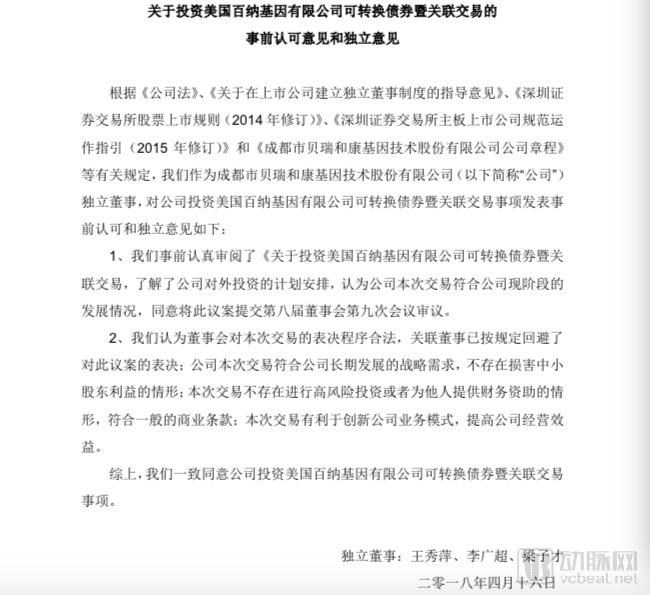
Image source: Xueqiu
On the evening of April 16, Berry Genomics announced that it would invest $5 million in BioNano Genomics through convertible bonds. The announcement did not disclose details of the transaction, nor did it explain the rationale behind the investment. Let us analyze the underlying reasons by examining both BioNano Genomics and Berry Genomics.
BioNano, a biotechnology company based in San Diego, USA, was founded in 2004. The company’s technology platform, known as the Single-Molecule Genome Analysis Platform, utilizes proprietary chip technology to align intact single DNA molecules in parallel within nanochannels for imaging, thereby enabling comprehensive visualization of genome structure.
More than a decade ago, the draft sequence of the human genome was initially completed at a cost of $3 billion. President Clinton enthusiastically declared that humanity would no longer be plagued by disease in the future; however, as we all know, this has not come to pass. The completion of the Human Genome Project was not the endpoint of human self-exploration, but rather can be regarded as the beginning of a comprehensive, precise, and in-depth understanding of ourselves.
NGS technology has become highly mature, but what exactly is the role of single-molecule imaging in this context? The principle of next-generation sequencing involves fragmenting the genome and then interpreting it piece by piece. Its advantages lie in its speed and low cost; however, reassembling these fragments afterward can be quite a headache. If the fragments were non-repetitive, assembly would be relatively straightforward. But are genomic fragments truly non-repetitive? Impossible!
This is where single-molecule imaging technology truly shines. BioNano’s unique advantage lies in its ability to perform long-range, linear whole-genome analysis at the single-molecule level using nanofluidic silicon chips, thereby addressing challenges that are difficult or impossible for next-generation sequencing (NGS) to resolve comprehensively.
In simple terms, single-molecule imaging technology generates a genomic map of long single-molecule fragments. So, what are the differences and connections between this approach and next-generation sequencing (NGS) technology? To quote Dr. Han Cao, the founder: “The map represents two-dimensional information, viewed from top to bottom like a geographical map; sequencing, in contrast, yields linear information, assembled segment by segment in a linear fashion from below.”
He offered a more vivid analogy than the one I mentioned earlier, comparing the genome to a book. Next-generation sequencing (NGS) involves tearing this book into individual pages, reading them, and then rebinding the pages back together. As previously noted, genomic fragments inevitably contain repetitive sequences. Consequently, this “book” must also have repeated sections, which complicates the subsequent reassembly process. Furthermore, given the considerable thickness of this book, errors such as misassembly or missing segments are unavoidable during the process, potentially rendering the book unreadable. If such errors occur precisely in regions where mutations are present, the implications for medicine and biology can be substantial.
Therefore, the map position can provide important information for the later functional application development of the genome. It is like a GPS system that can help researchers find large fragment structural variations and obtain more efficient and accurate results.
BioNano’s founding team included a professor from the University of Delaware and his graduate students, Dr. Deshpande and Dr. M. Austin. Although headquartered in the United States, the company has consistently placed significant emphasis on the Chinese market, driven by the founders’ commitment and market demand. In 2014, Legend Capital co-led BioNano’s Series C financing round alongside Novartis. The company has also established collaborative partnerships with numerous domestic gene sequencing firms, such as FutureOmics and JiYun HuiKang.
Berry Genomics and BioNano share a common investor, Legend Capital. The two companies may have established close ties many years ago, with their collaboration documented as early as 2016. At that time, they announced a joint effort to develop next-generation clinical products for chromosomal structural variation analysis based on the Irys® platform (BioNano’s second-generation technology), with Berry Genomics responsible for submitting product registration applications to the China Food and Drug Administration (CFDA).
The following year, Berry Genomics introduced several additional BioNano Irys and Saphyr (third-generation) optical mapping sequencing platforms, striving to deliver the premier one-stop sequencing service.
In January 2018, BioNano unveiled its latest labeling technology—DLS. As one of the first global and the exclusive Asian beta testers, Berry Genomics successfully completed testing on human blood samples.
It appears that Berry Genomics has long recognized the value of BioNano’s technology. As a leader in next-generation sequencing (NGS) and an owner of proprietary technology, respectively, the two companies not only complement each other technologically but also share a rapport reminiscent of the legendary friendship between Boya and Ziqi.
In its 2017 annual report, Berry Genomics noted that the company would primarily focus on clinical medical applications and extend into the broader health industry. Whether in clinical medicine or the wider health sector, developing rigorous and in-depth products inevitably involves technologies more complex than trisomy screening. Therefore, a more comprehensive and accurate understanding of the secrets hidden within genomic data is essential.
Similarly, this represents another strategic move by the company in the upstream sector. Prior to its IPO, Gao Yang stated that he was more interested in the comprehensiveness of the entire industry chain. This action suggests that Berry Genomics’ industry chain appears to extend beyond next-generation sequencing (NGS).
Additionally, VCBeat learned that Berry Genomics announced a series of capital increases in its subsidiaries Yuanhe Sunshine, Hexin Shengtou, Berry and Kang Big Data, and Lishen Kechuang on the evening of April 17, totaling RMB 134.5 million.