

Ping An Good Doctor to List on HKEX on May 4 Amid Losses, Valuation Soars to HK$80 Billion, Aiming to Tackle Three Core Healthcare Pain Points

Ping An Healthcare
One-stop Solution Provider for Health Management
Starting April 23, Ping An Good Doctor will conduct its global IPO roadshow. It will be officially listed on the Hong Kong Stock Exchange at 9:00 a.m. on May 4. The global offering comprises 160 million shares, with 6.5% allocated to the Hong Kong public offering and 93.5% to international placement. The indicative offer price range is HK$50.8 to HK$54.8 per share. Citigroup and JPMorgan Chase serve as the sponsors. Based on the upper end of the offer price range, the company aims to raise HK$8.8 billion.
The securities industry collectively estimates that Ping An Good Doctor’s valuation could reach as high as $10.3 billion (approximately HK$80.3 billion). JPMorgan, one of the sponsors, issued a report stating that the stock’s potential valuation is expected to range from $7.9 billion to $10.3 billion (approximately HK$61.6 billion to HK$80.3 billion). JPMorgan also noted that although Ping An Good Doctor remains unprofitable, its losses are projected to narrow gradually over the next two years. UBS, meanwhile, estimates the valuation at approximately $7.5 billion to $9.5 billion (approximately HK$58.5 billion to HK$74.1 billion).
Ping An Good Doctor took only four years from its inception in August 2014 to its initial public offering. To date, it remains the internet healthcare company with the shortest time to listing.
An examination of its development reveals several key characteristics: first, the founding team consists of high-profile executives; second, while the healthcare industry requires substantial investment, it is imperative to build an ecosystem and a closed-loop system; third, despite high valuations, its profitability remains elusive. These appear to be common traits among current internet healthcare platforms.
In fact, the development of the mobile healthcare industry is inseparable from the support of the capital market. Securing financing enables continued growth, while failure to do so means being unable to proceed to the next stage. Ping An Good Doctor’s listing on the capital market is also aimed at securing further capital support.
Management of Ping An Good Doctor introduced that,Forty percent of the funds raised will be allocated to business expansion, including broadening product offerings and coverage, as well as retaining sales and medical talent; 30% will be used for investing in and acquiring domestic companies and funding overseas expansion; 20% will be dedicated to developing information infrastructure and artificial intelligence technologies; and the remaining 10% will be reserved for corporate operations.
For a startup project, successful implementation hinges on talent, capital, and a clear business model.
In terms of talent, Ma Mingzhe, Chairman of Ping An Group, personally selected personnel for Ping An Good Doctor.In 2013, he successfully recruited Wang Tao, then Senior Vice President of Alibaba and President of Ali Software, who served as Chairman and CEO of Ping An Good Doctor.
Wang Tao’s arrival marked the first step in reviving Ma Mingzhe’s “Three-Network Integration” strategy and repositioning Ping An Health Insurance. Specifically, the company would no longer focus solely on selling traditional health insurance products; instead, it aimed to create a new internet-based integrated health management platform, reshaping the entire healthcare market through an internet-driven model.
The second step was to spin off Ping An Healthcare’s new internet-based businesses and establish Ping An Healthcare and Technology Company Limited as a separate entity. While clarifying the division of responsibilities, he openly acknowledged that this move was intended to lay the groundwork for a future independent IPO. This demonstrates that his vision for the company’s development was clear from the outset.
A month later, a healthcare app named “Ping An Health Manager” entered public beta testing, offering services such as online medical consultations and appointment scheduling with renowned physicians. While it may appear to be merely an online consultation platform, its underlying strategy reflects Ping An Group’s ambitious integration of policies, hospitals, physicians, pharmacies, the broader medical community, and insurance—demonstrating its bold aspiration to encompass the entire healthcare industry chain.
Step 3 isConfirmBusiness Model. He envisioned Ping An Good Doctor leveraging "light consultation" mobile healthcare as its entry point, building a medical service network and integrating domestic medical information to generate new customer leads for health insurance products, while further providing diverse health services to customers, thereby establishing a complete O2O closed loop.
Anchored in this O2O closed-loop health management model is Ping An’s ultimate “ambition” within the broader healthcare industry: to ultimately realize the new-type health industry chain envisioned by Ma Mingzheng, integrating the “Medical Network,” “Pharmaceutical Network,” and “Information Network” into a unified tri-network ecosystem. Wang Tao further revealed that,“To this end, the Group is sparing no effort to invest tens of billions in capital over the next five to ten years.”
In 2016, Ma Mingzhe also proposed the new strategy of “Ping An 3.0 Era,” shifting focus from internal financial services to cultivating platforms open to the entire industry.
The platform strategy has provided additional momentum for Ping An Good Doctor. This is because Ping An can supply the most critical component of a medical platform—a robust payer. By aligning with a strong payer, Ping An Good Doctor’s valuation becomes fundamentally different.Ping An’s 100 million users, when integrated, can form a natural value platform.
Currently, the core positioning of Ping An Good Doctor is “connectivity,” linking multiple stakeholders—including hospitals, users, insurance payers, and service providers—to form an open internet-based healthcare service ecosystem. A key objective of this “connectivity” is to address another bottleneck in the current development of the mobile health industry: determining who pays for mobile health services. This involves progressively exploring the inclusion of insurance claims within the scope of online medical payments, thereby fundamentally resolving the question of payment responsibility.
From this perspective, Ping An Group has invested heavily in building these medical resources to establish its own core healthcare capabilities, seeking an integration of “healthcare + insurance,” with the HMO model serving as its ideal benchmark. This model, which emphasizes prevention and maintenance, as well as early detection and treatment, is now referred to as managed care. Its key features include: insurance companies + hospitals + clinics + pharmacies + physicians + information systems.
At present, given that data accumulation by insurance companies and mobile healthcare providers in this area remains inadequate, the implementation of the HMO model in China will not proceed smoothly, and there is still a long road ahead.
As of the end of December last year, Ping An Good Doctor had accumulated 193 million registered users, a year-on-year increase of 46.6%, with an average of 32.9 million monthly active users, making it the largest internet healthcare platform in mainland China. Its business is mainly divided into four parts: family doctor services, consumer healthcare services, health mall services, and health management and interaction services.
“Family Doctor” provides online medical consultations, delivered by an in-house medical team and external physicians with AI assistance. Consumer healthcare services include health check-ups, genetic testing, aesthetic care, and oral hygiene services, along with the sale of health examination packages to individuals and enterprises. The Health Mall, representing its e-commerce business, offers medical products (such as pharmaceuticals, health supplements, and traditional Chinese medicine), medical devices, and fitness products.
Ping An Good Doctor started with two core businesses: family doctor services and consumer healthcare. In 2017, it had 172 doctors and 716 medical assistants, and signed service contracts with 2,100 external doctors. However, the largest contributor to its revenue is currently the Health Mall, which generated RMB 896 million in 2017, accounting for 48% of the company’s total revenue.
Financial data shows that from 2015 to 2017, Ping An Good Doctor’s revenue was RMB 279 million, RMB 602 million, and RMB 1.868 billion, respectively, representing year-on-year growth of 115.8% in 2016 and 210.6% in 2017.
Although revenue has continued to grow, Ping An Good Doctor has been operating at a loss since its inception, as the increase in costs has outpaced the growth in revenue. The net profits for 2015–2017 were RMB -324 million, RMB -758 million, and RMB -1.002 billion, respectively, resulting in cumulative losses exceeding RMB 2 billion over the three-year period.
The company explicitly stated in its prospectus that it expects to continue to incur a “significant net loss” in 2018, and may also continue to experience losses and negative operating cash flows in the future.
The perplexing profitability of Ping An Healthcare was a focal point of external scrutiny prior to its IPO. Meanwhile, the prospectus did not disclose any technological advantages possessed by Ping An Healthcare that would allow it to stand out significantly from competitors. Typically, during periods of market volatility, companies are eager to “eliminate” risks associated with the offering. Engaging multiple investment banks and pre-selling a substantial portion of the shares may help mitigate such risks. However, this approach also carries certain drawbacks. The presence of a large number of cornerstone investors reflects underlying weakness in market conditions, and new listings are becoming increasingly reliant on cornerstone investors.
Cornerstone investors refer to institutional investors who subscribe for a company’s shares as strategic investors before the public offering during an IPO. They are primarily large institutional investors such as banks, insurance companies, hedge funds, sovereign wealth funds, and pension funds, as well as large corporate groups and prominent high-net-worth individuals or their affiliated enterprises. Similar to institutional investors in mainland China, cornerstone investors purchase a pre-agreed number of shares at the IPO offering price and accept a lock-up period of 6 to 12 months.
The introduction of cornerstone investors is, in effect, an endorsement of the company’s fundamentals, business model, and growth prospects. It instills significant confidence in the market, acting as a stabilizer for the IPO.
From the perspective of the development of cornerstone investors, this mechanism was initially introduced in the Hong Kong IPO market. At that time, when state-owned enterprises (SOEs) listed in Hong Kong, there was limited understanding of their operations, and concerns persisted regarding their management, profitability models, and corporate governance. To address these apprehensions, Hong Kong introduced cornerstone investors. The practice of engaging cornerstone investors has become widespread in Asia, particularly among companies listing in Hong Kong. Since 2012, shares subscribed by cornerstone investors have accounted for 30% of new stock issuances in Hong Kong.
The prospectus shows that Ping An Good Doctor has signed agreements with multiple international cornerstone investors. The top ten cornerstone investors will contribute $550 million, subscribing for approximately 53% of the offering, which represents about 8% of the issued share capital.
Cornerstone investors include world-renowned investment management firms, national pension funds, and sovereign wealth funds, such as BlackRock, Capital Research and Management Company (a fund under The Capital Group), GIC (which manages Singapore’s foreign exchange reserves), CPPIB (Canada Pension Plan Investment Board), Pantai Juara Investments Limited (Malaysia’s strategic investment fund), Charoen Pokphand Group, and Swiss Re.
Fan Yin, Managing Director of Ping An Good Doctor, stated at the press conference that the criteria for selecting cornerstone investors included their understanding of the industry and potential strategic synergies. The investments made by these investors demonstrate their confidence in Ping An Good Doctor’s business model and future development. In response to why all cornerstone investors were foreign institutions, Fan Yin remarked, “There was strong interest from them, and this was a decision made after careful consideration by the company.”
At the global offering press conference held in Hong Kong, Wang Tao, Chairman and Chief Executive Officer of Ping An Good Doctor, attended alongside a full lineup of senior executives, including Chief Operating Officer Bai Xue, Chief Product Officer Wu Zongxun, Chief Technology Officer Wang Qi, Chief Financial Officer Guan Xinrong, and Managing Director Fan Yin.
Li Yuanxiang, Deputy Chief Executive Officer and Executive Director of Ping An Group, appeared at the press conference and stated in his address, “Today marks a milestone in the development of Ping An Good Doctor.”
From a macroeconomic perspective, China’s healthcare services market is vast and continues to expand. China’s total health expenditure reached nearly RMB 5 trillion in 2016 and is projected to exceed RMB 11.4 trillion by 2026, representing a compound annual growth rate (CAGR) of 9.4%. However, unlike the United States and other countries, China’s lack of a tiered diagnosis and treatment system and family doctor services has resulted in numerous structural pain points within its healthcare services market.
For instance, benchmarking against the United States reveals a significant shortage of qualified general practitioners in China. To build a primary care network with equivalent standards, adopting traditional solutions would require China to add approximately 280,000 family physicians and hundreds of thousands of clinics, along with substantial new capital investment. The entire construction process would take decades to complete.
This presents an opportunity for China to develop “Internet + Healthcare” treatment management solutions. According to Wang Tao, leveraging the internet and artificial intelligence, Ping An Good Doctor will address the pain points of the entire healthcare industry from three aspects:
First, to address the shortage of family doctors, alleviate pressure on offline medical institutions, and reduce the burden on both physicians and hospitals.
Second, provide 24/7 accessible, high-quality medical services with minimal wait times to reduce the burden on patients.
Third, by leveraging technology to reduce costs, alleviate the cost pressure on social health insurance, and ease the financial burden on the government.
Centered on the Ping An Good Doctor platform, Ping An Good Doctor has built a closed-loop ecosystem: it features an in-house team of 888 full-time medical professionals supported by AI technology, while also establishing an extensive offline partnership network that connects with 40,000 external doctors and covers 3,100 hospitals, 1,100 health examination centers, 500 dental clinics, 70 aesthetic medicine centers, and 7,500 partner pharmacies.
Wang Tao stated, “Ping An Healthcare’s mission is to build the world’s largest healthcare ecosystem and leverage technology to improve human health. Guided by this mission, Ping An Healthcare envisions providing every household in China with a family doctor, creating an electronic health record for each individual, and developing a personalized health management plan for everyone.”
On the afternoon of April 16, the State Council Information Office held a regular policy briefing of the State Council. Centered on the “Guiding Opinions on Promoting the Development of ‘Internet + Healthcare’,” the briefing not only elaborated on relevant regulations for implementation, regulatory approaches, and measures to protect the privacy of personal health information in the context of “Internet + Healthcare,” but also provided a detailed interpretation of the access requirements and behavioral management standards for internet-based medical services.
On April 12, the State Council executive meeting outlined measures to promote “Internet + Healthcare.” Following the listing of Ping An Good Doctor, news emerged that several other internet healthcare platforms are also seeking public listings, suggesting that 2018 may become the inaugural year for a wave of IPOs among internet healthcare platforms.
At the State Council executive meeting held on April 12, measures were established to promote “Internet + Healthcare,” including: accelerating the widespread provision of online services by hospitals at secondary level and above, such as appointment scheduling and inquiry of laboratory and diagnostic test results; permitting medical institutions to deliver certain internet-based medical services, including follow-up consultations for common and chronic diseases. Efforts will be made to extend telemedicine coverage to all medical consortia and county-level hospitals across China, facilitating the alignment of high-quality medical resources in eastern regions with demands in central and western regions. Support will be provided for high-speed broadband network coverage in urban and rural medical institutions, and dedicated internet lines will be established to meet telemedicine needs. Exploration will be conducted into information sharing between medical institution prescriptions and pharmaceutical retail data. Intelligent health insurance audits and “one-stop” settlement services will be implemented. The standard system for “Internet + Healthcare” will be improved, information interoperability and sharing accelerated, and supervision of medical quality and protection of information security strengthened.
In recent years, with the development of internet technology, online healthcare platforms such as Ping An Good Doctor, WeDoctor, and Chunyu Doctor have leveraged the fragmented time of offline physicians to provide the public with substantial medical resources, becoming a significant force in driving healthcare reform.
According to U.S. capital market standards, a “unicorn” refers to a company with a valuation exceeding $1 billion, while those valued at over $10 billion are termed “super unicorns.” According to research by the China Securities Regulatory Commission (CSRC), there are currently around 100 unlisted companies in China with assets worth $1 billion, and no more than 50 with assets worth $2 billion. Among them, the unicorns in the healthcare industry include:
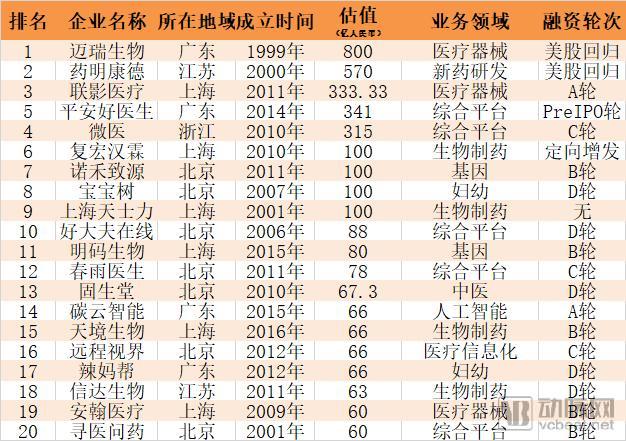
Among the aforementioned companies, some have already disclosed their IPO prospectuses, while others have seen rumors of impending listings surface. For instance, Mindray Bio-Medical swiftly restarted its listing plans after withdrawing its initial application, and WuXi AppTec is currently in the queue. Ping An Healthcare has disclosed its Hong Kong IPO prospectus, while WeDoctor, Henlius, and Shanghai Tasly have successively been reported as preparing for Hong Kong listings. These developments indicate that it is not only the market embracing unicorns, but also that these unicorn enterprises themselves demonstrate a strong willingness to go public and raise capital.
Notably, several healthcare unicorns have chosen to list on the Hong Kong Stock Exchange. Recently, news has emerged that multiple internet healthcare platforms are seeking public listings. Among them, Chen Hongzhe, Chief Strategy Officer of WeDoctor, revealed in a recent media interview that the company’s $500 million pre-IPO financing round is proceeding quite smoothly. Barring any unforeseen issues, WeDoctor plans to list in Hong Kong by the end of 2018.
According to Chen Hongzhe, WeDoctor plans to spin off for an IPO. The company currently comprises four business segments: WeDoctor Cloud, WeDoctor Healthcare, WeDoctor Pharma, and WeDoctor Insurance. Following the completion of its pre-IPO financing round, WeDoctor will restructure these four segments to enhance their clarity. In the near future, WeDoctor will also partner with overseas companies to expand its international market presence.
Li Tiantian, founder of DXY, also shared during an event, “We are preparing for an IPO.” He stated that the healthcare industry is not a sector where capital can rapidly accelerate maturity or clear out competitors. Financing and an IPO serve merely as fundamental safeguards for corporate development, not the key to success; the crucial factor lies in clearly recognizing one’s value within the industry.
Perhaps 2018 will become the inaugural year for the concentrated public listings of internet healthcare platforms.