

Five Major 'Internet + Healthcare' Policy Milestones in April: Insights from WeDoctor, Haodf, Chunyu, and Zhuojian
In April 2018, terms such as “Internet + Healthcare,” “Internet Hospitals,” “Chronic Disease Management,” and “Telemedicine” frequently appeared and gained official recognition, marking a new chapter for internet-based healthcare.
On April 28, the General Office of the State Council issued the “Opinions on Promoting the Development of ‘Internet + Healthcare’” (hereinafter referred to as the “Opinions”).
The "Opinions" consist of the following three components:
I. Improve the “Internet + Healthcare” Service System
II. Improving the Support System for “Internet + Healthcare”
III. Strengthen Industry Regulation and Security Assurance
The objective is to advance the implementation of the Healthy China strategy, enhance the modernized management of healthcare services, optimize resource allocation, innovate service models, improve service efficiency, reduce service costs, and meet the people’s growing demands for medical, health, and wellness services.
Internet hospitals may be established by leveraging medical institutions.Medical institutions may use an internet hospital as their secondary name., building upon physical hospitals, leverage internet technology to provide safe and appropriate medical services, allowing online follow-up consultations for certain common and chronic diseases. After physicians review patients’ medical records, they are permitted to issue online prescriptions for certain common and chronic diseases.
EncourageWithin medical consortia, tertiary healthcare institutions leverage artificial intelligence and other technologies to provide primary care facilities with services such as remote consultations, remote electrocardiogram (ECG) diagnosis, and remote imaging diagnosis., facilitating real-time access, mutual recognition, and sharing of examination and test results among medical institutions within the medical consortium.
This marks the official rollout of the “Internet + Healthcare” policy, following extensive research and evaluation.
On the morning of April 26, the National Health Commission held a special press conference on the theme of “Development of ‘Internet + Healthcare’ and Hospital-Based Internet Medical Services.” The event was hosted at China-Japan Friendship Hospital.
On April 12, the State Council Information Office held a press briefing on the “Guiding Opinions on Promoting the Development of ‘Internet Plus Healthcare’.” The key announcements included the official accreditation of internet hospitals and the comprehensive integration of medical care, pharmaceuticals, and health insurance services through internet platforms. The briefing also addressed concerns regarding security risks in online healthcare, data safety, and the establishment of internet hospitals.
Earlier in April, a delegation of leaders—including Premier of the State Council Li Keqiang, Shanghai Municipal Party Committee Secretary Li Qiang, Director of the National Health Commission Ma Xiaowei, and Shanghai Mayor Ying Yong—conducted an on-site visit to the Telemedicine Center of Huashan Hospital Affiliated to Fudan University to inspect the new pattern of tiered diagnosis and treatment established through models such as “Internet + Healthcare” and medical consortia.
The day after the visit, the Premier presided over an executive meeting of the State Council. Two healthcare-related decisions were made: first, to establish measures for developing “Internet Plus Healthcare” in order to alleviate difficulties in accessing medical care and improve public health; second, to implement zero tariffs on imported anticancer drugs and encourage the importation of innovative medicines, thereby responding to public expectations and enabling greater benefits for patients.
Yes, five major events related to “Internet + Healthcare” occurred in April. Some say that internet healthcare has finally seen the light at the end of the tunnel, others claim that spring has arrived for health IT enterprises, while still others argue that private internet hospitals are under greater pressure. With such diverse opinions, what is the perspective of industry insiders?
To this end, VCBeat (WeChat ID: vcbeat) reporters conducted separate interviews with Liao Jieyuan, Chairman and CEO of WeDoctor; Wang Hang, Founder of Haodf.com; Zhang Kun, CEO of Chunyu Doctors; and Wei Jianfeng, Founder of Zhuojian, in an effort to capture authentic insights from the front lines.
“Internet + Healthcare” is a complex chess game; internet hospitals are merely one part of it, and exaggerating their functional significance is of little value.
In fact, the regular policy briefing held by the State Council on April 16 mainly announced the results of research and discussions on the “Opinions on Promoting the Development of ‘Internet + Medical Health,’” which covered three aspects. The first point mentioned was to improve the “Internet + Medical Health” system. In other words, it was to define “Internet + Medical Health.”
His exact words were: “First, improve the "Internet + Medical Health" service system.Promote the integration of the Internet with healthcare services in areas such as medical care, public health, family doctor contracting, pharmaceutical supply assurance, health insurance settlement, medical education and science popularization, and artificial intelligence applications. This covers many aspects of the “three-medical linkage” involving medical care, pharmaceuticals, and health insurance.
From this, it can be inferred that to fully understand the significance of the “Internet + Healthcare” policy, it is necessary to integrate it with previously issued national policies such as “tiered diagnosis and treatment,” “multi-site practice,” “telemedicine,” “family doctor contracting,” “medical consortiums,” and “health insurance.”
Whether these policies are viewed collectively or individually, the main body of reform has centered on public medical institutions. In fact, public medical institutions have launched a wide range of “Internet+” services, advancing mobile healthcare initiatives through disease-specific focus areas, system upgrades, and platform development.
To date, VCBeat has identified eight mainstream models from China’s leading “Hospital + Internet” initiatives.
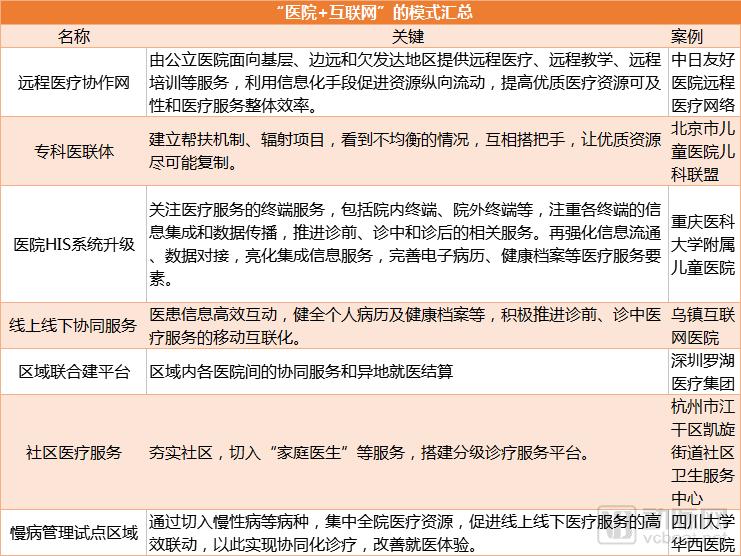
As shown in the figure, telemedicine is a component of the “Hospital + Internet” model and will become an important part of hospitals’ implementation of the “Internet + Healthcare” initiative, which explains why it is frequently mentioned.
As of October 2017, more than 6,800 public hospitals across China had launched telemedicine services.Taking the Huashan Hospital Telemedicine Center as an example, it has completed more than 6,500 remote consultations to date. Of these, 72.3% were provided to central and western regions (with central China accounting for 26.3% and western China for 46.0%), covering 24 provinces including Yunnan, Inner Mongolia, Tibet, and Xinjiang, and encompassing a wide range of diseases.
If memory serves, this marks the first time that internet hospitals have been included in a national policy document, providing a “definitive endorsement” for market exploration and representing a significant positive development for the industry.
In Liao Jieyuan’s view, WeDoctor was among the first batch of internet hospitals to rely on physical medical institutions. At that time, its positioning was not to provide initial consultations, but rather to offer online follow-up visits for common and chronic diseases, as well as remote consultation services. The National Health Commission also endorsed the “offline + online” model for internet hospitals.
Secondly, the document categorizes internet-based healthcare services and promotes the “Internet+” initiative across seven areas: medical care, public health, family doctor contracting, pharmaceutical supply assurance, medical insurance settlement, medical education and science popularization, and artificial intelligence applications. This provides a systematic impetus for the digital transformation of the pharmaceutical, medical, and insurance sectors.
Finally, the Guidelines also propose further standardization of related business activities, serving as a comprehensive assessment of the industry’s overall standards; only entities that meet the requirements will be permitted to conduct such businesses.
The State Council executive meeting, chaired by the Premier of the State Council, explicitly proposed three measures to develop “Internet+ Healthcare,” demonstrating the central government’s determination to promote the deep integration of the “Internet+” strategy with the healthcare industry. Each measure precisely addresses public livelihood concerns and market demands, serving as a significant encouragement to us.
It is worth noting that WeDoctor piloted the establishment and operation of the Wuzhen Internet Hospital in the Wuzhen Internet Innovation Development Pilot Zone on December 7, 2015. After 858 days and nights of exploration, the business model of the Wuzhen Internet Hospital has evolved from a “Xiaogang Village”-style pilot to a national policy benchmark endorsed by China’s central leadership.
The development of telemedicine facilitates the decentralization of high-quality urban medical resources, and the “Internet + Medical Consortium” model serves as a key lever for implementing tiered diagnosis and treatment. Currently, telemedicine still faces challenges such as inadequate communication infrastructure at the primary care level, insufficient overall supply of high-quality medical resources, and regional restrictions on physician practice qualifications. However, it is reasonable to believe that following the State Council’s executive meeting, relevant national authorities will introduce more detailed supporting policies to provide institutional and mechanistic safeguards for the healthy development of internet-based healthcare.
From 2010 to the end of 2017, WeDoctor’s platform connected the information systems of more than 2,700 hospitals across 30 provinces and municipalities, with over 220,000 online specialists. Initially, it helped these hospitals establish end-to-end services such as appointment scheduling and laboratory result inquiries; currently, it has assisted more than 100 public hospitals nationwide in building internet-based medical consortium platforms.
In the realm of primary healthcare, WeDoctor began exploring internet-based medical consortium practices for grassroots medical institutions in 2015, promoting the downward flow of high-quality resources to the primary care level through telemedicine and other means. After nearly three years of practice, WeDoctor has developed three core capabilities in system infrastructure, user traffic, and operations within the “Internet + Medical Consortium” framework. It has built eight major platform systems, including remote diagnosis and treatment, remote consultation, remote referral, remote training, cloud electronic medical records, cloud laboratory and imaging services, payment and settlement, and cloud pharmacy. These platforms enable interconnected data, capabilities, services, payments, and supply chains among medical institutions.
Moving forward, encouraged and supported by the State Council’s policies on “Internet + Healthcare,” WeDoctor will continue to promote the improvement and upgrading of internet healthcare services, facilitate information interconnectivity among medical institutions to enrich internet healthcare service offerings, and effectively operate the national prescription-sharing platform, leveraging technology to provide the public with high-quality and convenient healthcare services.
According to informed sources, on the afternoon of April 26, Vice Premier Sun Chunlan visited Yinchuan First People’s Hospital for research and highly praised the innovation and achievements of its remote expert outpatient services. As the operator’s representative, Haodf Online presented a work report, which received recognition and encouragement.
At a press conference last November, Wang Hang announced the 2018 strategic plan. According to him, starting from June 2017, Haodf.com pioneered the service model of remote expert outpatient clinics, using Yinchuan First People's Hospital as a pilot site.
Service Process: Step 1, the patient registers for a specialist appointment at a tertiary hospital through their local hospital. Step 2, Haodf Online assigns a tertiary specialist and a local physician to the patient; the local physician conducts the initial consultation, organizes the medical records, and completes all necessary examinations. Step 3, accompanied by the local physician, the patient initiates a remote video consultation with the tertiary specialist. Step 4, after the tertiary specialist provides diagnostic and treatment recommendations, the local physician formulates a specific treatment plan and administers the therapy at the local hospital.
From June to November, the number of senior experts who have activated their services has reached 10,000, and remote expert outpatient services have been conducted in 224 counties and cities across China.
Wang Hang announced Haodf Online’s 2018 goals: to invite at least 50,000 senior specialists to launch remote specialist consultation services, and to enhance operational capabilities for delivering specialist services to lower-tier markets, covering 80% of cities and counties across China.
To make more efficient use of experts’ time, Haodf Online has launched an Expert Team Platform. Senior and junior physicians form expert teams via a mobile platform; to date, 4,353 expert teams have been successfully established and are already conducting clinical consultations. Within these teams, the junior physician on duty responds to patients first; if they encounter issues beyond their scope, they can instantly invite senior experts online to resolve the problem.
Regarding the cluster of “Internet + Healthcare” policies issued by the state in April, Wang Hang believes that these initiatives will promote and drive the entire industry, which is a welcome development. According to currently disclosed information, this marks the first time that national functional departments have explicitly incorporated “Internet + Healthcare” into policy documents. The content is not only in-depth but also highly practical, addressing issues of concern to the general public and aligning with the needs of the population. This will significantly boost the development of China’s healthcare industry as a whole.
He stated that the business of internet hospitals constitutes only a portion of their overall operations, and their share should not be overstated. The broader concept of “Internet + Healthcare” is extensive, encompassing a wide range of services.
The key point is that this marks the first time the state has engaged in deep reflection on “Internet + Healthcare,” with internet hospitals being just one component. Since their inception, relevant regulatory frameworks have yet to be established. We look forward to the release of more detailed guidelines in the future.
Wang Hang believes that the so-called scenario of corporations taking over hospitals will not occur. Healthcare is a highly complex ecosystem; the assumption that acquiring a single hospital would resolve all challenges and ensure smooth operations is unfounded. If owning a hospital were sufficient to operate an internet hospital successfully, then theoretically, institutions like Peking Union Medical College Hospital would excel even further, leaving no room for corporate players.
Thus, owning a hospital is not the key to business success; rather, it hinges on whether you deliver core value and address specific pain points.
“We need to interpret current policies in conjunction with previous ones. It is insufficient to merely examine perspectives on the promotion of ‘Internet + Healthcare.’”
Previously, the state did not vigorously permit public hospitals to develop internet healthcare services. On one hand, there were concerns that large hospitals would use online platforms to siphon off patients; on the other hand, it was seen as contrary to the original intent of tiered diagnosis and treatment, with fears that the grassroots medical system would be further undermined.
Therefore, these policies are interconnected. For instance, the "Internet + Healthcare" initiative encourages large hospitals to disseminate high-quality resources via the internet, thereby enhancing the medical service capacity at the primary care level. This must be premised on adherence to the tiered diagnosis and treatment system and the policy allowing physicians to practice at multiple sites; the advent of the internet should not serve as a pretext to restrict physicians’ multi-site practice and mobility.
Wang Hang predicts that in the future, hospitals with different ownership structures will provide distinct medical services, each carving out its own niche. For instance, public hospitals will primarily focus on delivering basic medical care, while private hospitals will concentrate on offering multi-tiered, optional, and premium-oriented medical services.
Whether it is an internet hospital established by a hospital or one built by an enterprise, their relationship should resemble that of e-commerce platforms, with clear division of labor and distinct roles fostering corresponding development. Examples include Xiaomi’s direct sales platform, JD.com, Taobao, and Tmall.
Zhang Kun, CEO of Chunyu Doctors, stated that this wave of policies is generally favorable to the internet healthcare industry, particularly for enterprises with a profound understanding of medical services and mature internet-based products, technologies, service frameworks, and operational systems. Meanwhile, the policies also benefit forward-thinking hospitals, enabling them to legitimately leverage internet-based approaches to enhance their service capacity, service quality, and management standards.
Since joining Chunyu Yisheng (Spring Rain Doctor) last year, one of the strategic directions he has spearheaded is collaborating with offline physical medical institutions to facilitate their “+Internet” transformation, thereby achieving integration between internet platforms and healthcare providers. The implementation pathway centers on “empowering hospitals.” Specifically, after completing the integration of in-hospital information systems and aligning external internet-based products, technologies, and service solutions with hospital needs, Chunyu Yisheng continuously leverages internet-enabled methods to help medical institutions enhance their operations, services, management, and other key areas.
Many people fail to understand this, arguing that it does not align with internet thinking. They believe that collaborating with physical medical institutions to develop business is too slow, and B2B operations involve overly complex relationships, making them less straightforward and simple than pure online businesses. Zhang Kun stated that while the “physical hospital + internet” model may not seem as glamorous, it is an inevitable path for Chunyu Doctor’s future development, for the following reasons:
1. Purely online services cannot address all healthcare needs.As a leader in the internet healthcare sector, Chunyu frequently faces a dilemma: its core business of “online consultations” cannot fully meet all user needs. Although most user inquiries, including those related to common, frequent, general, and chronic conditions, can be addressed through text, voice, or even video interactions with physicians, a significant number of issues still require laboratory tests, diagnostic examinations, surgeries, and other procedures that necessitate face-to-face intervention. Limiting services to the online sphere would impose a ceiling on business growth and stifle future potential. Furthermore, guided by Chunyu Doctor’s vision of not only diagnosing but also treating diseases, mere health consultation is insufficient. Chunyu should collaborate with partners, including medical institutions, to deliver comprehensive “online + offline” and “in-hospital + out-of-hospital” medical and healthcare services. Therefore, Chunyu needs to build capabilities in delivering medical services.
2. In the future, the core competitiveness of most hospitals will lie not in surgical capabilities, but in service delivery.As medical standards improve, the incidence of major surgeries, such as those for tumors and cardiovascular or cerebrovascular diseases, has declined due to early diagnosis and treatment. With changes in lifestyle and population aging, chronic disease management will account for an increasingly larger proportion of the overall disease spectrum. Healthcare institutions are structured in a pyramid hierarchy; those at the middle and lower levels face diminishing opportunities for high-difficulty, large-scale surgeries and must therefore develop specialties focused on the depth and quality of service. Competition among most hospitals is shifting from “our ability to perform complex surgeries” to “our ability to provide excellent patient care,” placing greater emphasis on patient stickiness. “Internet + Healthcare” precisely provides this capability. It transforms hospitals from operating on a five-day, eight-hour schedule to a 24/7 model; it enables patients to connect with physicians from any location, rather than requiring physical visits to hospital buildings; and it unleashes many previously suppressed health service demands. Hospitals that establish online operations early will gain a first-mover advantage in customer acquisition channels and expand their market share. In contrast, hospitals that remain narrowly focused on surgical services will suffer a disruptive, asymmetric competitive disadvantage against those that have built robust internet-based service capabilities. Therefore, hospitals need internet enterprises like Chunyu Yisheng (Spring Rain Doctor) to help them build such capabilities.
3. Hospitals should not view “+Internet” as merely procuring an IT system, but rather as gaining an internet operations partner that integrates products, technology, and services.Internet-based service capabilities are not merely an app, a service account, or a software suite. Rather, they constitute a highly integrated service system that combines product capabilities with both online and offline operational capacities. Empowering hospitals should by no means replicate the traditional client-vendor dynamic of informatization projects; instead, the two parties should act more like partners, collaborating to serve patients. However, most Hospital Information System (HIS) companies currently transitioning into internet-based businesses remain confined to the role of technology vendors. This is because understanding the consumer (C-end) market and building consumer-facing service capabilities require a distinct corporate DNA, which is difficult for traditional B2B enterprises to develop organically. Meanwhile, hospitals, constrained by the inertia of their traditional operations, also struggle to independently navigate and establish internet-based business models.
4. From the perspective of global disciplinary development and business model innovation in the medical field, the information technology system centered on mobile internet, the Internet of Things (IoT), and big data is becoming the primary force driving the transformation of traditional healthcare services. This technological foundation underpins both the comprehensive digitalization of hospitals and the shift toward mobile-enabled telemedicine.In this context, hospitals should leverage “Internet Plus” initiatives as an opportunity to deepen their digital strategic transformation. By anchoring themselves in offline service capabilities while leveraging internet tools, they can maintain the agility needed to adapt when significant shifts occur in how healthcare services are accessed and delivered. Chunyu Doctor should also standardize, concretize, and make replicable its methods and tools for serving consumer-end (C-end) users, thereby reducing the learning curve for hospital teams and accelerating business expansion.
Therefore, Chunyu Yisheng’s transformation began last year. Its direction aligns with national requirements, with no plans for change, as it presses forward steadfastly along its established course.
Wei Jianfeng, founder of Zhuojian Health in Hangzhou, believes that there are two key points to this policy: one is allowing medical institutions to develop internet hospitals, and the other is permitting physical hospitals to use an internet hospital as their secondary name—for example, Beijing Hospital Internet Hospital operates under the entity of Beijing Hospital.
Furthermore, this also serves as an official endorsement by the State Council of the development of internet hospitals. In particular, the First Affiliated Hospital, Zhejiang University School of Medicine Internet Hospital is recognized as the first internet hospital in China established on the foundation of a physical hospital.
Over the years, Zhuojian has also facilitated the successful launch and operational implementation of several highly influential internet hospitals affiliated with leading public healthcare institutions, including The First Affiliated Hospital, Zhejiang University School of Medicine Internet Hospital, Beijing Internet Hospital, Zhejiang Provincial Eye Hospital Internet Hospital, Hunan Children’s Hospital, and Taizhou Enze Medical Center.
According to Wang Jianye, President of Beijing Hospital, the hospital’s internet hospital will establish a “Health Cloud” to enable health data collection and dynamic management. This initiative will organically integrate prevention, screening, diagnosis, and chronic disease management, while progressively enhancing the information platform system of the University for Elderly Health. The platform will facilitate functions such as the dissemination of popular science information, delivery of online courses, information exchange between students and clinical staff, and student information management.
In terms of organizational structure, Beijing Hospital will continue to improve the doctor-patient communication platform, health management platform, chronic disease management platform, and research data platform, in order to regularly study, coordinate, and resolve issues related to the management of the University for Elderly Health. In addition, the hospital has already established 18 teaching and research departments for the University for Elderly Health, including those in cardiovascular medicine, respiratory and critical care medicine, and other specialties.
Riding this wave, Wei Jianfeng stated that Zhuojian’s next plan is to empower public hospitals and vigorously develop internet hospitals anchored by physical hospitals.