

Global Surgical Robotics Market Heats Up: Four Startups Secure Over $100M in Funding as Titan Medical Files for IPO
In 2016, there were more than 4,000 medical robots worldwide; however, nearly all surgical robots originated from Intuitive Surgical, based in Sunnyvale, California. The company’s most prominent product is the da Vinci Robot-Assisted Surgical System, also known as the da Vinci Surgical Robot.
The da Vinci surgical robot delivers exceptional 3D visualization, providing surgeons with precise spatial depth perception. Its instrument armrests offer ergonomic support, significantly reducing fatigue associated with prolonged procedures. However, the system’s high price tag of RMB 20 million has given competitors strong incentive to challenge Intuitive Surgical’s market leadership.
According to data from TrendForce’s biotechnology report, “Development Trends in the Global Surgical Robotics Market,” the global market size for teleoperated surgical robots was approximately USD 3.8 billion in 2016. The market is expected to maintain a compound annual growth rate (CAGR) of around 20% in the coming years, reaching USD 9.3 billion by 2021, with its growth pace far exceeding that of most medical devices. Among all regions, the United States represents the largest market for surgical robots and has the highest proportion of surgeries performed with robotic assistance, followed by Europe, Asia, and other regions.
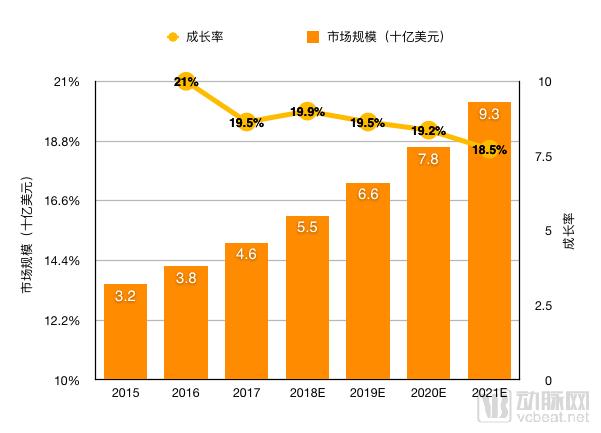
Data sourced from TrendForce
Although this market is highly closed, the profit margins are highly attractive. Today, an increasing number of companies are entering the competition in the surgical robotics field, attempting to break the monopoly held by the da Vinci Surgical System. Both domestically and internationally, emerging startups have risen rapidly, while industry giants such as Medtronic and Johnson & Johnson have also engaged in research and development. The medical applications covered by surgical robots have expanded from abdominal surgery to thoracic surgery, urology, head and neck surgery, and even cardiac surgery.
Between 2017 and 2018, numerous surgical robotics companies in China and abroad secured financing exceeding RMB 100 million. From late March to April 2018, Medical Microinstruments, Borns, and Vicarious Surgical each raised over RMB 100 million, while Auris Health secured USD 500 million in funding. Additionally, Titan Medical filed a prospectus with the Toronto Stock Exchange, planning an initial public offering.
With numerous players poised to enter the market, VCBeat (WeChat ID: vcbeat) has compiled an overview of emerging surgical robot companies, their product developments, and financing activities in recent years.
Cambridge Medical Robotics (CMR), founded in 2014 and headquartered in the suburbs of Cambridge, UK, has long been dedicated to bionics research, drawing inspiration from the human wrist joint. Since its inception, CMR had planned to develop a surgical robot featuring a lightweight, highly versatile, integrated arm that mimics the movement patterns of the wrist joint. However, it was not until September 6, 2017, that CMR unveiled images of its Versius system, with sales scheduled to commence in 2018.
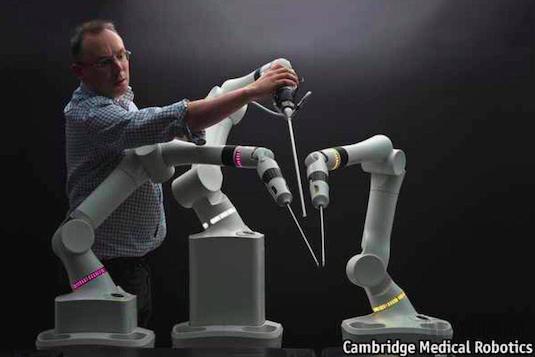
Image source: The Economist
Unlike the da Vinci surgical system, Versius features robotic arms mounted on separate bases. These compact and lightweight arms facilitate precise surgical maneuvers for surgeons and enable easy transfer of the equipment between operating rooms. This design eliminates the need for hospitals to dedicate exclusive space to the robot, allowing surgeons to determine the number of robotic arms required based on specific surgical needs.
Versius can mimic human arms to perform various types of laparoscopic surgeries, such as hernia repair, colorectal surgery, and prostate surgery, and can also be used for ear, nose, and throat surgeries.
Versius is disruptive to the development of surgical robotics. Its operative mode resembles that of the da Vinci Surgical System, yet it is only one-third the size, making it easier to relocate and transport, which directly enhances its practicality. Flexibility and compactness are common trends in the evolution of medical devices, offering endless possibilities for expanding Versius’s capabilities.
The most pressing issue at present is that the Versius system is priced at approximately RMB 18 million, a figure even the company’s CEO has acknowledged as potentially too high. With the da Vinci surgical robot priced at around RMB 20 million, Versius currently finds it difficult to challenge da Vinci’s cost competitiveness given the narrow price gap, especially since da Vinci has already established a mature ecosystem.
On April 19, 2018, Vicarious Surgical completed a $17 million Series A financing round.
Vicarious Surgical, headquartered in Cambridge, Massachusetts, USA, completed a $2.4 million financing round in January 2016 and secured an additional $800,000 in October of the same year.
Vicarious Surgical combines VR technology with its proprietary human-scale surgical robot to help surgeons perform minimally invasive procedures through a single small incision. Vicarious Surgical stated that this innovative technology achieves the goal of surgical robotics: miniaturizing the robot so it can be inserted into the patient’s body. Additionally, Vicarious Surgical announced that the funding will support the next phase of development, further expanding its robotics and software teams.
On April 18, 2018, Italian startup Medical Microinstruments (MMI) announced the completion of a €20 million Series A financing round, aimed at accelerating the development of MMI’s pioneering robotic platform for microsurgery.
Gus Castello, former Senior Vice President of Product Operations at Intuitive Surgical, participated in this investment. Having left ISRG and now expressing confidence in MMI, Castello has added further suspense to the battle in the robotics market.
In December 2017, MMI launched a novel robotic platform for open microsurgery, specifically designed for micro-surgical procedures. Surgeons can use this new platform to control two small, articulated micro-instruments for reconstructive work following traumatic injuries or tumor resection in soft tissue and bone. The following images illustrate its precision.

Astonishing Precision(Image source fromMedical Microinstruments Official Website)
MMI’s devices are compact and flexible, standing in stark contrast to the da Vinci Surgical System. By avoiding direct competition with industry giants, it has carved out its own path in the field of surgery.
On March 23, 2018, the Monarch Surgical Robot, developed by Auris Health, received FDA clearance. The FDA’s authorization indicates that the device can be used for diagnostic and therapeutic bronchoscopy procedures. The initial target of the Monarch robotic platform will be the treatment of lung cancer, but the company has remained tight-lipped about its research and development progress.
In late March, Auris Health secured an additional $500 million in financing, with investors including Lux Capital, Mithril Capital Management, Highland Capital, and Coatue Management. Following this round, Auris’s total funding has surpassed $1 billion.

Auris Financing Status
The Monarch system is a flexible robotic endoscopy platform whose technical advantage lies in its integration of software, data analytics, robotics, and visual imaging into a single unified system. Physicians can precisely control the joysticks via the platform to flexibly navigate within the patient’s body for visualization and access to pulmonary regions.
According to 2017 reports, Auris is developing a flexible robotic arm system equipped with surgical instruments and a camera, designed to access the body through the patient’s mouth. Detailed information about the product has not yet been disclosed, but Auris appears to have broad interests across the entire field of human surgery.
Titan Medical is a Canadian company primarily engaged in the surgical robotics business. Its SPORT robotic surgical system has been hailed as the “terminator” of the da Vinci Surgical System, with a price tag significantly lower than that of its competitor.
SPROT Robotic Surgical System is generally used for general surgery (abdominal), gynecological, and urological procedures. It features a 3D high-definition visualization system and multi-jointed instruments, enabling surgeons to perform minimally invasive surgery through a single incision.
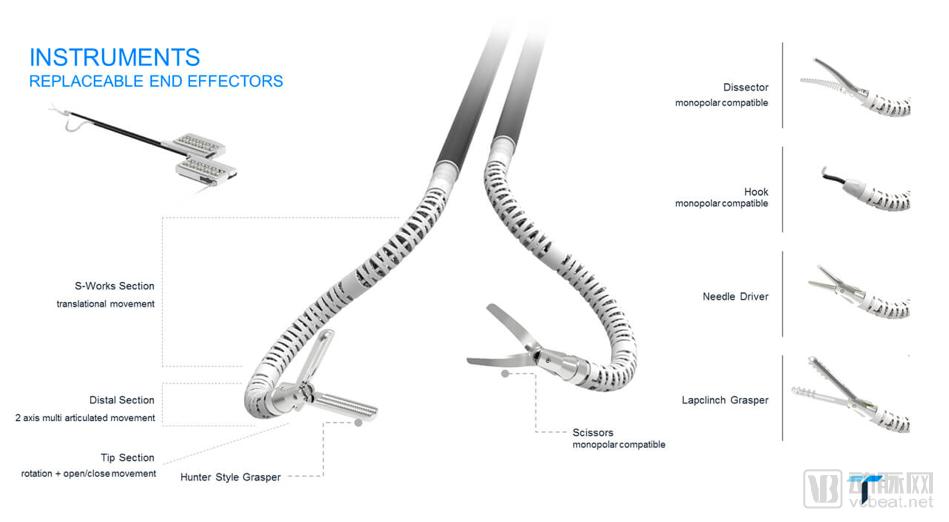
Titan Robotic Arm (Image source: Titan Medical official website)
On August 1, 2017, Titan Medical announced that it had reached an agreement with Longtai Medical, a Chinese company, to convert Longtai Medical’s RMB 2 million agency security deposit into equity in Titan Medical, thereby making Longtai Medical the largest shareholder of Titan Medical. The next step for both parties will be to target the markets in China and Southeast Asia.
On April 3, 2018, Titan Medical released its prospectus in preparation for listing on the Toronto Stock Exchange.
Faced with such an enticing market, medical technology giants like Medtronic are also eager to get a share. However, Medtronic has only disclosed its plans and direction to the media, without providing detailed descriptions of the product, and there is no information related to robotics on its entire official website. Nevertheless, from other sources, we can infer that Medtronic may adopt MIRO, a robot developed by the German Aerospace Center capable of being remotely controlled in space.
Medtronic’s Executive Vice President Bryan Hanson previously emphasized that the robot would be used for colorectal, thoracic, and bariatric surgeries, with the product expected to enter the market in 2018. However, as nearly half of 2018 has already passed, Medtronic has yet to release any related updates.
Johnson & Johnson and Google jointly established Verb Surgical. Like all ventures involving Google, Verb Surgical plans to embed AI into surgical robots, enabling them to perform machine learning during operation.
AI surgical robots equipped with deep learning capabilities can provide physicians with alternative decision-making options in complex scenarios, such as determining the optimal cutting trajectory and the appropriate force to apply during surgery.
Verb Surgical’s surgical robot is still under development. In today’s era of rapid internet technology growth, the Internet of Things (IoT) represents a future trend, and surgical robots will gradually evolve in this direction as well. Each surgery generates substantial reference data; barring safety concerns, future surgical robots have the potential to attract widespread societal attention, much like autonomous vehicles.
Anhan Medical, established in 2008, is the world’s first company to successfully develop and commercialize an “Active Precisely Controlled Capsule Endoscopy Robot System for the Gastrointestinal Tract.” Having won the championship at the 2013 Dark Horse Competition, the company has become a unicorn enterprise by leveraging its DNA of independent innovation alongside disruptive technological advancements.
Anhan Magnetically Controlled Capsule Gastroscopy Robot is the world’s only capsule endoscope capable of performing precise examinations of the human stomach, and it is also the only capsule gastroscopy robot holding a Class III medical device registration certificate issued by the China Food and Drug Administration (CFDA).
Each capsule robot captures approximately 20,000 images after entering the human body, making the analysis and processing of these images a significant challenge. To address this, Anhan Medical has entered into a strategic agreement with IBM to jointly develop AI technologies aimed at extracting valuable information from the vast volume of images.
Anhan Medical secured SoftBank investment for the second time in 2017, with its second funding round that year reaching $100 million. The funds obtained will be used for R&D to address the aforementioned issues related to gastroscopic imaging.
Bornes Medical Robotics Co., Ltd., based in Chengdu, is dedicated to the comprehensive advancement of minimally invasive surgery. Its product portfolio covers the entire surgical workflow, with hardware terminals encompassing assisted diagnosis, surgical systems, and interventional therapy. By achieving breakthroughs in core human-machine interaction control technologies, the company has realized the organic integration of robotic surgery with traditional minimally invasive surgical equipment, thereby comprehensively enhancing the intelligence, precision, and remote capabilities of laparoscopic surgery.
Borns Medical Robot Research Institute has successively established multilateral strategic partnerships with leading domestic and international research institutions, research universities, and medical centers. These partners include world-class medical robotics research entities such as the Stanford Artificial Intelligence Laboratory at Stanford University, the Center for Advanced Surgical and Interventional Technology at the University of California, Los Angeles, and the Health Engineering Center at the University of Illinois. Through in-depth collaboration in scientific research, technological innovation, and industry incubation, the Institute has formed a cross-disciplinary, cross-institutional, and cross-border collaborative innovation system.
The Borns Minimally Invasive Surgical Robot System, built upon the design principles of specialization, modularity, intelligence, and teleoperation, comprises an auxiliary manipulation arm, a surgical imaging assistance system, and a universal surgical instrument interface system. It is widely applicable for the automated upgrade of minimally invasive tumor resections in digestive surgery and various laparoscopic minimally invasive surgical procedures.
On April 9, Borns secured RMB 100 million in Series A financing, underscoring the determination of Chinese enterprises to enter this field.
At present, medical robots in China are primarily patient guidance robots, medication dispensing robots, and intelligent consultation robots, with surgical robots being relatively scarce. In September and October, there was a significant surge in news reports about surgeries performed using Tinavi’s “Tiandi” orthopedic surgical robot across various regions of China. Notably, these procedures were not confined to developed areas such as Beijing, Shanghai, and Guangzhou, but also took place in Sichuan, Karamay (Xinjiang), Jiangmen, and Foshan. This indicates that the robot has moved beyond the laboratory setting of Beijing hospitals and entered the commercial market.
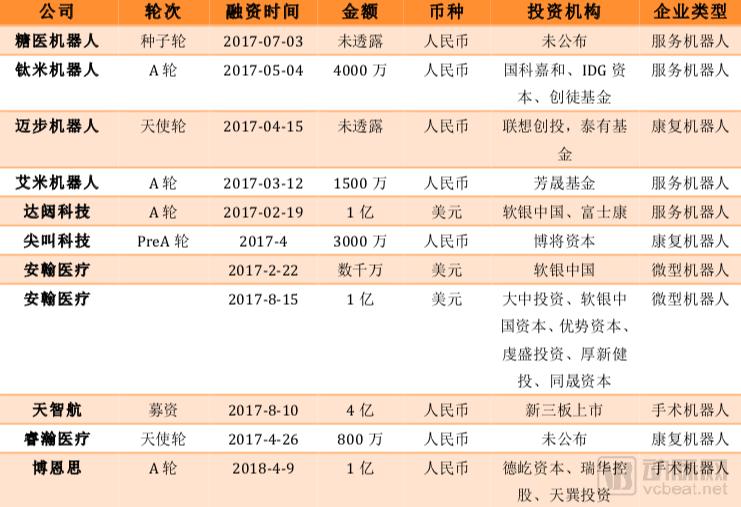
Domestic Medical Robot Financing Situation (Source: VCBeat Database)
Nevertheless, the overall development of China’s surgical robot market lags slightly behind, with the few companies that have secured financing actively engaged in R&D. China represents a vast market, yet the overwhelming majority of robotic surgeries are monopolized by the da Vinci Surgical System. Breaking this stranglehold will require sustained perseverance from domestic enterprises.
From the above overview, we can see that different companies are attempting to broaden their product portfolios, such as expanding into general surgery and even medical aesthetics; technologically, they are also increasingly integrating with AI. There remain significant untapped areas in the surgical field for surgical robots to penetrate. In the future, medical robots will possess greater capabilities to assist physicians in addressing real-world clinical cases, which is likely a key reason why many startups have secured substantial financing.
Surgical robotics companies, both domestic and international, face the same challenges: lengthy R&D cycles and regulatory constraints. The journey from research and development, testing, and clinical trials to regulatory approval can take many years. Furthermore, operating surgical robots is a highly specialized skill that requires professional training; for instance, Intuitive Surgical (ISRG) maintains its own dedicated training team. This creates a dependency among physicians on specific robotic systems: surgeons accustomed to the da Vinci Surgical System may exhibit resistance when confronted with new platforms, as they are generally reluctant to alter their established operational habits for the sake of adopting different devices.
Nevertheless, there is still hope for a breakthrough in terms of cost reduction and market expansion. If any company can control the costs of equipment and single-use surgical consumables, or tap into markets not currently served by existing robotic systems, it is entirely possible to reverse the tide and achieve victory in the competitive battle for the robotics market.