State Council General Office Issues Guidelines on 'Internet + Healthcare', Allowing Hospitals to Establish Internet Hospitals
On April 28, the General Office of the State Council issued the “Opinions on Promoting the Development of ‘Internet + Healthcare’” (hereinafter referred to as the “Opinions”).
The "Opinions" consist of the following three components:
I. Improve the “Internet + Healthcare” service system
II. Improving the Support System for “Internet + Healthcare”
III. Strengthening Industry Regulation and Security Assurance
The objective is to advance the implementation of the Healthy China Strategy, enhance the modernization of healthcare management, optimize resource allocation, innovate service delivery models, improve service efficiency, reduce service costs, and meet the growing public demand for medical, health, and wellness services.
I. Excerpts of the Core Points for Improving the “Internet + Healthcare” Service System
Abstract: Permitting the development of internet hospitals based on medical institutions.Medical institutions may use an internet hospital as their secondary name., building upon physical hospitals, leverage internet technologies to provide safe and appropriate medical services, allowing online follow-up consultations for certain common and chronic diseases. After physicians have reviewed patients’ medical records, they are permitted to issue online prescriptions for certain common and chronic diseases.
EncouragementWithin medical consortia, tertiary healthcare institutions leverage artificial intelligence and other technologies to provide grassroots facilities with services such as remote consultations, remote electrocardiogram (ECG) diagnosis, and remote imaging diagnosis., facilitating real-time access, mutual recognition, and sharing of examination and test results among medical institutions within the medical consortium.
Abstract: Promote online access and standardized use of residents’ electronic health records. Focus on conditions such as hypertension and diabetes to strengthen online service management for chronic diseases among the elderly. Prioritize children included in the National Immunization Program, integrate existing immunization information platforms, and optimize vaccination services.Encourage the use of wearable devices to capture vital signs data, providing health monitoring and management for pregnant and postpartum women.。
Abstract:Encourage the provision of online contract signing services to offer contracted residents health consultations, appointment referrals, chronic disease follow-ups, health management, and extended prescriptions., promote the transformation of the family doctor service model, and improve the public's experience with contracted services.
Abstract: For prescriptions of common and chronic diseases issued online, after being reviewed by pharmacists,Medical institutions and pharmaceutical distributors may entrust qualified third-party agencies with distribution.. ExploreInterconnectivity and Real-Time Sharing of Prescription Information from Healthcare Institutions with Drug Retail Consumption Data, to promote the standardized development of online drug sales and medical logistics distribution.
Abstract: Continue to expand the scope of designated medical institutions connected to the network,Gradually include more primary healthcare institutions in the direct settlement system for cross-regional medical care.. Further improve the direct settlement of cross-provincial inpatient expenses for migrant workers and individuals engaged in “mass entrepreneurship and innovation.”
Vigorously Promote Intelligent Audit and Real-Time Monitoring of Medical Insurance, embed rules such as clinical pathways, rational drug use, and payment policies into hospital information systems to strictly regulate medical practices and costs.
Abstract:Encourage the Establishment of a Cloud-Based Platform for Medical and Health Education and Training, offering diverse online medical courses and medical education. It aims to build a networked, digitalized, personalized, and lifelong medical education and training system, encouraging healthcare professionals to engage in discussions and exchanges on complex cases and major diseases to enhance their professional competence.
Abstract:Develop an AI-based clinical diagnosis and treatment decision support system, and implement applications of intelligent medical imaging recognition, pathological classification, multidisciplinary consultation, and intelligent voice technology across various healthcare scenarios., thereby improving the efficiency of medical services. Support the application of intelligent auxiliary systems for syndrome differentiation and treatment in Traditional Chinese Medicine (TCM), so as to enhance the capacity of primary-level TCM diagnosis and treatment. Carry out mobile healthcare demonstrations based on artificial intelligence technologies and smart medical devices, enabling real-time personal health monitoring and assessment, disease early warning, chronic disease screening, and proactive intervention.
II. Key Points for Improving the “Internet + Healthcare” Support System
Abstract: All regions and relevant departments shall coordinate and advance the development of a unified, authoritative, and interoperable national health information platform, gradually achieving integration and connectivity with the national data sharing and exchange platform.
Hospitals at Level II and above shall improve the functionality of their hospital information platforms, integrate various internal system resources, and enhance hospital management efficiency. Tertiary hospitals shall achieve interoperability and sharing of medical service information within the hospital by 2020; hospitals with the necessary conditions shall accomplish this as soon as possible.
Improve the tiered diagnosis and treatment information system based on internet and big data technologies, promote the gradual realization of sharing electronic health records, electronic medical records, and test and examination results among hospitals at all levels and types, as well as authorized use between medical and health institutions at different levels. Support the construction of hardware and software for informatization in grassroots medical and health institutions in old revolutionary base areas, ethnic minority regions, border areas, and poverty-stricken areas.
Abstract: Establish a sound, unified, and standardized national catalog and standard system for medical and health data resources. Strengthen the standardized management of “Internet + Medical Health” standards, formulate foundational standards for medical services, data security, personal information protection, and information sharing, and comprehensively implement them nationwide.Standardized Documentation of the Medical Record Face Sheet, Disease Classification and Coding, Surgical Procedure Classification and Coding, and “Four Unifications” of Medical Nomenclature。
Accelerate ApplicationNational Standards and Specifications for Hospital Information System Construction in China, strengthen the functional guidelines and promote the application of data standards for provincial-level integrated regional platforms and hospital information platforms, unify data interfaces, and provide support for interoperability and data sharing.
Abstract: By 2020, hospitals at the secondary level and above generally providedTime-slot appointment scheduling, intelligent patient triage and guidance, waiting reminders, lab and imaging result inquiry, point-of-care settlement, mobile paymentand other online services. Healthcare institutions with the necessary conditions may provide mobile nursing, online vital signs monitoring, intelligent medical image recognition, and home monitoring services.
Support medical testing institutions and healthcare facilities in partnering with internet companies to develop health services such as disease prevention and laboratory testing. Promote the integration of pre-hospital emergency vehicle monitoring systems with regional or hospital information platforms, ensuring standardized sharing of patient information, remote emergency guidance, and in-hospital emergency preparedness, thereby enhancing the efficiency of emergency care.
Abstract: Advance the development of the healthcare service system, optimize spatial layout, ensure rational resource allocation, and implement the project to guarantee the configuration of medical diagnostic equipment in regional central hospitals.The state provides appropriate support to poverty-stricken areas in the central and western regions, among others.。Accelerate the Standardized Construction of Primary Healthcare Institutions and Enhance Equipment Support Capabilities at the Grassroots Level。
To address the needs of telemedicine, medical information sharing, and other related areas,Encourage telecommunications enterprises to provide high-quality internet dedicated lines, virtual private networks (VPNs), and other network access services to medical institutions., advance the construction of dedicated telemedicine networks to ensure the quality of service for medical data transmission. Support healthcare institutions in selecting and adopting high-speed, highly reliable network access services.
Abstract: To adapt to the development of "Internet + Healthcare," further improve the medical insurance payment policy.Gradually include eligible internet diagnosis and treatment services in the scope of medical insurance payment., establish a cost-sharing mechanism to facilitate access to medical care closer to home and promote the effective utilization of high-quality medical resources.
Improve the policy on physicians' multi-site practice,Encourage Licensed Physicians to Provide “Internet + Healthcare” Services。
III. Key Points on Strengthening Industry Supervision and Safety Assurance
Abstract: Promote the construction of a trusted network system and accelerate the establishment of a unified national identification system for healthcare professionals and medical institutions.Trusted Medical Digital Identity, Electronic Real-Name Authentication, and Data Access Control Information System, innovate regulatory mechanisms and enhance regulatory capabilities.
Data generated by “Internet + Healthcare” services shallFull-process traceability: queryable and traceable, to meet industry regulatory requirements.
Abstract: Research and formulate regulations on the confirmation of rights, opening, circulation, trading, and property rights protection of health and medical big data.Strictly adhere to information security and healthcare data confidentiality regulations, establish and improve a system for the protection of personal privacy information,Strictly manage patient information, user profiles, genetic data, and other sensitive information, and impose penalties in accordance with laws and regulations on illegal trading and leakage of such information.。
Patient information and other sensitive data shall be stored within China., where it is indeed necessary to provide such data overseas, a security assessment shall be conducted in accordance with relevant regulations.
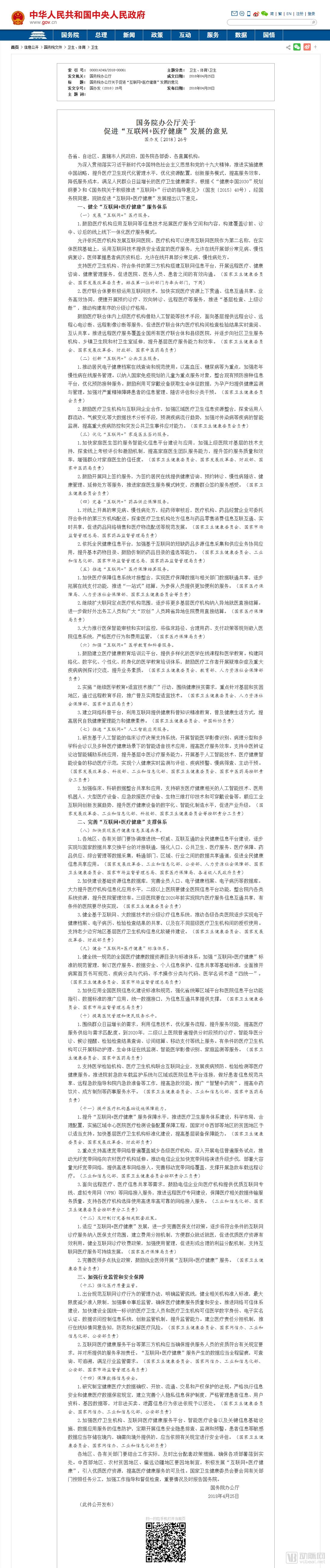
The following is the original text of the "Opinions on Promoting the Development of 'Internet + Healthcare'" issued by the General Office of the State Council: