

CloudMedx Files IPO Prospectus: AI Platform Reduces Hospital Readmissions and Enhances Clinical Decision-Making
Before the widespread adoption of computer technology, healthcare professionals had to manually manage patient medical records on large blackboards. This entire process of collecting and organizing patient data not only consumed significant time but also was prone to errors. Furthermore, analyzing massive amounts of data posed a burdensome task for physicians; in addition to misjudgments arising from subjective factors, this inefficiency exacerbated societal issues such as difficult and slow access to medical care, particularly amid current shortages of healthcare resources.

Taken at a hospital in Budapest, the capital of Hungary
Therefore, the collection, storage, and standardization of medical records constitute the first step in reforming the existing healthcare system. Organizing and streamlining medical records is also one of the most common applications of artificial intelligence (AI) in medicine. In the healthcare sector, AI can replace healthcare workers in performing repetitive, monotonous, yet time-consuming tasks such as data collection, organization, and analysis. This assists medical professionals in designing optimized treatment plans and identifying the most suitable approaches for each patient, while simultaneously saving doctors and nurses a significant amount of valuable time.
CloudMedx Inc. Improves the Patient Journey
CloudMedx Inc. is a healthcare data collection and analytics service provider founded in 2014, headquartered in Palo Alto, California.
Tashfeen Suleman, Co-founder and CEO of CloudMedX, spoke about the original motivation behind founding the company: “My father suffered from a subdural hematoma, but it was not detected and treated in time by his physicians, which ultimately led to him falling into a coma. To survive, my father had to undergo emergency surgery as well as six months of arduous rehabilitation. Although he has now made a full recovery, we were deeply shaken by this experience and recognized the need to establish a system that collects and analyzes patient data for use by clinicians, enabling timely diagnosis to save lives and benefit other patients. This was the original intent behind founding CloudMedX.”
CloudMedx is a platform that provides healthcare organizations with big data-driven integration and decision support. It collects real-time data from diverse patients across numerous hospitals, processes and analyzes the information, and delivers HIPAA-compliant health predictions and analytical insights to medical institutions. By analyzing raw patient data, CloudMedx identifies trends, patterns, and anomalies in various conditions, predicts potential outcomes, and thereby offers valuable references for clinical treatment and early detection and diagnosis.
In an interview, Tashfeen stated, “We are enabling doctors to return to their primary role as clinicians rather than data entry clerks. We aim to alleviate the burden on healthcare professionals by removing tasks that fall outside their scope of expertise. CloudMedx’s primary market consists of physician organizations, including Accountable Care Organizations (ACOs), Physician-Hospital Organizations (PHOs), Independent Practice Associations (IPAs), and Qualified Health Centers. Our focus is on reducing patient readmission rates.”
CloudMedx Platform and Its Workflow
CloudMedx is building an unprecedented clinical artificial intelligence platform. The platform combines algorithms with big data architecture by leveraging healthcare-specific natural language processing (NLP) and machine learning algorithms. It utilizes NLP algorithms to comprehend tens of millions of medical records from mainstream healthcare institutions, which contain diverse structured and unstructured data. These data are integrated into clinical workflows to ultimately generate medical insights, providing healthcare institutions with clinical decision support solutions.
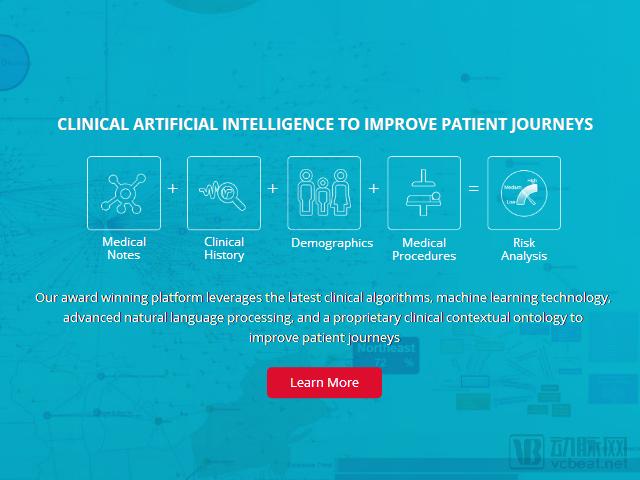
The CloudMedx platform leverages state-of-the-art clinical algorithms, machine learning technologies, advanced natural language processing, and proprietary clinical expertise to enhance the patient healthcare journey. It provides patients with personal medical records, clinical disease history, patient characteristic statistics, medical progression tracking, and risk analysis. The platform’s workflow consists of three steps:

Step 1: Upload Data: Acquire structured and unstructured data from various EMRs (Electronic Medical Record systems), laboratories, medical devices, etc.
Step 2: The AI platform begins operation by analyzing patient-uploaded data using existing algorithmic models.
Step 3: Provide Results and Solutions: Deliver analysis results and clinical recommendations to patients and physicians.
For consumers, this is a one-stop service that enables them to monitor and manage their health status in real time. The platform features three key characteristics:
Real-time acquisition of all clinical data;
Personalized Medical Outcomes and Recommendations: For Individuals Only;
Comprehensive Clinical Analysis Results: Integrating Observations from Similar Clinical Patients.
When a patient visits a clinic, the physician uploads the consultation information to the EHR (Electronic Health Record), and the patient’s data is then transmitted to the CloudMedx platform. The results generated by the CloudMedx platform can be delivered to the patient via a smartphone application, thereby enabling more convenient access to their medical records.
For CloudMedx’s clinical partners, meaningful real-time insights can be derived from CloudMedx’s data. For instance, the algorithms within the CloudMedx platform predict readmissions based on patients’ hospitalization status, thereby improving patient outcomes. Data show that the platform helps hospitals reduce readmission rates by 30%. Readmissions often indicate complications such as secondary infections or disease recurrence.
Two Major Analytical Tools of the CloudMedx Platform
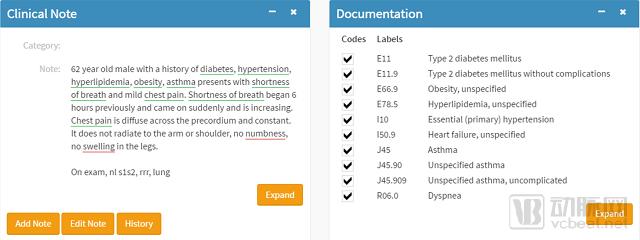
Clinical analyzers examine patients’ medical records to provide recommendations for improving patient health to clinicians, nurses, and frontline staff. For example, when a patient or healthcare provider enters diagnostic terms such as “hypertension” or “HTN,” CloudMedx’s clinical analyzer automatically detects the data and immediately leverages it to:
a. Record the ICD-10 code (International Classification of Diseases, 10th Revision) for this category of diseases;
b. Use this algorithm to calculate the risk probability of hypertension;
c. Return the probability of the patient having other related comorbidities (such as obesity and diabetes);
d. Provide the patient with a treatment pathway and progress updates based on his or her complete medical history.
By using clinical analyzers, physicians do not need to directly inquire about patients’ medical histories, thereby saving time for diagnosis and treatment. Furthermore, many patients have an inadequate understanding of their own health conditions and often provide inaccurate information, which can ultimately affect the accuracy of physicians’ diagnostic conclusions.
Coding analyzers are primarily used in the following areas:
a. Extract useful structured and unstructured data;
b. Leverage NLP and machine learning algorithms to derive insights from data;
c. Provide connectivity tools for programmers and healthcare information providers.
A Boon for Doctors, Patients, and API Partners
The CloudMedx system serves physicians, patients, and API partners.
1、Physicians—Providing More Comprehensive Treatment by Reviewing Patients’ Medical History and Other Factors
CloudMedx is acutely aware of the challenges and constraints in tracking patient treatment outcomes within healthcare information systems. Its platform enables predictive and prescriptive analytics, generating evidence-based outcome recommendations through relevant data. By leveraging predictive risk analytics, CloudMedx helps physicians identify patients at high risk and supports interventions to mitigate those risks.
2、Patients—can better track their own health data and arrange a more reasonable lifestyle
CloudMedx’s analytics platform integrates with laboratories, pharmacies, and hospitals to capture relevant clinical information, which is then shared with all healthcare stakeholders.
3. APIs Partners—Use the CloudMedx platform within their existing facilities via APIs (Application Programming Interfaces)
For technology companies (such as medical IT vendors, device manufacturers, and application developers), CloudMedx’s APIs enable direct integration of the platform into their databases or electronic health records (EHRs). This allows analytical results generated by the CloudMedx platform—such as clinical terminology, patient risk stratification, and disease progression—to be displayed within their existing infrastructure.
Startups That Have Caught Tencent’s Eye
Artificial intelligence in the healthcare market is categorized into hardware, software, and services, with software currently holding the largest share of the healthcare market.TechnicallyCategorized into deep learning, query methods, natural language processing (NLP), and environmental perception processing, NLP currently holds the largest market share in the field of artificial intelligence technology.From an application perspective, further subdivided into patient data and risk analysis, lifestyle management and monitoring, precision medicine, inpatient care and hospital management, medical imaging and diagnostics, drug discovery, virtual assistants, wearable devices, and laboratory research,Among these, patient data and risk analysis applications accounted for the largest market share between 2016 and 2017.
CloudMedx is capitalizing on the surge in artificial intelligence (AI) within healthcare by applying natural language processing (NLP) and deep learning technologies to patient data analysis and risk assessment. In the medical AI market, it will join forces with companies such as IBM, NVIDIA, Microsoft, Intel, Deep Genomics, Siemens Healthineers, GE Healthcare, Google, Johnson & Johnson, and Medtronic to drive the growth of the global medical AI market.
Since its establishment in August 2014, CloudMedx has completed three rounds of financing. In March 2015, it secured its first seed round from Palm Drive Capital, with the specific amount undisclosed. In May 2015, it closed a second seed round, again with the amount undisclosed; Tencent was one of the eight investors. In May 2017, the company raised an additional $4.2 million in venture capital.。
In 2017, CloudMedx was named to the “AI 100” list. For this selection, CB Insights’ research team evaluated submissions based on company-provided data and Mosaic scores (Mosaic is an algorithm funded by the U.S. National Science Foundation that predicts and scores companies’ future growth potential). More than 1,650 companies applied for the award, with only 6% ultimately selected.
CloudMedx is currently compatible with 18 mainstream EHR systems, providing healthcare institutions with intelligent insights in areas such as real-time patient information alerts and risk management. In an interview, Dr. Stefano Bini, MD, from the Department of Orthopedic Surgery at the University of California, San Francisco, stated: “We have long sought to integrate patient-reported outcomes, electronic health record data, and data from wearable patient sensors to gain a comprehensive understanding of patient conditions. To this end, we partnered with CloudMedx because they can analyze and process large volumes of data, providing us with predictive insights into patient behavior.”
Practical Clinical Applications of CloudMedx | |||
Hip and Knee Surgery | Congestive Heart Failure |
Chronic Kidney Disease |
Diabetes |
CloudMedx collaborates with the Department of Orthopaedic Surgery at the University of California, San Francisco (UCSF) to predict outcomes for patients who have recently undergone hip and/or knee replacement surgery. By integrating electronic health record (EHR) data, patient-reported outcome measures, and data from measurement devices, the CloudMedx platform generates insights into factors influencing patient recovery. | The CloudMedx platform features algorithms for monitoring and predicting congestive heart failure. The goal is to identify high-risk populations and provide appropriate care to these individuals to prevent adverse events. | The CloudMedx platform is used to predict and monitor the progression of disease treatment in patients with chronic kidney disease. The goal is to identify high-risk patients (those who may rapidly progress to end-stage renal disease). This platform enables caregivers to take appropriate measures in advance. | CloudMedx Platform Enables Caregivers to Manage and Monitor Their Diabetes Population. The Platform Not Only Identifies High-Risk Individuals with Diabetes but Also Detects Other Related Complications That May Lead to Adverse Events. |
Tashfeen Suleman: “Our platform has proven capable of significantly reducing the rate of hospital readmissions—which cost $25 billion annually, with $17 billion being entirely preventable—by helping physicians immediately identify high-risk patients. This represents a significant breakthrough, as the risk profile for these patients becomes unimaginably severe if they end up in the emergency room due to delayed treatment, leading to a substantial surge in medical costs. We assist physicians in identifying these patients and providing them with better care. This is also why patients are increasingly accustomed to leveraging advanced technologies within hospitals; they desire real-time access to their clinical data, and our patient portal enables them to do just that, allowing them to view their data anytime, anywhere. Surprisingly, however, in this day and age, patients’ medical records remain paper-based, requiring them to carry bulky physical files when seeking care. Addressing this issue—specifically, achieving full interoperability and data exchange among devices to meet patient needs—is what CloudMedx aims to resolve in the future.”