

China's Pharmaceutical E-commerce Leaders Report Strong Profitability, with Top Player Achieving RMB 1.369 Billion in Revenue and RMB 319.1 Million in Net Profit
Recently, the State Council issued guidelines to promote the development of “Internet + Healthcare,” stating that prescriptions for common and chronic diseases may be issued online. After review by pharmacists, medical institutions and pharmaceutical distributors may entrust qualified third-party agencies with delivery. Meanwhile, efforts will be made to explore the interconnectivity and real-time sharing of prescription information from healthcare institutions with drug retail consumption data, thereby fostering the standardized development of online drug sales and medical logistics distribution.
Policy breakthroughs appear to have created an opening in the regulation of “Internet + pharmaceutical retail.” At the industry level, 111.com announced the completion of a new $50 million financing round, signaling capital markets’ recognition of the online pharmaceutical business model. With favorable policies and positive investor sentiment converging, the development of online pharmaceutical sales may reach a new level.
From a market performance perspective, various pharmaceutical e-commerce platforms have also delivered impressive results. Data compiled by VCBeat (WeChat ID: vcbeat) from the 2017 annual reports of relevant publicly listed companies and those listed on the New Third Board shows that the revenues of these pharmaceutical e-commerce platforms increased significantly compared to the previous year, with the majority achieving profitability.
“Listed-Company” Pharmaceutical E-Commerce Performance Report
Although there is currently no listed company on the A-share market whose core business is pharmaceutical e-commerce, there are already dozens of stocks considered part of the pharmaceutical e-commerce concept. These include traditional distribution giants such as Shanghai Pharmaceuticals, Baiyunshan, and Jointown Pharmaceutical Group, as well as listed retail pharmacy chains like Yixintang, Laobaixing Pharmacy, Dashenlin Pharmaceutical Group, and Yifeng Pharmacy.
A-Share "Pharmaceutical E-commerce" Concept Stocks
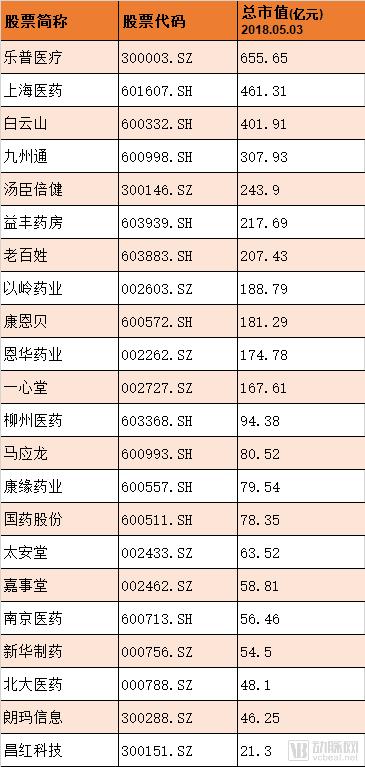
Some listed companies in the pharmaceutical e-commerce sector have disclosed their e-commerce performance in their annual reports, from which the general market trend can also be observed.
“Listed-Company” Pharmaceutical E-Commerce Performance Report
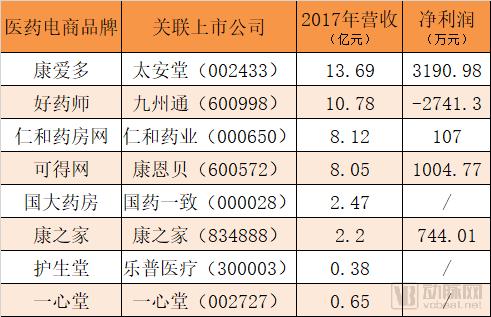
E-commerce platforms that have clearly disclosed their revenue data include Kangaiduo, Haoyaoshi, Renhe Pharmacy Online, and Kede Wang. Among them, Kangaiduo ranked first with a revenue of RMB 1.369 billion and a net profit of RMB 31.9098 million. In 2016, Kangaiduo also ranked first, with a revenue of RMB 1.33 billion and a net profit of RMB 8.86 million. Other notable performers include Haoyaoshi under Jointown Pharmaceutical Group, Renhe Pharmacy Online under Renhe Pharmaceutical, and Kede Wang under Conba Pharma.
Kangaidu
Tai’an Tang’s annual report states that Kang’aiduo, leveraging its internet platform, extensively engages in collaborative operations with internet companies, pharmaceutical manufacturers, and offline retail pharmacies, positioning itself as a diversified internet-based pharmaceutical company.Kang Aiduo has cumulatively provided disease medication consultation and professional pharmaceutical services to over 700 million online shoppers in China., with a strong market reputation, it has been ranked among the Top 100 E-commerce Enterprises in China for six consecutive years.
Notably, as early as 2015, Kang Aiduo began laying out its offline DTP (Direct-to-Patient) pharmacy network with Grade A tertiary hospitals in Guangzhou as the core. With support from numerous domestic and international pharmaceutical companies, it has established robust collaborations, creating a scalable DTP model that serves both upstream manufacturers and downstream DTP patients.
Jointown
In 2017, Haoyaoshi’s retail chain business generated operating revenue of RMB 1.877 billion, representing a 16.53% increase from RMB 1.611 billion in the same period of the previous year. Of this total, its 953 brick-and-mortar stores contributed RMB 798 million in revenue, while its online business generated RMB 1.078 billion, an 11.52% year-on-year increase, with a gross profit margin of 13.06%.
According to the annual report, Jointown Pharmaceutical Group has adjusted the online and offline service platforms of Haoyaoshi, launched Haoyaoshi APP 3.0, integrated the official Haoyaoshi e-commerce store with the O2O medicine delivery services of “24-hour delivery” and “1-hour guaranteed delivery” on the Haoyaoshi APP, and established a nationwide three-dimensional network of “9 warehouses + 18 cities” for medicine delivery.Currently, Haoyaoshi users in 18 first- and second-tier cities, including Beijing, Wuhan, and Shanghai, can enjoy professional consultations and home delivery services provided by Haoyaoshi.
In terms of expanding partnerships with third-party platforms, Haoyaoshi has signed strategic cooperation agreements with Ele.me and Ping An Good Doctor. In the area of intelligent consultation, it collaborates with Dashu Yida, leveraging cutting-edge artificial intelligence methods such as deep learning to model and analyze the diagnosis and treatment of common diseases. By introducing AI-powered consultation services into the Haoyaoshi APP, it utilizes modern AI technologies to provide the public with more effective and precise data-driven intelligent consultation services. In health management, Haoyaoshi boasts a team of over 300 licensed pharmacists and professional physicians. It has established strategic partnerships with specialized medical platforms including Da Zhuanjia, Quyi Network, Haodafu, and Xinlianda, while also building various health databases to lay the foundation for future chronic disease management services for its members.
Renhe Pharmacy Network
In 2016, the company’s name was changed from “Beijing Jingwei Yuanhua Pharmaceutical Technology Co., Ltd.” to “Renhe Pharmacy Network (Beijing) Pharmaceutical Technology Co., Ltd.” Currently, Renhe Pharmaceutical Co., Ltd. holds a 60% equity stake in Renhe Pharmacy Network (Beijing) Pharmaceutical Technology Co., Ltd., and its financial data are consolidated into the parent company’s financial statements. Among the companies included in Renhe Pharmaceutical’s consolidated financial statements that contain “Renhe Pharmacy Network” in their names, there are eight in total; apart from Renhe Pharmacy Network (Beijing) Company, all others are third- or fourth-tier subsidiaries. According to the financial statements,Renhe Pharmacy Network and its subsidiaries reported operating revenue of RMB 812 million and net profit of RMB 1.0794 million in 2017.
KeDe.com
Kede.com is a professional B2C eyewear e-commerce platform. It was launched in May 2007 and obtained the Medical Device Operation Enterprise License in July of the same year. In November 2015, Zhejiang Conba Pharmaceutical Co., Ltd. was added to Kede.com’s list of shareholders. According to Conba’s 2017 annual report, it held a 20% stake in Kede.com.
Kede.com reported revenue of RMB 805 million and net profit of RMB 10.0477 million in 2017. According to an announcement by Conba, Shanghai Kede Network Technology Co., Ltd. has strengthened its market expansion over the past two years,Promote the development of O2O brick-and-mortar stores and continuously strengthen the promotion of private-label brands,Through the integration of online and offline channels, overall development has been relatively rapid, with operating revenue increasing by 22.97% year-on-year during the reporting period.
Shanghai Pharmaceuticals
Shanghai Pharmaceuticals’ retail business ranks among the top in China’s pharmaceutical retail industry, with more than 1,892 retail pharmacies distributed across 16 provinces, autonomous regions, and municipalities nationwide. Its subsidiary, Shanghai Huashi Pharmacy, is one of the pharmaceutical retailers with the largest pharmacy network in East China. Another subsidiary, Shanghai Pharmaceuticals Cloud Health, is committed to building an innovative pharmaceutical e-commerce model based on the circulation of electronic prescriptions.
The company leverages Shanghai Pharma Cloud Health as its platform to develop the “Internet+” new retail business for prescription drugs., during the reporting period, it entered into a strategic cooperation agreement with Tencent, initially forming a closed-loop new retail value chain for prescription drugs that covers prescription acquisition and management, fulfillment and delivery, and value-added prescription services. On the electronic prescription circulation end,During the reporting period, connections were established with 214 medical institutions at various levels, and over 2 million electronic prescriptions were processed.
Guoda Pharmacy
Financial reports indicate that Sinopharm Group’s online sales progressed steadily in 2017. The company began developing its own platform in October, with two subsidiaries currently onboarded; ten additional subsidiaries are scheduled to join the platform sequentially in 2018. Meanwhile, third-party platforms remained the primary source of online sales in 2017. Sales on Tmall (under the “Sinopharm Online” store) reached RMB 226 million, ranking first, while sales on Yaofangwang Mall amounted to RMB 9.11 million. The company also maintained a presence on other platforms, including 1 Drug Store, JD Daojia, and Baibafang.
It should be noted that the e-commerce performance of Guoda Drugstore is closely related to Sinopharm Online. Sinopharm Online, fully named Sinopharm Health Online Co., Ltd., was established in June 2015, with Sinopharm Holdings and Sinopharm Holdings Guoda Drugstore as its founding shareholders. In July 2017, Sinopharm Online secured RMB 150 million in Series A financing, with participation from Yunfeng Capital and Longsheng Investment. According to Sinopharm Accord’s 2017 annual report, its voting rights in Sinopharm Online amounted to 8.06%.
Sinopharm’s e-commerce ecosystem comprises business segments such as Sinopharm 1 Health, Sinopharm Holding Guangzhou Pharmaceutical Network, Sinopharm Pharmacy, Sinopharm Mall, and Sinopharm Reagents. Sinopharm Online plays a pivotal connecting role within this structure, aiming to build a vertical e-commerce service platform that integrates B2C, O2O, and B2B services.
Yi Xin Tang
The company entered the e-commerce sector in 2013 and established its E-Commerce Business Division in September 2014. Leveraging the internationally advanced Hybris e-commerce platform, it built a comprehensive business architecture encompassing B2C, B2B, B2B2C, and O2O models, enabling seamless business integration and order flow with other e-commerce platforms, thereby laying a solid foundation for Yixintang’s omnichannel e-commerce operations.
In terms of B2C business, the company in the first half of 2016Successively launched cross-industry B2C businesses, including the Yixintang APP, group-buying services, cross-border e-commerce, and same-city delivery services.Leveraging its strong brand influence and regional service advantages, the company launched the “Yixin Daojia” B2C business. In 2017, the total transaction volume of its e-commerce business reached RMB 65.3891 million, of which RMB 13.1122 million was generated through third-party sales platforms.
The Common People
The company develops its e-commerce business through multiple channels, including its official website store, flagship stores on major e-commerce platforms, WeChat official accounts, and mobile terminals, while exploring and advancing O2O and B2C business models.
Dashenlin
While focusing on its core traditional retail business, the Company has actively developed new ventures to capture outpatient prescription outflows, including pharmaceutical e-commerce (covering both B2C and O2O models), Traditional Chinese Medicine (TCM) clinics, and integrated TCM consultation-and-pharmacy services. Its model of establishing DTP (Direct-to-Patient) pharmacies and expanding hospital-adjacent stores, coupled with in-depth collaboration with clinical-stage pharmaceutical manufacturers, has yielded significant results. During the reporting period, the Company aggressively expanded its network of hospital-adjacent stores, adding 118 new locations, thereby laying a solid foundation for capitalizing on the outcomes of healthcare reform.
Yifeng Pharmacy
The company launched its pharmaceutical e-commerce business in 2013 and established an E-commerce Business Group in 2016. This group comprises several divisions, including B2C, O2O, CRM, and E-commerce Technology. With CRM and big data at its core, the company has built an integrated online-offline pharmaceutical e-commerce ecosystem.
In 2017, the organizational structure of Yifeng Pharmacy’s e-commerce business group was continuously refined, and operations across all e-commerce modules were brought onto a standardized track.Products such as PASS, WeChat Official Account, WeChat Store, CRM receipt-based promotions, online pharmacist consultations, and medication reminders have been successively launched for pilot testing, while collaborations with multiple third-party platforms, including JD Daojia and Baidu Waimai, are gradually being rolled out.
Yifeng has also leveraged its existing member base to develop its self-operated e-commerce platform. By driving traffic through third-party channels, it has expanded its O2O (Online-to-Offline) business, with on-demand delivery services covering nearly 20 cities where its offline stores are located, including Shanghai, Nanjing, Changsha, Wuhan, and Jiangxi Province. An increasing number of consumers have experienced the convenience of purchasing medications at Yifeng. Furthermore, by developing pure internet-based products, Yifeng has built a mobile-centric business platform. Through innovation in e-commerce operations and the application of internet technologies, the company has transformed its employee management model, enhanced the intelligence of professional services and operational management, and achieved integrated growth in both online and offline sales.
Hushengtang
Hushengtang’s e-commerce platform effectively improved the gross profit margin of product sales by restructuring its core product categories and optimizing its private-label product lines. Meanwhile, to counter market competition, it added three new online stores. Among its offline pharmacies, one pharmacy has officially passed the review for the retail medical insurance program conducted by the Beijing Municipal Human Resources and Social Security Bureau.Three pharmacies have launched O2O services on the JD Daojia platform, offering one-hour delivery for orders within a 3-kilometer radius and next-day delivery across the entire city., the operational capabilities of the pharmacy have steadily improved. During the reporting period, Hushengtang achieved operating revenue of RMB 37.15 million.
Kangzhijia
Kangzhijia possesses a complete product supply chain. By integrating its existing online and offline resources, it has created a closed-loop pharmaceutical e-commerce ecosystem spanning B2B2C, O2O, and C2B models, thereby leading the development of new retail in the pharmaceutical sector. It provides services including online and offline pharmaceutical purchases, pharmaceutical delivery, mobile healthcare, and smart pharmacy solutions, addressing the deep integration of pharmaceutical services. The company has established a vertically integrated ecosystem based on the “platform + products + services” model, achieving an ecological closed loop across the entire value chain of the pharmaceutical industry. This enables an O2O pharmaceutical service model that is service-centric, data-driven, focused on repeat purchases, and linked through community outreach.
In 2017, Kangzhijia achieved operating revenue of RMB 220 million, a year-on-year increase of 13.51%; the net profit attributable to shareholders of the listed company was RMB 7.4401 million, representing a year-on-year increase of RMB 5.8529 million.
Kangzhijia’s revenue is not derived entirely from online channels. According to its financial report, its new retail business generated RMB 84.4709 million in revenue, while the market influence of its official website has expanded, leading to a gradual growth in its customer base.Increased Customer Repurchase Rate; Revenue from franchise stores and O2O experience stores reached RMB 126 million, representing a year-on-year increase of 68.17%. This revenue growth was driven by the expansion of the Company’s franchise stores and O2O collaborative experience stores to over 2,000 locations during the reporting period, as the Company promoted its IT capabilities and internet sales expertise to franchise pharmacies. Consequently, revenue generated from pharmaceutical product distribution to franchise stores increased significantly.
The Landscape of Pharmaceutical E-Commerce Is Set to Solidify, with Innovation as the Key to Breaking Through
The foregoing has outlined the origins, market strategies, and achievements of “publicly-listed-affiliated” pharmaceutical e-commerce companies, demonstrating that they hold a significant share of the market. This phenomenon can be attributed to the fact that the pharmaceutical e-commerce sector remains heavily reliant on resources. For instance, obtaining approval for an online pharmacy requires first securing an Internet Information Service Qualification License, followed by a Transaction Qualification License based on an established offline chain store network. This regulatory framework gives companies with existing chain operations a distinct advantage in entering the market. Furthermore, leveraging pharmaceutical supply chain resources and industry marketing capabilities demands experienced professionals with deep-rooted expertise. Consequently, early participants in the pharmaceutical e-commerce industry were predominantly players with traditional backgrounds.
However, it should also be noted that,Non-listed companies and those with internet DNA account for a significant proportion of the pharmaceutical e-commerce industry, such as Jianke, 111.com.cn, Qilekang, Yunkai Yamei, 360 Haoyao, and 800 Fang., these companies entered the pharmaceutical e-commerce industry with internet-centric philosophies, introducing new approaches to technology, operations, and marketing.
Overall, the landscape of the pharmaceutical e-commerce market has gradually become clear, with a tier of leading enterprises emerging. A number of companies possessing strength, resources, and market expertise have established their brands and secured corresponding market shares. However, the pharmaceutical e-commerce market remains subject to many variables, including policy changes, technological innovation, and business model innovation.
First, from a policy perspective, the online sale of prescription drugs has remained restricted, forcing e-commerce companies to navigate this space tentatively. Once clear regulatory red lines are established, many enterprises’ operations will be significantly impacted. Even though the recently issued “Internet + Healthcare” policy has opened some avenues for regulatory flexibility, it has not relaxed the core regulatory boundaries. What is still encouraged are models that have an offline foundation and can establish strong connections with hospitals. In terms of medication safety,Prescription drugs will remain under restrictions for online sales for a certain period, which will impose a ceiling on the business expansion of pharmaceutical e-commerce., constraining industry expansion.
Secondly, from the perspective of technological innovation, the core competency of e-commerce lies in enhancing supply chain efficiency to serve a larger user base at lower costs. When e-commerce served as an incremental channel, it was able to maintain strong relationships with industrial enterprises. However, as the market matures and efficiency gains reach their ceiling, the cost savings achieved through supply chain optimization can no longer cover expansion costs. Consequently, the willingness of industrial enterprises and supply chain participants to engage diminishes, or cooperation models become exclusive. This undoubtedly causes some pharmaceutical e-commerce platforms to lose supply chain support.
Therefore, the pharmaceutical e-commerce model requires innovation; in fact, we have already observed pharmaceutical e-commerce companies engaging in such innovative practices.For instance, companies are experimenting with the “pharmaceuticals + healthcare” model—such as partnering with internet hospitals, acquiring hospitals, and launching mobile health apps. This approach addresses the source of prescriptions for pharmaceutical e-commerce while enhancing user stickiness and effectively “capturing” users. Another example is the hybrid operation of multiple business formats, including B2B, B2C, and O2O, to create a closed-loop business ecosystem. Additionally, some players are expanding into niche markets, deepening their service offerings, and exploring integrations with insurance and health management services.
No market is static; the essence of business lies in change. Pharmaceutical e-commerce has exerted a profound impact on drug distribution and the retail sector. As policies such as the “Two-Invoice System” and the separation of prescribing from dispensing are further implemented, pharmaceutical e-commerce will play an increasingly vital role in drug distribution and shape national health consumption patterns. Throughout its development, innovation will be the key to breaking through competitive barriers.