

How Can Small and Medium-Sized Aesthetic Clinics Survive in a Highly Competitive Market? — Jin Xing of SoYoung Shares Strategic Insights
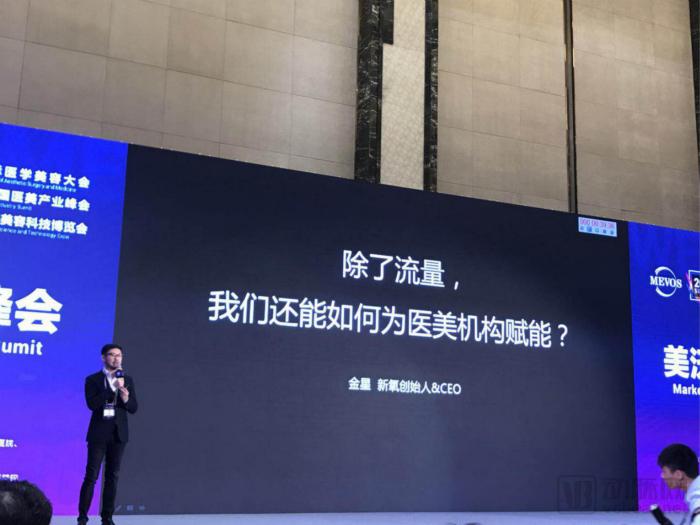
Jin Xing Delivers Speech Titled “Beyond Traffic: How Else Can We Empower Medical Aesthetics Clinics?” Image from SoYoung
In May 2018, the MedWorld International Medical Aesthetics Conference was held in Wuhan, attended by more than 7,000 professionals from the medical aesthetics industry. At the Operations and Management Summit, SoYoung CEO Jin Xing delivered a speech titled “Beyond Traffic: How Else Can We Empower Medical Aesthetics Institutions?”
The SoYoung app, a product under the SoYoung brand, is a world-leading medical aesthetics transaction platform, boasting 30 million users and 25,814 registered doctors. Additionally, SoYoung operates a new media matrix with an annual reach of 114 million impressions and hosts a medical aesthetics community featuring 3.5 million plastic surgery diaries, solidifying its position as the leading platform in this niche sector.
In recent years, the medical aesthetics industry has experienced rapid growth, with its market size continuously expanding. Platforms such as Dianping and Tmall have ventured into the medical aesthetics sector. In light of the entry of these industry giants, what are Venus Medtech’s strategic considerations? What core competencies does So-Young possess that make it difficult to replace?
The following is a summary of the key points from his speech, organized and shared by VCBeat (WeChat: vcbeat).
This is my fourth time attending MedWorld. I am delighted to have witnessed the development of MedWorld in recent years, as well as the explosive growth of China’s medical aesthetics industry. The topic of my presentation today is “Beyond Traffic: How Can We Empower Medical Aesthetics Institutions?”
SoYoung entered the medical aesthetics industry in 2013, and it has been over five years since then. I will first outline the changes in the operation of medical aesthetics institutions during these five years.
Five years ago, Baidu was the only online platform for operating medical aesthetic institutions. Today, however, the landscape has changed. In addition to Baidu, customer acquisition channels now include various medical aesthetic apps, Weibo, WeChat Official Accounts, WeChat Moments, short-video platforms such as Douyin (TikTok), Tmall Medical Aesthetics, JD.com’s Medical Aesthetics Hub, Toutiao, mini-programs, and Weidian stores.
New platforms continually emerge, the media landscape is in constant flux, and trends shift every year. Is this state of affairs truly reasonable?
The next question is: How can medical aesthetic institutions adapt to this current reality? It seems they have no choice but to do so. Over the past five years, the medical aesthetics industry has undergone significant changes, placing increasingly higher and more comprehensive demands on operational professionals. With a wider array of choices available, platform-based opportunities and sporadic opportunities have proliferated.
Many of you here may be owners or marketing professionals at medical aesthetics clinics. If you don’t take action, your boss will likely say, “Look, other clinics have posted videos on Douyin; their new media operations are running smoothly, and their WeChat stores and Moments campaigns are performing exceptionally well.” You’ll feel that not engaging in these efforts is simply not an option.
But how effective is it really? That remains questionable, as many platforms may not deliver such strong results.
My perspective is this: opportunities do exist, but they may not necessarily belong to you. Why do I say this? Suppose you are a recent college graduate seeking a path and direction for your future development. Those with a more traditional mindset might choose to join a company and strive relentlessly. A typical promotion trajectory might lead to becoming a manager in three years and a director in five; whether one can become a general manager within ten years is uncertain. However, if you are exceptionally talented and hardworking, it is possible to rise to the position of vice president. I refer to this asPlatform-based opportunities,Your returns are roughly proportional to your efforts. I believe this is what most of us refer to as opportunity.
But if you insist on entering the entertainment industry, saying, “I want to become an idol,” whether you succeed is not up to you. No matter how hard you try, success is not guaranteed. I refer to this type of opportunity asChance Occurrence。
In reality, success is a matter of probability. The pyramid is extremely steep, and the likelihood of reaching its apex may be as low as one in ten thousand, or even one in a million. Is such a slim chance truly an opportunity for you? If you are exceptionally gifted, you might consider giving it a try. However, for the vast majority of institutions, I would not recommend pursuing this path.
Has anyone analyzed Douyin’s algorithm? How can one align with Douyin’s algorithm to secure substantial traffic on the platform? To operate a platform effectively, you must have some understanding of its rules and algorithms.
Douyin’s algorithm is quite intriguing; it essentially operates on a horse-racing mechanism. Each day, perhaps one million users upload short videos to Douyin, and the platform randomly assigns each video to a small, average-sized traffic pool—for instance, granting each video an average of 1,000 impressions.
For content distribution, it is easy to cap impressions at 1,000. By evaluating comprehensive metrics such as likes, follows, comments, and shares from these initial 1,000 impressions across one million short videos, approximately 10,000 videos can be selected. Each of these 10,000 short videos is then allocated an additional 100,000 impressions on average.
From these 10,000 posts, further analyze the 100,000 impressions to identify those with the highest numbers of likes, follows, shares, and comments. Then, select the top 100 posts, which have undergone multiple rounds of validation and are guaranteed to have exceptionally high click-through rates.
These short videos are added to the recommendation pool. As high-quality recommended content accumulates daily, the pool grows increasingly large, and all users receive recommendations from this single, unified pool.
This recommendation pool has another characteristic: its content is not highly time-sensitive. Since it consists of non-time-critical material—such as humorous posts, scenic views, and attractive individuals—the decay rate is actually very slow. This leads to the accumulation of long-standing, dominant content within the pool, with some items garnering millions of likes.
On Douyin, you post a video that achieves explosive growth, attracting a large viewership. However, when you create your second video, you start from scratch once again, competing on equal footing with the one million other videos uploaded that day, with no carryover benefit from your previous success.
So, what do you think is the biggest difference between Douyin’s algorithm and Weibo’s? Weibo is structured around user followings, based on the premise that users have the long-term, sustained ability to contribute high-quality content. In contrast, Douyin defaults to promoting viral hit content, which no individual user can consistently produce over the long term.
Compared to Weibo and WeChat, Douyin is a far more cutthroat platform, where each content post constitutes an independent event.
If you establish a presence on Weibo and WeChat, even with just 50,000 or 100,000 followers, these followers constitute your digital assets. They will see any content you publish, and this asset base will continue to grow.
However, even if you create a viral video on Douyin that gains you followers, the reality is that most users primarily browse the “For You” feed and the “Nearby” tab, while rarely viewing content from accounts they follow. This reflects the platform’s core product design: every product has a primary form factor, which represents the key area where users spend the majority of their time.
Therefore, my personal take on platforms like this is that, first and foremost, traffic is uncontrollable. It fluctuates unpredictably; a single video may go viral, while a subsequent batch of videos fails to gain traction.
Second, traffic is non-directional. On a platform, a video might attract one million viewers, but the issue is that if you are based in Shijiazhuang, how many of those one million fans are actually located in Shijiazhuang? Possibly only a few thousand. Among these few thousand, half may be male (whereas males account for only one-tenth of aesthetic medicine consumers). After excluding the elderly and children, the remaining audience consists of women of appropriate age. As is well known, aesthetic medicine consumers represent only slightly over 1% of the general population. Therefore, even with high view counts, how significant can the conversion rate be? Consequently, the number of precise target users you can reach remains questionable.
Furthermore, its touchpoints are minimal and brief. Given the small size of mobile screens, capturing user attention requires featuring attractive individuals, which leaves limited space for brand visibility and exposure. With a duration of only 15 seconds, such formats are ill-suited for medical aesthetics, a sector involving high-stakes decisions that demand in-depth communication. What meaningful content can truly be conveyed in just 15 seconds? Consequently, this type of touchpoint fails to drive effective conversions for your business.
In my view, for the vast majority of organizations, if you are looking to pursue Douyin (TikTok) marketing, it would be more effective to identify top performers on the platform and seek collaboration with them, rather than having your in-house team handle it. The latter approach carries a somewhat unpredictable return on investment.
Content distribution platforms like Douyin prioritize content over creators, a model shared by all short-video and long-video platforms (such as Youku and iQiyi) as well as Toutiao; therefore, achieving success on these platforms offers a low cost-performance ratio.
I believe the core issue remains focus—identifying the most effective approach.
Society is evolving in the direction of specialized division of labor. Within a large industrial chain, segmentation will become increasingly refined in the future, with professional companies emerging to handle each vertical segment.
The core positioning of the aesthetic medicine institutions present is to focus on treatment and services. In terms of traffic acquisition and distribution, individual efforts are neither a strength nor efficient.
However, for SoYoung, as a platform hosting over 7,000 medical aesthetic institutions, we can achieve significantly higher efficiency in executing similar initiatives. Our partner institutions are spread across hundreds of cities, offering a comprehensive range of procedures. SoYoung’s short videos have accumulated 1.5 billion views across all major online platforms, ranking fourth among all entertainment programs nationwide. SoYoung’s official WeChat account ranks 23rd among the 20 million public accounts on WeChat, reaching over 100 million users annually.
When we identify new opportunities, we promptly assist medical institutions in capitalizing on them. We then cleanse the traffic, recognizing that web traffic and actual customers are distinct entities; much of the traffic may be invalid or low-quality. By tagging users, we gain insights into their interests in specific procedures, geographic location, spending capacity, and prior history of aesthetic medicine consumption. Following this profiling, we execute precise distribution, directing qualified leads to respective institutions.
If you conduct operations on platforms like SoYoung, your efficiency will be significantly higher because all the traffic you reach is highly targeted.
One of the three criteria for selecting a platform: Traffic quality outweighs traffic quantity.
For professionals in the medical aesthetics industry, the volume of traffic actually holds limited significance. Why?
To summarize a few key points. First, the traffic-driven mindset is only suitable for mass-market platforms, such as Pinduoduo and Taobao. These platforms require high volumes of traffic because they cater to mass-market demand. However, the medical aesthetics industry is a luxury business, with purchase frequencies and average transaction values both reaching tens of thousands of yuan, and customers typically making several purchases per year.
Mass-market business involves earning small margins from a large customer base, whereas the luxury goods business entails generating substantial profits from a limited clientele; their strategic approaches are fundamentally different.
In 2017, China’s medical aesthetics industry reached a new peak, with just over 10 million consumers spending in the entire year. On average, legitimate medical aesthetics institutions generated only slightly more than RMB 1 million in consumer spending per month. All platforms operating in the medical aesthetics sector are essentially striving to capture as large a share as possible of this pool of spenders.
Therefore, having hundreds of millions of monthly active users on certain platforms is actually of little value. For these platforms and the medical aesthetics sector in particular, what matters most is the ability to reach a precise target audience. Paradoxically, the larger the user base, the more difficult it becomes to identify and filter out these high-precision users.
Medical aesthetic institutions will have a tangible understanding of this: likely, more than half of your revenue is generated by the top 20% of customers with high average transaction values, while the remaining 80% of customers with lower average transaction values contribute less than half of your total turnover.
Two of the Three Criteria for Platform Selection: Scenario Trumps Traffic
Even with high-quality traffic, the importance of context is easily overlooked. For instance, have you ever seen a high-end restaurant selling luxury goods? It probably wouldn’t sell well. Although the target audience may be right, the setting is not.
What is a “scenario”? A scenario is the subconscious mindset that has been subtly shaped within you over time. In a given scenario, individuals feel an innate sense of what they ought to do. Only when people, products, and context are all properly aligned can effective transactions and conversions be achieved.
The healthcare industry differs significantly from other sectors. Consider the successful platforms in the healthcare space, such as Haodf, WeDoctor, So-Young, DXY, and Chunyu Doctors; tech giants like Baidu, Alibaba, and Tencent (BAT) have rarely participated directly. In contrast, in other industries, BAT’s involvement is commonplace. For instance, during the early era of web portals, every major portal featured channels for real estate, automobiles, digital products, and women’s interests. Similarly, tech giants have entered various other sectors, including travel and dining.
The general public recognizes that healthcare involves risks and requires specialized expertise. Therefore, the more professional a platform’s brand perception is in the minds of consumers, the more likely it is to succeed. Conversely, if you are a major platform—such as Tencent, which launched Tencent Health—consumers may acknowledge Tencent’s excellence in gaming and entertainment, but they will question whether Tencent can be equally formidable in the healthcare sector.
In fact, we have found that these major industry giants are also quite astute. Companies such as Haodf, WeDoctor, DXY, and So-Young have all received investment from Tencent. Tencent has recognized that the larger its master brand becomes, the greater the obstacles it may encounter when venturing into specialized, vertical sectors. Therefore, it is more advantageous for Tencent to adopt an investment strategy, positioning itself behind these professional healthcare platforms.
On one hand, there are specialized platforms in the healthcare sector, and consumers require professional guidance; on the other hand, it is also a matter of scenario-based positioning. SoYoung, Haodf, WeDoctor, and DXY have established themselves as specialized, domain-specific scenarios in the minds of consumers.
When a user opens SoYoung, she sees millions of cosmetic surgery diaries. She gets the impression that everyone is discussing cosmetic procedures, with a wide array of new treatment options and various live video streams. In this atmosphere, she comes to view cosmetic surgery as no big deal, or even as a trendy choice, and the bandwagon effect begins to influence her.
Three Criteria for Platform Selection (3): Retention Outweighs User Acquisition
All institutions present are engaged in marketing, with customer acquisition likely being the most critical issue on their minds each day. But do we truly lack traffic? Let’s do the math: if you have only five customers visiting your facility for services each day—a very small number—but maintain a 50% repurchase rate, and these customers spend on average once every three months, then after 15 months, you would already have 525 paying customers per month.
If you continue on this trajectory, within one to two years, the number of customers visiting your store each month will reach 1,000–2,000, generating annual revenue in excess of RMB 100 million.
Therefore, what is truly lacking is not customer acquisition. Most medical institutions can achieve five in-store customers per day. Your problem lies in the inability to retain users; constantly focusing on acquiring new customers creates a vicious cycle.
If your own products and services are not up to standard, merely acquiring new customers is futile. Therefore, SoYoung’s operational mechanism is designed to help institutions improve customer retention, as this is the essence of solving the problem.
Many people are teaching small institutions how to build physician IPs, which is a trendy term. But the reality is that most physicians cannot become IPs, just as most beautiful women cannot become internet celebrities.
The reality is that in most small and medium-sized institutions, physicians’ clinical expertise is not particularly high, nor do they possess distinctive strengths. The number of plastic surgeons in China is limited, and those who are truly exceptional are even fewer. The Chinese medical aesthetics market is characterized by both a substantial size and rapid growth. Therefore, the most critical factor is to identify a target patient population that you can serve effectively and achieve high levels of satisfaction among them.
This is neither consumption upgrading nor consumption downgrading; rather, it is precisely consumption stratification. The key lies in matching. While your physician’s technical skills may be average, there is a vast consumer market. Moreover, top-tier physicians command high fees. This highlights an advantage of the medical aesthetics sector: unlike fast-moving consumer goods (FMCG) such as Coca-Cola, which have virtually unlimited production capacity, even the most skilled surgeons can perform only 8 to 10 procedures per day at maximum. Their capacity is inherently limited.
In fact, there are still more than 10 million consumers of medical aesthetics in China each year, which leaves us ample room for survival.
So, how can small and medium-sized institutions survive in this competitive environment? I don’t think there’s anything particularly special about it; it’s justCompeting on Equipment, Efficiency, Cost, Service, and Marketing。
Regarding the choice of specific niche sectors, if your surgeon’s technical skills are not particularly strong, the field of energy-based devices represents a substantial market.The user base for photoelectric skin rejuvenation is significantly larger than that for surgical and injectable procedures., coupled with long user lifecycles and rapid growth in the incremental market, I believe there is significant market potential for medical devices. Competitiveness hinges on low-cost operations, competitive pricing, high-quality service, and cost-effective customer acquisition.
Current Status of China's Medical Aesthetics MarketThe probability of small and medium-sized institutions using the equipment is very low., because first, high-quality equipment is very expensive, with prices ranging from 500,000 to 1 million yuan, or even higher.
Several major equipment manufacturers in China generate annual domestic sales of only RMB 100–300 million. In fact, given the total of nearly 10,000 medical aesthetic institutions nationwide, they likely sell only a few hundred devices per year in China, with the majority of these devices being purchased by medium- to large-sized medical aesthetic institutions.
How can small and medium-sized medical aesthetic institutions acquire equipment to improve efficiency? In this regard, I believe that likeEquipment Rental Platform, and the project company is a good choice:
First, it can significantly reduce the acquisition cost of equipment;
Second, it offers greater flexibility. Healthcare institutions often worry about the risks of purchasing expensive equipment—what if the device fails to gain traction? What if it becomes obsolete within six months to a year? The leasing model effectively addresses these concerns.
Third, it offers on-demand flexibility: clients can lease equipment for only the number of days required within a month. The project company can provide comprehensive services, including project design and packaging, operational support, and even assistance with seminar-based sales. In fact, an increasing number of small and medium-sized medical aesthetic institutions are adopting such models to expand their share of the energy-based device market.
However, this model also presents significant pain points. For instance, with simple equipment leasing, utilization rates are often low due to limited familiarity with the devices and a lack of qualified physicians to operate them. While project companies offer comprehensive solutions, they typically charge exorbitant revenue-sharing fees—often 50% or higher—leaving minimal profit for healthcare providers. Since these companies manage all aspects of operations, they retain the core competitive advantages; consequently, if they withdraw, providers are left with no lasting assets or capabilities.
Based on the aforementioned needs and pain points, So-Young has recently launched aNew Equipment Service Projects, it has several characteristics:
First, we assist you in project design, equipment provision, as well as marketing and maintenance. While numerous new devices are launched annually, not all achieve widespread popularity. As an e-commerce platform, we leverage big data to analyze device trends, and to conduct targeted marketing and promotion.
Second, the model is highly flexible. For instance, for a hot-light therapy device valued at RMB 300,000, institutions need only pay a deposit of RMB 30,000 to take possession of the equipment. Subsequent charges are based on usage volume, offering greater flexibility compared to traditional daily or monthly rental models. If patient volume is lower, the incurred costs will be correspondingly reduced.
In short, So-Young is essentially a platform that empowers medical aesthetic institutions in every aspect. For us, driving patient traffic to these institutions is only one part of our function; we also provide them with tools for profitability, training, co-advertising campaigns, events, and a comprehensive aesthetics system.