

Yue Mei's Teresa Xiang: Three Key Insights from Over a Year of Operating an Offline Aesthetic Medicine Clinic
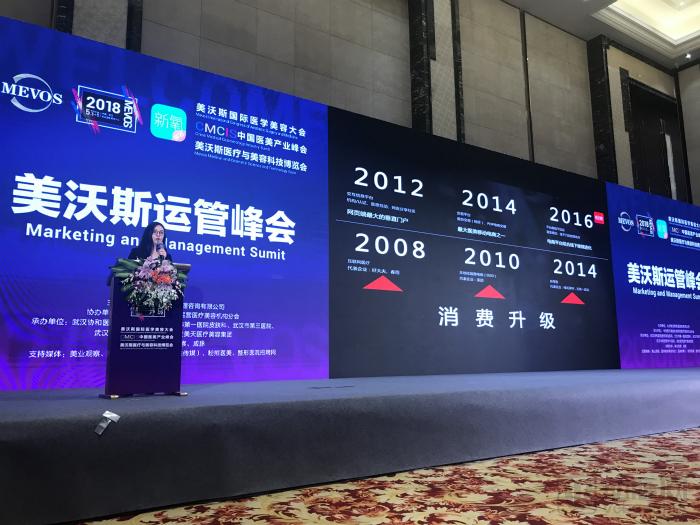
Xiang Xiaoqin, Founder and CEO of Yuemei, Delivers a Speech on the Growth Path of Internet-Based Medical Aesthetics Enterprises (Image courtesy of Yuemei)
On May 5, 2018, Xiang Xiaoqin, founder and CEO of Yuemei, delivered an insightful presentation titled “Insight into Trends, Cognitive Iteration: The Growth Path for Internet-Based Medical Aesthetics Enterprises” at the Meivos International Medical Aesthetics Conference. VCBeat (WeChat ID: vcbeat) has compiled and shared the content.
Yuemei Introduction
Launched in 2012, Yuemei has amassed over 23 million activated users after six years of development. The platform collaborates with more than 6,678 medical institutions, hosts over 10,000 registered plastic surgeons—75% of whom offer their own service SKUs—and features 3.2 million user-generated community posts, achieving an annual transaction volume amounting to hundreds of millions of RMB.
To create a smoother and higher-quality user experience, Yuemei has built an integrated online-to-offline closed-loop ecosystem. In 2016, it began establishing and operating its own offline medical aesthetic outpatient clinics under the brand “Yuemei Haoyi.” The clinic features four departments, including anesthesiology, and has implemented a novel model distinct from traditional hospitals in areas such as patient acquisition, physician sharing, and departmental operations. This approach has achieved considerable growth momentum, with the practical insights gained feeding back into the enhancement of its online platform.
In the future, we will further solidify a new business model for medical aesthetics that integrates online and offline services, aiming to become a medical aesthetics group renowned for its quality, reputation, and scale. The company has completed its Series C financing round, with investors including Ceyuan Ventures, SAIF Partners, and Han Energy Capital. The Series D financing round is expected to be completed in the near term.
As one of the few platform-based enterprises in the current medical aesthetics industry, I am here today to share our entrepreneurial insights from the past few years and to offer a perspective on viewing the industry as well as specific medical aesthetics marketing strategies.
Let’s briefly outline YueMei’s background. As the earliest internet-based team to enter the medical aesthetics industry, YueMei launched in 2012 and has undergone three developmental stages along with several shifts in its business model:Information Portals, Trading Platforms, and the Phase of Integrating Online and Offline Operations。
First, as an information platform, we established ourselves as a vertical portal within the industry. Meanwhile, we were the first to implement institution and physician verification, doctor-patient Q&A services, and a user-sharing community, thereby filling the gap left by Haodf Online at the time, which did not cover physicians in private institutions or engage in the field of plastic surgery. Today, these features have long become standard offerings for platform-based enterprises.
We later discovered that the essence of this industry is transactional. Online users are not here to discuss hobbies and interests; they want to know where to undergo cosmetic procedures and which doctors to choose. Institutions seek actual customers, not mere brand exposure. Therefore, YueMei began facilitating matched transactions, commonly known as patient referrals.
At the end of 2014, we optimized this transaction model and developed a mobile e-commerce product—Tao Zhengxing—and gradually iterated it into the medical aesthetics e-commerce platform you see today.
The third phase is characterized by the coexistence of online and offline operations. In the second half of 2015, we attempted to collaborate with physicians at public hospitals, aiming to create a “Public Hospital Expert Services” product as a supplement to our platform’s offerings, which subsequently motivated us to establish an offline physical entity. Ultimately, in 2016, after nine months of development, we independently established a medical aesthetics outpatient clinic named Yuemei Haoyi.
Currently, Yuemei is one of the few remaining internet platforms in the medical aesthetics industry, having secured three rounds of financing, with its Series D round expected to be completed in the coming months.
Over the past decade, the internet sector, including the medical aesthetics industry, has undergone rapid and profound changes. Companies operating within this landscape have faced numerous challenges, with platform-based internet companies being among the highest-risk categories. Today, Yuemei is far from being considered a success; it has merely achieved some阶段性 results at this stage.
Over the past few years, my greatest insight from operating Yuemei is that what enterprises face most during their development is uncertainty; the only constant is change. What determines how far a company can go and the quality of its ultimate outcome lies in its grasp of macro trends. Its strategic rhythm must align with the pulse of the times, while refusing to impose self-limiting boundaries, thereby seizing opportunities through diligent effort.
How to understand this passage?
Looking back at the development stages of Yuemei, each corresponds to a wave in the internet era, with the medical aesthetics sector being the last to be impacted by these waves.
In 2006, Haodafu went online, marking the beginning of internet transformation in the healthcare industry, which had long suffered from severe information asymmetry. In 2010, Meituan was founded, initiating the e-commerce transformation of non-standardized service industries. In 2014, Alibaba began its offline expansion, and in 2016, it officially introduced the concept of “New Retail.” Many internet companies have since ventured into offline operations, leading to more diversified business models and scenarios in the consumer sector. The boundary between online and offline is becoming increasingly blurred.
Underlying these trends is the most significant shift: the advent of consumption upgrading. Generational changes among consumers have profoundly influenced the industry’s business models. The rise of post-90s and even post-00s consumers has brought about substantial changes in this generation’s demand for information transparency, pursuit of cost-effectiveness, and patterns of word-of-mouth dissemination.
Consumption upgrading has been made possible not only by changes on the demand side, but also by adequate preparation on the supply side: the relaxation of policies allowing physicians to practice at multiple institutions has increased the supply of effective medical resources, while minimally invasive cosmetic techniques have become more widely adopted.
Identifying these trends makes it imperative to iterate on one’s business model. For instance, in the traditional patient referral model, we believe that sales still rely heavily on information asymmetry. Moreover, the distribution of sales leads is overly influenced by human factors, resulting in inefficiency, and the product form fails to meet the demands of the mobile era. Therefore, we have proactively transitioned to an e-commerce transaction model.
The day before yesterday, a journalist came to interview me and asked, “Customer acquisition in the medical aesthetics industry comes from three sources: media, KOLs, and personal referrals. What exactly is the impact of your app on marketing?” Aren’t media, KOLs, and personal referrals (word-of-mouth) precisely the types of information that apps effectively integrate? In fact, our app’s capabilities have already far exceeded these categories.
I understand that medical aesthetic institutions treat medical aesthetic apps as traffic-acquisition tools, which is why these apps are consistently featured in the “Operations Sub-venue.” This is my personal perspective on the value of medical aesthetic apps.
I. Connecting People and Information
Medical aesthetics is aDecision-Heavy Consumption, its consumption decisions require a vast amount of information, such as the institution, physician, specific procedure, price, reputation, and reviews. How is this information organized within the app? In medical aesthetics apps, when a user posts a diary entry, it is first categorized and linked to a specific procedure (e.g., thread lift for facial rejuvenation) and a corresponding SKU. Through this SKU, the entry is associated with a particular hospital, a specific physician, other procedures offered by that hospital, and other consumers who have undergone similar procedures.
This information is organized in a structured and systematic manner, enabling users to quickly locate the desired content with high efficiency and an excellent user experience. Such content exists across the internet, including various forums, Tieba, Weibo, and WeChat Moments; however, it is isolated and fragmented, requiring users to spend considerably more time conducting their research.
Medical aesthetics apps not only systematically reorganize and store content, but also guide users to continuously generate content. Over the years, as the depth of accumulated content has increased, these platforms have become the most convenient source of information for medical aesthetics users. This content depth has also created a competitive moat for vertical app products, offering a better user experience than search engines. As a result, in the mobile era, medical aesthetics apps have, to some extent, replaced search engines as the new entry point for individuals seeking cosmetic procedures.
Of course, the presentation of information today has become highly diversified. In the past, Q&A sessions and text-and-image content were sufficient to meet user needs. Now, we are continuously producing new content formats—such as videos, live streams, key opinion leaders (KOLs), and self-produced programs—to attract users and further satisfy their demands.
II. Connecting People and Services
Previously, e-commerce only connected people with products. The emergence of group-buying platforms enabled connections between people and lifestyle services. Later, Didi facilitated connections between people and transportation services, while medical aesthetics apps can connect people with medical services.
Medical aesthetics apps enable consumers to directly select a medically oriented service product online, place an order and complete payment, and then receive the service at the clinic, thereby connecting individuals with services.
In connecting patients with healthcare services, two aspects are worth noting: one is price certainty. Certainty brings a sense of security, especially when it comes to pricing.
Price certainty is a prerequisite for user experience. It is hard to imagine a consumer industry in which users do not know how much medical aesthetic services cost. How large can such an industry grow? What proportion of GDP would it account for? For industries related to clothing, food, housing, and transportation—such as homes, cars, clothes, dining, and ride-hailing—users generally have a rough idea of prices.
Let’s take another example: How much does it cost to play golf for a year? How much does it cost to be a diving enthusiast annually? Does anyone here know? Therefore, although these two fields are high-end, they are very niche and their contribution to GDP is negligible. It is difficult for the entire industry to scale up, as price transparency and certainty are prerequisites for scalability.
The medical aesthetics industry previously faced a similar situation. In Beijing, with a population of 22 million, how many people clearly know the approximate cost of a single botulinum toxin injection for facial slimming? Before the emergence of medical aesthetics apps, pricing for medical aesthetic services was not available online. Instead, information asymmetry served as a key marketing strategy within the industry. However, this also constrained industry development and gave rise to numerous gray areas. The resulting uncertainty fostered insecurity, leading many people to hold negative perceptions of medical aesthetics and view the sector as excessively profitable. This uncertainty, in turn, suppressed consumer demand.
After several years of development, the e-commerce platforms of medical aesthetics apps have covered over 300 cities, partnered with 6,000–7,000 institutions, and offered 50,000 SKUs. This has significantly advanced price transparency in the industry and greatly enhanced user experience.
Thus, in recent years, medical aesthetics apps have helped many novice users—those who aspire to beauty but have no prior knowledge of medical aesthetics, are price-sensitive, and harbor concerns about safety—by guiding them into aesthetic clinics and driving incremental growth for the industry.
Furthermore, service connectivity is achieved by empowering merchants through the platform. By leveraging systematic and data-driven products, the platform helps institutions generate content, acquire users, and build online reputation, which in turn drives the improvement of offline services.
Over the past six months, we have launched a series of new product features for institutions, significantly improving customer acquisition efficiency for merchants. These enhancements include our fully self-developed private messaging system—a critical communication tool—a comprehensive data analytics dashboard in the merchant backend, and marketing tools such as group-buying campaigns and red packets. We remain committed to further enhancing merchants’ customer acquisition efficiency.
III. Connecting People to People
We recognize that medical aesthetic services are characterized by their unique nature: low purchase frequency, high price points, and significant decision-making complexity. Consequently, consumers prioritize multiple factors, including safety, efficacy, and cost.
Merely providing users with content and service pricing is insufficient, as purchase conversion rates remain low. Therefore, in the medical aesthetics industry, fostering human-to-human connections is particularly crucial, with the personalized consultation and empathetic engagement provided by individuals being even more vital.
For users, another significant value of medical aesthetics apps is the ability to communicate with any medical aesthetics consultant or doctor across China using a single account. Here, I would like to emphasize the connection between consumers and doctors.
As many are aware, a popular concept in the current fashion e-commerce landscape is “same-style-as-factory-outlet.” When you shop on e-commerce platforms, they may inform you that a product’s supplier is the same one that manufactures for brands like Nike, Calvin Klein (CK), or Decathlon, offering comparable quality at a lower price.
Amid the trend of consumption upgrading, the pursuit of quality has extended to tracing product origins and upstream suppliers. In the past, consumers could simply pick any brand when buying a towel; today, high-quality towels highlight their use of Xinjiang long-staple cotton, prized for its abundant sunshine exposure.
By the same token, consumers may say, “I want to enjoy the same level of service as private hospitals, such as appointment scheduling and a comfortable environment, but I also want access to the same physicians available at public Grade 3A hospitals.” The current multi-site practice model for physicians makes this possible.
Physicians, originally positioned upstream in the value chain, have moved closer to consumers in pre-purchase decision-making due to the emergence of medical aesthetics apps. Previously, patients could only consult physicians in person at clinics; now, interactions are facilitated through various online channels such as Q&A sessions, video consultations, and live streaming, thereby enhancing the prominence of physicians’ personal brands.
With the liberalization of multi-site practice, the influence of physicians’ personal brands has strengthened. As upstream providers, physicians—even independent of institutional brands—now engage directly with consumers. This trend is even more prevalent among physicians in public hospitals.
Since the second half of 2015, Yuemei has established a physician agent team to assist a group of influential physicians from public hospitals in Beijing with brand building and patient acquisition. Many of these physicians have achieved annual incomes exceeding one million yuan under our facilitation.
The connection between doctors and consumers has given rise to Yuemei’s offline institution—Yuemei Haoyi. Yuemei Haoyi is essentially a product of Yuemei’s integration of physician resources; with the establishment of this medical institution, the value of physicians can be fully realized, and the consumer journey can form a complete closed loop.
Over the past year-plus of operating Yuemei’s brick-and-mortar business, we have encountered numerous pitfalls and gradually accumulated valuable experience. In summary,Platform thinking and product thinking are two very different mindsets., over the past two days, some speakers have mentioned"Super User""This concept, I believe, captures the essence of brick-and-mortar operations."
A Brief Share of My Personal Thoughts on Offline Operations
Compared to online platforms, the top priority for offline operations isSupply Chain ManagementThe supply chain comprises both human and material elements. Among the human resources, physicians are one of the most critical components. How should healthcare organizations select physicians, manage their professional brands, and maintain the stability of medical teams? The three primary aspirations of physicians are reputation, financial compensation, and professional growth. Addressing and balancing these aspirations is central to effective strategic consideration.
Second is pricing. As I mentioned earlier, price certainty is crucial for users’ sense of security. This principle equally applies to in-hospital pricing systems. For rhinoplasty, should we adopt a complex pricing structure based on 10 anatomical subunits, or quote using three bundled service packages? How can we balance the drive for upselling with the need for price transparency and certainty?
Third, how can standardized clinical diagnosis and treatment be implemented, and how can the organizational structure of chain institutions be optimized? Yuemei Haoyi’s business model has not yet taken shape and remains under exploration. Nevertheless, it is worth noting that Yuemei has distilled replicable experience from its hospital operations, such as user data analytics, which are integrated into the platform’s merchant backend to better assist other institutions.
We have observed that, to date, Yuemei has successfully integrated the entire consumer journey in medical aesthetics, spanning more than ten online and offline touchpoints across a prolonged decision-making and consumption cycle with countless experience nodes. Within this process, there remain numerous unmet consumer needs, which will be the focus of our future efforts.
To conclude today’s sharing with one sentence: The evolution of business models is a process of continuously aligning with major trends and relentlessly pursuing the delivery of optimal value to consumers.