

Meinian Onehealth Plans RMB 388 Million Acquisition of Mega Genomics to Facilitate Its Reintegration into Listed Entity
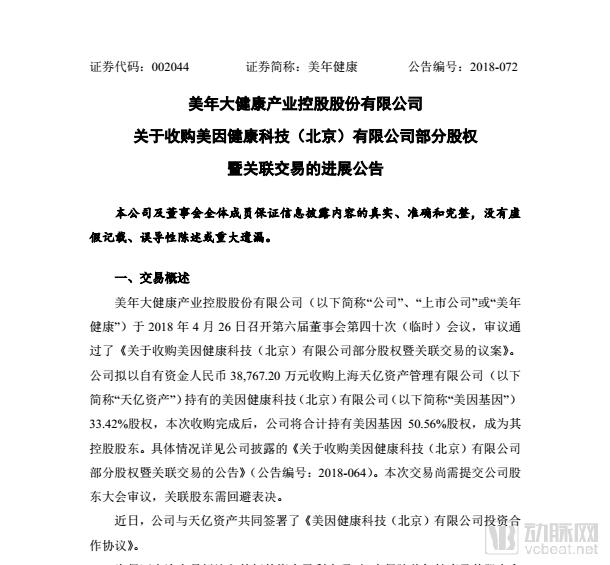
Recently, Meinian Onehealth Healthcare Holdings Co., Ltd. (hereinafter referred to as “Meinian Onehealth”) announced that it plans to use its own funds of RMB 387.672 million to acquire the 33.42% equity interest in Mei Yin Health Technology (Beijing) Co., Ltd. (hereinafter referred to as “Mei Yin Genomics”) held by Shanghai Tianyi Asset Management Co., Ltd. (hereinafter referred to as “Tianyi Asset”).
Upon completion of this transaction, Meinian Onehealth will hold a total of 50.56% equity interest in MeiYin Genomics, thereby becoming its controlling shareholder.
Founded in 2016, Meinian Gene is an integral member of the Meinian Onehealth ecosystem. While Meiwei Dental and Minsheng ENT specialize in their respective fields, and Zhang Zhongyi focuses on Traditional Chinese Medicine (TCM), Meinian Gene represents a key component of Meinian Onehealth’s strategic layout in genetic technology.
At the core of Meinian Gene’s business is population health genetic testing, which primarily includes fitness and wellness genetics, disease susceptibility testing (Meiyin An), early cancer screening, and personal whole-genome sequencing products. Unlike other consumer genetic testing companies, Meinian Gene enjoys inherent advantages by virtue of its affiliation with Meinian Onehealth Healthcare.
Currently, Meinian Onehealth operates approximately 300 centers nationwide, serving a total of around 15 million clients. The sheer volume of customers acquired through this single channel is already substantial, enabling Meiyin Gene to rapidly achieve nationwide coverage. Furthermore, Meiyin Gene has actively expanded its partnerships across multiple channels, including other health examination providers, health management platforms, and insurance institutions.
In terms of product strategy, Meinian Genetics has also opted to focus primarily on small gene panels. The majority of Meinian Genetics’ products are health risk assessment kits; with the exception of a few, most are designed for one-time use over an individual’s lifetime.
How to Generate High-Frequency Consumer Demand with Low-Frequency Products? They Chose to Fragment the Product.
Many disease-associated loci are distributed across the 23 pairs of chromosomes. At present, the cost of one-time whole-genome sequencing remains prohibitive for many individuals. However, fragmenting the whole-genome analysis into targeted tests for specific loci significantly reduces costs and offers users greater flexibility. This approach allows consumers to choose different products in subsequent tests after completing an initial assessment.
Following this model, the frequency of health risk monitoring can also align with that of physical examinations. With the support of traffic entry points and product design, MeiYin Genomics rapidly achieved break-even, and even profitability, within two years.
According to Meinian Gene, its sample size had reached 700,000 by 2017. Zhongrui Shilian projected that Meinian Gene’s net profits for 2018, 2019, and 2020 would be RMB 42.6273 million, RMB 88.6608 million, and RMB 123.3033 million, respectively.
Unlike other M&A transactions, this acquisition may have been planned since the very inception of Mayin Gene.
Shortly after its establishment, Meinian Gene reached agreements with seven investors and completed its first round of financing, raising RMB 167 million. Yu Rong, Chairman of Meinian Onehealth, became the company’s actual controlling shareholder through Tianyi Group, Meinian Onehealth, and personal holdings.
In other words, regardless of whether the acquisition takes place, Meinian Gene has always been part of Yu Rong’s strategic layout in the healthcare industry. The current move to bring it under the listed company is likely driven by Meinian Gene’s profitability and maturity.
According to Meinian Gene, its sample size had reached 700,000 by 2017. Zhongrui Shilian projected that Meinian Gene’s net profits for 2018, 2019, and 2020 would be RMB 42.6273 million, RMB 88.6608 million, and RMB 123.3033 million, respectively.
As a startup, Meinian Gene must inevitably go through the stages of pre-profitability, break-even, and finally profitability. For the listed company Meinian Onehealth Healthcare, acquiring Meinian Gene during its pre-profitable period will certainly have an impact on the listed company’s revenue.
The agreement further stipulates that if the actual net profit realized by Meinian Gene in each period during the profit compensation period falls short of the committed net profit for the corresponding period, Tianyi Assets shall compensate the Company for the net profit shortfall. However, the cumulative cash compensation payable by Tianyi Assets shall not exceed the total consideration for the target assets in this transaction, i.e., RMB 387.672 million.
In other words, Tianyi Assets not only completed the early-stage incubation of MeiYin Genetics, but also ensured the maximization of the listed company’s interests even after its acquisition.
Placing it under the unlisted company Tianyi Assets in the early stages, only to repurchase it into the listed entity once the company had matured, can only be described as “shrewd.” Furthermore, the Meinian Onehealth system includes numerous subsidiaries, such as Daxiang Medical and Haozhuo Data. It remains to be seen whether these other companies will be incorporated into the listed entity through similar maneuvers.