

If I Were the Hospital Dean: Feng Tang's Satirical Vision for Healthcare Reform
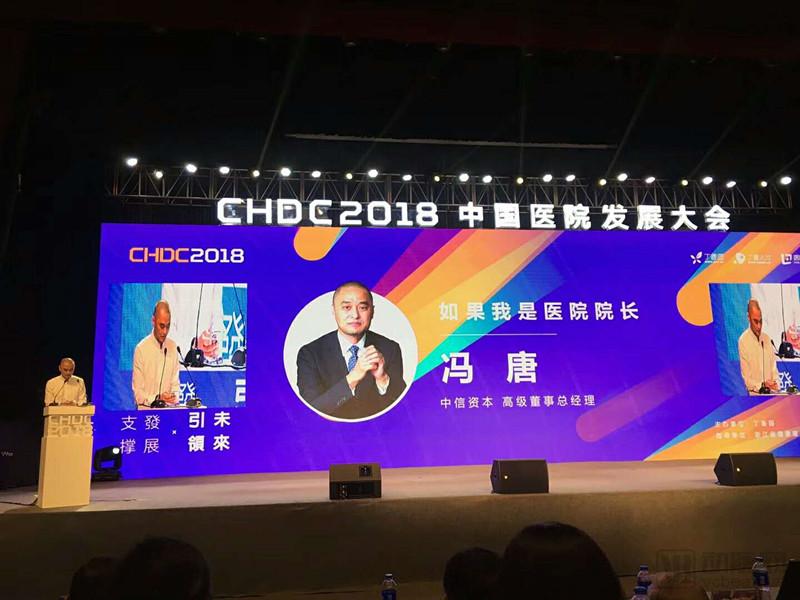
May 12 is a special day. It marks both the 10th anniversary of the Wenchuan Earthquake and International Nurses Day. On this day, DXY, as a connector in China’s healthcare sector, hosted the 2018 China Hospital Development Conference (CHDC) at the InterContinental Hangzhou Hotel. Closely aligned with the contemporary context, the conference centered on the theme “Talent Supports Development; Brand Leads the Future,” bringing together leaders and pioneers in the healthcare industry for discussion and exchange.
The participating guests included Victor R. Fuchs, Member of the U.S. National Academy of Sciences; Luo Jie, President of Taihe Hospital in Shiyan City, Hubei Province; Zhu Yaochuan, President of the Zhejiang Health Service Industry Promotion Association; Liao Xinbo, former Deputy Director of the Guangdong Provincial Department of Health; Bai Zhiqin, Vice President of the Chinese Hospital Association; and Feng Tang, Senior Managing Director and Head of Healthcare at CITIC Capital, who also holds an M.D., among other healthcare industry professionals.
VCBeat provided comprehensive coverage of the event. Among the guest speakers, Feng Tang’s presentation, “If I Were a Hospital Director,” stood out for its unique approach, employing irony to highlight some of the challenges currently facing hospitals in China.
Below is the full transcript of the speech:
In the medical community, there is a joke about human taxonomy: humans can be simply divided into three categories—women, men, and hospital directors.
If I were the hospital president, I would become a unique species and existence: I am an official yet not an official; I am an expert yet not an expert; I am a physician yet not a physician; I am a businessman yet not a businessman; I am an administrator yet not an administrator.
"If I were the hospital director, then I would be a 'slave owner.' In a sense, all doctors are my slaves, my means of production, and my personal wealth—at least during my tenure as director."
"If I were the hospital director, I would never grant physicians any autonomy. During my tenure, they must serve me exclusively within my domain. Any form of multi-site practice must be suppressed through various formal and informal means. Why should I encourage such freedom? All the benefits accrue to the physicians, while all the troubles fall on me. Since I derive no benefit whatsoever, why would I do it?"
If I were the hospital director, my doctors would have to work day and night, handling one hundred outpatient visits per day, with no rest and no holidays. All of this is for a noble purpose: the health of the people. This is a sacred cause, a great spiritual practice. Every doctor must be like Lei Feng; every doctor must make sacrifices—sacrificing their youth, then their entire lives, and even the future of their children and grandchildren. Only when doctors’ energy is completely exhausted will they lack the strength to realize they are being exploited.
“If I were the hospital director, I would certainly pay physicians the lowest possible salaries. This way, they would inevitably accept illicit payments and red envelopes. Strictly speaking, each of them would be a criminal. With leverage over all of them, I could take action against anyone who stepped out of line.”
"If I were the hospital director, I would inevitably devalue the lives of doctors. They live in a state of utter insecurity, where a single incident of medical violence can easily cost them their lives. They endure years of fear, lacking the courage to think about anything other than working for me."
"If I were the hospital director, I would ensure that the hospital does not generate a profit. Once the hospital becomes profitable, my financial subsidies may be reduced. I fully support the zero-markup policy for pharmaceuticals."
If I were the hospital director, I would certainly have close friends among several pharmaceutical manufacturers, distributors, medical device companies, and medical supply firms. I have known them for many years; they are all highly intelligent and reliable individuals. No matter how national policies change, they always find ways to safeguard my interests.
If I were the hospital director, I would do my utmost to take good care of various leaders. It seems that many leaders have authority over me; indeed, there are so many who ostensibly supervise me that, paradoxically, none truly exercises effective oversight. Having served as hospital director for an extended period, I recognize that leaders are also human beings with relatives and friends who may fall ill. Consequently, these leaders treat me with considerable courtesy.
"If I were the hospital director, I would spare no expense in constructing new buildings and adding beds, striving to expand the hospital’s scale as much as possible. If I built the largest hospital in the universe, I would become the greatest hospital director in the universe."
"If I were the hospital director, I would absolutely support retirement at age 65—ideally at 75 or even 85. With an average human lifespan of 120 years just around the corner, I aim to maximize my contributions to public health. This way, I can remain a slave driver for as long as possible, finding ever-greater satisfaction in the role."
The above text heavily employs a rhetorical device: irony.
I am not the hospital director. Even if I were, I would first and foremost be a human being, with an innate commitment to kindness, justice, and goodness. Even if I could act otherwise, I would not.
If I were truly the hospital director, I would genuinely prioritize patient well-being and satisfaction above all else. Throughout history, across time and cultures, healthcare has never been, nor should it ever be, a business driven solely by profit. Saving a life is an act of immense merit; alleviating or relieving the pain and suffering of others brings even greater blessings. I would urge physicians to regard medical quality and patient satisfaction as their primary metrics. Furthermore, I would institute a rule requiring doctors to ask every patient one final question before they leave: “Do you have any other questions for me?”
If I were truly the hospital director, I would prioritize physicians’ well-being and satisfaction above my own interests. Leveraging the hospital’s resources, I would strive to provide them with the clinical, teaching, and research environments essential for their professional growth. I would encourage multi-site practice and grant them as much autonomy as possible, enabling them to generate social wealth under controlled risk conditions and lead dignified lives—so they could afford to take their boyfriends or girlfriends to a popular movie, rather than being limited to stargazing.
If I were truly the hospital director, I would actively embrace management technologies by introducing well-established corporate management practices—such as performance management, financial management, marketing management, and operational process optimization—into the hospital setting. This approach would comprehensively enhance hospital efficiency without infringing on anyone’s vested interests.
If I were truly the hospital director, I would actively embrace internet technologies, artificial intelligence, and big data. Even within the current institutional framework, without infringing on anyone’s vested interests, these IT-related technologies could still enhance satisfaction among patients, physicians, and even social security agencies, thereby making the world a better place.
“If I were truly the hospital director, I would tirelessly promote and practice my medical vision within the scope of my capabilities: healthcare that is high-quality, service-oriented, and scalable, even in today’s China.”