

Feng Tang to Serve as Co-Chairman of Century Kangrui, Focusing on Healthcare Services Investment
On May 8, CITIC Capital and Shiji Kangrui held an equity investment signing ceremony in Beijing. Notably, Feng Tang will officially assume the role of Co-Chairman of Shiji Kangrui upon the completion of future project closings, providing strategic guidance at the macro level to support the hospital group’s faster and more robust development.
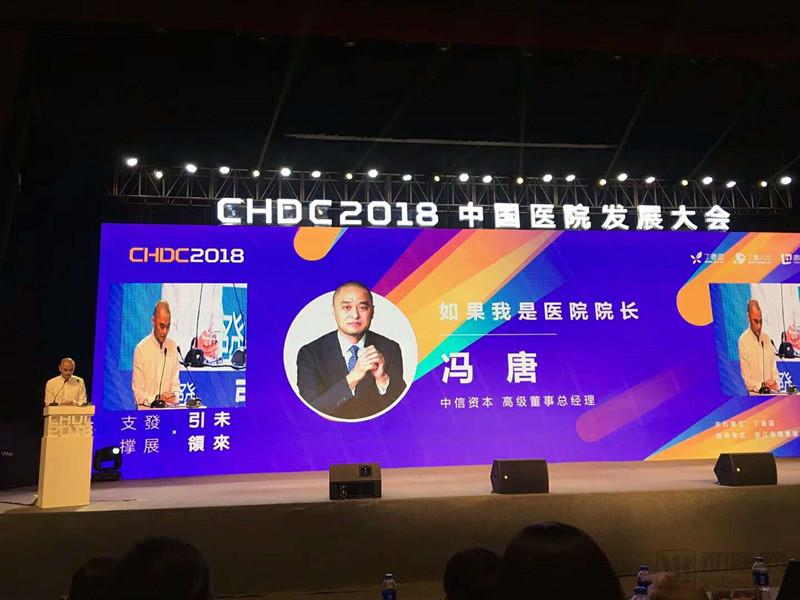
On May 12, at the 2018 China Hospital Development Conference (CHDC) held at the InterContinental Hangzhou, VCBeat interviewed Feng Tang, Senior Managing Director at CITIC Capital, to explore the story behind his investment in Shiji Kangrui and his future investment direction.
Feng Tang holds multiple identities, including poet, writer, physician, and businessman. Below is his resume:
Born in May 1971, he received his Doctor of Medicine (M.D.) degree in Clinical Medicine from Peking Union Medical College in 1998 and his Master of Business Administration (MBA) from the Goizueta Business School at Emory University in the United States in 2000.
1990–1998: Studied at Peking Union Medical College, earning a Doctor of Medicine (M.D.) in Clinical Medicine with a specialization in Gynecologic Oncology; holds a Master of Business Administration (MBA) from Goizueta Business School, Emory University, USA.
Formerly employed at McKinsey & Company, engaged in work historically referred to as that of a strategist, advisor, or private secretary; previously served as General Manager of the Strategy Management Department at China Resources Group.
July 2009 – May 2011: Deputy General Manager, Strategic Management Department, China Resources (Holdings) Co., Ltd.;
May 2011 – October 2011: General Manager, Strategic Management Department, China Resources (Holdings) Company Limited;
In October 2011, he was appointed as the CEO of China Resources Medical Group Co., Ltd.
October 2011–July 2014: Served as Chief Executive Officer of China Resources Medical Group;
On December 5, 2013, it was listed on the “2013 Eighth China Writers’ Rich List”;
In July 2014, Zhang Haipeng stepped down as CEO of China Resources Medical Group and General Manager of the Strategic Management Department of China Resources Group;
On September 1, 2015, the private equity (PE) division of CITIC Capital Holdings Limited announced in Hong Kong the appointment of veteran investor Zhang Haipeng as Senior Managing Director, overseeing healthcare investments.
Despite such a rich resume and extensive experience, he said, “I prefer the identity of a poet, although the Chinese poetry community does not really recognize it.”
Yet, the identity of a physician was one he could not escape; medicine carried a hint of fate from which he could not hide. Having never practiced as a clinician, he went to the United States to pursue an MBA after completing his eight-year medical program in 1998.
“At the time, I felt that the healthcare industry was beyond hope, but now I have faith in the country and the government, and I believe the healthcare sector will continue to improve.”
It is reported that following Feng Tang’s investment in Century Kangrui, CITIC Capital will fully leverage its substantial resource advantages to assist Century Kangrui in exploring additional sectors, including integrated medical and elderly care, the integration of healthcare and insurance, and “Internet Plus” healthcare. These areas present significant growth potential for Century Kangrui. In addition, Feng Tang will serve as the Dean, providing support to Century Kangrui in the following four aspects.
1. Improve the hospital management system, hospitals are not only institutions for treating diseases and saving lives but also organizations that, to some extent, operate with a corporate nature. How can existing management techniques, such as HR and financial management, be leveraged to transform hospitals into groups with higher overall profitability and better efficiency? This is likely a critical issue currently facing hospitals, and it was also the focus he had been advancing during his tenure at Kunming Children's Hospital seven or eight years ago.
Second, enhance specialty-specific features., such as trauma, emergency care, and oncology departments. Currently, Shiji Kangrui has established certain foundational advantages; however, it needs to further strengthen these strengths to enhance its specialized characteristics.
3. Exploring the Integration of Healthcare and Elderly Care, particularly the care of the elderly in their final stages of life. By deeply integrating healthcare with insurance, breaking down data silos, and designing innovative health insurance products, this goal can be achieved. Currently, Shiji Kangrui has established a solid foundation. Founded in 2014, Beijing Shiji Kangrui Hospital Management Co., Ltd. is primarily engaged in the investment, construction, and operational management of medical institutions. As of 2017, Shiji Kangrui operated seven hospital campuses (one under construction), all located in Beijing, with a total of approximately 4,500 beds and a professional medical team comprising 3,000 members.
Fourth, actively explore collaborations with medium- and large-sized hospitals., such as in the areas of AI, big data, and mobile health. We aim to help more patients afford medical care, facilitate access to healthcare services, improve efficiency, and create greater value. We are actively exploring how to better meet the differentiated needs of certain patient groups, given that current processes in tertiary Grade A hospitals are relatively rigid.
“I am currently working with my team at CITIC to manage a healthcare-focused fund, with our primary investment focus being on healthcare services, such as clinics, general hospitals, and specialized hospitals,” said Feng Tang.
Regarding Century Kangrui Hospital, Feng Tang offered this assessment: “It is a comprehensive private hospital with strong specialized features.”
The current investment projects mainly consist of three parts,The first part consists of projects like Century Kangrui Hospital, accounting for approximately 50% to 60%.;Part II: Precision Medicine, focusing primarily on genetic diagnostics and genetic data, including related medical equipment or innovative medical devices. Examples include instruments for joints, ligaments, or other precision devices, while largely avoiding large-scale medical equipment such as imaging systems.
The third part focuses on healthcare big data, mobile health, or AI, with an emphasis on big data-driven innovations in medicine, representing the general business direction.However, its proportion is relatively smaller compared to other sectors.
Take Shiji Kangrui as an example; Feng Tang believes that private hospitals serve as a valuable complement to public hospitals.Although public hospitals will remain the dominant force in the foreseeable future, accounting for the vast majority of both bed capacity and volume of complex surgeries, there is still significant room for differentiated consumer demand in healthcare from a market perspective. The overarching development direction of public hospitals will continue to prioritize their public nature, ensuring that the basic healthcare needs of the entire population are met.
Therefore, Feng Tang believes that private hospitals should serve as a complement to public hospitals, particularly tertiary Grade A hospitals, by offering new therapies, innovative diagnostic and treatment approaches, as well as differentiated services and enhanced efficiency.