

Allergan Reports $3.7 Billion Revenue in Q1 2018, Plans Major Expansion into China Market
Allergan, headquartered in Dublin, Ireland, is an ambitious global pharmaceutical company and a leader in the global medical aesthetics and growth-oriented pharmaceutical business model.
According to the Q1 financial report, Allergan’s revenue in the first quarter of 2018 increased by 2.8% year-over-year to reach $3.7 billion, demonstrating impressive performance. Having evolved from a company primarily focused on ophthalmic products into a leading pharmaceutical enterprise in the medical aesthetics sector, Allergan has established three core business segments: U.S. Specialty Pharmaceuticals, U.S. Generics, and International Operations. What drives Allergan’s sustained strong growth? To address this question, VCBeat (WeChat ID: vcbeat) has reviewed Allergan’s M&A history, provided an overview of its business operations, and analyzed the challenges it faces in the medical aesthetics field going forward.
Allergan was founded by pharmacist Gavin S. Herbert in 1948 and now employs 17,000 people in nearly 100 countries worldwide.
Allergan is dedicated to developing, manufacturing, and marketing branded pharmaceuticals, devices, biologics, and surgical and regenerative medicine products for patients worldwide. Its products are widely used in the treatment of conditions affecting the central nervous system, eye care, medical aesthetics and dermatology, gastroenterology, women’s health, urology, and infectious diseases.
Herbert, together with chemist Stanley Bly, invented the company’s first product in Los Angeles: an anti-allergy nasal spray containing antihistamines, which they named Allergan. Allergan subsequently launched eye drop products, formally entering the eye care sector, andIts primary business remained eye care products until its initial public offering in 1970.。
In 1980, Allergan merged with the pharmaceutical company SmithKline Beckman. Around 1989, the FDA approved botulinum toxin type A (Botox) for the treatment of amblyopia, and Allergan acquired the company that manufactured this novel drug.
In the 1990s, ophthalmologist Jean Carruthers inadvertently discovered that while using Botox to treat patients with eye strain,The patient's wrinkles also disappeared.. After the physician published his findings, dermatologists began to pay close attention to this off-label use of Botox.
In 1997, Botox became so popular that it was in short supply across the entire United States, causing panic among patients who used the drug monthly to reduce wrinkles. It was not until 2002 that its use forBotox for cosmetic use has just received official FDA approval.In the second quarter of 2015, Botox sales reached $632 million, nearly $200 million higher than Pfizer’s Viagra sales in the same quarter.
By the mid-2010s, Allergan had expanded into treatments for eye care, medical aesthetics (breast implants, dermal fillers, and botulinum toxin for wrinkle reduction), neuroscience, and obesity.
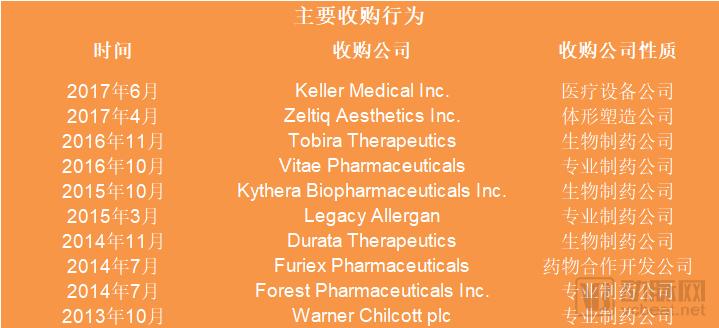
In 2014, Valeant’s CEO Michael Pearson sought to acquire Allergan, aiming to turn it into a cash cow. Subsequently, Actavis, a pharmaceutical company specializing in generic and over-the-counter products, acquired Allergan in a deal valued at $66 billion in cash and stock.
In March 2015, Actavis CEO Brent Saunders announced the completion of the transaction with Allergan and became the CEO of Allergan. In July 2015, Allergan agreed to be acquired by Israel’s Teva Pharmaceutical Industries for $40.5 billion.Sale of its generic drug business. This has allowed Allergan to devote more resources to areas such as eye care, aesthetics, gastroenterology, and women’s health.
Allergan has restructured its business in recent years, dividing it into three segments: U.S. Specialty Pharmaceuticals, U.S. Generics, and International Operations. Currently, 80% of the company’s revenue comes from the U.S. market,20% from overseas markets. According to reports,2017 China Market'sRevenue was approximately $180 million,PlaceWe will vigorously expand our business in China and seek potential M&A opportunities.
U.S. Specialty Drugs
Allergan’s U.S. specialty pharmaceuticals business encompasses the company’s operations in the United States related to eye care, medical aesthetics, medical dermatology, neuroscience, and urology products.
As its most significant business segment, ophthalmology accounts for nearly half (47%) of Allergan’s global operations. Allergan’s global ophthalmology portfolio features a comprehensive range of products covering the treatment of glaucoma, dry eye disease, and ocular surface inflammation. Furthermore, the company is actively conducting research into therapies for ocular conditions such as macular edema, diabetic retinopathy, and age-related macular degeneration, thereby providing eye care professionals and patients with cutting-edge solutions for ophthalmic diseases.
The ophthalmic care products under this business segment include Restasis, Alphagan/Combigan, Lumigan/Ganfort, Ozurdex, and other products. Revenue from ophthalmic care products decreased to $491 million in the first quarter of 2018, representing an 11.2% decline from $553.1 million in the first quarter of 2017.
Medical aesthetics in the U.S. business segment includes products related to facial aesthetics, plastic surgery, regenerative medicine, body contouring, and skincare. Revenue from the U.S. medical aesthetics business increased to $635.6 million in the first quarter of 2018, compared with $491.0 million in the first quarter of 2017.
Allergan’s medical aesthetics product portfolio includes BOTOX® Cosmetic, the JUVÉDERM® dermal filler collection, Latisse® eyelash growth solution, and medical-grade skincare products. BOTOX® has accumulated 20 years of clinical use and trial experience. According to Allergan’s data, it holds approximately 80% of the global market share and has established a comprehensive set of clinical technical training standards. Furthermore, Allergan’s data indicates thatThe Juvéderm® dermal filler series also ranks first in global market share.。
of this branchFacial aesthetics products generated $327.7 million in revenue in the first quarter of 2018, compared to $318.7 million in the first quarter of 2017. Strong performance by Botox and Juvederm products drove this growth and partially offset lower sales of deoxycholic acid in the first quarter of 2018.
InThe Field of Breast Reconstruction and Aesthetic Surgery, Allergan’s Natrelle® and McGhan® brands of breast implants offer the most extensive range of silicone implant models currently available. According to Allergan’s data,Allergan holds a 43% share of the global breast implant market., backed by 25 years of quality credibility since its market listing.
Regenerative medicine products, including Alloderm, Strattice, and other offerings, generated $128.2 million in revenue in the first quarter of 2018. The Aesthetics franchise, which includes breast implants, reported revenues of $60.7 million for the first quarter of 2018, an increase from $54.3 million during the same period in 2017. Revenue from body contouring products within this business segment amounted to $87.1 million in the first quarter of 2018.
Skincare products, including the Latisse brand, generated $31.9 million in revenue in the first quarter of 2018, a 23.3% year-over-year decline. Allergan’s Medical Dermatology franchise includes Aczone, Tazorac, and other advanced dermatological products. Revenue from Medical Dermatology fell to $54 million in the first quarter, driven by lower sales of Aczone and Tazorac.
In the first quarter of 2018, Allergan’s total U.S. specialty pharmaceutical business revenue grew by 6.5% to reach $1.6 billion, compared with $1.5 billion in the first quarter of 2017. This growth was driven by several new acquisitions and increased sales of its key brands. Allergan’s neuroscience and urology franchises generated $381.3 million in revenue in the first quarter of 2018, representing a 13.9% increase from $334.7 million in the first quarter of 2017.
US Generic Drugs
The U.S. generic drug business includes generic drugs related to the central nervous system, women's health, and gastroenterology, as well as anti-infective agents and diversified brands.
In the first quarter of 2018, U.S. generic drug revenues declined by 9.1% to $1.2 billion, down from $1.3 billion in the first quarter of 2017. This weak performance was driven by sales declines in central nervous system products, women’s health products, and diversified branded portfolio products.
Allergan’s anti-infective franchise generated $71.6 million in revenue in the first quarter of 2018, representing a 28.5% increase from $55.7 million in the same period last year. This growth was driven by strong sales of Dalvance, Avycaz, and Teflaro.
The Central Nervous System Franchise generated revenues of $262.8 million in the first quarter of 2018, a 15.0% decrease year-over-year. The decline in sales was driven by lower performance from Namenda XR, Saphris, and Viibryd/Fetzima, partially offset by strong sales of Vraylar.
In the first quarter of 2018, revenue from diversified brand franchise operations amounted to $274.9 million, representing an 8.1% year-over-year decline. The decrease in sales was attributed to lower revenues from Bystolic and Savella.
Gastrointestinal Products Franchise reported revenue of $388.7 million in the first quarter of 2018, a slight increase from $387 million in the same period last year. Strong sales of Linzess, Zenpap, and Viberzi drove revenue growth. However, this growth was largely offset by a significant decline in sales of Asacol/Delzicol and Carafate/Sulcrate.
The Women’s Health franchise generated revenues of $163.3 million in the first quarter of 2018, a decrease from $244.7 million in the first quarter of 2017. The decline in revenues was driven by lower sales of Minastrin 24 and Estrace Cream, partially offset by strong sales of Lo Loestrin and Liletta.
International Business
Allergan’s international business comprises the company’s sales operations outside the U.S. market. These operations include Botox therapeutic products, eye care products, medical aesthetics products, and other products.
Allergan entered the Chinese market in 2009, with its headquarters in Shanghai and offices in Beijing, Guangzhou, and Chengdu. Currently, the company has a localized professional team of approximately 400 employees, with business operations spanning 50 cities across 28 provinces in China. Allergan isProducts marketed in China span the fields of ophthalmology and medical aesthetics., and ophthalmic products sold in the Chinese market are mainly categorized into three types: glaucoma medications, artificial tears, and steroid hormones. Allergan has clearly identified 12 core non-U.S. markets, including Brazil, China, and Russia.
Allergan’s international business comprises revenues from its specialty therapeutics portfolio and generic pharmaceuticals portfolio outside the U.S. market. The company’s international revenue grew by 17.2% year over year, reaching $864 million in the first quarter of 2018, compared with $737 million in the first quarter of 2017.
The international eye care portfolio includes Alphagan, Combigan, and Lumigan for the treatment of glaucoma; Refresh and Restasis for the treatment of dry eye disease; and other products such as Acular LS, Acuvail, Elestat, and Pred Forte. Revenue from the eye care portfolio amounted to $343.7 million in the first quarter of 2018, up from $299.5 million in the first quarter of 2017. This growth was driven by strong sales of Lumigan/Ganfort, Ozurdex, and Alphagan/Combigan.
International medical aesthetic products include those related to plastic surgery, body contouring, facial aesthetics, regenerative medicine, and skincare. Revenue from international medical aesthetics reached $358.5 million in the first quarter of 2018, up from $288.1 million in the same period last year.
Allergan’s international facial aesthetics portfolio includes Juvederm, Kybella, Botox, Latisse, and other facial aesthetic products. Revenue from the international facial aesthetics portfolio amounted to $296.1 million in the first quarter of 2018, up from $245.9 million in the first quarter of the prior year.
The international plastic surgery product portfolio includes breast augmentation products, implants, and breast reconstruction products. Revenue from plastic surgery products in the first quarter of 2018 was $44.5 million, higher than the $38 million in the same period last year.
In the first quarter of 2018, revenue from international skincare products amounted to $3.8 million, compared with $2.2 million in the same period of the previous year. In the first quarter of 2018, revenue from internationally franchised body-shaping products reached $9.2 million, while revenue from regenerative medicine stood at $4.9 million. Within the international business segmentBotox, Asacol, and Constella generated $149.7 million in revenue in the first quarter of 2018., representing an increase from $133.9 million in the first quarter of 2017.
On April 30, Allergan announced a 2.8% year-over-year increase in its first-quarter 2018 revenue, totaling $3.7 billion, compared with $3.6 billion in the first quarter of 2017. Allergan exceeded Wall Street analysts’ estimates for both earnings per share (EPS) and total revenue. The company reported EPS of $3.74 and total revenue of $3.7 billion, whereas analysts had projected Q1 revenue of $3.6 billion and EPS of $3.36.
In the first quarter of 2018, the company’s revenue growth was strongly driven by its U.S. specialty pharmaceuticals and international operations, while its U.S. generic drugs performed poorly.
of the turnoverGrowth was primarily driven by the strong performance of medical aesthetics.as well as the contribution from neuroscience and urology products within the U.S. specialty pharmaceutical portfolio. Gastrointestinal and anti-infective products in the U.S. generic pharmaceutical portfolio also contributed to this growth, along with eye care, medical aesthetics, and botulinum toxin therapy products from international markets.
However, Allergan’s stock price fell 39.5% over the past 12 months and has declined 9.8% so far in 2018. Analyst estimates suggest the stock is poised to rebound by approximately 40.5% over the next 12 months.
In just two years, Allergan has gone from being a lucrative acquisition target for pharmaceutical giant Pfizer to facing intense market competition. In its Q1 2018 earnings report, Allergan stated that it was undergoing an “urgent” strategic review but also maintained that a complete overhaul was unnecessary. However, the reality may prove otherwise.
Allergan’s stock price decline was largely driven by intense market competition for its dry eye disease drug Restasis, in which the company’s management left much to be desired. Although Allergan’s new drug development pipeline held promise for boosting its stock price, the actual outcomes fell short of expectations. Moreover,Potential competitors to Allergan’s flagship product, Botox, are on the rise.
Allergan had the opportunity to maintain its growth trajectory. Brent Saunders, the company’s CEO, sold its legacy generic drug business to Teva Pharmaceutical Industries Ltd. for $40 billion, a move that significantly benefited Allergan as the generics market began to collapse. However, a portion of the corporate proceeds was allocated to mergers and acquisitions, with only a small fraction invested in Allergan’s unstable pharmaceutical division.
The $639 million spent to acquire Vitae Pharmaceuticals was not only the largest pharma-centric deal but also a significant expenditure for Allergan. Since its transaction with Teva Pharmaceutical, the company has spent $17 billion on share buybacks.
Allergan has yet to demonstrate the viability of simultaneously maintaining its Botox, CoolSculpting, and biopharmaceutical businesses. Meanwhile, the company has also failed to prove to external stakeholders whether its strategy of focusing on acquiring drugs developed by other companies, rather than inventing its own, is truly correct.
In March this year, Saunders stated at the Barclays Healthcare Conference that the company is creating value for every available option in a completely new way. He also mentioned that the company’s strategic choices can be divided into five major categories: stock buybacks, asset divestitures, corporate spin-offs, acquisitions or mergers, and continuing to operate the company under its current configuration. Among these, the company will de-emphasize its stock buyback and acquisition strategies. Secondly, adhering to the existing model, selling assets, or pursuing corporate spin-offs will become the primary principles.
However, Saunders appears to be signaling that what he truly seeks is more time to prove the validity of his strategy. For Allergan, sticking with the current model could prove highly challenging. In the coming year, the company may face intense competition in its generic drug business, along with declining or sluggish sales growth.
Saunders also stated on the earnings call that the companyWe will focus on business development in five key verticals: medical aesthetics, ophthalmic care, the central nervous system, and gastroenterology.. Although Allergan places great value on its women’s health and anti-infective businesses, these are not its strategic priorities.
In April this year, media reports stated that Allergan was considering selling its women’s health business, which includes the vaginal product Estrace cream, the contraceptive Lo Loestrin Fe, and the eyelash growth serum Latisse.
Allergan’s recent M&A activities include the acquisition of Elastagen Pty. Ltd., a company developing injectable aesthetic products, in a deal valued at $260 million.
On May 7, a female spokesperson for Allergan Plc stated that the company was planning to launch its first advertising campaign targeted at men, aiming to promote its renowned wrinkle-reducing drug, Botox, to male consumers, with television commercials to be aired simultaneously. However, to date, this injectable dermatological treatment’sThe primary audience remains women.。
Furthermore, to strengthen its brand, Allergan is establishing a U.S. healthcare institution forTraining tens of thousands of healthcare professionals in Botox injection. Allergan is also expanding its consumer loyalty program, which already has more than 3.6 million users. Bill Meury, the company’s Chief Commercial Officer, stated during a conference call with analysts that while these initiatives will take several years to complete, they will provide the company with a significant competitive advantage.
Allergan’s flagship drug is facing increasingly fierce competition. Earlier this year, Mylan NV announced a partnership with Revance Therapeutics Inc. to develop a wrinkle-reducing drug that mimics Botox. Revance also released data on an experimental drug, with study results suggesting that its effects may last longer than those of Botox. As a result, analysts have begun to express concerns about the future of Botox.
With sales showing a decline, Credit Suisse analyst Vamil Divan stated in a report to investors, “Concerns about the long-term stability of the Botox franchise persist amid intensifying competition.”
In this regard, Allergan stated that the company has been addressing competition facing Botox for many years. CEO Brent Saunders said, “Claims that additional competitors will enter the market are overly exaggerated. This is not the first time we have heard such rumors, nor will it be the last.”
Note: All information involving stock prices and other data in the text is as of May 7.
References:
http://www.businessinsider.com/allergan-history-since-1948-founding-2015-11
https://marketrealist.com/2018/05/how-analysts-view-allergan-after-its-1q18-earnings
http://allergan.cn/Home
https://www.bloomberg.com/news/articles/2018-04-30/allergan-bets-on-botox-ad-campaign-this-time-geared-for-men-too
https://www.thestreet.com/investing/stocks/allergan-expects-to-finish-strategic-review-shortly-14583753
https://www.bloomberg.com/gadfly/articles/2018-04-30/allergan-earnings-more-than-a-facelift-may-be-needed