

First Nanshan Summit – Global Forum on China's Strategy for Addressing Population Aging to Be Held in Hainan
On May 10, the Chinese Academy of Medical Sciences and Peking Union Medical College held a media briefing to announce that the “First Nanshan Summit: China Strategy Forum on Global Responses to Population Aging” will be held in Sanya, Hainan, from May 25 to 27. As the first international health and wellness forum hosted in Hainan since the Boao Forum for Asia, the Nanshan Summit aims to draw on international expertise from the field of geriatrics to explore Chinese solutions for addressing global population aging.
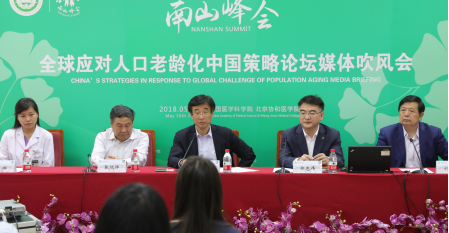
Media Briefing Session
Data released by the National Bureau of Statistics shows that by the end of 2014, China’s population aged 60 and above accounted for 15.5% of the total population, reaching 212 million. It is projected that by 2050, the global elderly population will reach 2.02 billion, with China’s elderly population reaching 480 million, accounting for nearly one-quarter of the world’s elderly population.
“In 2012, China’s elderly population accounted for 14% of the total population, while the aging rate in the United States was 17%. However, by 2030, the aging trends of the two countries will intersect. Thereafter, the aging process in the United States will enter a plateau phase, whereas China’s elderly population is projected to reach 30%,” stated Wang Chen, President of the Chinese Academy of Medical Sciences and Peking Union Medical College. He candidly noted that, in line with broader societal development patterns, population aging will pose a significant challenge in the future, but this does not mean that older adults are a burden.
“Regarding population aging, many view it as a burden, unaware that the greatest happiness in life is to live long and healthy lives. In old age, all past sufferings and experiences transform into personal cultivation, becoming a form of life experience and insight. However, if old age is not happy, even a lifelong hero will end up lonely and isolated.” Wang Chen believes that older adults are those who have accumulated the most wisdom and experience, and they are the group whose subjective and objective perspectives align best when contemplating issues. Therefore, they should be fully respected, and their wisdom should be leveraged. Older adults should become a sustaining force in society, actively promoting social development.
“To address this issue, China urgently needs a top-down discussion of the agenda, delving into the principles of medicine and health, as well as broader social development and national strategy, so as to drive the formulation and implementation of relevant policies, provide scientific guidance and social governance expertise, and thus make it ‘imperative to convene the Nanshan Summit.’”
For China’s aging population, characterized by “getting old before getting rich” and “aging before adequate preparation,” it is particularly crucial to provide wisdom for scientific guidance and management in response to population aging, in accordance with the laws of social development, management principles, and national planning.
“Proactive responses to population aging must begin in childhood.” Liu Yuanli, Dean of the School of Public Health at the Chinese Academy of Medical Sciences and Peking Union Medical College, believes that health in old age is closely linked to lifestyle habits established from an early age, and that cardiovascular issues in middle-aged adults can directly influence the onset of dementia. He advocates for greater emphasis on the integration of medical and elderly care services within communities: “Extensive international experience has demonstrated that establishing a robust community-based integrated medical and elderly care support system facilitates a proactive shift in addressing the challenges of population aging.”
Furthermore, attention should be paid to the value-oriented geriatric care model. As Academician Wang Chen stated, a life can only be considered complete when it features health and happiness in old age. However, according to Dr. Kang Lin, Associate Chief Physician of the Department of Geriatrics at Peking Union Medical College Hospital, 80% of medical expenses for elderly people in China are incurred in the last year of life, largely due to the neglect of preventive healthcare in earlier stages.
To address this issue, the summit has established five sub-forums: “Healthy Aging and Sustainable Development,” “Value-Based Geriatric Care Models,” “Elderly Care Investment and Industry Trends,” “Development of Elderly Care Security Systems and Smart Innovation,” and “Advances in International Geriatric Healthcare.” Drawing on multiple perspectives—including policy, technology, and industry—the summit aims to tackle China’s current elderly care challenges, encourage broad societal participation, and foster a global dialogue and knowledge-sharing platform.
It is reported that this summit is co-hosted by the Chinese Academy of Medical Sciences and Peking Union Medical College, the Health and Family Planning Commission of Hainan Province, and the People’s Government of Sanya City, Hainan Province, under the theme “Geriatrics Supporting Healthy Aging.” Attendees will include representatives from government, academia, and industry, as well as experts in the health and elderly care sector from the United States, Germany, France, Australia, Singapore, and other countries, who will travel to Hainan to participate in the event.