

MediTrust Health's Patient Benefit Management Model Enhances Access to High-Quality Medicines at Lower Costs
In The Innovator’s Prescription, the authors propose “disruptive innovation” as a solution to the healthcare industry’s problems of insufficient supply of high-quality medical services and prohibitive costs. Innovators should focus on technological innovation, business model innovation, and building value networks to make high-quality medical services and products affordable and accessible, while enabling providers to bring their offerings to market with greater ease.
Starting from “disruptive innovation,” we arrive at the problem of the “impossible triangle of healthcare”—the inability of healthcare systems to simultaneously balance cost, accessibility, and quality of care. This issue is particularly pronounced in China, manifesting as what is commonly referred to as “difficulty and high cost in accessing medical care,” as well as the frequent emergence of doctor–patient conflicts.
Taking healthcare payments as an example, out-of-pocket expenditures currently account for approximately 50% of the total healthcare market size, amounting to around RMB 1.2 trillion. This proportion is even higher in the fields of major diseases such as cancer and innovative therapies, placing a greater financial burden on patients. Although basic medical insurance provides fundamental coverage and commercial health insurance serves as a supplement, individuals facing major illnesses remain vulnerable to falling into poverty or returning to poverty due to medical expenses.
MediTrust Health, a young company founded in 2017, has decided to tackle the “impossible trinity” of healthcare. By aggregating the needs of self-paying patients and providing them with patient benefit management programs, the company focuses on two main pillars—“new payment” and “new retail”—to enable patients to access high-quality medications more conveniently and at lower costs, thereby improving the current landscape of medical payments.
Recently, VCBeat (WeChat ID: vcbeat) interviewed Mr. Zhang Xiaodong, Founder and CEO of Magellan Health, and Ms. Qu Yuqi, its CFO. They provided a detailed overview of Magellan Health’s founding background, business model, and future development plans.

Zhang Xiaodong, Founder and CEO of MedXin Health (left), and Qu Yuqi, CFO (right). Photo provided by the company.
Zhang Xiaodong previously served as the Chief Operating Officer (COO) of Shanghai Pharmaceuticals Cloud Health. In early 2017, Zhang began preparing for the Medbanks Health project, which also received support from Shanghai Pharmaceuticals Cloud Health. According to Zhang, Medbanks Health primarily focuses on innovative healthcare payment solutions, aiming to address the issues of high out-of-pocket expenses for patients and their lack of access to high-quality services.
“Although we have a relatively comprehensive basic medical security system and a supplementary commercial insurance system, basic medical insurance only covers essential needs, and commercial insurance is still in its early stages. Out-of-pocket expenses still account for a significant proportion of patients’ and families’ medical expenditures. The occurrence of a critical illness imposes a substantial burden on anyone, which explains the emergence of various crowdfunding and mutual aid platforms aiming to leverage societal resources to help patients or affected individuals alleviate their medical financial burdens.”
“What Medxcel Health aims to do is start from the payment side, aggregate the needs of self-paying patients, and integrate the upstream and downstream segments of the healthcare value chain, thereby helping patients access cutting-edge medications or medical services more conveniently and at a lower cost,” said Zhang Xiaodong.
To improve the accessibility of pharmaceuticals and high-quality medical services, MedXin Health primarily focuses on two key areas: “New Payment” and “New Retail.” The “New Payment” model encompasses drug benefits, installment payment plans for medications, and efficacy insurance. The “New Retail” model includes a DTP (Direct-to-Patient) pharmacy network and home delivery services via cloud pharmacies.
Magi Health’s “New Payment” and “New Retail” Business Lines
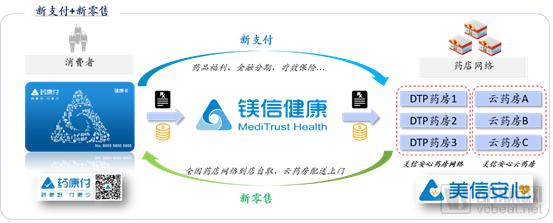
Image provided by the company
Zhang Xiaodong provided VCBeat with a detailed explanation of the business logic behind “New Payment” and “New Retail.” Specifically, drug benefits refer to prescription discount programs; financial installment plans involve partnerships with financial institutions to offer patients installment payment options for high-cost medications or therapies; and efficacy insurance, also targeting high-priced drugs or innovative treatments, collaborates with insurance companies to provide coverage for treatment outcomes, thereby alleviating patients’ concerns.
In the realm of “New Retail,” Meixin Health has established comprehensive, in-depth collaborations with 400 DTP (Direct-to-Patient) pharmacies across China and, through its Meixin Anxin Cloud Pharmacy, is able to serve patients nationwide to the greatest extent possible.
Magnesium Health refers to this model as Patient Benefit Management, which bears certain similarities to the Pharmacy Benefit Management (PBM) model prevalent in the United States. The core logic of PBM is to help commercial insurance companies control costs through measures such as prescription review and price negotiations, primarily serving commercial insurers and corporate employers. In contrast, Patient Benefit Management is primarily patient-centric, designed to serve patients, with objectives that extend beyond merely reducing medication costs.
“From the perspective of addressing pain points, Magi Health’s original intention is closely aligned with policy directions and public needs. For instance, policies aimed at resolving the issues of ‘poverty caused by illness’ and ‘returning to poverty due to illness,’ as well as the recent initiative to implement zero tariffs on anticancer drugs, are all designed to enable the public to better access high-quality medicines and medical services. From the standpoint of out-of-pocket patients, leveraging professional third-party institutions to integrate the upstream and downstream segments of the healthcare industry chain can effectively reduce medical costs and improve the accessibility of high-quality medical services and pharmaceuticals,” said Zhang Xiaodong.
In MedBank Health’s innovative medical payment model, pharmaceutical companies and insurance institutions are key participants. Currently, MedBank Health has partnered with AstraZeneca, Bristol Myers Squibb (BMS), CMB-ING Life Insurance, ZhongAn Insurance, and China Everbright Bank to launch “New Payment” and “New Retail” services for multiple blockbuster drugs.
Taking the collaboration between Medbanks Health and AstraZeneca on Tagrisso, a targeted therapy for lung cancer, as an example: Tagrisso is a third-generation EGFR-targeted drug for the treatment of lung cancer. It was approved in the United States in November 2015 and received regulatory approval in China in March 2017. Due to its significant efficacy, the annual treatment cost exceeds RMB 200,000, and the drug is not included in the National Reimbursement Drug List. To address this, Medbanks Health introduced installment payment services for Tagrisso, substantially alleviating the short-term cash flow burden on patients’ families.
Magi Health has also partnered with Bristol Myers Squibb to launch the “Liver Cure Guard” insurance program. In response to China’s first approved and market-launched all-oral direct-acting antiviral combination therapy for hepatitis C, Magi Health has introduced a comprehensive membership service for hepatitis C patients. This initiative provides insurance compensation for patients who are not cured after completing the medication regimen, thereby safeguarding those undergoing this treatment.
Meanwhile, Magxin Health has established deep collaborations with financial and insurance enterprises such as Cigna & CMB, ZhongAn Insurance, and China Everbright Bank, jointly exploring the cross-sector integration of healthcare and finance.
CEO Zhang Xiaodong stated that Medbanks Health primarily serves or collaborates with three types of clients. First, for self-paying patients, Medbanks Health launched the “Yaokangfu” platform, offering medication benefit management plans to achieve the goal of “better drugs, lower costs.” Second, for pharmaceutical companies, it provides customized payment solutions for new or blockbuster drugs to enhance drug accessibility. Third, for pharmacies, Medbanks Health introduced the “Meixin Anxin” DTP pharmacy service standard, aiming to provide standardized solutions covering order processing, payment, delivery, and patient services for the DTP pharmacy network.
Previously, MedTrust Health had already secured support from investors including Shanghai Pharma Cloud Health, SDAO Capital, and Yuanyi Capital.
Lin Rui, Partner at Sidao Capital, stated, “We have always believed that innovation in healthcare payment is a critical step toward enhancing the efficiency of China’s healthcare services. We are delighted to have been involved in this significant transformation since the early stages of MedXin’s establishment. The success of the MedXin model requires comprehensive capabilities across healthcare, finance, pharmaceutical retail, and information technology, with each element being indispensable.”
“We highly recognize the strong execution capabilities of the management team led by Mr. Zhang. We sincerely hope that, through the company’s efforts, the general public can access more high-quality medicines and services at lower costs, truly realizing patient-centric value-based healthcare,” said Lin Rui. She noted that F-Prime Capital began supporting China’s healthcare innovation enterprises over a decade ago, with extensive investment coverage across the entire industry chain and global industry resources. F-Prime will leverage its international and local resources to support MediciNova’s continued growth.
Gao Yi, Partner at Yuanyi Capital, stated, “Medbanks has already possessed the core elements of a successful business model: it has optimized and enhanced the industrial value chain and established win-win collaborations with various stakeholders in the ecosystem. By addressing rigid payment demands, it has aggregated patient needs to generate professional centralized procurement effects, thereby unlocking previously unmet demand through innovative financial and service products. For pharmaceutical companies, it has effectively achieved broader accessibility and more efficient sales mobilization, particularly for specialty drugs and new medicines. For participating insurance and financial institutions, it has provided long-awaited credible clinical data, as well as closed-loop patient services and comprehensive follow-up data, thus significantly accelerating product innovation in the healthcare sector.”
“DTP pharmacies are also empowered within this ecosystem: from patient onboarding and coordination with third-party professional pharmaceutical distribution to systematic patient management services, all of which effectively enhance patient adherence, cure rates, and loyalty. We anticipate that, bolstered by the team’s strong execution capabilities, Medbanks’ business will rapidly expand its coverage to include a broader range of pharmaceuticals and medical devices, benefiting a wider patient population. This will also support pharmaceutical companies dedicated to innovative products, accelerating the healthcare system’s transition toward patient-centric value-based care.”
From an operational perspective, since its official launch in September 2017, Magnesium Health has served tens of thousands of members. The cumulative credit line granted for pharmaceutical installment plans has reached tens of millions, with no overdue payments or bad debts recorded to date. Meanwhile, the company has established partnerships with more than 10 pharmaceutical enterprises, covering over 400 DTP (Direct-to-Patient) pharmacies offline.
“Our core philosophy is rooted in improving the healthcare and medication-purchasing environment for the public, enabling ordinary people to access and utilize high-quality medicines at lower costs; allowing patients and everyday individuals around us to benefit from premium medical services—this is our original aspiration,” stated Ms. Qu Yuqi of Medxplain Health.
“The key metrics of the ‘impossible trinity’ in healthcare are cost, accessibility, and quality. By aggregating the needs of patients paying out-of-pocket and integrating the industry chain, Magnesium Xin has addressed this issue to a certain extent. After validating this model in the field of pharmaceutical payment, it can be replicated across the entire healthcare system in the future, such as in medical services and devices, making high-quality services more accessible, reducing patient expenditures, and improving patient experience,” said Zhang Xiaodong.