China's Hemodialysis Market Poised for Rapid Growth Amid Rising Chronic Kidney Disease Prevalence
China currently has a high prevalence of chronic kidney disease (CKD), and patients with end-stage renal disease (ESRD) are not receiving adequate dialysis treatment. According to data from the “Epidemiological Survey of Chronic Kidney Disease in China” published in 2012,In China, the prevalence of chronic kidney disease (CKD) among adults is as high as 10.8%, and the growth rate of CKD is projected to exceed 17% over the next decade.At this ratio, China currentlyApproximately 150 million people suffer from varying degrees of renal impairment, with over 2 million patients diagnosed with end-stage renal disease (ESRD). According to data from the Ministry of Health’s 2012 “Green Book on China’s Health Development,” the average annual direct treatment cost per hemodialysis patient is RMB 75,085.92, which exceeds the financial capacity of most ESRD patients, resulting in a low treatment rate. Currently, only about 290,000 dialysis patients are registered in China, while the actual estimated number is approximately 330,000, including around 300,000 undergoing hemodialysis.Among the 2 million patients with end-stage renal disease (ESRD) in China, only 300,000 undergo hemodialysis. Based on an annual dialysis cost of RMB 75,000 per patient, the current market size for hemodialysis in China is approximately RMB 22.5 billion.
With 2 million ESRD patients all undergoing hemodialysis treatment, and an annual treatment cost of RMB 75,000 per patient, the theoretical market size for hemodialysis centers amounts to RMB 150 billion.Compared to the 90% treatment rate for end-stage renal disease (ESRD) in developed countries, there is a significant gap. Therefore, compared to the theoretical market size, China’s hemodialysis market still has a potential value of over RMB 120 billion; even calculated at a 90% treatment rate, there remains nearly fivefold room for market growth.
VCBeat identifies two primary reasons for this gap.First, hemodialysis centers in China previously faced significant policy barriers, with strict regulatory entry requirements for the service sector, leading to their establishment primarily within public general hospitals.This characteristic has led to the concentration of most hemodialysis centers in major cities, with a scarcity of such facilities at the primary care level. However, patients with end-stage renal disease (ESRD) require long-term, regular hemodialysis treatment. Due to the limited availability of hemodialysis centers at the grassroots level, patients are forced to seek care at large hospitals or forgo treatment altogether. Consequently, there is a significant mismatch between the supply and demand for hemodialysis services provided by medical institutions in China.
Prior to the introduction of the Standards, very few enterprises with private capital in China were able to enter the hemodialysis sector. In an article titled “In-Depth Interpretation: The Liberalization of Policies for Hemodialysis Centers in China,” written by Zhang Yongqiang of Aishen Medical and published by VCBeat in December last year, the development journey of third-party hemodialysis centers in China was reviewed. Around 2009, Shenyang Sansheng Pharmaceutical (a domestic producer of erythropoietin [EPO]) established the “Sansheng Kidney Friends Home” in Jinzhou, Liaoning Province, and other areas, initiating the creation of a “chain of grassroots hemodialysis centers.” In December 2010, Shandong Province approved pilot programs involving Weigao Group and the Bethune Fund Management Committee. Amidst unclear policies at the time, these three private enterprises launched pilots for third-party hemodialysis centers through arrangements such as affiliations.
Second, insufficient coverage of medical insurance.Currently, the coverage of medical insurance in China has reached 95%, and critical illness insurance can reimburse approximately 90% of hemodialysis costs. For patients with end-stage renal disease (ESRD), assuming a frequency of three sessions per week at a cost of 500 yuan per session, their annual out-of-pocket expenses can be kept below 10,000 yuan after insurance reimbursement. However, the significant expansion of medical insurance coverage is a development that has occurred only in the past two years. In the earlier period, low insurance coverage among ESRD patients, coupled with the substantial financial burden of hemodialysis, resulted in low treatment rates.
According to a research report by Orient Securities, there are currently 3,637 hemodialysis centers in China, predominantly concentrated in large public hospitals, which hold an absolute monopoly.With the expansion of coverage under the critical illness insurance program, the number of ESRD patients undergoing hemodialysis will increase significantly.With over 3,000 hemodialysis centers currently in operation, there is a severe shortage relative to China’s vast patient population; it is estimated that the country requires 30,000 such facilities.The massive gap cannot be filled by the continued expansion of hemodialysis centers in public hospitals; the remaining substantial market space will be occupied by private institutions, a sector that remains largely undeveloped and ripe for exploration.
In addition, the current penetration rate of hemodialysis centers is low, and their substantial expansion will benefit the entire dialysis industry chain, including dialysis machines, dialyzers, dialysis consumables, and dialysis drugs. However, the dialysis machine market is currently dominated by foreign brands such as Fresenius, with a domestic production rate of only 16%, while the localization rate for other hemodialysis consumables and drugs is gradually increasing.
From a policy perspective, the state has opened hemodialysis centers to private capital and issued corresponding detailed management rules and regulations. It is foreseeable that private capital will subsequently enter this field in large numbers. Early entrants such as 3SBio Inc. and Weigao Group are already positioned within the hemodialysis industry chain, primarily manufacturing related hemodialysis pharmaceuticals and hemodialysis machines. Like industry leader Fresenius, it is a natural progression for these companies to establish dialysis centers and provide dialysis services after entering the industry chain to produce dialysis products.
2018 Outlook and Recommendations
1. “Difficulty” and “Speed”
Speed is essential for the development of both an industry and individual enterprises. In the short term, acquiring specialized hospitals or hemodialysis centers appears to be a relatively easier and faster strategy (provided that capital is not a constraint). However, are there still high-quality acquisition targets available in the market? Furthermore, post-acquisition integration may prove even more challenging than establishing new facilities from scratch. We believe that the core value of a chain of hemodialysis centers lies in its "chain" nature, which should be reflected not merely in branding but, more importantly, in management and operations. Recently, the author evaluated several small general hospitals interested in being acquired by or partnering with Aishen (iKidney). It was found that meeting Aishen’s current standards and systems would essentially require tearing down and rebuilding their operations, with investment costs and time commitments far exceeding those of opening new centers. In the long run, the growth of independent hemodialysis centers will primarily come from newly established facilities. Therefore, the concepts of "difficulty versus ease" and "speed versus slowness" are relative, depending on the development plans, financial resources, and operational capabilities of different teams.
2. Competition and Cooperation
Foster Healthy Competition and Jointly Safeguard the Market Environment: China Remains the Largest Dialysis Market with Sustained Essential DemandNot long ago, I participated in an expert review meeting for hemodialysis centers organized by the Guangdong Provincial Health and Family Planning Commission. It was evident that there was limited overlapping competition among the projects submitted by peers within the same region. We should adopt a more open mindset to build industry synergy. In areas such as policy recommendations, centralized procurement, and dialysis tourism, collaboration holds greater significance than competition.
3. Prioritize the Development of Core Competencies
Medical safety comes first; dialysis treatment concerns patients’ lives and their families, and we must never follow the old path of the Putian system. Medical safety and quality are key to the survival of enterprises and the industry.
In terms of differentiated competition, private hemodialysis centers still possess unique advantages in design and layout, environmental hardware, and service management, enabling them to establish a competitive edge through differentiation.
Emphasizing the Humanistic Value of Healthcare: Healthcare is, at its core, a humanistic issue. Particularly in China today, where doctor-patient relations are strained, both healthcare providers and patients harbor biases and shortcomings. Whether a new medical institution can reconstruct the doctor-patient relationship is an unavoidable question for all stakeholders. It is essential to focus on the “experience” of both healthcare professionals and patients. Only by effectively implementing humanistic care can we inject vitality into China’s hemodialysis service industry.
2018 was a pivotal year for the development of independent hemodialysis centers. International investment bank Goldman Sachs also invested in domestic independent hemodialysis centers. The entry of these heavyweight investment institutions, coupled with the launch of independent hemodialysis centers by Fresenius and Baxter, will accelerate the development of independent chain hemodialysis centers in China.
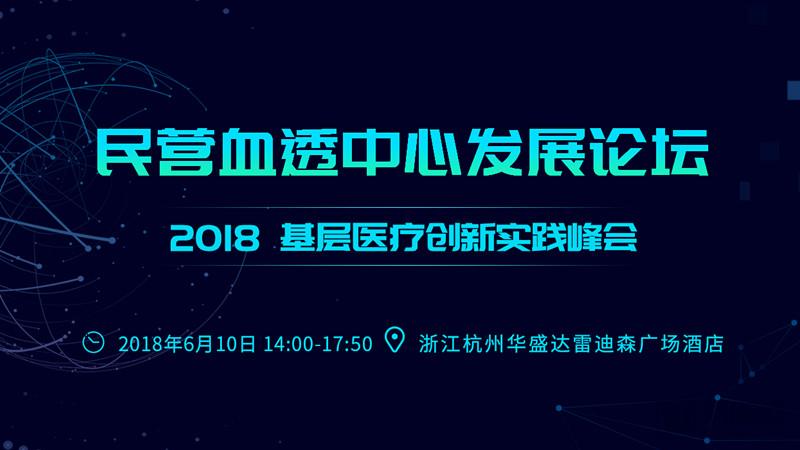
How exactly will it develop? To address this, on June 10, we invited several industry experts with practical experience in hemodialysis, including representatives from investment firms and entrepreneurs. The details are as follows:
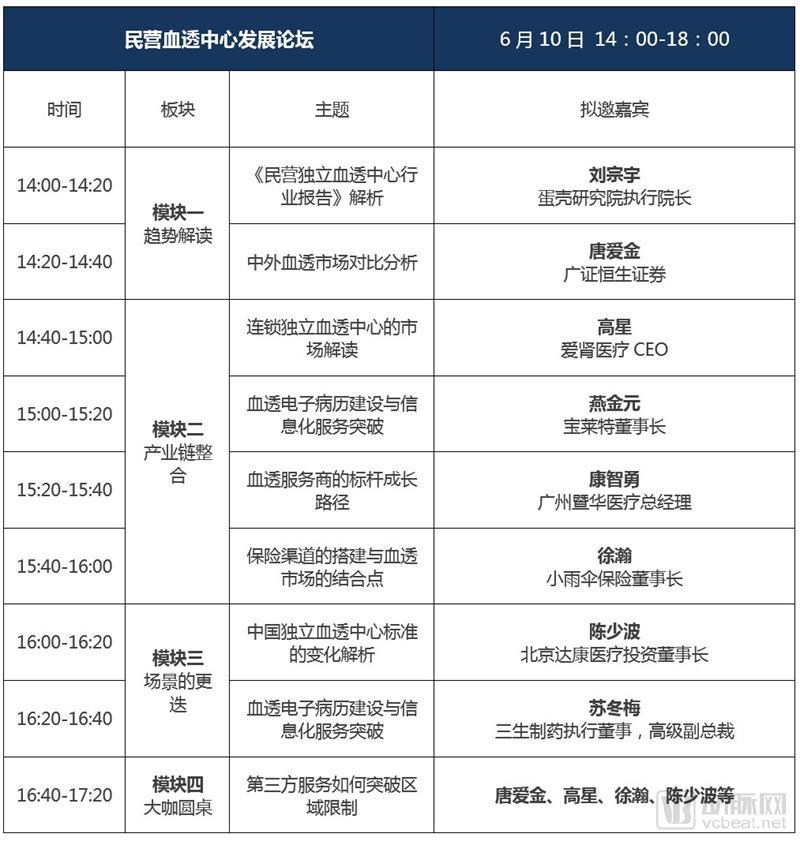
From policy to industrial development trends, from building online traffic entry points to enhancing offline customer acquisition capabilities, and from the standardization to the chain operation of hemodialysis centers, we invite government officials, industry experts, hospital directors, and numerous industry professionals to jointly explore the “New Structure.”
At this hemodialysis center forum, VCBeat will also release a related report. This report embodies the long-term attention and reflections of VCBeat, its editors, and researchers from VBInsight on the industry, serving as a concrete manifestation of VCBeat’s values and methodology. Stay tuned.
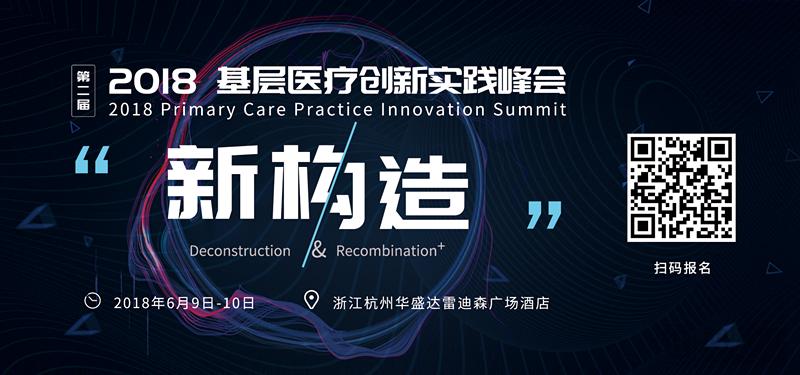
Ticket Prices: Limited-Time Special Offer
Scan the QR code to register.
Of course,“New Structure” – 2018 Summit on Innovative Practices in Primary HealthcareIn addition to the Hemodialysis Center Development ForumFrontier Forum, and it also featuresForum on Innovation and Practical Development of Medical Consortiums, Frontier Forum on Chronic Disease and Health Management, Forum on the Development of Pharmaceutical Retail and Distribution, Forum on Clinic Development, and Forums on the Development of Third-Party Imaging Centers and Third-Party Hemodialysis Centers—these five major forums. The conference has invited over 70 industry leaders to gather in Hangzhou, looking forward to meeting you there!
We have always approached the study, documentation, and exploration of developments in the third-party hemodialysis center sector with a sense of humility and reverence. By scanning the QR code at the end of this article to join our community group, you will gain access to 37 primary healthcare reports authored by VCBeat Eggshell Research Institute or curated by VCBeat. Additionally, you can connect with like-minded professionals who share your interest in medical consortia, facilitating mutual exchange and collaboration.