

Yitu Healthcare's Product Director Wang Zhao: AI Is the Foundation of Medical Big Data
On May 17, 2018, the “2018 China Health Information Technology/Health and Medical Big Data Application Exchange Conference,” hosted by the Chinese Society for Health Informatics and Health Big Data, was grandly convened in Jinan. The China Health Information Technology Exchange Conference is the largest, most content-rich, and most authoritative and influential high-level symposium for information technology and academic exchange in China.
As the only AI company in the medical artificial intelligence industry to propose a full-spectrum AI product matrix for medicine, Wang Zhao, Product Director at Yitu Healthcare, was invited to attend the conference and deliver a keynote speech titled “The Path to Applying Medical Big Data Based on Artificial Intelligence.” He pointed out that artificial intelligence is the foundation of medical big data; only medical data that has been analyzed and processed by AI can be considered true medical big data. Only on this basis, by leveraging AI technology, can advanced applications such as intelligent scientific research, clinical quality control, and telemedicine be developed.
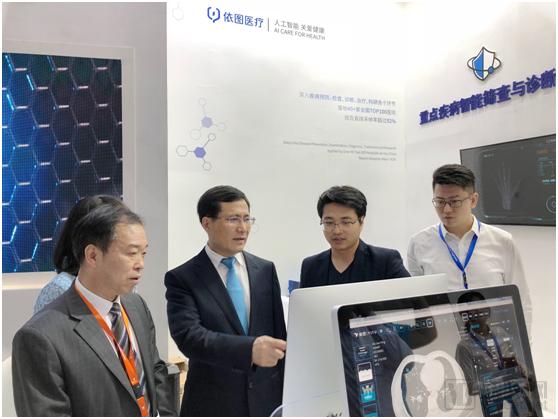
Jin Xiaotao (second from left), former Deputy Director of the National Health and Family Planning Commission, and President of the Chinese Society for Health Informatics and Medical Big Data
Hu Jianping (far left), Deputy Director and Research Fellow of the Statistical Information Center of the National Health and Family Planning Commission, and Deputy Secretary-General of the Chinese Society for Health Informatics and Medical Big Data
Ni Hao, President of Yitu Healthcare (second from right); Wang Zhao, Product Director of Yitu Healthcare (first from right)
For a long time, the AI industry has regarded medical big data as the foundation of artificial intelligence, expecting to “feed” AI with massive amounts of clinical data. In reality, however, given the current level of healthcare informatization in China, the vast majority of medical data remains non-standardized and unstructured. A huge volume of textual medical data lies dormant, and clinical data is fraught with noise. Before even considering “feeding” AI, basic data sharing and interoperability have yet to be achieved, let alone in-depth analysis and utilization.
“To fully leverage the advantages of China’s vast medical data, we must rely on artificial intelligence to drive the analysis, cleaning, and structuring of clinical data, awaken dormant textual data, integrate imaging data trapped in information silos, and build a true medical big data network. Through AI, we can fully unlock the potential value of medical big data, ultimately benefiting patients,” said Wang Zhao.
AI-powered clinical products have become commonplace, increasingly resembling a saturated “red ocean.” Yet what specific roles can AI play in data processing and the construction of scenario-based applications? Wang Zhao revealed that, when confronted with complex and heterogeneous health data—such as clinical data, population health data, and public health data—AI can fully leverage its robust capabilities: parsing complex textual data, reducing dimensionality and structuring medical imaging data, purifying data through quality analysis and control, and standardizing data via diverse governance frameworks. By sifting sand from rice and washing dust off vegetable leaves, and by applying appropriate “temperatures” and sophisticated “culinary skills,” AI transforms disordered raw data into a well-organized, visually appealing feast of medical big data, ready to be served.
After completing data parsing and processing, artificial intelligence also demonstrates robust capabilities in building scenario-specific applications, such as preparing multi-dimensional clinical research datasets, enhancing the standardization of diagnosis and treatment, and expanding healthcare service capacity at primary and secondary care levels. These advancements continuously improve the clinical service and research capabilities of medical institutions, ultimately facilitating the development of smart hospitals.
As one of the earliest AI enterprises in China to engage in intelligent solutions for medical big data, Yitu Healthcare has developed a solution that leverages its advanced AI algorithms, semantic parsing technologies, text structuring capabilities, and self-built medical terminology database. This solution seamlessly integrates with Hospital Information Systems (HIS), Laboratory Information Systems (LIS), Picture Archiving and Communication Systems (PACS), and Radiology Information Systems (RIS) to establish multimodal, full-lifecycle research databases. As a result, the efficiency of research data preparation has increased manifold, reducing the time required for comprehensive data extraction from tens of thousands of patients from years to months. Furthermore, the system has established a comprehensive quality control framework, encompassing model performance evaluation protocols and data spot-check assessment systems. This has significantly enhanced the quality of research data across the platform, ensuring it is both evaluable and optimizable.
“In the future, AI will inevitably become an essential infrastructure for healthcare institutions and a valuable assistant to physicians in clinical diagnosis and research, helping to unlock the immense value of the vast amounts of dormant medical data within Chinese healthcare institutions,” said Wang Zhao.