

Xiaomi, Valued Near $100 Billion, Invests in 23 Companies to Build 'Internet + Healthcare' Ecosystem—Is Xiaomi Health Imminent?
On March 23, 2018, the “2017 Report on the Development of Chinese Unicorn Enterprises” was released, with Xiaomi ranking third at a valuation of $46 billion, behind Ant Financial and Didi Chuxing.
On May 3, 2018, Xiaomi formally filed its listing application with the Hong Kong Stock Exchange. The prospectus revealed that Xiaomi’s revenue for 2017 amounted to RMB 114.6 billion. Its rapidly expanding business and impressive financial figures have fueled continuous speculation about the company’s valuation, with industry analysts suggesting that Xiaomi’s valuation could well reach USD 100 billion.
Starting with Xiaomi smartphones, Lei Jun built a “unicorn” over the course of eight years. From air conditioners, robot vacuums, and water purifiers to Meituan, Kuaishou, and offline retail stores, its extensive reach rivals that of BAT.
Healthcare is a tough nut to crack, but BAT’s healthcare ambitions have never waned. In recent years, BAT has accelerated its strategic layout in the healthcare sector, aiming to empower the medical industry with internet technologies. Their initiatives span multiple domains, including smart medical devices, pharmaceutical O2O services, medical artificial intelligence, and hospitals.
So, as China’s fourth-largest internet company after BAT, what is Xiaomi’s strategic layout in the healthcare sector? And how significant a role does healthcare play in Lei Jun’s business empire?
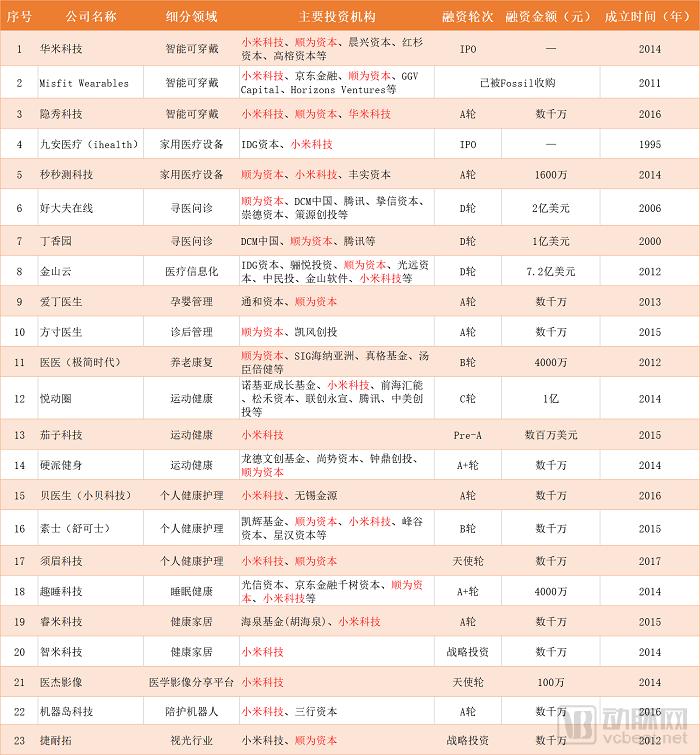
Lei Jun’s Medical Empire (Incomplete Statistics)
By mapping out the medical landscape of the Lei Jun-affiliated enterprises, VCBeat (WeChat ID: vcbeat) has identified two primary characteristics of healthcare companies within the Lei Jun ecosystem.
First, the industry is predominantly centered on smart hardware, covering multiple sub-sectors including wearable devices, home medical equipment, online consultation and diagnosis, healthcare informatization, sports and wellness, elderly care and rehabilitation, personal health management, and sleep health.
Second, focus on a specific niche to develop an ultimate product, then leverage Xiaomi’s channel resources to reach a massive user base, thereby creating opportunities to provide more value-added services.
Obviously, this is related to Xiaomi’s hardware DNA and the ripple effect of its ecosystem chain.From a data perspective, Lei Jun’s strategic layout in the healthcare sector primarily relies on three entities: Xiaomi Technology, Shunwei Capital, and Kingsoft Cloud.
Xiaomi Corporation primarily focuses its strategic layout on the ecosystem of smart hardware and content; Shunwei Capital mainly pursues a broad strategic investment portfolio centered on “hardware + software + services”; Kingsoft Software emphasizes Kingsoft Cloud, with its strategic layout primarily reflected in cloud services.
Ecosystem Layout: Xiaomi Technology
Xiaomi started out with smartphones, garnering a large base of loyal “Mi Fans” by offering exceptional price-to-performance ratios. However, as competition in the smartphone market has intensified, Xiaomi’s competitive edge has increasingly diminished.
Therefore, in late 2013, Xiaomi launched the Xiaomi Ecological Chain Initiative. Lei Jun adopted a strategy of “internal development plus investment” to expand its product portfolio, with smartphones at the core and supported by peripheral companies within the Xiaomi Ecological Chain, thereby penetrating various products into users’ households.
Lei Jun has repeatedly stated that he aims to extend the Xiaomi model into 100 niche sectors, driving the overall development of smart hardware and transforming Xiaomi from a single large vessel into an entire fleet.
Xiaomi’s investment portfolio spans dozens of sectors, including e-commerce, internet content, internet services, finance, hardware, and medical monitoring capabilities, covering nearly one hundred companies. The power of Xiaomi’s ecosystem “hardware + software + internet services” triathlon model will gradually come to the fore.
According to incomplete statistics from the E-Commerce Research Center, Xiaomi’s ecosystem has already encompassed 90 hardware startups, of which approximately 30 have launched products, including automotive electronics, smart projectors, VR/AR devices, intelligent in-vehicle equipment, water purifiers, self-balancing scooters, rice cookers, and drones.
Xiaomi’s strategy for smart hardware is to invest in smart hardware companies, integrating them into the Xiaomi ecosystem to maximize the utilization of Xiaomi’s resources—not only those within the Xiaomi sphere but also industry resources beyond it.
By using Xiaomi smartphones, hardware devices in the home are interconnected to build a peripheral hardware ecosystem centered around three core types of hardware: Xiaomi smartphones (including tablets), TVs (including Xiaomi Box), and smart routers. All these smart products are connected to Xiaomi smartphones, enabling data sharing.
In the healthcare sector, Xiaomi has also centered its strategy around home health, investing sequentially in smart hardware companies such as Huami Technology, Andon Health iHealth, Miaomiaoce, Bei Doctor, and Qiezi Tech, as well as in medical informatics and healthcare service providers like Kingsoft Cloud, Yue Dong Quan, and Yijie Imaging. Among these investments, smart hardware still constitutes the majority.
Huami Technology, established in January 2014, is a company specializing in intelligent hardware devices and services for smart wearables, digital identity (ID), and human body data. It is the only member of the Xiaomi ecosystem focused on wearable devices. Its product portfolio primarily includes smart bands and smart scales under the Xiaomi brand, as well as smartwatches and smart bands from its proprietary AMAZFIT series.
At its inception in 2014, Huami Technology secured tens of millions of yuan in Series A funding from Xiaomi Technology and Shunwei Capital.
In July 2014, the Xiaomi Mi Band, produced by Huami Technology, was launched. Leveraging its powerful marketing capabilities and an ultra-low price of just RMB 79, it sold one million units in merely three months.
Lei Jun, who hails from the internet sector, has been aggressively expanding his footprint in the hardware industry. The establishment of Huami Technology is also closely tied to Lei Jun, successfully completing the wearable device segment of Xiaomi’s hardware ecosystem.
On December 4, 2014, Huami Technology announced another round of $35 million in Series B financing, led by Gaorong Capital, with participation from Sequoia Capital, Morningside Venture Capital, and Shunwei Capital.
Evidently, investors at the time were highly optimistic about the development trends in the smart wearable devices and smart home markets, as well as Huami Technology’s R&D capabilities and team operational prowess. They held strong confidence in the strength of Xiaomi’s hardware ecosystem and its comprehensive ecological system.
On February 8, 2018, Huami went public in the United States with a market capitalization of $656 million, becoming the first company from Xiaomi’s ecosystem to list on the stock market. According to its prospectus, Huami shipped 11.6 million units in the first three quarters of 2017, securing the top spot in global market share and surpassing U.S.-based Fitbit to become the world’s largest wearable device manufacturer.
On September 19, 2014, Xiaomi Tech invested $25 million in Andon Health’s iHealth brand, acquiring a 20% equity stake. As a result, iHealth became Xiaomi Tech’s partner in the mobile health sector. The two companies will engage in in-depth collaboration in user experience, Xiaomi’s e-commerce platform, and cloud services, jointly building a globally leading mobile health cloud platform.
Andon Health, established in 1995, is a company engaged in the research and development, production, and sales of home medical health electronic products, while providing related technical services to build a “Mobile Internet + Health Management Cloud Platform.” The company’s main product portfolio covers blood pressure, blood glucose, blood oxygen, electrocardiogram (ECG), heart rate, body weight, body fat, sleep, and physical activity, featuring a relatively comprehensive product line of personal health wearable devices.
The iHealth series by Andon Health received strong support from Apple in its early stages. Following the launch of its first mobile-connected blood pressure monitor, the BP3, on Apple’s channels, the company introduced a range of additional products, including wireless smart mobile blood pressure monitors, glucose meters, and body fat scales.
As with other portfolio companies, this means iHealth can access Xiaomi’s resource ecosystem to collaborate on user experience, sales channels, and cloud services; Xiaomi’s marketing resources are also a critically important component.
For Xiaomi, the company boasts a large base of high-quality, highly loyal fans who also have corresponding healthcare needs. The continuous growth in its user base, combined with the uniqueness of its operational model, is expected to enable iHealth’s hardware to rapidly capture market share with Xiaomi’s support.
By investing in Andon Health’s iHealth, Xiaomi will join hands with Andon Health to implement “Entering the fields of mobile healthcare and health big data through wearable devices and smart hardware, thereby establishing a health ecosystem centered around users."Strategy: Deeply mine big data and enter the mobile healthcare sector."
Evidence shows that the model pioneered by Xiaomi, which integrates smart wearable devices with mobile health information to assist in the management and monitoring of chronic diseases, is becoming the mainstream paradigm in current mobile healthcare.
Investment Vehicle: Shunwei Capital
Shunwei Capital, co-founded by Lei Jun, serves as the investment vehicle for expanding his business empire. Currently, the majority of projects within the Lei Jun ecosystem are funded by Shunwei Capital.
Shunwei Capital was established in October 2011 under the full name “Shunwei China Internet Fund.” Its founding partners are Lei Jun and Hsu Ta-Lai. The firm manages three U.S. dollar funds totaling $1.75 billion and two RMB funds amounting to RMB 2 billion. Its limited partners primarily consist of top-tier international institutional investors, including sovereign wealth funds, family offices, funds of funds, and university endowments.
Shunwei Capital focuses on the internet, mobile internet, high-tech industries, and the transformative changes brought about by the integration of the internet with other sectors. Its investment areas include, but are not limited to, mobile internet, e-commerce, and social networking platforms, with a primary focus on high-quality startups in their early and growth stages.
Prior to 2013, apart from investing in Xiaomi itself, the projects invested in by Shunwei Capital were basically co-investments following Lei Jun’s personal angel investments, including Haodf Online, DXY, and Yiyi.
In 2007, Haodf Online secured RMB 3 million in angel-round funding from Ceyuan Ventures and Shunwei Capital; in 2012, DXY completed a tens-of-millions-of-US-dollars Series B financing round, with investors including Shunwei Capital and DCM; also in 2012, “Yiyi” (i.e., Jijian Shidai), an internet platform focused on post-discharge management for cardiac rehabilitation, received angel investment from Lei Jun.
Since 2013, the projects invested by Shunwei Capital have been largely related to the improvement of Xiaomi's ecosystem, including multiple healthcare companies such as Huami Technology, Aiding Doctor, Fangcun Doctor, Yingpai Fitness, Qushui Technology, Miaomiaocai Technology, and Sukeshi.
In 2014, Huami Technology secured tens of millions of yuan in Series A financing from investors including Xiaomi Technology and Shunwei Capital.
In 2014, Hard Core Fitness secured an angel round investment of several hundred thousand US dollars from Shunwei Capital;
In 2015, Qushui Technology received RMB 10 million in investment from Shunwei Capital, led by Lei Jun, as well as from JD.com, owned by Liu Qiangdong.
In 2016, “Aiding Doctor,” a platform dedicated to maternal and child health, secured tens of millions of yuan in Series A financing from Tonghe Capital and Shunwei Capital.
In 2016, Miaomiaoce (smart thermometer) secured tens of millions in Pre-A round funding from Xiaomi Technology and Shunwei Capital;
In 2016, Soocas (Soocare Electric Toothbrush) received Pre-A and Series A investments from Shunwei Capital, with the amounts undisclosed.
Among the healthcare companies invested in by Shunwei Capital, Beijing Jijian Shidai Software Technology Co., Ltd. (hereinafter referred to as “Jijian Shidai”) is a Xiaomi ecosystem enterprise and the only company within the Xiaomi ecosystem deeply rooted in products and medical services for the elderly.
The company was founded in 2012 and has received investments from Lei Jun, Xu Xiaoping, Heyihui, By-Health, and others. Positioning itself as an internet hospital, the company officially entered the internet healthcare sector in 2016, with a focus on post-discharge patient management.
Ji Jian Times focuses on the elderly health and wellness sector and the medical rehabilitation market. Its key products launched to date include the Post-Hospital Management Platform, the Yi Yi App, and the Ji Jian Desktop.
To date, the total number of users of the Minimalist Desktop software has exceeded 28 million, making it the first internet product in China to surpass ten million elderly users. Building on this base of tens of millions of elderly users, the company has developed the “Post-Hospital Management Platform,” aiming to provide professional solutions for post-discharge cardiac rehabilitation management for both physicians and patients through a “software + hardware + service” model.
This means that, following in the footsteps of BAT and JD.com after the surge of interest in internet healthcare, Xiaomi’s ecosystem companies have also begun to lay out their strategies in the medical and health services sector, ultimately choosing to implement these services through internet hospitals.
Cloud Services Strategy: Kingsoft Cloud
In September 2010, Lei Jun returned to Kingsoft Software as Chairman and began transforming the company based on his understanding of the mobile internet. Under his leadership, Kingsoft Software’s complex array of business units was ultimately consolidated into a “3+1” structure, with the “1” referring to Kingsoft Cloud.
As early as 2014, Lei Jun proposed to go all-in on Kingsoft Cloud, believing that Xiaomi and Kingsoft Cloud could establish a close partnership.
On the one hand, Kingsoft Cloud can secure a share of the market even as the BAT giants dominate the industry, owing to its status as an independent third party that does not align with any of the BAT companies. Meanwhile, cloud service development requires substantial cash flow, which Xiaomi, currently in strong financial health, is well-positioned to provide.
On the other hand, Xiaomi’s ecosystem also requires a foundational cloud service provider, and Xiaomi can further promote the adoption of Kingsoft Cloud services by companies within its ecosystem.
Therefore, Xiaomi has not only injected capital into Kingsoft Cloud on several occasions but is also a customer of Kingsoft Cloud.
In December 2014, Xiaomi announced a $1 billion investment in Kingsoft, with a future focus on advancing Kingsoft Cloud services. Kingsoft Cloud and Xiaomi have strategically positioned themselves in the cloud services sector, focusing on infrastructure-level services and application-level solutions, respectively.
In recent years, leveraging its leading technological capabilities and scale advantages in the cloud computing industry, Kingsoft Cloud has continuously expanded its presence in sectors such as gaming, video, government services, healthcare, and artificial intelligence. It has rapidly established a strong reputation in China’s public cloud market and played a significant role in driving the adoption of cloud computing technologies across various industries. Even in the healthcare sector, where cloud migration has progressed relatively slowly, Kingsoft Cloud continues to serve as an industry bellwether.
In 2015, Kingsoft Cloud announced a strategic partnership with Peking University Medical Information Technology (PKU MIIT) and officially launched its “Cloud Computing + Healthcare” product, “Kingsoft Medical Cloud,” to rapidly expand and capture the healthcare market.。
Currently, the healthcare informatics sector faces challenges such as data silos, high system development costs, and poor user experience. Meanwhile, given that healthcare is an industry with both public welfare and livelihood implications, it involves a broad and complex range of stakeholders. The significant technical difficulties involved mean that, despite the substantial market potential, cloud computing vendors face immense challenges in terms of both technological capabilities and commercial monetization.
Nevertheless, Kingsoft Cloud has demonstrated substantial ambition and strength in the healthcare sector. In 2015, Kingsoft Cloud launched “Kingsoft Medical Cloud,” enabling Peking University People’s Hospital to become the first Grade A tertiary hospital in China to synchronize its core Clinical Data Repository (CDR) data center resources to the medical cloud.
In 2016, Kingsoft Cloud and Hangzhou B-Soft joined forces to create the “Regional Healthcare Cloud.”, and subsequently accelerated its development in the healthcare sector by establishing strategic cooperation intentions with Xi’an Yinggu Technology, Kangzhi Health Technology, and Beijing Quanyu Medical, respectively launching Imaging Cloud PACS services, a full-course management cloud platform, and precision cloud radiotherapy services.
It is evident that Kingsoft Cloud is accelerating its development pace in the healthcare industry. However, unlike many cloud computing providers that focus on peripheral medical cloud services such as health and hygiene, Kingsoft Cloud’s future strategy in the medical cloud sector will be characterized by strengthening the core medical cloud infrastructure itself. While migrating hospitals’ core technologies to the cloud, it will also achieve deep integration with existing industries, thereby generating significant industrial synergy effects.
For example,Currently, Kingsoft Cloud and Xiaomi have established a cloud data platform capable of collecting monitoring data from Xiaomi’s fitness bands, blood pressure monitors, and glucometers, as well as from scanners developed by partner companies. Once these medical big data resources are fully integrated, they will undoubtedly open up new markets for Kingsoft Medical Cloud.
Xiaomi’s Healthcare Empire Begins to Take Shape
Lei Jun’s business logic involves simultaneously building an industrial ecosystem and a capital investment circle, with capital injecting vitality into the industry to construct a “Lei Jun-style” integration of industry and finance through strategic investments.
In the healthcare sector, in addition to smart hardware devices and medical services, Lei Jun and his Xiaomi have also extended their reach into the health insurance domain.
In the Internet era, big data has brought about transformative changes to the insurance industry. With the advancement of wearable devices and electronic health records (EHRs), it has become possible to monitor human physiological indicators and behavioral patterns comprehensively and around the clock, thereby invisibly achieving the dual objectives of enhancing the attractiveness of insurance products and reducing healthcare costs.
In addition to smartphones, Xiaomi offers a range of health products, including the Mi Band, Mi Body Composition Scale, and Mi Blood Pressure Monitor, which have become deeply integrated into the daily lives of its fans, known as “Mi Fans.” By leveraging data monitoring, Xiaomi can comprehensively assess and manage each Mi Fan’s health status and associated risks. This capability provides a foundation for precise pricing by Xiaomi Insurance and enables deep integration of insurance services into health management. Through such proactive involvement, Xiaomi can shift claims management upstream, mitigating claims risks through preventive measures.
In August 2015, ZhongAn Insurance, China’s first internet-based insurance company, partnered with Xiaomi Sports and the Ledongli APP to launch “BuBuBao,” the country’s first health management plan integrating wearable devices and sports big data. The initial BuBuBao product used users’ actual physical activity levels as the basis for pricing, allowing step counts to offset insurance premiums. In other words, if a user is a consistent “runner,” they could potentially exchange their activity data for a critical illness insurance policy with coverage of up to RMB 200,000 at no cost, truly realizing the concept of “running for health.”
Starting from smart medical devices and extending to healthcare services, we have found that Xiaomi’s healthcare empire is beginning to take shape. However, it must be acknowledged that compared with the high-profile moves made by BAT (Baidu, Alibaba, and Tencent) in the past two years, Xiaomi still needs to step up its efforts in the healthcare sector!