

Insilico Medicine Files IPO Prospectus: Pioneering AI-Driven Anti-Aging Research with 250+ Industry-Academia Collaborations and Over $8M Raised
Deep Knowledge Ventures
Venture Capital Fund Management Company
With the advancement of the healthcare industry and data acquisition technologies, the integration of AI with the biomedical sector has demonstrated immense potential, yielding numerous breakthroughs in pharmaceuticals and driving deeper research into biological anti-aging.
Since ancient times, China has been steeped in legends of immortality and the quest for elixirs of life. Insilico Medicine, a medical and bioinformatics company headquartered in Baltimore, USA, is turning these mythical narratives into reality.
In 2014, Insilico Medicine was founded by its founder, Alexander Zhavoronkov. The company focuses on leveraging AI technology for novel drug discovery and lifespan extension, dedicating itself to research related to personal health management and aging.
To date, Insilico Medicine has raised a total of $8.26 million from investors including Deep Knowledge Ventures, JHU A-Level Capital, and Juvenescence.

According to VCBeat, which has learned from multiple overseas media outlets, Insilico Medicine is categorized within the venture capital market—a market where emerging high-tech enterprises in their growth stage conduct equity financing. The company’s main competitors in the United States are Atomwise, twoXAR, and Qrativ.
As the CEO of Insilico Medicine, Zhavoronkov has the largest number of employees among his peers. In the past two years, they have raised a total of $6.8 million in funding and generated $5.7 million in revenue for the company.
Efficient Teams as the Core Strength
Currently, Insilico Medicine has research teams in Russia, the United Kingdom, Switzerland, Poland, and the United States, and conducts R&D collaborations in Canada, Israel, Switzerland, and China.
Through the application of AI technology, Insilico Medicine has established over 250 industry-academia collaborations to date, successfully building applications in the fields of drug discovery and biomarker development, thereby becoming an innovation-driven leader in the pharmaceutical industry.
Insilico Medicine’s experienced team includes Chairman Alexander Aliper, Chief Operating Officer Qingsong Zhu, and founder Alex Zhavoronkov, among others. Prior to joining the company, Qingsong Zhu completed postdoctoral training at the Johns Hopkins University School of Medicine.
According to VCBeat, Zhavoronkov initially focused primarily on aging research in the early stages of his entrepreneurial journey. By collecting multi-omics data from a large cohort of healthy and diseased individuals across various age groups, his team leveraged machine learning to comprehensively analyze these data and identify biomarkers associated with aging and disease. Currently, Zhavoronkov and his team are collaborating with companies in multiple related fields, engaging in practical innovation with the aim of discovering anti-aging drugs to extend patients’ lifespans.
Zhavoronkov stated that pharmaceutical R&D is a task not to be underestimated. The development cost for each drug can reach $2.6 billion, while the global expenditure on developing these drugs amounts to $150 billion. This explains why only 46 new drugs were launched in total in 2014. The failure rate for new drug development stands at 92%. Furthermore, there are approximately 60,000 diseases in reality.
It is evident that the fight against human aging through pharmaceutical R&D is no easy task. Insilico Medicine aims to enhance the quality-adjusted life years (QALY) for everyone by promoting AI technology. Currently, the cost to increase one unit of QALY is $60,000, a metric driven by the development of new drugs.
Furthermore, founder Zhavoronkov’s professional background underpins his exploration and innovation in AI technology and the biopharmaceutical research industry. At just 39 years old, he already holds a Ph.D. in Biophysics, a Master’s degree in Biotechnology, and a Bachelor’s degree in Computer Science, and has built an extensive career in bioinformatics and regenerative medicine.
As a renowned scholar in the field of aging research, Zhavoronkov published *Ageless: The New Science of Getting Older Without Getting Old* (Chinese title: *Transcending Aging: How Advances in Biomedicine Will Transform the Global Economy*) in December 2015. The perspectives explored in the book cover numerous issues, including the mechanisms of human aging, pension system reforms of interest to governments, and the growing aging population that concerns socioeconomists. In his view, the social and economic challenges triggered by population aging in countries such as the United States and Japan offer profound lessons for China.
By 2020, China’s population aged 60 and above is projected to reach 250 million, making China one of the countries with the most severe aging demographics globally, thereby imposing significant burdens and challenges. However, anti-aging research in biomedicine has the potential to alter this trajectory by raising the standard retirement age and even redefining the broader concept of the “elderly population.”
Data Probes Your Health Status
Zhavoronkov has always firmly believed that AI technology is a crucial pathway to improving the pharmaceutical industry, enhancing industrial efficiency, and reducing the risks associated with aging. Leveraging its expertise in deep neural networks and machine learning, the company assists others in drug development and the treatment of age-related diseases.
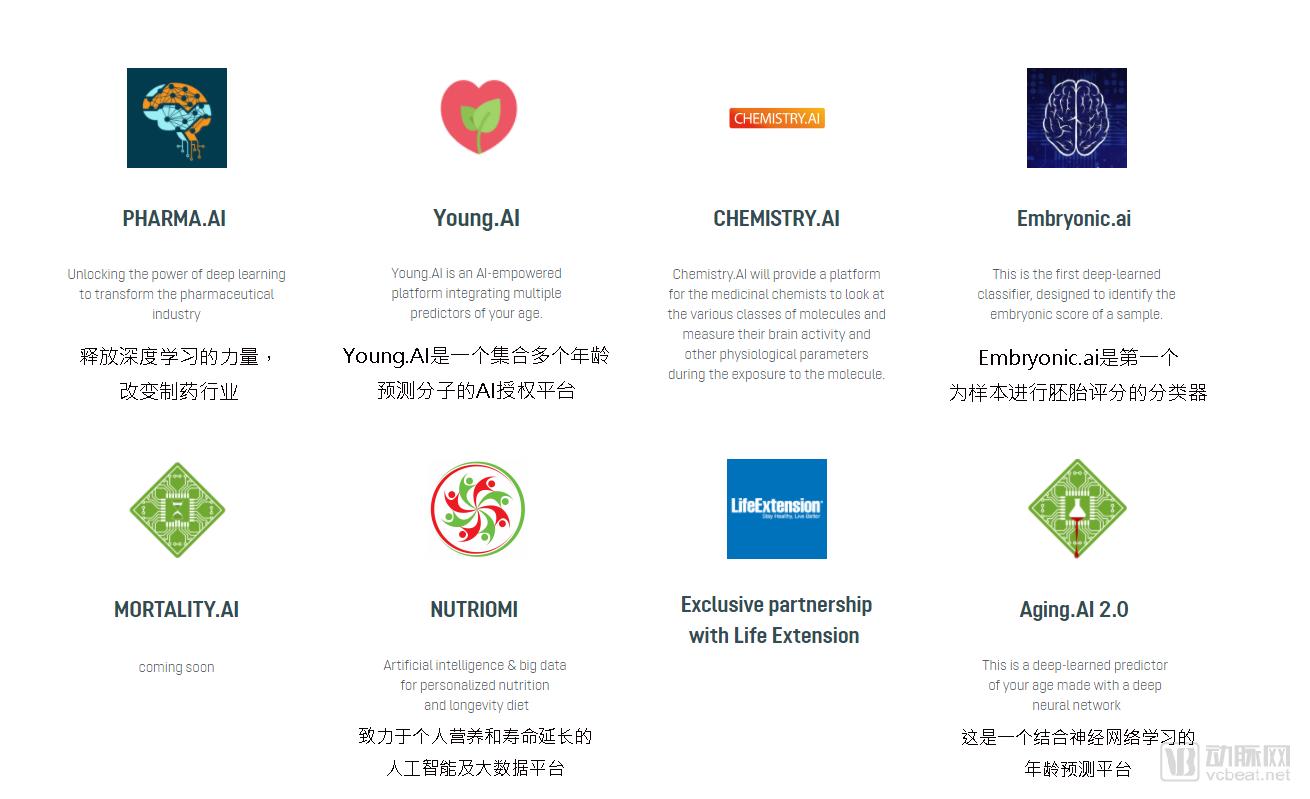
PHARMA.AI、Young.AIandNUTRIOMIThese are three key products of Insilico Medicine:
PHARMA.AI: Investigations have revealed that few professionals possess integrated expertise in multi-omics, pharmaceuticals, clinical experience, and deep neural networks. As one of the research and development initiatives by Insilico Medicine, PHARMA.AI is dedicated to alleviating the shortage of such specialized talent that has plagued the biopharmaceutical industry in recent years.
By accessing millions of standardized multi-omics datasets and human biological samples, PHARMA.AI enables pharmaceutical companies, biotechnology firms, and academic teams worldwide to develop, train, commercialize, or license a variety of deep neural network-based solutions. Furthermore, the tools developed by PHARMA.AI facilitate deeper insights into biomarkers and accelerate novel drug discovery, paving the way for personalized therapeutic strategies for cancer and age-related diseases in the future.
Young.AI Beta 1.0: Insilico Medicine launched the beta 1.0 version of Young.AI in September 2017. As an intelligent platform capable of predicting users’ biological age, Young.AI is tasked with optimizing users’ lives by modulating their health and aging rates and tracking temporal changes. A key feature of its algorithm is the ability to perform deep tracking via neural networks across tens of thousands to millions of samples.
This project investigated 21 commonly used blood parameters, such as cholesterol, inflammatory markers (CRP), hemoglobin count, and albumin concentration, along with 17 other biochemical indicators. By leveraging AI to analyze and correlate blood chemistry data with age, ethnicity, and other variables, Young.AI has developed an algorithm described as “the first truly reliable aging clock” for humans. According to VCBeat, it is now possible to determine an individual’s life expectancy by analyzing just a single drop of blood.
Anyone can visit the Young.AI website to learn about their health and future, as the system’s analysis is free of charge. To use the platform, participants must conduct local tests for 18 blood parameters, upload the results to the Young.AI site, and also submit a photograph for visual age assessment. Within seconds, the website will generate a report.
If the user’s biological age is found to be greater than their chronological age, the report generated by Young.AI will effectively help them take necessary measures to improve their weakest health indicators.
NUTRIOMI: As another key product of Insilico Medicine, NUTRIOMI is dedicated to promoting dietary health and mitigating and preventing common signs of aging. Its unique approach involves tracking users’ aging dynamics by analyzing individual blood biochemistry data. NUTRIOMI encourages individuals to adopt healthy lifestyles aimed at improving the aging process, maintaining a balanced diet, and enhancing nutritional status.
GAN Sets Insilico Medicine Apart
What advantages does Insilico Medicine hold in the pharmaceutical industry? It is understood that Insilico Medicine is the first company to apply “Generative Adversarial Networks (GANs),” dedicated to in-depth analysis of molecular structures with specific parameters and prediction of drug molecules with the best therapeutic efficacy.
Generative Adversarial Networks (GANs), named one of the Top 10 Technologies of 2018 by MIT Technology Review, are distinctive in their ability to train two networks simultaneously: a generative network, also known as the generator, and a discriminative network, also known as the discriminator.
We propose an intuitive analogy to clarify this concept. The core idea behind Generative Adversarial Networks (GANs) is rooted in two-player zero-sum game theory, where the sum of the players’ payoffs remains constant. Consider arm wrestling: assuming the total available space is fixed, if you exert greater strength, you occupy more space, thereby reducing my share; conversely, if I exert greater strength, I gain more space at your expense. What remains certain is that the total space shared by both parties is constant. This exemplifies a two-player game with a fixed total payoff. In GANs, the two players are the generative model and the discriminative model.
The generative model randomly samples from the latent space as input, and its output should closely mimic real samples from the training set. The inputs to the discriminative model are either real samples or outputs from the generative network, with the aim of distinguishing the generative network’s outputs from real samples as effectively as possible. Meanwhile, the generative network strives to deceive the discriminative network. The two networks compete against each other, continuously adjusting their parameters, with the ultimate goal of making it impossible for the discriminative network to determine whether the outputs of the generative network are real.
The ultimate goal of employing GANs is to train high-quality artificial intelligence by having the two networks compete and antagonize each other while simultaneously learning from one another.
The greatest advantage of GANs stems from the introduction of the discriminator, which eliminates the need to painstakingly design objective functions for tasks where quality is difficult to measure directly using mathematical formulas. With GANs, we can leverage the discriminator to learn how to assess image style.
Furthermore, Insilico Medicine is committed to sharing its research findings within the academic community and fostering long-term, stable relationships with its audience. The company regularly publishes groundbreaking papers in Oncotarget and Molecular Pharmaceutics, summarizing and synthesizing its research efforts.
In 2016, a paper published by Insilico Medicine in *Molecular Pharmaceutics* showcased its research and application of deep neural networks. The study proposed the use of transcriptional response data to predict categories of molecular therapeutics. This article received the ACS Editors’ Choice Award from the American Chemical Society.
In November 2017, Insilico Medicine published a new paper on the application of next-generation AI and blockchain technology and support, dedicated to promoting users’ control and management of their personal data. A recent paper published in a gerontology journal also demonstrated the company’s reasonable assessment by deeply exploring the impact of neural networks on patients’ physiological age.
It is evident that Insilico Medicine has made significant contributions to humanity in the fields of AI-driven biomedicine and technology-enabled pharmaceutical development. Its corporate philosophy, competitive advantages, and product portfolio will lay a robust foundation for future human health management and the mitigation of aging-related challenges.
Collaboration Drives Advancement in the Healthcare Sector
To date, Insilico Medicine has collaborated with 11 research institutes and pharmaceutical companies in the application of next-generation artificial intelligence technologies. Among these, its partnership with Juvenescence has provided substantial support to the company’s product development efforts.
Juvenescence, as an investment firm dedicated to funding companies focused on aging research, prioritizes and develops the integration of AI technology with the pharmaceutical industry, delivering cutting-edge medical services to clients and patients.
According to VCBeat, Juvenescence has brought deep learning-based molecular validation technology to Insilico Medicine and launched multimodal biomarkers of human aging.
Its Chairman, James Mellon, is a British billionaire businessman who has pledged to support and contribute to research on human longevity. His expertise in biotechnology and pharmaceutical management has enhanced the company’s operational efficiency, with a focus on commercialization potential. Mellon earned his master’s degree from the University of Oxford in 1978.
In 2015, Insilico Medicine was awarded the title of “Most Promising Company” at the World Congress on Personalized Medicine in Palo Alto.
In 2016, Insilico Medicine and Singapore-based Asia Genomics jointly signed an agreement to collaborate on the development of advanced anti-aging biomarkers and personalized longevity technologies for the Asian population, with the aim of extending their lifespan.
In 2017, Insilico Medicine was listed by NVIDIA founder Jensen Huang as one of the top five global artificial intelligence companies with the greatest social impact. In 2018, it was also recognized by the renowned venture capital research firm CB Insights as one of the Top 100 AI Companies globally.
In March of the same year, Insilico Medicine, a pioneer in artificial intelligence, established Asia’s first AI R&D center in Taiwan and announced the incorporation of its subsidiary, “Insilico Medicine Taiwan.”
Taiwan Inco Intelligence will focus on the development and validation services of "Generative Adversarial Networks (GANs)" in the future, leveraging Taiwan's abundant talent in pharmaceutical biotechnology to enhance the application and learning of medicinal chemistry, while continuing to collaborate closely with the Asian biotechnology, pharmaceutical, and skincare industries.
Reflections for Chinese Entrepreneurs
Innovation in the healthcare industry is built on collaboration and communication. As exemplified by Insilico Medicine, engaging in discussions and exchanges with companies across multiple disciplines—whether in artificial intelligence or big data R&D—helps translate ideas into action, avoiding mere theoretical speculation.
Of course, regularly sharing the company’s research findings in text or multimedia formats is also an optimal way to maintain engagement with readers. This not only facilitates knowledge accumulation and advancement in the medical field but also enhances the company’s visibility and attracts potential investors.