

Advancing Rare Disease Diagnosis and Research: China's National Rare Diseases Registry System Files Prospectus Following Release of First National Rare Disease Catalog
By the Chinese National Rare Disease Registry System
On May 22, 2018, the *First Batch of Rare Diseases Catalog*, jointly formulated by five ministries and commissions including the National Health Commission, the Ministry of Science and Technology, the Ministry of Industry and Information Technology, the National Medical Products Administration, and the National Administration of Traditional Chinese Medicine, was officially released. This represents a significant measure taken by relevant authorities to implement the Central Government’s opinions on deepening the reform of the review and approval system and encouraging innovation in drugs and medical devices, so as to strengthen the management of rare diseases in China, improve the diagnosis and treatment standards for rare diseases, and safeguard the health rights and interests of patients with rare diseases.
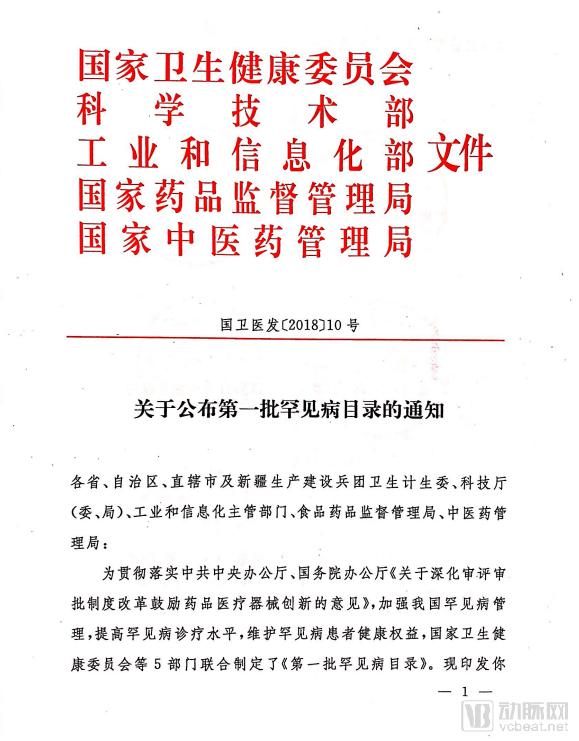
Formulating a Catalog of Rare Diseases to Promote Research on Rare Diseases
As early as the end of 2015, the Bureau of Medical Administration and Hospital Management under the National Health and Family Planning Commission established the Expert Committee on Diagnosis, Treatment, and Assurance for Rare Diseases, with its office set up at Peking Union Medical College Hospital. Leveraging expert expertise, the committee organized the development of relevant technical standards and clinical pathways to further strengthen research on the prevention, screening, diagnosis, treatment, and medication use of rare diseases. Since its establishment, the Expert Committee has convened multiple meetings to conduct repeated and in-depth discussions on rare diseases characterized by relatively high incidence, substantial disease burden, and strong treatability, thereby providing valuable expert guidance to relevant authorities in formulating the first batch of the National List of Rare Diseases.
The Committee Office coordinates expert resources from multiple parties and leverages the National Rare Disease Registry System—a platform rich in diagnostic, therapeutic, and research resources for rare diseases—to vigorously promote rare disease registration and clinical cohort studies. The resulting research findings can provide a basis for formulating the National Rare Disease List or standardizing the definition of rare diseases. Meanwhile, with the official release of the National Rare Disease List, large-scale registration and clinical research on related diseases will also be facilitated.
The release of the first batch of the Catalogue of 121 Rare Diseases provides important guidance and a basis for rare disease research communities in standardizing rare disease management, improving the level of diagnosis and treatment, and safeguarding the health rights and interests of patients with rare diseases. Meanwhile, it has aroused keen attention from all sectors of society, laying the foundation for further construction of scientific research infrastructure, collection of data on patients with rare diseases, and promotion of scientific and technological innovation, which is of great significance to the long-term development of rare disease research in China.
Implement Disease Registry Programs and Promote the Application of the Rare Disease Catalog
In the past, rare disease research in China was constrained by fragmented resources, resulting in overall weak research capacity and highly uneven clinical diagnostic and therapeutic capabilities. Consequently, the large volume of rare disease cases failed to be effectively translated into scientific advantages and clinical outcomes to benefit patients. In recent years, rare diseases have garnered increasing attention from both the government and the public, with social resources increasingly directed toward this field. Previously, the national "Healthy China" initiative was elevated to a strategic level, and rare disease research was incorporated into the National Key R&D Program during the 13th Five-Year Plan period. Led by Peking Union Medical College Hospital, the key special project on precision medicine titled "Clinical Cohort Study of Rare Diseases" was launched, and the National Rare Disease Registry System was established.
From the perspective of a national clinical research platform for rare diseases, the National Registration System will leverage a nationwide clinical service network for rare diseases to promote the comprehensive utilization of individualized patient information in China’s healthcare sector. This initiative aims to accelerate the accumulation of resources related to diseases listed in the Rare Disease Catalog and accurately assess the application prospects of the catalog in practice. The National Rare Disease Registration System has achieved nationwide coverage, and the collected data possess certain representativeness and specificity to the Chinese population, thereby providing important scientific evidence for the formulation of subsequent policies related to the Rare Disease Catalog.
Furthermore, socioeconomic conditions, market access, and reimbursement policies are the most critical factors determining whether patients can obtain therapeutic medications. By consolidating rare disease patients scattered across China onto a unified national platform through the National Rare Disease Registry System, significant benefits are realized for both surveys on the availability of rare disease drugs and the implementation of medical insurance reimbursement policies.
Encouraging Innovation and Sharing to Enhance the Diagnosis, Treatment, and Research of Rare Diseases
Professor Zhang Shuyang, Vice President of Peking Union Medical College Hospital and Principal Investigator of the National Key R&D Program project “Clinical Cohort Study of Rare Diseases,” stated that, as the National Center for Guidance in Diagnosis and Treatment of Complex and Critical Diseases designated by the National Health Commission, Peking Union Medical College Hospital possesses abundant clinical resources for the diagnosis and treatment of rare diseases and a solid foundation for clinical research.
In late 2016, the “Clinical Cohort Study of Rare Diseases” project under the National Key R&D Program of the 13th Five-Year Plan was officially launched. A national collaborative group for clinical research on rare diseases was rapidly established, covering seven regions across China and more than 20 large tertiary Grade-A hospitals, thereby forming a mainstay force in the diagnosis, treatment, and research of rare diseases.
Over the past year, the project team has spearheaded the establishment of China’s first national rare disease registration platform, developing a national clinical database and biobank for rare diseases based on innovative informatics technologies. The team has established clinical case reporting standards for more than 150 rare diseases and collected clinical data from over 15,000 cases across more than 80 rare diseases. Furthermore, by integrating superior domestic and international resources, the project team provides frontline clinicians and researchers with a comprehensive cohort study platform for rare diseases. This platform includes clinical genomics tools, a comprehensive rare disease knowledge base, and training in—and open-source access to—internationally mainstream standardized clinical terminologies and phenotype ontology tools. By creating a new collaborative research model characterized by active connectivity and synergistic innovation, the project aims to rapidly elevate China’s diagnosis, treatment, and research capabilities for rare diseases to world-class standards in the new era.