

China's First Health Medical Big Data Industry Alliance Signals the Era of National-Level Data Integration
Thanos, the unparalleled and formidable cosmic overlord, ravaged the entire universe alongside his Black Order to embed the six Infinity Stones into the Infinity Gauntlet. With this artifact, half of all life in the universe would be wiped out with a mere snap of his fingers. To save the world, Iron Man and Captain America once again joined forces to reassemble the Avengers, uniting with heroes such as Spider-Man, Doctor Strange, and the Guardians of the Galaxy to engage Thanos in a desperate, life-or-death confrontation.
The preceding paragraph outlines the plot of *Avengers: Infinity War*, currently a box-office hit. Meanwhile, in China, the health and medical big data industry has also formed a powerful industrial alliance with diverse expertise, spearheaded by national-level teams.
On May 16, Inspur initiated the establishment of China’s first Strategic Alliance for the Health and Medical Big Data Industry Ecosystem. The inaugural cohort of alliance members comprises more than 30 entities, including Xiamen Zhiye, Miaoyijia, Huajian Lanhai, Kangfuzi, Renhe Future, Shandong University, and Jinan Industrial Development Investment Group.
This signal inevitably sparks speculation: Has big data in health and healthcare entered a phase of consolidation under state-level teams? VCBeat’s reasoning stems, in no small part, from the moves made by CEC Data, another “state-level team” player.
In 2018, CE Health Fund successively invested in Medlinker, a real-name physician platform; Unisound, an AIoT and artificial intelligence service provider; Senyi Intelligence, a medical natural language processing company; and Chuanshi Technology, a supply chain technology enterprise in the pharmaceutical industry. The total investment amount for these four deals approached RMB 700 million.
It is evident that although these two health and medical big data companies frequently interact with healthcare enterprises, their approaches differ fundamentally. One adopts industrial alliance partnerships, while the other engages through equity investment. Based on their recent actions, VCBeat (WeChat ID: vcbeat) believes that the health and medical big data industry has officially entered a phase of consolidation led by “national teams.”
Recruiting "Teammates"
Inspire Group’s decision to establish such a high-profile ecosystem strategic alliance at this juncture is precisely grounded in a significant industrial backdrop.
On April 27, 2018, Ma Xiaowei, Director of the National Health Commission, issued a congratulatory letter, marking Shandong Province and Jinan City as China’s first pilot province and pilot city, respectively, authorized by the National Health Commission to assume responsibilities and rights in the collection, storage, development and utilization, security assurance, open sharing, management, “Internet+” services, and operation of health and medical big data.

This signing marks the official entry of the National Health and Medical Big Data Northern Center into the substantive construction phase, making Jinan the first pilot city in China to launch the construction of a National Health and Medical Big Data Center.
As a major health industry project operating under the framework of “national coordination, provincial overall responsibility, and municipal implementation,” the construction of the National Health and Medical Big Data Northern Center and its industrial park cannot be undertaken by Inspur alone. Therefore, establishing a strategic alliance for the health and medical big data industry ecosystem to pool collective strengths has become an imperative move.
Inspur Group officially describes the alliance as follows: Alliance members will leverage their respective strengths and unique capabilities in industry, platforms, technology, data, and solutions to foster in-depth collaboration in areas such as health intervention management, “Internet + Health” application services, and the integrated medical and elderly care health industry.
"Fill the gaps where they exist"—this is precisely the significance of an ecological strategic alliance.
From a technical perspective, Inspur Group’s capabilities primarily lie in open platform solutions, including leveraging technologies such as cloud computing, storage, K-DB database, and disaster recovery to empower the healthcare industry. Taking the joint solution for regional medical and health information platforms introduced on Inspur Group’s official website as an example:
This solution is provided by Inspur and XinYi InternationalJointly launched,Core business delivery includes:
Population Health Information Platform System;
Public Health Information Management System;
Basic Diagnosis and Treatment Information Platform System.
Based on the delivery of three core business lines, elastically deploy and orchestrate computing, storage, and network resources on a cloud-based management platform to support upper-layer applications; meanwhile, plan and implement an end-to-end security management system and operations and maintenance (O&M) system.
Furthermore, leveraging its hyper-converged InCloudRack architecture solution, Inspur has enabled integrated delivery of the Xinyi International Regional Medical Health Information Platform with computing, storage, networking, virtualization, database, and operations management capabilities, thereby achieving business integration, rapid deployment, on-demand scalability, and visualized operations and maintenance.
It is evident that within the overall solution, Inspur provides IaaS and PaaS-level infrastructure services, including cloud computing, storage, databases, and disaster recovery architecture. Meanwhile, Xinyi International is responsible for building the Medical Consortium Platform at the SaaS level, with both parties achieving deep integration across different technical dimensions.
Within the ecological strategic alliance, Inspur and other medical innovation enterprises may adopt positioning similar to this solution.
"Eight Immortals Cross the Sea, Each Showing Their Prowess"
To further clarify the synergy logic among healthcare companies within the alliance, VCBeat has categorized and organized the involved companies as shown in the figure below:
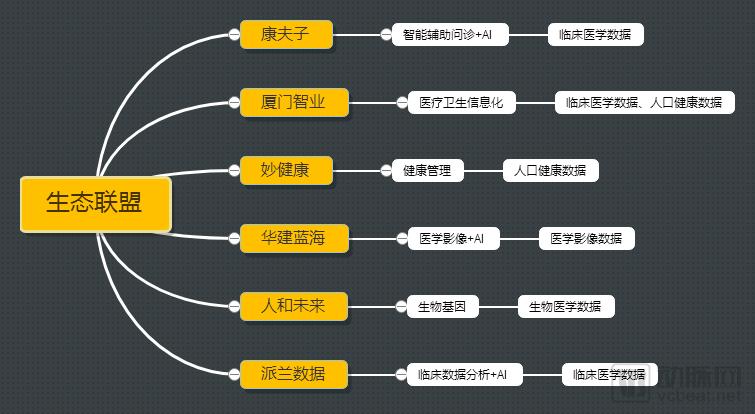
As can be seen from the types of enterprises involved, members of the ecological strategic alliance primarily cover companies in several major categories, including artificial intelligence, big data, bio-gene technology, medical informatization, and health management. In terms of the data categories involved, these companies encompass the most significant categories of healthcare big data, such as clinical medical data, population health data, medical imaging data, and biomedical data.
As a long-established domestic health IT vendor, Zhiye Software partnered with Inspur Group as early as September 2017 to establish Inspur Zhiye (Xiamen) Health and Medical Big Data Technology Co., Ltd. According to data available in the National Enterprise Credit Information Publicity System, the company has a registered capital of RMB 25 million, jointly contributed by Inspur Group and Zhiye Software.

Source: National Enterprise Credit Information Publicity System
The strong partnership between the two companies will further expand their respective market reach.
Among other enterprises, Kangfuzi’s core team hails from Baidu’s Natural Language Processing Department, bringing extensive R&D expertise in areas such as information extraction, knowledge graphs, and semantic dialogue understanding.
The collaboration between Kangfuzi and Inspur will leverage the data resources of Shandong Health and Medical Big Data Co., Ltd., the platform service operator advantages of Inspur’s nationwide “Inspur Health and Medical Big Data Cloud Platform,” as well as Kangfuzi’s expertise in medical data governance, AI-powered robotic doctor applications, and artificial intelligence technologies, to jointly advance the implementation of Healthy China and smart healthcare initiatives.
As the technology provider for clinical big data analytics management, healthcare big data application solutions, and artificial intelligence platforms, the collaboration between Pailan Data and Inspur Group mainly includes the following aspects:
1. Collaborate in areas such as health and medical big data processing, integrated cloud platforms for clinical research on health and medical big data, management of chronic and rare diseases, intelligent clinical decision support, and precision medicine, to jointly provide big data-driven cloud analytics services for scientific research to various types of clients.
2. Inspur Group will fully leverage its globally leading advantages in core areas such as servers, cloud computing, and big data platforms, as well as its strengths in autonomous and controllable security solutions. It will continue to intensify innovation efforts and advance big data platforms and application services based on technological innovations in cloud services, big data, and artificial intelligence;
3. Both parties shall use “Inspur Pailan” as the brand name for their collaborative services, releasing scientific research application service products on the Inspur Health Medical Big Data Platform to better serve medical, pharmaceutical, and research institutions with advanced technologies and solutions, while jointly expanding the market across China.
As a representative of biological genetics within the alliance, Renhe Future Biotechnology was founded in San Diego by a team of young North American scientists. The company initiated clinical translational research on genetic testing in 2009 and was formally established in Beijing in 2014. It is a healthcare solutions provider centered on genetic technology. Its collaboration with Inspur effectively complements the research and practical application of big data in biological genetics.
It is also worth mentioning Miao Health, a health management company under the Sanpower Group.
Data collected during patients’ in-hospital visits do not constitute the entirety of medical big data. Out-of-hospital human physiological data reflect various aspects of patients’ daily routines, lifestyle habits, physiological changes, potential lesions, disease progression, medication frequency, and rehabilitation status, and thus also hold clinical value in medicine.
Historically, acquiring big data on out-of-hospital health and health-related behaviors has been challenging. Hospitals often rely on follow-up visits to collect such data; however, due to the heavy workload of healthcare professionals and poor patient compliance, the quality and completeness of these data collections have been suboptimal.
With the widespread adoption of smartphones, wearable devices, and other products, non-medical-grade health monitoring solutions have experienced significant growth. Individuals across various health statuses—including those who are healthy, in a sub-health state, or managing chronic conditions—can now conveniently monitor their health metrics using these devices.
Therefore, in the application of big data, leveraging the Internet of Things (IoT), wearable devices, and other technologies to continuously monitor and collect patient data during and after clinical visits has become a critical strategy for bridging the data gap between diagnosis and treatment phases, thereby establishing a closed-loop big data ecosystem.
In early 2016, Miao Health launched “Miao+,” an open platform for health data and services. To date, the platform has integrated data from over 300 smart devices across major mainstream brands. It also incorporates various health-related data types, including physical examination results, genetic information, and insurance records, enabling comprehensive out-of-hospital health monitoring and management for users. Furthermore, “Miao+” has accumulated hundreds of health metrics and behavioral data points covering more than ten physiological systems, such as the circulatory, digestive, and respiratory systems. This robust data foundation facilitated the partnership between Miao Health and Inspur Group.
Electronic Health Card — The Origin of the “Holographic Digital Human”
Nowadays, “Healthy China” and “Internet Plus Healthcare” have been elevated to national strategies, with Shandong Province further designating the integrated medical and elderly care health industry as one of its ten key industries. The establishment of the Health and Medical Big Data Industry Ecosystem Strategic Alliance has inspired Inspur to pursue more futuristic and “bold” ambitions.
Inspur stated that it would focus on creating “holographic digital humans,” leveraging cloud services, big data, and artificial intelligence to innovate its big data platform and application services. It aims to accelerate the secure and convenient sharing of patient information through electronic health cards, deliver precise online and offline services for conditions and populations such as hypertension, diabetes, pregnant women, and infants, and foster the integrated development of smart healthcare, rehabilitation, elderly care, medical devices, and AI. This effort seeks to build a new ecosystem for integrated medical and elderly care services powered by big data.
As early as March this year, a symposium for information centers of pilot units for the Electronic Health Card was held at the Jinan Municipal Health and Family Planning Information Center. At that time, Li Jie from the Information Center emphasized the importance and urgency of the pilot work for the Electronic Health Card, as well as the next steps. He required the information centers of all participating units to report to their main leaders and make advance plans to ensure the smooth implementation of the pilot tasks.
At the meeting, Shanda Digiwin provided a technical presentation on the “Implementation Plan for Virtualized Applications of Jinan Resident Health Cards” and outlined the next steps for the pilot units.
In May, also in Jinan, at the recently concluded 2018 CHITEC conference, the Electronic Health Card was used for the first time as an entry credential for attendees. As of the publication date of the article by the National Public Service Platform for Resident Health Cards, a total of 14,138 representatives attended the conference, among whom 9,424 were registered electronically, and on-site card swipes reached 14,818 times.
According to the latest data from the National Public Service Platform for Resident Health Cards, as of May 2018, 22 provinces and municipalities across China, including Jiangsu, Sichuan, Qinghai, Fujian, Wuhan, Jiangxi, Anhui, and Hebei, had completed the initial issuance of electronic health cards. Jinan, Shandong Province, home to the National Northern Center for Health and Medical Big Data, is undoubtedly among them.
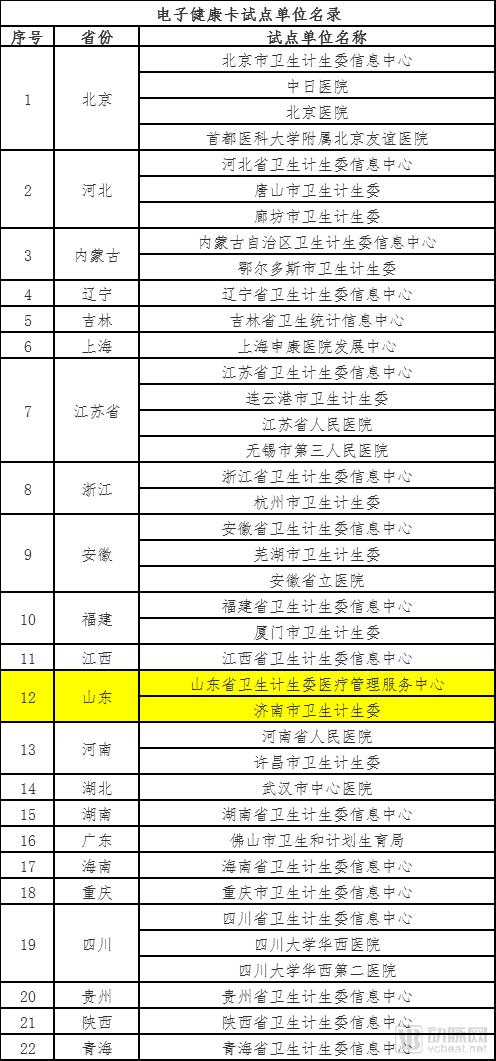
Data Source: National Public Service Platform for Resident Health Cards
The so-called holographic digital human is designed to visualize all cases in the health and medical big data center, enabling real-time display of various vital signs and specialized omics data. By capturing diverse imaging materials and all data generated during production, daily life, and biological processes, accurate and reliable health and medical alerts can be provided to residents.
Each holographic digital human should possess a unique identity identifier. Currently, the electronic health card serves as this unique identity identifier. Therefore, Inspur’s exploration of “holographic digital humans” is fundamentally based on the electronic health card.
In a report by HIT Expert Network, Zhou Gongwei, Deputy Director of the Statistical Information Center of the National Health and Family Planning Commission and Deputy Secretary-General of the Chinese Society for Health Informatics and Medical Big Data, categorized the functions of the electronic health card into three main aspects.
First, health services, comprising 14 major categories and 37 sub-items, such as pre-consultation, during-consultation, and post-consultation services for outpatient and emergency care, inpatient services, referral services, emergency medical services, reproductive health service management, and personal health record services; second, health security, comprising 7 major categories and 18 sub-items, such as medical care guarantees for impoverished populations, management of relief fund disbursement, special assistance for family planning households, and commercial insurance; third, healthy living, comprising 10 major categories and 36 sub-items, such as health examination services, health education services, health management services, disease prevention services, and financial wellness services.
It can be seen that the information contained in the electronic health card includes not only clinical diagnosis and treatment data within hospitals, but also out-of-hospital health data and financial data. The collection and application of these data are closely related to the services provided by members of the Inspur Health Medical Big Data Industry Ecosystem Strategic Alliance.
Leverage Industry Alliances to Generate Synergies
The “industry-city” model is both a hot opportunity and an emerging trend.
Focusing on industry, providing diversified industrial services around the government's needs for urban planning, industrial upgrading, and economic development, and cultivating core competitiveness in the field of industry-city integration is currently the mainstream trend in the industry.
In terms of specific project operations, lead enterprises (such as Inspur Group) often adopt an “industry alliance” model to engage in strategic cooperation with industry partners, due to their limited industrial resources. Under this arrangement, some enterprises are responsible for development and construction, while other industry resource providers handle the introduction, cultivation, and operation of industrial resources. From VCBeat’s perspective, the operation of the Health and Medical Big Data Industry Ecosystem Strategic Alliance led by Inspur Group also follows this mainstream model.
Taking real estate giant Country Garden as an example, to accelerate the implementation of its industry-city integration strategy, its partners mainly fall into five major categories:
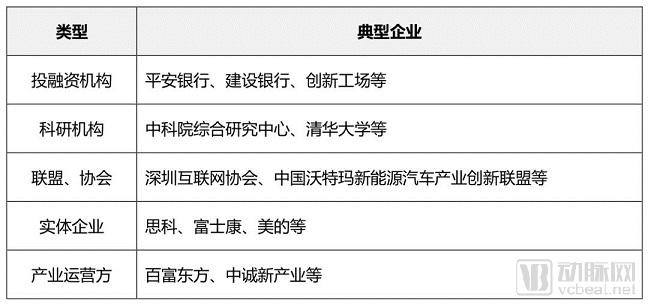
Country Garden Industry Alliance Partners | Image Source: E-House Think Tank
Since the project’s inception in August 2016, the Alliance has secured strategic residency partnerships with companies including Cisco, Sinovation Ventures, Inspur Group, and iSoftStone. Partners signed to provide industrial resource introduction services for the town include the Shenzhen UAV Association, the Shenzhen Security & Protection Industry Association, and the Information Center of the Ministry of Industry and Information Technology.
Similar to the Country Garden Industrial Alliance, the Health and Medical Big Data Industry Ecosystem Strategic Alliance, led by Inspur Group, also plans to attract top global health and medical internet enterprises, big data research institutions, and healthcare organizations to join, aiming to build an ecosystem service and industrial collaborative development system oriented toward comprehensive health.
In addition to the publicly mentioned medical technology companies such as Xiamen Zhiye, Miaoyijia, Huajian Lanhai, Kangfuzi, and Renhe Future, member units including Shandong University and Jinan Industrial Development Investment Group have also drawn parallels with partners in the Country Garden Industrial Alliance, such as investment and financing institutions and research organizations.
As some experts have stated, the establishment of industrial alliances must be grounded in project implementation and the actual introduction of invested enterprises. Only by thoroughly studying national development directions and regional development needs, and by building industrial alliances with broad coverage and strong feasibility, can we continuously introduce high-tech innovations that drive urban development and enhance regional value. Only by solidifying the industrial foundation can we expand the scope for future development.
VCBeat believes that the establishment of the Industrial Ecosystem Strategic Alliance is poised to integrate the previously fragmented and siloed healthcare data. Through internal collaboration within the alliance, multidisciplinary and multi-dimensional scattered medical data will be consolidated and leveraged, then standardized and regulated, to unlock data value with a patient-centric approach.
“The Infinity Stones have been assembled”: The industrial ecosystem strategic alliance led by Inspur Group may herald the beginning of a transformation.
References:E-House Think Tank — How to Build an Industrial Alliance Like Country Garden?