

Syrebo Launches China's First Soft Exoskeleton for AI-Assisted Movement Rehabilitation
With the accelerating aging of China’s population, the number of stroke patients continues to rise. According to data published in the 2017 Report on Stroke Prevention and Treatment in China, there are approximately 2.46 million new stroke cases annually in China, with a continuous annual increase of 8.7%. Among them, up to 75% of stroke survivors experience varying degrees of motor dysfunction.
According to the industry report on rehabilitation center robotics (including rehabilitation robots, active prosthetics, robotic exoskeletons, etc.) released by the authoritative U.S. firm Wintergreen Research, the market size in the United States is projected to reach $1.8 billion in 2020. As a country with a large population, China holds even greater market potential.
China’s rehabilitation medical industry remains in its early stages of development, with a severe mismatch between the vast and urgent market demand and the current realities of limited capital investment, a small number of rehabilitation institutions, their modest scale, and lagging equipment R&D.
The rising number of patients with motor dysfunction is driving continuous expansion of the postoperative rehabilitation market, while limited rehabilitation venues and facilities are clearly insufficient to meet such demand. Both hospitals and patients hope for the emergence of a device that assists patients in rehabilitating at home, thereby alleviating patient flow pressure on hospitals and optimizing the rehabilitation experience for patients.
Therefore, the market urgently needs an affordable, technologically innovative rehabilitation robot to fill this gap.
Against this backdrop, Shanghai Siyi Intelligent Technology Co., Ltd. (hereinafter referred to as “Siyi Intelligence”), established in September 2017, has pioneered innovative applications of soft robotics technology in the field of rehabilitation, providing comprehensive solutions for motor function recovery and compensatory techniques for post-stroke patients.
Siyi Intelligence is located in Zhangjiang Hi-Tech Park, a national high-tech industrial development zone. In its early stages, the company secured funding from the Shanghai College Student Entrepreneurship Foundation, and its lower-limb soft exoskeleton has recently been approved as a project by the Shanghai Municipal Science and Technology Commission. Within less than a year, Siyi Intelligence launched two rehabilitation robotics products: a soft robotic rehabilitation glove and a bionic soft exoskeleton robot. The company’s name draws inspiration from the mythological archer Hou Yi, who shot down the suns, symbolizing that its products empower users to be strong and robust like Hou Yi.
Traditional lower-limb rehabilitation robots feature complex structures and high costs. The well-known Lokomat lower-limb rehabilitation robot is priced at RMB 3 million in China, while the 7-degree-of-freedom exoskeleton Flexbot, developed by Jinghe Technology, is priced at RMB 1 million. Although these rehabilitation robots demonstrate significant efficacy, their bulky design prevents them from being worn for ambulation.
Existing wearable exoskeleton products launched by companies typically weigh more than 12 kilograms and are priced at RMB 300,000 or higher. Such exoskeletons facilitate rehabilitation training by driving the human body through a fixed gait pattern, and are generally used in rehabilitation centers.
After analyzing the market, Siyi Intelligence identified a substantial market opportunity for non-fixed soft robots designed to assist patients with activities of daily living (ADLs), and subsequently initiated research and development efforts in this area.
At the BIO-FORUM 2018 conference held on May 24, Siyi Intelligence launched EasyWalk, China’s first lower-limb soft exoskeleton.TM, this product weighs less than 3 kilograms and is priced at only tens of thousands of yuan. It is lightweight and portable, featuring no rigid frame and relying primarily on textile-based fixation, making the entire device light and easy to handle.
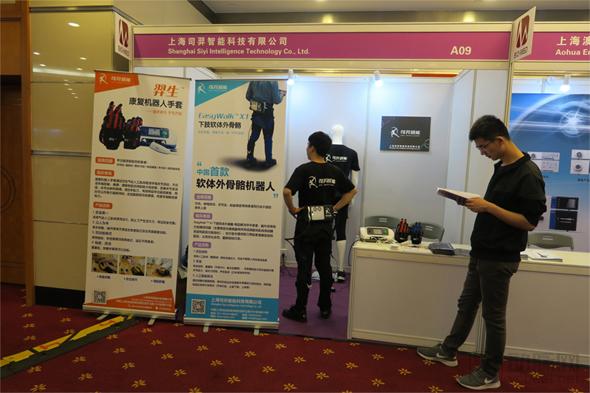
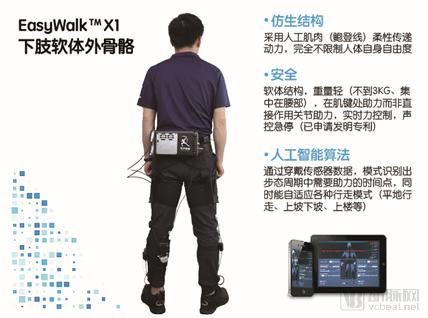
This soft exoskeleton robot provides assistance at the tendons, features real-time force control, and includes voice-activated emergency stop functionality (patent pending). Patients can easily carry this product for daily activities, thereby liberating them from the constraints of traditional robotic systems.
In terms of functionality, this soft exoskeleton currently provides effective assistance to stroke patients. Additionally, it is suitable for individuals with cerebral palsy, Alzheimer’s disease (senile dementia), multiple sclerosis, Parkinson’s disease, and age-related mobility impairments.
The above design stems from the open philosophy of researchers at Siyi Intelligence. Yin Gang, General Manager of Siyi Intelligence, told VCBeat: “Siyi Intelligence has launched EasyWalk, a lower-limb soft exoskeleton.”TMX1 does not feature a rigid frame; instead, it adopts a “motor + cable-driven” architecture. Its assistance principle mimics human muscle contraction: straps are secured around the user’s calf muscles, and power is transmitted via Bowden cables (similar to bicycle brake cables). To deliver precise assistance, Siyi Intelligence’s soft exoskeleton employs sensors such as foot pressure sensors, accelerometers, and gyroscopes to measure the wearer’s leg velocity and angle, thereby predicting movement in real time and providing rapid, on-demand assistance with accurate timing. Furthermore, the robot leverages artificial intelligence algorithms to analyze wearable sensor data, identifying the specific moments within the gait cycle that require assistance through pattern recognition, while also adapting autonomously to various walking modes (level walking, ascending and descending slopes, stair climbing, etc.).
Siyi Intelligence is currently collaborating with Director Wu Yi from Huashan Hospital and Professor Peter Shull from Shanghai Jiao Tong University on EasyWalkTMCollaborate on the product technology, safety testing, and clinical efficacy of X1 to obtain CFDA certification and achieve commercial application as early as possible. We believe that in the future, even healthy individuals will be able to easily carry this product for daily activities, or wear it while outing and mountain climbing.
Fingers are endowed with a wide range of motor functions; therefore, restoring finger function is of significant importance for patients’ psychological well-being and the recovery of their ability to perform activities of daily living independently. The rehabilitation robotic glove developed by Siyi Intelligence has established a close collaboration with the Department of Rehabilitation at Huashan Hospital in Shanghai, and has received guidance and endorsement from Professor Jia Jie, Director of the Department of Rehabilitation Medicine at Huashan Hospital, Fudan University, in terms of clinical application.
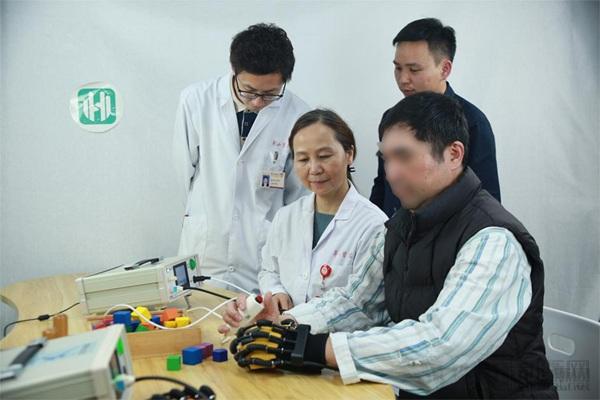
For symptoms such as finger spasms, numbness, and paralysis, YishengTMSoft robotic rehabilitation gloves drive finger joint movement through biomimetic pneumatic artificial muscles, significantly improving symptoms such as finger spasticity, paralysis, and hemiplegia. While effectively aiding the rehabilitation of various hand functions, this product also acts on cerebral nerves to promote motor recovery.
Siyi Intelligence pioneers the use of bionic pneumatic artificial muscle flexible actuators to power its rehabilitation glove, offering a safe and lightweight solution that moves away from the cold, rigid mechanical structures of the past. Meanwhile, the compact size and light weight of the robotic rehabilitation glove enable patients to begin bedridden rehabilitation training earlier, thereby improving rehabilitation outcomes.
YishengTMSoft rehabilitation robotic gloves assist patients in performing various training modes, including active training, passive training, gamified training, and contralateral training, while also enabling rehabilitation assessments. Their IoT capabilities allow real-time upload of patient rehabilitation data to the cloud, facilitating remote guidance by physicians based on this data.
Currently, this rehabilitation robotic glove is undergoing simultaneous research and clinical trials in the rehabilitation departments of multiple hospitals. The product has been submitted to the Shanghai Medical Device Testing Institute for testing. It is expected that the application materials for clinical trials will be submitted by the end of 2018, with CFDA certification anticipated in 2019. In the future, in addition to hospital sales, the rehabilitation glove will adopt a combined leasing and retail model to tap into the blue-ocean market of home-based rehabilitation.
Shanghai Siyi Intelligent Technology Co., Ltd. currently has a team of nearly ten members, including technical professionals from the fields of mechanical engineering, electronics, software, and rehabilitation engineering, all of whom are graduates of top-tier universities in China.
SiYi’s founder, Yin Ganggang, has nearly a decade of experience in the robotics industry. Since 2014, he has been engaged in the research and development of rehabilitation robots, successively developing cutting-edge products such as rigid exoskeletons, robotic nursing beds, and intelligent walking assistants for Japanese enterprises and universities. Upholding internationally advanced rehabilitation equipment and concepts, he possesses an in-depth understanding of the current state of the rehabilitation industry both in China and abroad.
The company has established long-term collaborative partnerships with research institutions and hospitals such as Huashan Hospital Affiliated to Fudan University, Shanghai Jiao Tong University, and Shanghai Tenth People’s Hospital. In response to the demands of clinical medical applications, it develops rehabilitation robotic products that possess genuine clinical value and can effectively benefit both patients and physicians, thereby accelerating the R&D, sales, and promotion of new products.
In March 2016, the National Health and Family Planning Commission, in conjunction with five other departments, issued the "Notice on Including Additional Medical Rehabilitation Services in the Basic Medical Insurance Reimbursement Scope," which added 20 new rehabilitation services, including "comprehensive rehabilitation assessment," to the insurance reimbursement list, expanding upon the original nine covered services.
According to the “Report on Development Prospects and Investment Forecast Analysis of China’s Rehabilitation Medical Industry” released by Qianzhan Industry Research Institute, the market size of China’s rehabilitation medical industry was approximately RMB 27 billion in 2016.
With China’s continued efforts to deepen healthcare service reforms, improve the three-tier rehabilitation medical system, and further implement insurance policies related to rehabilitation care, the market size of China’s rehabilitation medical sector is projected to exceed RMB 70 billion in 2020, with a compound annual growth rate (CAGR) of no less than 20%.
National policies are increasingly supporting social capital in healthcare and private rehabilitation institutions, with China’s aging market poised to become the next frontier for rapid growth.
Rehabilitation hospitals are highly favored by social capital due to their advantages of low talent requirements, short profitability cycles, and ease of replication and expansion, creating significant development opportunities for domestic products.
Soft exoskeleton robots are not only suitable for institutional users such as rehabilitation centers, but also show great potential in popularization among individual users. In this context, Siyi Intelligence will seize the opportunity, devote itself to research and development, and serve patients.