

Subtle Medical Secures $5M Pre-A Funding to Enhance Medical Imaging Efficiency and Reduce Radiation Dose by Up to 100x Using AI
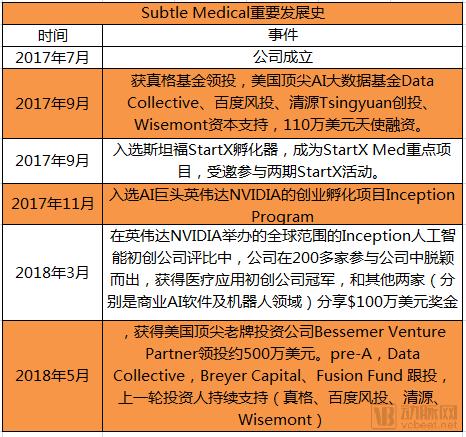
VCBeat (WeChat ID: vcbeat) has learned that Subtle Medical, a medical AI company specializing in medical image enhancement, recently secured approximately $5 million in Pre-A series financing.
The lead investors in this round were the top U.S. venture capital firm Bessemer Venture Partners and seed-round investor Data Collective, with follow-on investments from Breyer Capital and Fusion Fund. Angel investors ZhenFund, Baidu Ventures, Qingyuan Venture Capital, and Wisemont Capital continued their support.
This funding round came just two months after Subtle Medical won the NVIDIA Inception Program Challenge.

Group Photo of the Subtle Medical Team with Jensen Huang
Subtle Medical is committed to making imaging workflows more efficient, safer, and smarter. The company leverages deep learning algorithms to enhance the quality and diagnostic value of medical images, while reducing scan time, risks, and costs. Subtle Medical has achieved significant success in major imaging modalities such as MRI and PET.
Subtle Medical founder Enhao Gong told VCBeat that the funds from this round will primarily be used for three purposes:
1. The funds will be used for approvals from the U.S. FDA, China’s NMPA, and the European CE marking. The company’s product is expected to receive FDA clearance by the end of this year.
2. Expand the AI imaging development team and broaden the scope of collaboration on clinical products.
3. Complete the layout of the medical industry chain. Building on its existing partnerships with over a dozen top-tier medical institutions in the United States, Subtle Medical will engage in strategic collaborations with more healthcare providers and manufacturers globally, while gradually expanding its operations in Europe and China.
High Costs and Low Efficiency of Medical Imaging Examinations in the United States
CB Insights’ latest healthcare consumer report indicates that total U.S. healthcare expenditure amounts to approximately $3 trillion, accounting for over 17% of GDP. Medical imaging alone constitutes 10% of total healthcare costs. Behind these high expenditures lies significant room for improvement.
Gong Enhao told VCBeat that in the United States, the charge for a magnetic resonance imaging (MRI) scan ranges from $1,000 to $2,000, while a positron emission tomography (PET) scan costs several thousand to over ten thousand dollars. Only about 10% of this fee is used to pay for the radiologist’s diagnostic services, with the remaining 80%-90% covering the procurement costs of equipment, maintenance expenses, and the costs associated with the entire duration of the imaging procedure. In addition to the high costs, long appointment wait times not only inconvenience patients but may also delay disease diagnosis.
Therefore, improving efficiency is of great importance to both hospitals and patients, provided that diagnostic quality is not compromised.
Because conventional methods for shortening imaging time severely degrade image quality and compromise diagnostic accuracy, the problem of prolonged imaging examination times has remained unresolved for many years.
Gong Enhao told reporters that Stanford University had developed compressed sensing technology more than a decade ago to improve the efficiency of MRI examinations. Currently, major medical imaging equipment companies have their own similar technologies, many of which have received FDA approval and entered the healthcare market. However, in practical applications, physicians have not fully embraced this technology based on fixed models and statistical algorithms, primarily because its advantages in image quality and computational efficiency fail to meet clinical needs.
Interdisciplinary Teams Deepen Research and Clinical Translation
Bridging the translational gap between scientific research technologies and clinical applications requires not only professional technical development capabilities but also an understanding of clinical pain points. The core members of the Subtle Medical team all possess dual backgrounds in medicine and engineering.
Company founder Gong Enhao graduated with a bachelor’s degree in Biomedical Engineering from Tsinghua University in 2012. During his undergraduate studies, he collaborated with scientists at Philips to optimize compressed sensing technology, publishing multiple papers and patents. In 2012, he enrolled in the Ph.D. program in the Department of Electrical Engineering at Stanford University, where he further explored research in the field of magnetic resonance imaging (MRI). During this period, he recognized the substantial clinical demand and market potential in this area, as well as the disconnect between academic research projects and practical clinical applications.
Since early 2016, Gong Enhao has leveraged his solid foundation in deep learning and artificial intelligence, cultivated during his years at Stanford University, to conduct research on the application of deep learning techniques in medical image post-processing, image reconstruction, and computer-aided diagnosis.
In July 2017, Gong Enhao officially registered and established Subtle Medical together with Dr. Greg Zaharchuk, a Professor of Radiology at Stanford University School of Medicine, a neuroradiologist, and the Director of the Center for Advanced Neuroimaging, with whom he had long collaborated. Subsequently, two Tsinghua University biomedical engineering alumni, Zhang Tao and Zhu Liren, who were engaged in medical imaging research in the United States, joined the company one after another.
Dr. Tao Zhang previously developed magnetic resonance imaging technologies at GE Healthcare and held a faculty position at The University of Texas MD Anderson Cancer Center. Dr. Liren Zhu has extensive academic and industry experience in multimodal imaging.
As a graduate in biomedical engineering, Gong Enhao stated that this major is characterized by a strong integration of medicine and engineering. Students are required to leverage engineering knowledge while mastering foundational medical concepts, and to address clinical needs by applying engineering technologies to solve clinical problems. Therefore, the training provided by this program is highly suitable for research and professional roles in the medical artificial intelligence industry.
The founding teams of numerous medical AI companies, both in China and abroad, have professional backgrounds in biomedical engineering, with many being alumni of Tsinghua University’s Biomedical Engineering program.
Simultaneously Enhancing Imaging Efficiency and Reducing Radiation Dose
Subtle Medical’s inaugural product leverages AI to enhance the quality and efficiency of medical imaging diagnosis, empowering hospitals and imaging centers. As a team composed of AI experts and radiologists, Subtle Medical does not aim to replace radiologists.Focusing on addressing the pain points that impact actual work efficiency, the company aims to make imaging examinations more efficient, cost-effective, safer, and intelligent.. Subtle Medical provides AI-powered imaging processing platforms for hospitals and imaging centers, with its inaugural product offering multiple functionalities.
Enhance Imaging Speed and Improve Image Quality: The product leverages AI to improve the image quality of MRI (Magnetic Resonance Imaging) and PET (Positron Emission Tomography) scans, thereby achieving a 2–4× acceleration in MRI and a 4–10× acceleration in PET on top of existing imaging equipment hardware and software.
Gong Enhao emphasized that, at the current stage, Subtle Medical primarily focuses on processing MRI and PET (including PET-CT and PET-MR) images. In these fields, Gong’s laboratory at Stanford University has accumulated decades of experience in research and industry collaboration, resulting in substantial data reserves and expertise. From the perspective of clinical needs, MRI and PET imaging are the slowest modalities, making the pain points for physicians and patients particularly pronounced. MRI provides superior visualization of soft tissues and contrast resolution. Meanwhile, PET-CT and PET-MR enable molecular and functional imaging, holding significant value in many clinical examinations, such as early cancer screening and staging.
Reduce radiation dose and shorten examination time: While enhancing imaging speed and quality, Subtle Medical is also leveraging technology to reduce the use of radiopharmaceuticals, cutting contrast agent usage by at least 10-fold and radiation exposure by 100-fold. PET-CT, PET-MRI, and PET all require radiopharmaceuticals and carry radiation risks; in particular, the radiation dose from a PET-CT scan is several times higher than that of a head CT. Gong Enhao stated that in a recently published paper, his team at Stanford University demonstrated that radiation doses could be reduced by 100–200 times while maintaining image quality. In clinical practice, the goal is to reduce radiation doses to at least one-tenth of the original level while ensuring diagnostic image quality.
Meanwhile, Subtle Medical’s system can be used simultaneously to achieve two goals: accelerating imaging examinations and reducing radiation dose.
Product Embedded in Physician Workflow
Gong Enhao stated that while developing product quality, they also consider physicians’ workflow to avoid adding to their burden.Subtle Medical applies AI technology to the very front end of imaging examinations. Imaging data flows directly from the equipment into their system, where it is processed before being sent to the PACS imaging workstation. Physicians view the AI-processed images, while their workflow remains unchanged, imposing no additional burden on them.
Precisely because Subtle Medical’s system is deployed at the front end of imaging examinations, it has access to first-hand medical imaging data.Their partners can include medical imaging equipment manufacturers, PACS system vendors, and healthcare AI companies.For these three companies, the ability to maintain or even enhance image quality while reducing radiation dose, without adding to physicians’ workflow, is highly attractive.
Gong Enhao stated,The company’s first FDA (Class II 510(k)) product is expected to receive clearance in October–November 2018. Subsequently, the company will continue to pursue multiple FDA applications to continuously expand its product portfolio. By optimizing imaging examination workflows as a breakthrough point, it aims to build an AI-powered medical imaging platform to streamline image acquisition and analysis processes.
Gong Enhao told reporters that the company pursued Class II certification because Subtle Medical aims to reduce the cost of imaging examinations and shorten examination time by enhancing the quality of medical images, thereby assisting physicians in making diagnoses. Since the specific performance indicators can be quantitatively assessed and the product itself does not directly provide diagnostic results, Class III certification was not required.
Backed by Millions of High-Quality Medical Images from Stanford
The development of models using deep learning technology is inseparable from the support of high-quality big data, and Subtle Medical is no exception. Gong Enhao introduced that, as the company originated from Stanford University, it was granted exclusive authorization to use three patents and a vast amount of medical imaging data (with a rough estimate of over two million medical images used recently, primarily MRI, PET/CT, and PET/MR scans). Both the patents and the data were research achievements produced by their team at Stanford.
In addition to the data accumulated through routine scientific research by these Stanford researchers, Subtle Medical is also collaborating with renowned U.S. hospitals and third-party imaging centers to utilize their clinical data, while ensuring privacy protection and regulatory compliance.
It is worth mentioning that,Unlike domestic medical AI companies that hire large teams of physicians to annotate data, Subtle Medical designs, acquires, and processes specific medical imaging datasets according to research needs, converting them into the data required for R&D.
Gong Enhao stated that acquiring a complete set of medical imaging data often requires an hour or more, can only be achieved with high quality in a research setting, and places substantial demands on researchers’ imaging expertise.
Such a vast amount of data cannot be acquired overnight; it has been accumulated by Stanford researchers over many years. Furthermore, the quality of this data has been validated through scientific research over the years.
Regarding the disease types involved, Gong Enhao stated,Subtle Medical’s research focuses on modality-specific studies rather than disease-specific ones, with its products dedicated to image enhancement and post-processing.. For diseases that undergo routine examinations using radiological equipment such as MRI, PET-CT, PET-MRI, and PET—including stroke, brain tumors, lung cancer, and Alzheimer’s disease—they can provide image enhancement services.
Accelerate Market Expansion, Product Commercialization, and Partnerships
Currently, Subtle Medical has embarked on its international market expansion.
Subtle Medical focuses primarily on the U.S. market, where it has established collaborations and conducted clinical system testing with more than ten leading medical institutions, hospitals, and third-party imaging centers. Partners include Stanford University, UCSF (University of California, San Francisco School of Medicine), MD Anderson Cancer Center, Mayo Clinic, OHSU (Oregon Health & Science University), Hoag Hospital, and RadNet, the largest imaging center network in the United States.
In the industry, Subtle Medical is also actively collaborating with Neusoft Medical, NVIDIA, and other medical imaging and artificial intelligence companies to jointly develop and optimize AI-based medical image processing technologies.
This round of financing will also accelerate market expansion and product commercialization.