

ReActive Robotics Files for IPO Highlighting VEM Therapy That Reduces ICU Stay by 1 Day and Hospitalization by 3 Days

ReActive Robotics
Early-stage Rehabilitation Robot Developer
In an era marked by a shortage of healthcare professionals, the development and application of novel therapeutic technologies are crucial to meeting patient needs and enhancing industry efficiency. As the world’s first company to implement Very Early Mobilization (VEM) therapy, ReActive Robotics GmbH provides hospitals and patients with efficient, high-quality, and cost-effective intelligent medical services, committing to reduce the length of hospital stays for ICU patients. VCBeat has reported on the company.
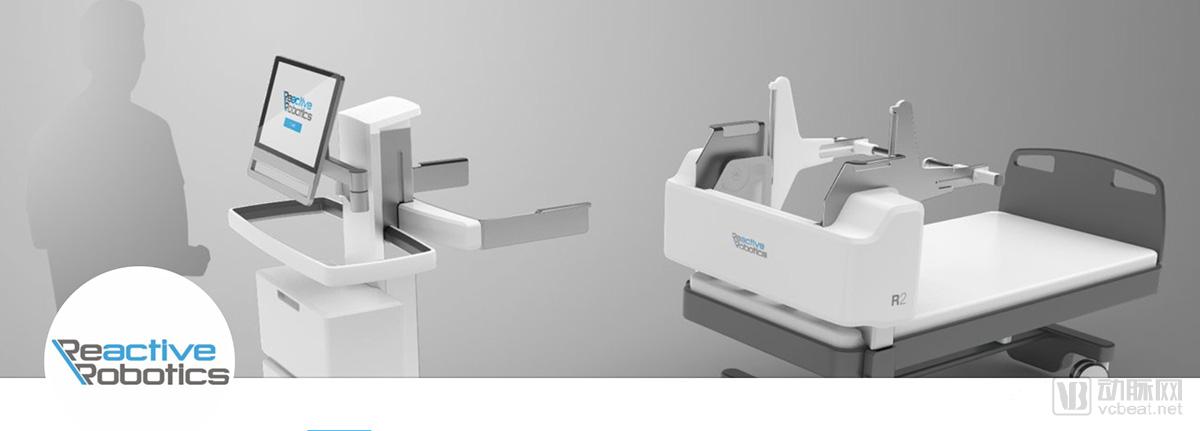
ReActive Robotics, founded in Munich, Germany in April 2015, is dedicated to providing automated ultra-early (within 48 hours post-surgery) gait rehabilitation solutions for patients undergoing neurosurgical or joint replacement procedures. This approach ensures full utilization of the critical window for rehabilitation, accelerates patient recovery, and reduces ICU costs. Clinical trials have demonstrated that ReActive Robotics enables patients to be transferred out of the ICU one day earlier on average and shortens hospital stays by three days.
In September 2017, ReActive Robotics secured a Series B funding round of millions of U.S. dollars (the exact amount was not disclosed), with investors including MTIP MedTech Innovation Partners AG, High-Tech Gruenderfonds, Bayern Kapital, and TQ-Group. Reportedly, the funds will be used for robotic product development and market expansion. According to information provided by Crunchbase, ReActive had raised $1.5 million in its Series A funding round in June 2016, with the same investors participating in both the Series A and Series B rounds.

Generating Startup Ideas from Years of Research Experience
Alexander Koenig, Founder and CEO of ReActive Robotics, stated that his eight years of experience in the field of robotics for stroke patient rehabilitation laid a strong foundation for his subsequent career in clinical R&D, engineering, and entrepreneurship.
During his doctoral studies at ETH Zurich, Koenig played a key role in orchestrating the MIMICS project and contributed to the development of the “Bio-Cooperation” initiative, a €1.6 million project focused on robot-assisted gait rehabilitation.
Meanwhile, during his tenure as a postdoctoral fellow at Harvard Medical School, Koenig conducted an in-depth analysis of motor conditions in stroke patients and summarized underlying patterns. Aiming to develop personalized intervention strategies, he employed patient data-driven theoretical models to elucidate the process of gait recovery after stroke and predict parameters reflecting patients’ responsiveness to specific interventions.
In February 2011, he joined OmniCompete, a London-based startup in the United Kingdom, where he was primarily responsible for projects related to medical technology, robotics, satellite navigation, and synthetic biology. During this period, Koenig gained valuable startup experience.
Koenig stated that while working as an engineer in hospitals across Switzerland, Germany, and the United States, he recognized the demographic trends of an aging society and the growing shortage of nurses and therapists. As patient numbers rose, society lacked sufficient healthcare professionals, resources, and equipment to provide adequate care. To enhance the efficiency of clinicians so they could continue delivering optimal patient care, Koenig decided to leverage robotics technology to augment traditional medical practices, thereby helping patients recover more quickly and effectively.
With this concept in mind, Koenig and his team initiated their research by focusing on conditions associated with nerve injuries, subsequently expanding to include aerobic and orthopedic patients who require physical therapy but are often bedridden due to their medical conditions. Furthermore, they plan to extend their efforts in the future to help more elderly individuals and those receiving home care address rehabilitation challenges.
ReActive Robotics’ team includes not only its founder, Koenig, who brings extensive research experience, but also Chief Technology Officer Helfried Peyrl and board member Dr. Arash Dodge, among others. As an expert in automation and control, Helfried Peyrl joined ABB’s Research Division in 2010 as a Principal Scientist, where he managed industrial R&D projects for more than five years. In addition, Dr. Arash Dodge’s many years of experience at Medtronic have contributed valuable knowledge and applications in rehabilitation robotics to the team.
Currently, ReActive Robotics’ team integrates expertise from multiple professional fields, including engineering, quality management, and machine development, and has been engaged in the exploration, R&D, and innovation of rehabilitation robots for 11 years. Extensive entrepreneurial experience, a vast clinical network, and a diverse workforce have gradually propelled this rehabilitation device to prominence. In February 2015, ReActive Robotics joined the European Space Agency Business Incubation Centre (ESA-BIC). In March 2016, they unveiled the first prototype of their device.
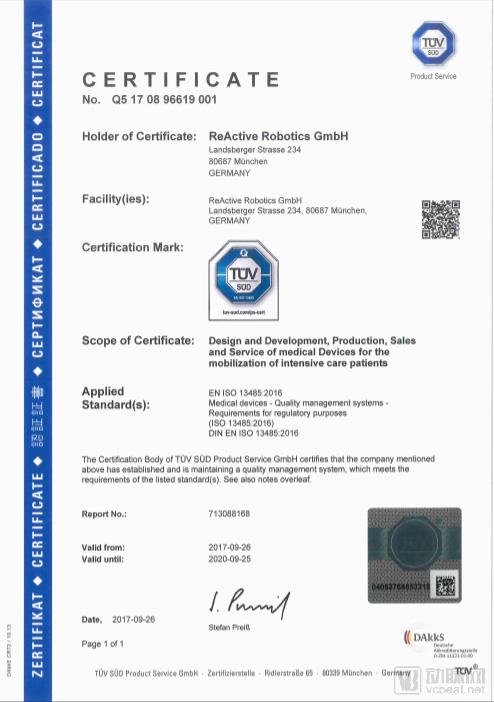
In September 2017, ReActive Robotics’ rehabilitation robot successfully passed the audit by TÜV Süd (certificate below). TÜV Süd is an independent third-party verification organization headquartered in Munich, Germany, specializing in professional testing, inspection, auditing, certification, training, and knowledge service solutions for quality, safety, and sustainability. ReActive Robotics plans to enter the healthcare market in 2018 to promote and sell its products.
Simplifying the Rehabilitation Process with Technology
In an interview with Startus Magazine, Koenig stated that the therapeutic process using rehabilitation robots is remarkably simple. “Our bodies are designed for movement, particularly upright locomotion. Prolonged bed rest leads to the deterioration of organ function, thereby hindering recovery. When you lose muscle mass and experience reduced bone density, your cardiovascular system also deteriorates.”
According to VCBeat, which has gathered information from multiple overseas media outlets, the advantages of ReActive Robotics over traditional rehabilitation models are evident. In conventional rehabilitation processes, a patient often needs to be frequently transferred between different rehabilitation machines, requiring the simultaneous attention of several medical staff members. With ReActive Robotics’ equipment, only one healthcare professional is needed to assist patients in completing complex ultra-early rehabilitation procedures. The robot is installed at the patient’s bedside (operated by medical staff), allowing the patient to perform exercises and complete rehabilitation movements while lying in bed. This not only eliminates the risk of injury during transfers between machines but also conserves hospital bed resources. The entire process, from device startup to application, can take less than 10 minutes.
Meanwhile, the application of automation simplifies the entire operational process, enabling detailed tracking and monitoring of patients’ rehabilitation progress while eliminating the need for healthcare professionals to perform real-time documentation. After use, the system automatically disinfects and cleans its components, ensuring convenience for subsequent patient sessions. Testing has confirmed that the VEO therapy provided by ReActive Robotics meets the highest standards of clinical validation.
Rehabilitation Robots: A Comparative Analysis of Domestic and International Peers
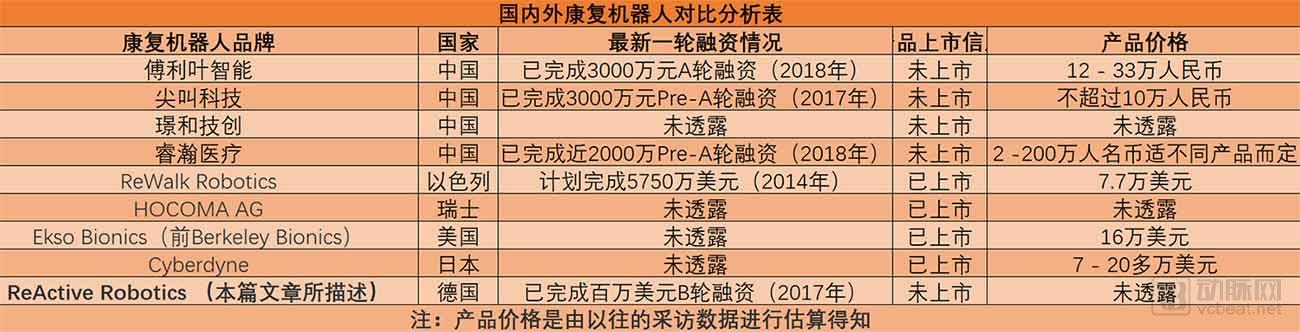
Data sourced from VCBeat's compilation and collectionRehabilitation robots are primarily used for the limbs, with a focus on lower-limb rehabilitation training. Their main function is to provide patients with a virtual environment for passive or active lower-limb exercise training. In passive rehabilitation training, the rehabilitation robot executes programs consisting of single or sequential movement postures, driving a reciprocating mechanism to guide the patient’s trained body parts through the prescribed movement postures. Patients passively perform various training movements under the guidance of the rehabilitation robot.
During active rehabilitation training, patients are immersed in a virtual environment provided by the robot, striving to control a specific object within that environment through voluntary movements. Throughout this process, the rehabilitation robot collects parameters such as movement distance, angle, and force, providing real-time feedback to guide patients in continuously adjusting their actions to meet the requirements of the rehabilitation training. Meanwhile, the rehabilitation robot records the patient’s movement data in its entirety to analyze and evaluate the effectiveness of the rehabilitation.
Due to the immense potential in the field of rehabilitation, market demand for rehabilitation robots is particularly high. According to forecasts by Grand View Research, a well-known U.S. market research and consulting firm, the market share of exoskeleton robots and assistive rehabilitation robots increased significantly from 2012 to 2022. It is estimated that over the next five years, the compound annual growth rate (CAGR) of the broader rehabilitation robotics sector will be approximately 37%, with the CAGR for rehabilitation robots specifically at 21%.
Accordingly, rehabilitation robots have garnered widespread attention in recent years, with an increasing number of companies joining the research and development in this field. Examples include Hocoma, ReWalk Robotics, and BARRETT, which were among the earliest to achieve commercialization, as well as Synchron, which entered the market at a relatively early stage. Typical domestic examples include Fourier Intelligence, GYENNO Science (which focuses on functional impairments in Parkinson’s disease patients), and Ruihan Medical (which specializes in hand rehabilitation for stroke patients).
1. Rehabilitation robots in China are relatively low-priced
As shown in the figure, the selling prices of domestic rehabilitation robot products are generally one-third to one-fifth lower than those of foreign counterparts, or even more. Compared with foreign countries, domestic rehabilitation enterprises are still in the R&D stage and have not yet been launched for sale. Due to the weak foundation of China's rehabilitation market, many investors are currently in a wait-and-see stance.
2. Many domestic rehabilitation robot products have not yet been launched on the market
Although many rehabilitation robot products are in the stages of planning, coordination, and research and development, they have not yet been widely adopted within China’s medical industry. The greatest challenge facing current R&D efforts is how to translate scientific achievements out of the laboratory, bring robotic innovations to market, and achieve industrialization.