

China's $70 Billion Care Market: 31 Nursing Enterprises Focus on Four Strategic Directions with Talent Training as the Core Supply-Side Driver
Recently, a professional in the elderly care industry stated, “The core of integrated medical and elderly care operations is not treatment, but nursing,” a perspective that warrants deep reflection.
Amid the immense demographic pressure of an aging population, statistical data indicate that over 40 million elderly individuals have diverse care needs due to disability, dementia, or chronic diseases. Nursing care serves individuals throughout the entire life course—from birth to death—playing a vital role in acute-phase diagnosis and treatment, chronic-phase rehabilitation, and end-of-life care and support.
Across China, many regions and healthcare institutions are proactively adapting to shifts in the disease spectrum and the accelerating pace of population aging. They are continuously enriching the professional scope of nursing by extending services into communities and homes, thereby providing elderly care, chronic disease management, rehabilitative nursing, long-term care, and hospice care. These efforts have further met the public’s diverse and multi-level health service needs.
Yet, the number of nursing professionals remains a drop in the ocean. According to statistics from the National Health Commission of China, by the end of 2017, there were only 3.8 million registered nurses in the country. The majority of them worked in medical institutions such as hospitals and clinics, particularly in large tertiary Grade A hospitals, which clearly demonstrated a strong siphon effect on nursing talent. In contrast, very few nurses were actually employed in elderly care facilities or nursing institutions outside of hospitals.
Some argue that current nursing services have yet to achieve the level of industrialization seen in developed countries such as those in Europe and the United States. What pain points does the nursing industry face in the current market? Which companies are entering the field to provide services? And where do the opportunities for industrial development lie? In reviewing the current state of the industry, VCBeat seeks to answer these questions.
Current Status of Nursing Services
According to the 2016 "Findings from the Fourth National Sample Survey on the Living Conditions of Urban and Rural Elderly in China" released by the Office of the National Working Commission on Aging, there are approximately 40.63 million elderly individuals with disabilities or partial disabilities in China, accounting for 18.3% of the total elderly population. Over the next two decades, the aging of China’s population will become even more severe. Meanwhile, with the implementation of the universal two-child policy, the proportion of infants, young children, and postpartum women will increase significantly.
The demand for medical services, particularly nursing care, among the elderly, newborns, and pregnant and postpartum women is significantly higher than the population average. Research indicates that approximately 0.5% of individuals aged 65 and above require hospitalization, about 2% need institutional care, and roughly 5% require community-based care. Furthermore, nursing needs in other populations are also accelerating, such as daily care for individuals in a sub-health state, therapeutic nursing, and comprehensive convalescence. These types of care stem from the growing demand to enhance quality of life.
Compared with the enormous demand for nursing services, China faces a substantial shortage of professional nursing staff. The current ratio of hospital beds to nurses in China is 1:0.27, whereas the actual requirement is 1:0.4. In developed countries such as the United States, the bed-to-nurse ratio has reached 1:2. Growing demand for social, community, and home-based nursing care will further widen this nursing workforce gap.
Furthermore, nursing service fees in China amount to only about 10% of the actual cost of care, falling far short of the true labor costs. Nursing is a typical modern service industry that encompasses both personal consumer services and public services; these substantial gaps signify emerging industrial opportunities.
In healthcare services, there is a concept of "30% medical treatment and 70% nursing care." Currently, there are two main types of nursing care models in China:
First, hospital bed nursing: due to the lack of professional and independent nursing institutions, there is a recurring and intermittent occupation of beds in general secondary and tertiary hospitals when nursing care is needed;
Second is home-based care, but the prevalence of small-family households and the substantial costs associated with long-term care make this model unsustainable. Furthermore, care provided by family members fails to meet professional standards and cannot address more advanced nursing needs. Neither of these two care models can satisfy current clinical nursing demands, let alone the broader requirements of comprehensive care.
Furthermore, with the diversification of nursing needs and the rapid development of modern technology, various high-tech solutions should be extensively and deeply researched and applied in conjunction with the characteristics of novel nursing models. However, current nursing theories, methods, and technologies remain relatively singular and fail to meet the rapidly growing demands.
Currently, nursing care in China is predominantly medical in nature, with professional services provided by nurses. There is a lack of self-sufficient home-based care, and nursing aides typically have low educational attainment and low incomes. Significant market gaps exist for professional care targeting disabled elderly individuals, infants and young children, perinatal women, as well as those with eldercare and high-end needs. Service coordination between institutions is inadequate, and the transition of care from within hospitals to community settings remains disjointed. Consequently, a comprehensive nursing care industry has yet to be established.
In summary, the nursing industry is characterized by homogeneous institutions, insufficient equipment, a shortage of practitioners, and functions that are yet to be transformed, which also indicates that the industrialization of nursing holds immense promise.
The Out-of-Hospital Care Market Is Vast, with Five Major Development Directions for Enterprises
Lin Yanglin, CEO of New Milestone Hospital Group, stated: “Care needs beyond the hospital setting—including those provided by community health institutions and integrated medical-elderly care or elderly care facilities—have not yet been standardized, normalized, or quality-assured. From a market-wide perspective, the focus remains on the technical roles nurses play within hospitals.”
In the out-of-hospital market, the care needs of over 40 million elderly individuals with disabilities or partial disabilities have presented significant opportunities for the caregiving industry. As early as in the “12th Five-Year Plan for the Construction of a Social Elderly Care Service System (Draft for Comments)” issued by the Ministry of Civil Affairs in 2011, it was projected that by 2020, the potential market size for elderly care services and daily living assistance in China would exceed RMB 500 billion. However, with the rising proportions of both the aging population and those suffering from chronic diseases, the out-of-hospital market, despite its vast scale, continues to face challenges related to talent shortages, business models, and standardization.
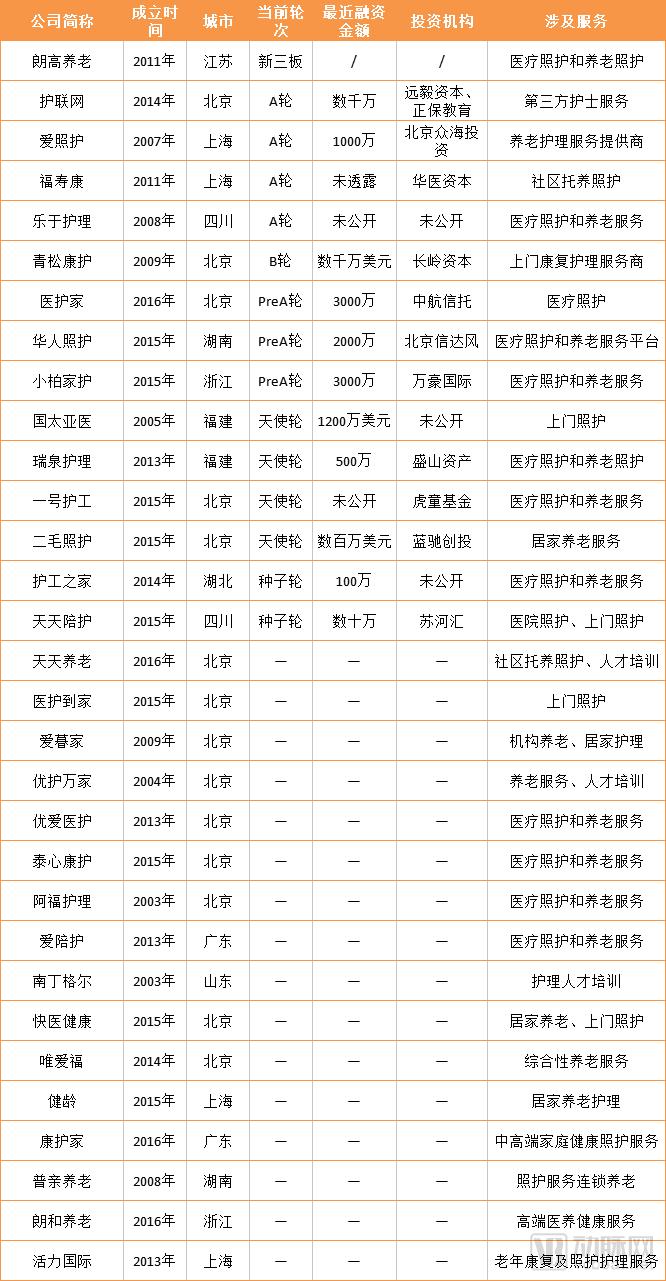
VCBeat’s Statistics on Selected Patient Escort Companies and Their Business Scopes (Incomplete List)
Data Sources: VCBeat Database, IT Juzi, Tianyancha
Among the 31 care enterprises, 15 have received capital support. Of these, only two have reached Series B or later stages, indicating that the industry as a whole is still immature and its profitability models are still being explored.
From the perspective of capital trends, the home-based nursing sector intersecting with the internet is highly favored. This preference stems from its asset-light operational model and the current dominance of the “9073” pattern in home-based elderly care demand. By addressing the needs of the elderly as a breakthrough point and leveraging internet platforms to innovate service models, companies such as Xiaobojiahu and Qingsong Kanghu have launched O2O home-visit services.
Since the payers for elderly care are not the seniors themselves but their children, embracing internet-based models has become a crucial pathway to expanding service coverage.
Observing the aforementioned companies, they can be categorized into the following four types based on the services and models they provide:
Home Care
There is a large population of disabled elderly people in home settings, yet this group is precisely the one with the least access to professional medical and nursing care. This model represents the “lightest” form of elderly care services. VCBeat’s previously published report on the at-home nursing industry also suggests that having medical professionals provide healthcare services to the elderly in their homes may evolve into a key component of home-based elderly care in the future.
For instance, platforms such as Qingsong Kanghu, Huli Daohao, and Xiaobojiahu all focus on home-based care services, adopting an O2O model to provide in-home services by caregivers and nurses. In terms of standardizing care protocols, Xiaobojiahu has established its own proprietary standards for in-home nursing procedures, thereby maximizing risk control in person-to-person service delivery.
Among home-based elderly care companies, those with in-house service teams include Qingsong Kanghu (which employs both employee-based and contracted models), Xiaobojiahu (where all home care specialists are company employees), and Ermao Care. These companies are characterized by services that are more customized and standardized, with a market positioning skewed toward the mid-to-high-end segment.
Primary Community Care
Community-based care models, such as day care centers and elderly care homes that provide “doorstep” elderly care services, can offer seniors basic services including daily living assistance, rehabilitation therapy, emotional support, and emergency aid, as well as additional services like entertainment, education, and social engagement. As elderly care gradually shifts toward marketization, various model explorations have emerged, such as public-private partnerships (PPP), government-funded leasing, and private construction with community operation.
Government operational subsidies, along with the provision of venues at low cost or even free of charge, have helped operators maintain a more “asset-light” model. Through continuous exploration of elderly care needs and by leveraging resources such as in-home services, mutual aid among seniors, and platform-based operation of diverse service offerings, community-based care is gradually moving away from the longstanding perception that it is “unprofitable.”
For instance, in collaboration with the Haidian District Government of Beijing, Youhu Wanjia established the first community-embedded, small-scale medical and elderly care institution at Building 5, Erli Zhuang Community, Haidian District—the Youhu Wanjia Elderly Care Center on Xueyuan Road, Haidian District. It operates two types of facilities: a “Community Health Service Station” and an “Elderly Care Center.” The community health service center is publicly owned but privately operated, while the elderly care center is independently operated, thereby providing elderly care and nursing services through small-scale community-based institutions.
In addition to elderly care services provided by enterprises within communities, this also includes pilot practices at the national level that are based on community health service centers.
In July 2017, Anhui Province launched a training initiative to deploy senior nurses to grassroots healthcare settings. Selected senior nurses from hospitals underwent training and credentialing before being assigned to community health service centers and township hospitals. This initiative aimed to optimize nursing resource allocation and innovate urban medical consortia, with pilot programs first implemented in Luyang District of Hefei, Wuhu City, and Bengbu City.
Zhang Guangpeng, Director of the Human Resources Research Office at the Health Development Research Center of the National Health Commission, stated that senior nurses primarily serve several key roles when working in community health centers:
First, serving as the connecting link within the medical consortium to facilitate communication between upper- and lower-level institutions;
Second, provide operational guidance to primary-level community health service centers. "For instance, in areas such as infection control and nursing management at primary care institutions, many community centers do not primarily need specialists from large hospitals; rather, they require guidance and support in infection control, nursing, and related fields."
Third, specialized nursing outpatient clinics are established to provide specialized nursing services, with a focus on delivering comprehensive and continuous care for three key populations—the elderly with hypertension, hyperglycemia, and hyperlipidemia; infants and young children; and pregnant and postpartum women—across four major disease categories.
Deploying senior nurses to grassroots levels is one of the important practices for revitalizing nursing resources. In the context of a shortage of community nursing talent, senior nurses who can assume duties without additional training provide professional technical support for grassroots nursing care.
Institutional Care/Hospital Caregivers
From the perspective of market size for hospital care, the caregiver industry boasts a vast market. On one hand, the rapid growth in domestic nursing demand, coupled with long-term underinvestment in nursing resources, has resulted in many hospitals failing to meet the required nurse-to-bed ratios, leading to a severe shortage of nursing staff. On the other hand, the accelerating pace of life means that urban residents often lack the time to provide bedside companionship for patients in hospitals. The convergence of these multiple factors has directly given rise to an intermediate industrial chain—caregiving agencies—thereby fostering the emergence and development of the professional caregiver industry.
In institutional care, organizations such as Yihu Jia, Youai Medical Care, Taixin Kanghu, and Afu Nursing primarily provide in-hospital bedside companionship services. These services are delivered through bidding processes, labor dispatch, or O2O models. As these nursing services are provided by third parties external to both the patients and the hospitals, talent reserves and the establishment of standardized protocols are of paramount importance for such enterprises.
Nursing Talent Training
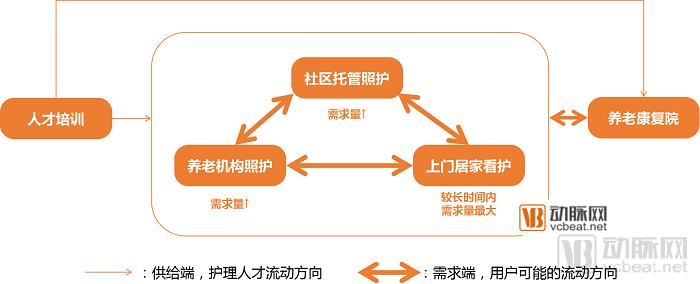
This is an element flow diagram of nursing services based on different models, created by VCBeat in its previous review of elderly care companies. From the diagram, we can see that talent training constitutes the upstream segment of the care industry. Whether it involves home-based nursing or institutional care, the essence remains human-to-human service; therefore, building a robust nursing workforce is crucial for enterprises involved in nursing services. As shown in the diagram above, talent training on the supply side serves various types of care enterprises and has the broadest coverage.
Currently, third-party service providers primarily targeting the nursing industry include Nightingale, which specializes in cultivating elderly care talent, and HuLianWang, which focuses on professional training for nurses.
The Nursing Care Industry Remains Immature, Yet Opportunities Arise in Talent Training, Primary Care, and Home-Based Nursing Services
Through market observation, we have found that talent training on the supply side, primary care with the broadest population coverage, and home-based nursing services fully integrated with the internet are more likely to take the lead in this industry.
Demand for Talent Skills Creates Opportunities for Training
We are currently in a new phase of expanding the connotation and extension of nursing, with emerging demands testing the skills of nursing professionals. Nurses serve as a critical force of professional service across institutional care, home-based care, integrated medical and elderly care, palliative care, and chronic disease management. This landscape requires nurses to master a broader range of skills and calls for diverse types of nursing talent to deliver services. Driven by these needs, nursing skills training institutions are seizing new opportunities within the industry.
Among the various specialized professionals involved in professional nursing services, including nurses, nursing assistants, rehabilitation therapists, and health managers, nurses are the talent category that provides the most professional nursing resources. As such, they can offer professional support in other types of services and drive the broader nursing workforce.
Zhang Xueli, founder of the third-party nursing service platform HuLianWang, stated: “Demand for nursing care is robust, while the supply side faces numerous challenges. Addressing these issues represents a source of incremental growth, whereas the opportunity lies in tapping into existing market potential.”
The value proposition of senior nurses, despite an annual waste rate of 30%, lies in their comprehensive nursing skills. This group possesses significant potential for professional and value growth. What nurse training platforms need to do is empower them, enhance their efficiency, and allocate resources rationally.
While assisting nurses with career planning, HuLianWang has developed a training program comprising six major course systems. In addition to fundamental career path development, the curriculum covers health management training, specialized skills training, and nursing management training, thereby better aligning nursing professionals with market demands and extending their careers.
The Demand for Tiered Diagnosis and Treatment Brings Opportunities to the Development of Primary Care Nursing
Since the 1970s, a considerable number of economically developed countries have initiated specialized training programs for community nursing professionals within traditional nursing colleges and universities, resulting in a generally higher level of educational attainment among their community nursing workforce.
From a comprehensive perspective, community nursing in the United States is broadly categorized into the following three models: ① community nursing centers affiliated with specific institutions (such as educational institutions); ② community clinics or health stations; and ③ private community nursing centers established and managed by healthcare entrepreneurs. Nursing care provided within educational institution settings appropriately integrates teaching, scientific research, and clinical services, and has become one of the predominant forms of community nursing in the United States. Among the numerous community health agencies in the U.S., nursing personnel account for more than 80.00% of the workforce.
The United Kingdom is the birthplace of community nursing. The number of community nurses has continuously increased during its development, leading to the gradual emergence of many new community nursing roles, such as district nurses, school health nurses, and health visitor nurses.
Typically, nursing students can become registered nurses after graduation by passing the national nursing licensure examination. However, students specializing in community nursing must complete an additional one-year training program in community nursing skills on top of their three-year foundational nursing education. This ensures they develop a solid theoretical foundation and practical competence, enabling them to quickly adapt to community nursing roles and effectively meet the demands of community-based care.
Community care nurses in Japan are commonly referred to as Public Health Nurses. Professionals in the healthcare field must first obtain registration as a Registered Nurse, then complete a specialized one-year community nursing program, and successfully pass the national unified examination to qualify for certification as a Public Health Nurse. The primary pathways for training community nurses in Japan include transitioning hospital nurses into community roles and academic education. Statistics indicate that, in terms of formal education, Japan had established 65 medical and nursing institutions by the end of the 20th century.
In China’s current community nursing landscape, not only is the overall competency of community nursing staff generally low, but the number of personnel in these roles is also exceedingly scarce, failing to meet the demand for community nursing services.
Therefore, China can draw on the strengths of foreign community nursing practices by incorporating community nursing courses into existing medical and nursing curricula and continuously strengthening practical training. Targeted nursing training programs should also be established specifically for community nurses. Furthermore, outstanding community nursing personnel can be dispatched abroad to study advanced community nursing techniques and experiences, thereby accelerating the development of China’s community nursing workforce.
Policy Support for Home- and Community-Based Elderly Care as the Mainstream: Opportunities for In-Home Care Emerge
The elderly are a high-risk population for chronic diseases and thus have greater need for quality medical and nursing care services. The State Council’s “Several Opinions on Accelerating the Development of the Elderly Care Service Industry” (Guo Fa [2013] No. 35) states that “we should actively respond to population aging, accelerate the development of the elderly care service industry, take the active promotion of integration between medical and health services and elderly care as our primary task, and effectively carry out prevention, treatment, rehabilitation, and nursing care for chronic diseases among the elderly.” Medical and nursing care services have become one of the most important components of elderly care services.
The aging population will inevitably lead to a surge in demand for elderly care services in China, both now and in the future, particularly for medical and nursing care. However, the current quantity and quality of elderly care personnel in China, especially professionals specializing in geriatric medical and nursing care related to health management, are far from meeting this rapidly growing demand. The insufficient number and low professional competency of geriatric medical and nursing care providers have become significant constraints on the expansion and quality improvement of elderly care services, as well as on the overall development of China’s elderly care industry.
Theoretically, the pool of professional personnel for elderly medical and nursing care in China can be drawn from various sources, including staff recruited and trained internally by elderly care institutions, recent graduates with nursing degrees from educational institutions at all levels, registered nurses from large hospitals, and nurses from primary healthcare facilities.
In comparison, nurses in China’s primary healthcare institutions have all received professional medical and nursing education and training. Their knowledge, skills, and clinical experience are fully adequate to meet the demands of elderly care and medical nursing. Tapping into the potential of this workforce represents another approach to revitalizing the currently scarce nursing resources.
Meanwhile, many primary healthcare institutions have gradually become ideal integrations of medical care and elderly care, beginning to explore new models of integrated medical and elderly care. These include adopting contracted partnerships with seniors to provide regular in-home medical and nursing care for the elderly, as well as establishing geriatric nursing units within primary healthcare facilities to deliver professional medical and nursing services.