

How CStone Pharmaceuticals Became China's Fastest-Moving PD-L1 Unicorn: $410M Raised Within Two Years
In May 2018, CStone Pharmaceuticals announced the completion of its Series B financing. This $260 million round set a new record for the largest Series B funding ever raised by an innovative biopharmaceutical company in China. Although the valuation was not disclosed, CEO Jiang Ningjun stated that it had undoubtedly reached unicorn status.
Established just two years ago, the company has raised over $410 million in financing and garnered favor from top-tier global investment institutions, including the Government of Singapore Investment Corporation (GIC), ARCH Venture Partners, Sequoia Capital, and Hillhouse Capital. In merely a few short years, its PD-L1 drug is poised to enter pivotal Phase II clinical trials, positioning the company as one of the fastest-moving enterprises in China in this field.
How did this young company achieve such success? How did it rise to prominence in just two years, becoming a unicorn in China’s pharmaceutical innovation industry?
One afternoon in May, armed with these questions, VCBeat visited CStone Pharmaceuticals’ Shanghai office, discreetly located in a standalone villa. There, VCBeat met with CStone’s founding team and listened to them share the story of CStone Pharmaceuticals.
Team: Veteran Entrepreneurs
CStone Pharmaceuticals was founded in 2016. Although it is a young company, its team comprises seasoned pharmaceutical veterans with extensive R&D experience both domestically and internationally.
Dr. Jiang Ningjun, Chief Executive Officer, graduated from the University of British Columbia in Canada and practiced internal medicine and emergency medicine in the United States, with nearly 30 years of professional experience.
Prior to joining CStone Pharmaceuticals, he was involved in Eli Lilly’s sepsis drug research and, during his tenure at Sanofi, completed research on the anticoagulant Lovenox, which achieved global market launch. He served as Global Vice President at Sanofi; in his final five years with the company, he led more than 80 clinical studies across the Asia-Pacific region, over 30 of which secured multi-country marketing approvals.
Dr. Yang Jianxin, Chief Medical Officer and a postdoctoral fellow at Harvard University, has over 25 years of experience in drug R&D at major multinational pharmaceutical companies and innovative biopharmaceutical firms overseas, including Pfizer and Covance. He is well-versed in the entire process from preclinical to clinical research. Previously, he returned to China at invitation to serve as Senior Vice President and Head of Clinical Development at BeiGene, where he built the clinical development team and led clinical studies on multiple innovative anti-tumor drugs, including the first PD-1 monoclonal antibody of Chinese origin to enter clinical trials. His joining has further solidified CStone Pharmaceuticals’ expertise in clinical development.
Dr. Yuan Bin, Senior Vice President of Corporate Development, earned his doctorate from Columbia University and an MBA from Cornell University. Previously, he spent many years working in new product strategy, marketing, and business development at companies including Eisai, Novartis, and Merck & Co. Prior to joining CStone Pharmaceuticals, he was responsible for global business development of oncology drugs at Merck’s headquarters, with a particular focus on the global BD efforts for Keytruda, the company’s flagship immunotherapy product. Throughout his career, he has made outstanding contributions to the successful commercialization of eight international oncology products.
Dr. Xinzhong Wang, Senior Vice President of Scientific Affairs, earned his degree from the University of Ohio, completed his postdoctoral fellowship at Harvard Medical School, and served as a Lecturer there. He is one of the few senior scientists who have maintained a long-term focus on and conducted in-depth research in immuno-oncology over the past decade. Prior to joining CStone Pharmaceuticals, he held positions at MedImmune, Biogen, AstraZeneca, and Merck & Co., where he was engaged in the research and development of immuno-oncology therapeutics.
Such a young company has assembled a team of pharmaceutical industry veterans from Sanofi, Merck & Co., and Novartis, who contribute their expertise in management, corporate development, clinical medicine, and scientific research, serving as the cornerstone of BaseCure Therapeutics’ growth.
Product Pipeline: Rich and diverse, with oncology immuno-combination therapies as the core
CStone Pharmaceuticals’ R&D core focuses on combination therapies in tumor immunotherapy. Beyond integrating immunotherapy with conventional chemotherapy and targeted therapy, the company believes that any regimen capable of improving patient survival rates and quality of life is worth pursuing.
Looking back at the history of cancer treatment, three major revolutions have occurred: the first was chemotherapy, the second targeted therapy, and the third immunotherapy. Immunotherapy is a groundbreaking approach that has turned cancer into a chronic disease for some patients, enabling long-term survival. However, this proportion remains insufficient, as the current response rate to tumor immunotherapy is only 20%–30%.

Dr. Jiang Ningjun, CEO of CStone Pharmaceuticals
“How can we increase the response rate to 40%, 50%, or even 100%?” Discussing CStone Pharmaceuticals’ long-term vision, Jiang Ningjun stated, “We hope that cancer will truly become a chronic disease in the future, much like hypertension and diabetes today, with effective means to control it.”
Since the launch of oncology immunotherapies in 2014, sales of immune-oncology drugs have increased approximately tenfold, with a projected compound annual growth rate (CAGR) of 41% by 2023. “No other therapeutic area or drug class has ever achieved such rapid growth,” he added.
Abroad, immunotherapy pioneers such as Merck & Co. and Bristol-Myers Squibb have already demonstrated the feasibility of combination immunotherapy. By integrating immunotherapy with other treatment modalities, patient response rates can be effectively improved. CStone Pharmaceuticals aims to further enhance patient response rates and survival outcomes through combination regimens that pair immunotherapy with targeted therapy, chemotherapy, or dual immunotherapy approaches.
To achieve breakthroughs in the field of combination immuno-oncology therapy, two conditions are essential: one is a core flagship product, and the other is product scale.
“With only one or two products, it is impossible to develop combination therapies,” emphasized Jiang Ningjun. “As the number of products continues to grow, the potential for combination therapies increases not linearly, but exponentially.”
It is reported that, as of May 2018, CStone Pharmaceuticals had more than ten independently developed products in its R&D pipeline. Although these products are at various stages of development, four have already entered clinical trials, which serves as the primary driver behind CStone’s recent large-scale financing round.
The most advanced project is the PD-L1 antibody CS1001. This project has currently completed its Phase I clinical trial and will soon enter pivotal Phase II clinical studies. In terms of funding, CS1001 alone requires substantial financial support.
Meanwhile, the company disclosed that it will file an Investigational New Drug (IND) application for CS1001 in the United States. This move positions CS1001 as a global product.
“We believe that in many respects, this will be a best-in-class product,” said Jiang Ningjun.
In addition to PD-L1, in December 2017, Australia’s Scientia Clinical Research Ltd. formally accepted CStone Pharmaceuticals’ Investigational New Drug (IND) application for its PD-1 antibody, CS1003. This marks the third self-developed anti-tumor innovative drug from CStone Pharmaceuticals and the second one submitted in Australia to enter clinical trials.
Yuan Bin introduced that CStone Pharmaceuticals’ PD-L1 inhibitor is a fully human antibody and currently among the most advanced candidates in China, positioning it as one of the products likely to reach the market earliest. Meanwhile, its PD-1 product is the only one globally capable of recognizing both murine and human PD-1 targets.
“Our R&D focus is on oncology drugs, with combination therapy research centered around three core platform products: PD-1, PD-L1, and CTLA-4. We must ensure the success of at least one of our PD-1 or PD-L1 candidates, as these two drugs serve as backups for each other,” he added.
It is understood that PD-1 and CTLA-4 products have already entered the clinical trial phase in Australia, and good news regarding the MEK project will be announced soon. Jiang Ningjun revealed that the company expects to initiate more than 10 clinical trials by the end of 2018.
“We have also launched combination therapy studies involving our internal products,” disclosed Jiang Ningjun. “2018 marked the inaugural year for immunotherapy combinations, and 2019 is set to be a breakthrough year.”
In China, combination immunotherapy is still in its early stages. In contrast, there are many years of experience abroad. When asked how to cope with competition from multinational corporations, Yang Jianxin responded: “Multinational corporations focus on global market deployment, whereas we are a company rooted in China and dedicated to serving Chinese patients. Research on combination therapies in China is just getting started, which offers numerous advantages for domestic enterprises.”

Dr. Yang Jianxin, Chief Medical Officer of CStone Pharmaceuticals
He noted that, compared with multinational corporations, local enterprises have their R&D headquarters located in China, enabling much faster decision-making and adjustments. Moreover, local enterprises have relatively simple and flat organizational structures, resulting in higher R&D management efficiency than multinational corporations. Furthermore, local enterprises are focused on the Chinese market and possess a deeper and more thorough understanding of the disease characteristics and medical practice patterns among Chinese patients. In contrast, researchers at multinational corporations in China often need to relay their opinions to global headquarters for understanding, endorsement, and even approval of protocol amendments—a process that is both highly time-consuming and difficult to achieve.
“Our clinical trials are better aligned with the Chinese context, which is our advantage compared to multinational corporations,” he concluded.
Business Model: In-house Development + In-licensing, Clinically Driven
“In China, due to factors such as the research environment, significant progress has been made in upstream basic R&D, yet very few achievements have been translated into downstream applications. ‘A key reason for this is that clinical development has become a bottleneck in our progress,’ mentioned Jiang Ningjun.”
Based on its own capabilities and the current R&D landscape in China, CStone Pharmaceuticals has focused its drug development efforts on clinical development. The company aims to build an acceleration engine for clinical development, incorporating innovative models to enhance clinical efficiency, a high-caliber team, and clinical resources, as well as supporting infrastructure such as translational medicine centers.
In October 2017, the Suzhou Translational Medicine Research Center of CStone Pharmaceuticals was officially inaugurated at the Suzhou BioBAY. Established in accordance with advanced international standards, this clinical research center aims to accelerate clinical development, promote the discovery and validation of precision medicine and biomarkers, and improve the success rate of clinical trials by supporting clinical trial operations.
Furthermore, the Company entered into a strategic cooperation agreement with Soochow University in January 2018. This collaboration aims to enhance joint innovation capabilities, better promote industry-academia-research integration, and meet the demands of the pharmaceutical industry.
Under the framework cooperation agreement, CStone Pharmaceuticals and the School of Pharmaceutical Sciences, Medical College of Soochow University, will establish a joint research center to carry out comprehensive strategic cooperation across multiple dimensions, including collaborative research projects, talent development, and innovation-driven growth in the pharmaceutical industry.

Dr. Xinzhong Wang, Senior Vice President of Scientific Affairs
“On the one hand, we aim to prioritize clinical development, while still maintaining our focus on novel targets. In this regard, we will collaborate with renowned local and international research institutions for joint development,” stated Wang Xinzhong.
Drawing on the team’s extensive experience in international markets, they have carefully designed a framework—encompassing clinical study design, treatment strategies, operational speed, and internal and external communication mechanisms—to establish a model best suited for accelerating clinical development in China.
In the realm of basic research, CStone Pharmaceuticals maintains a global perspective, seeking opportunities worldwide. By addressing the specific characteristics of cancer in China, the company introduces the most outstanding domestic and international products to further expand its portfolio, thereby delivering superior therapies to patients more rapidly and effectively.
“We believe that integrating these elements into a cohesive whole is the core of the entire industry chain,” said Jiang Ningjun.
Synergy to Accelerate Market Entry
From its product pipeline to its business model, all factors dictate that CStone Pharmaceuticals must advance its projects simultaneously, at scale, and rapidly. Therefore, funding is a critical component.
Of course, in addition to independent research and development, CStone Pharmaceuticals also aims to collaborate with leading domestic and international enterprises to accelerate the market launch of its drugs.
“No single company can drive the pharmaceutical innovation industry alone; we are eager to form alliances with leading players across the sector,” said Jiang Ningjun.
He revealed to reporters that CStone Pharmaceuticals aims to license in products at mid-to-late clinical stages from both domestic and international markets, which would further accelerate the market launch of the company’s current product pipeline.
“If these drugs demonstrate advantages in combination therapy with PD-1, PD-L1, or CTLA-4 inhibitors, we will give them priority consideration,” he stated.
Currently, CStone Pharmaceuticals’ R&D pipeline is essentially a combination of in-house development and external licensing. In terms of in-house development, the strong scientific team led by Wang Xinzhong is responsible for target discovery, with early-stage products developed through customized CRO collaborations. For external licensing, the team led by Yuan Bin sources suitable projects globally, adhering to a first-in-class standard.
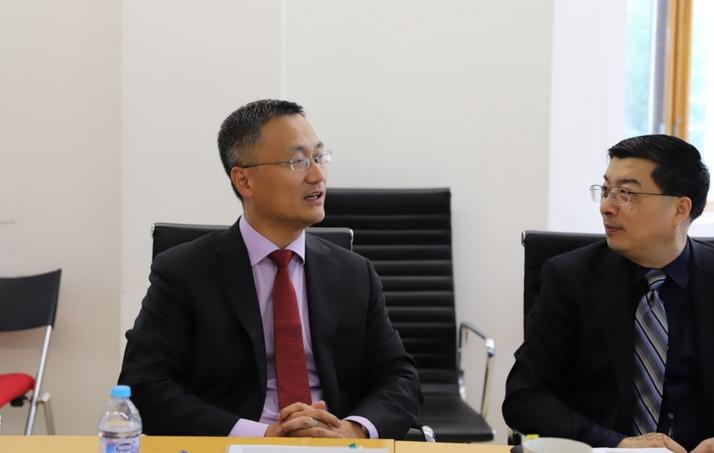
Dr. Yuan Bin, Senior Vice President of Corporate Development
Of course, in addition to product in-licensing, CStone Pharmaceuticals also considers collaborating with suitable partners to conduct combination therapy studies of their respective drugs. Similarly, as CStone Pharmaceuticals currently holds global rights to all its products, the company is seeking global partners to assist with the worldwide development and commercialization of its portfolio.
It is reported that as clinical research projects continue to advance, the team led by Yuan Bin is establishing an independent commercialization platform to prepare for the successful market launch of new products in China.
Jiang Ningjun revealed that prior to this funding round, they had believed it would require a significant amount of time and effort to engage and communicate with investors. However, the actual process proved much smoother than anticipated, allowing them to focus on other aspects of the company’s business development.
Following this round of financing, CStone Pharmaceuticals will sequentially initiate more than 10 clinical trials. Yang Jianxin revealed that, based on the current progress, the company’s first PD-L1 product is expected to be launched in 2020. Subsequently, the company will also consider adopting a production strategy combining contract manufacturing organizations (CMOs) with its own manufacturing facilities.