

Guangzhou Internet Hospital Accelerates Growth Amid Supportive 'Internet + Healthcare' Policies
Favorable Policies for “Internet + Healthcare” Emerge Frequently. In April 2018, the General Office of the State Council issued the Opinions on Promoting the Development of “Internet + Healthcare,” proposing a series of policy measures to facilitate the deep integration and development of the internet with healthcare. On July 12, the National Health Commission, jointly with the National Administration of Traditional Chinese Medicine, released the Notice on Deepening the Implementation of Convenient and Beneficial “Internet + Healthcare” Activities. The introduction of these favorable documents signals that internet-based healthcare is poised to enter a new peak of development.
Meanwhile, local governments have also responded actively. It is understood that Guangdong Province, as a hub for the internet industry, has planned to build a national highland for “Internet + Healthcare.” In June 2018, the Guangdong Provincial Government issued the Notice on the Action Plan for Promoting the Development of “Internet + Medical Health,” to facilitate the implementation of Internet + Medical Health policies.
New “Internet + Healthcare” business models, represented by WeDoctor Guangzhou Internet Hospital, have driven the aggregation of a wave of emerging Internet + Healthcare projects over the past two years. Officially launched on January 7, 2017, Guangzhou Internet Hospital expanded its coverage to all 21 prefecture-level cities in Guangdong Province within less than two years, established connections with more than 100 key hospitals, co-built 31 medical consortiums, attracted over 6,000 physicians to join its platform, and served nearly 4 million users in Guangdong. These figures reflect the leapfrog development of internet hospitals, while an increasing number of physical medical institutions are proactively embracing the “Internet +” model to expand into new frontiers of traditional medical services.
"Internet + Hospital": Making Medical Consultation and Treatment Services More Worry-Free
“Registration is like the Spring Festival travel rush, and seeing a doctor is like going to war”—this vividly captures the mismatch between high-quality medical resources and patient demand. The original intention behind establishing Weiyi, a healthcare technology platform, was to provide people with appointment registration services, bridge the supply-demand gap for access to top-tier medical experts, optimize the healthcare-seeking process, and offer convenient services such as intelligent triage, report inquiries, and health knowledge consultations.
After Micro Medical’s launch in Guangdong, to meet the demand for large-scale online triage and improve the conversion efficiency of high-quality medical resources, Guangzhou Internet Hospital invited a vast number of top-tier expert teams in Guangdong to join its platform, providing online diagnosis and treatment services to the public. When patients seek consultations, they only need to upload their medical records and test reports to the platform. The expert teams can then make precise matches based on the patients’ conditions, recommending the most suitable hospitals and doctors, thereby achieving efficient and accurate triage. In addition, a green channel for referrals has been established. When primary care physicians encounter patients with complex conditions, they can easily refer them to higher-level medical institutions by simply clicking and performing basic operations on the Micro Medical platform.
Through internet hospital platforms, patients can initiate online consultations, register appointments, check orders, make payments, renew prescriptions, and arrange medication dispensing anytime and anywhere. Addressing healthcare needs across pre-consultation, during-consultation, and post-consultation phases, medical services are no longer confined within hospital walls, becoming more efficient and convenient.
For hospitals, Guangzhou Internet Hospital has deployed a comprehensive suite of services—including interconnected remote diagnosis and treatment collaboration, regional remote outpatient consultations, and remote training for medical personnel—to achieve the sharing of high-quality medical resources. This approach addresses the shortage of physicians in primary care institutions, promotes the gradual implementation of tiered diagnosis and treatment, and successfully creates an effective solution to alleviate difficulties in accessing medical care. By enabling cloud-based medical record sharing, remote consultations, remote follow-up visits, remote referrals, and remote training and education, it has multiplied both the efficiency of medical services and the utilization rate of high-quality medical resources.
“Pharmacy-Clinic + Prescription-Sharing Platform” Strategy Targets the Prescription Outflow Market
Driven by the comprehensive and in-depth implementation of the Healthy China strategy, as well as the active promotion of policies such as zero drug markups and reforms to health insurance payment methods, the trend toward “prescription sharing” has become irreversible.
Guangzhou Internet Hospital has capitalized on this trend by forging deep collaborations with key hospitals, pharmaceutical companies, and retail pharmacy chains. By leveraging technologies such as the internet, big data, and artificial intelligence, it has achieved data synchronization and high-level coordination across “medical care, prescriptions, medications, and insurance.” For instance, when an outpatient physician issues a prescription and uploads it to the internet hospital platform, patients can settle medication costs online. The prescribed drugs are then delivered to the patient’s home by a nearby designated pharmacy or made available for patient pickup. This approach significantly reduces the proportion of drug revenue in hospitals and lowers pharmacy operational costs.
Guangzhou Internet Hospital has successively established strategic partnerships with Guangzhou Pharmaceutical Holdings, Heshuntang, and Dashenlin, a leading pharmaceutical retail chain. Taking Dashenlin as an example, Guangzhou Internet Hospital integrates medical resources and clinical capabilities to embed its services into pharmacies through a “software + hardware” model. This approach provides Dashenlin’s customers with more professional medical services, creates a closed-loop healthcare service ecosystem, and achieves full coverage within a 500-meter service radius centered on each pharmacy. It helps upgrade nearly 3,000 Dashenlin pharmacies into community health centers and medical care service hubs, thereby enabling these pharmacies to offer services such as precise appointment scheduling, remote consultations, and electronic prescriptions.
Through the Weiyi Health Terminal, users can connect with their dedicated family doctor at the touch of a button. Via voice and video interactions, they can receive online consultations for common ailments, while cloud-based health records are established for each user. Leveraging wearable devices and smart health terminals, the system continuously monitors vital signs and proactively provides comprehensive health management, thereby enhancing health outcomes for individuals and families. This enables pharmacies to seamlessly transform into “Health Management Centers” within local communities, fully addressing users’ medical and healthcare needs.
In the future, Guangzhou Internet Hospital will establish interconnected and shared access with partner hospitals and medical consortium prescription platforms, thereby creating a mechanism for prescription circulation, medication sharing, and distribution within the medical consortium.
"Internet Plus Health Poverty Alleviation: Ensuring Guangdong Launches the Battle Against Poverty"
Long before Guangdong Province issued the Three-Year Action Plan for Health-Based Poverty Alleviation in Guangdong Province (2018–2020), Guangzhou Internet Hospital had already undertaken extensive explorations in health-based poverty alleviation, carving out a distinctive “Internet + Health-Based Poverty Alleviation” pathway and emerging as a “new force” in the effort to lift people out of poverty through improved health.
On January 7, 2017, the Guangzhou Municipal Health and Family Planning Commission, the Meizhou Municipal Health and Family Planning Bureau, and Guangzhou Internet Hospital signed the “Framework Agreement on ‘Guangzhou-Meizhou Collaboration to Jointly Advance Health-Oriented Poverty Alleviation’.” The parties deployed software and hardware platforms for precision internet-based health poverty alleviation in pilot primary healthcare institutions, and carried out a series of activities including operations, publicity, and resource allocation, thereby facilitating the implementation of targeted point-to-point assistance in the Guangzhou-Meizhou health poverty alleviation initiative.
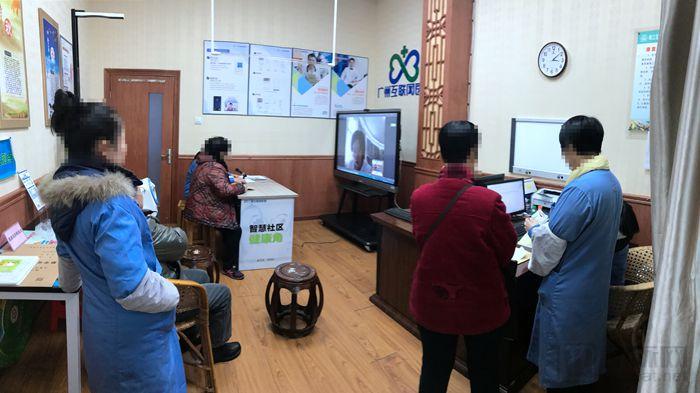
According to incomplete statistics, the remote consultation site at Shizheng Town Central Health Center has benefited 32,000 residents in Shizheng Town. It has established electronic health records for 594 local individuals living in poverty to facilitate health management and monitoring, helping to reduce the incidence of poverty relapse due to illness, and has provided services to over 1,200 patient visits. In terms of expert team support, specialists from Guangdong Provincial Hospital of Traditional Chinese Medicine, Nanfang Hospital of Southern Medical University, and Zhujiang Hospital have provided remote consultation services to 78 individuals living in poverty and elderly people aged 65 and above, significantly enhancing primary healthcare service capabilities. Additionally, Guangzhou Internet Hospital donated 19 all-in-one health kiosks to the 17 villages under the jurisdiction of Shizheng Town.
Guangzhou Internet Hospital has made steady progress and implemented solid measures on the existing foundation, further deepening and refining its poverty alleviation efforts, thereby expanding its achievements. By leveraging the high-quality hospital and physician resources efficiently aggregated over the years by the WeDoctor Guangzhou Internet Hospital platform, it has established paired assistance partnerships with local clinics and health centers. Through phased rotational training for grassroots physicians, the initiative aims to enhance their professional diagnostic and treatment capabilities as well as health management skills, thereby bridging the “last mile” of healthcare delivery at the village level.