

Huiying Medical Empowers Wuhan Resources WISCO General Hospital to Establish a Regional Medical Imaging Diagnostic Center

HY Medical
Provider of Medical Imaging and Oncology Radiotherapy Platforms
Recently, China Resources Wugang General Hospital partnered with HY Medical to establish an integrated imaging diagnosis center via the internet, leveraging its Department of Radiology. As the only Grade A tertiary general hospital in Qingshan District, Wuhan, China Resources Wugang General Hospital houses a Department of Medical Imaging that integrates clinical practice, teaching, and scientific research. The department offers conventional radiography, CT, MRI, and digital subtraction angiography (DSA). The regional imaging center is staffed by an expert team comprising specialists from the hospital’s Department of Medical Imaging who hold the title of associate chief physician or higher.
HY Medical is a national-level high-tech enterprise specializing in artificial intelligence for medical imaging. The company possesses core technologies in deep learning for image analysis and holds multiple patented technologies. Leveraging cloud computing, big data, and artificial intelligence, HY Medical has developed six core services: the Smart Imaging Cloud Platform, Digital Intelligent Film, Tumor Radiotherapy Cloud Platform, Big Data Intelligent Analysis Cloud Platform, Intelligent Imaging Screening System, and AI Diagnostic Cloud Platform. These offerings have facilitated the digitization, mobilization, and intelligent transformation of medical imaging, establishing a closed-loop system encompassing screening, diagnosis, and treatment decision support. HY Medical is the only high-tech company in China that is data-driven and provides comprehensive coverage from scientific research to clinical practice.
Regional Imaging Diagnostic CenterLeveraging the HY Medical Cloud Platform for medical imaging, the Regional Imaging Diagnostic Center connects imaging equipment across hospitals within the medical consortium. This enables automated acquisition and transmission of imaging data, digitization of workflow processes, and digital image interpretation. By achieving bidirectional integration of medical imaging data between institutions, patients at affiliated collaborative hospitals can access remote, expert-level diagnostic services for medical imaging. Patients undergo imaging examinations at community hospitals, where the imaging data is transmitted via the cloud to the diagnostic center. Artificial intelligence provides initial auxiliary diagnosis, followed by analysis and consultation by a team of experts who issue the final report. The report is instantly transmitted back to the community hospital, eliminating the need for patients to undergo repeat examinations. Additionally, reports can be delivered directly to patients’ mobile phones via the internet, removing the necessity to visit the radiology department in person to collect hard copies.
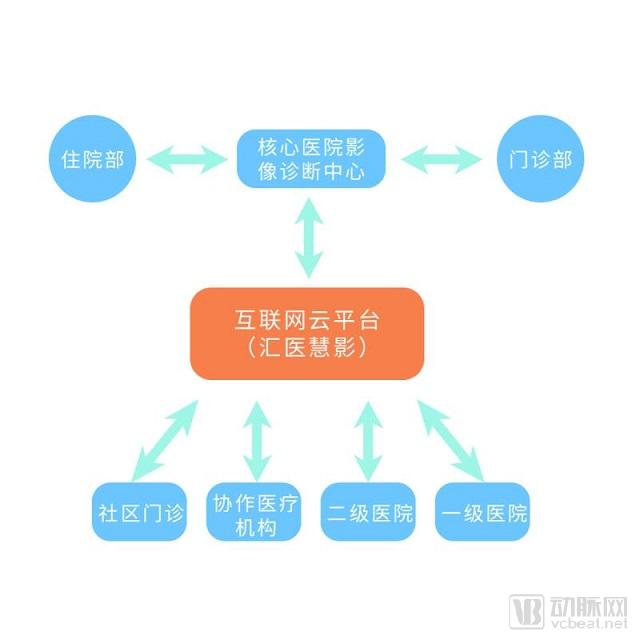
Compared with traditional solutions, the imaging diagnosis center solution based on the medical imaging cloud platform has the following advantages:
1. Leverage the advantages of AI technology to fully enhance the diagnostic efficiency and accuracy of various imaging examinations, rationally optimize resource allocation, and address prominent issues such as difficulty and high cost in accessing medical care, as well as inconvenience for patients seeking treatment.
2. Alleviate the shortage of professional imaging diagnostic personnel in primary healthcare institutions, thereby helping to make tiered diagnosis and treatment a genuine and effective practice.
3. Achieve sharing of imaging information to address the issue of redundant imaging examinations.
4. Facilitates the training of young and grassroots physicians.
5. Facilitates the establishment of new business models.
6. Facilitates patient access to medical care and helps improve the patient experience.
In addition to its collaboration with China Resources Wugang General Hospital, HY Medical had connected with over 700 hospitals by September 2017, including more than 200 Grade III Class A hospitals such as Peking University Third Hospital, the PLA General Hospital (301 Hospital), and Beijing Cancer Hospital, as well as a series of high-end chain medical institutions. Among these, there are numerous cases of collaborating with hospitals to establish regional medical imaging centers. For instance, in partnership with the Third Affiliated Hospital of Zhengzhou University, HY Medical helped build Henan’s first intelligent imaging center for a maternal and child health specialized medical consortium, creating fully intelligent medical imaging services and a maternal and child health specialty data center within the consortium to promote tiered diagnosis and treatment. By establishing this intelligent imaging center for the maternal and child health alliance, the Third Affiliated Hospital of Zhengzhou University enables the sharing of medical imaging information and diagnostic reports within the consortium, promotes the integration and sharing of medical imaging resources and imaging-based healthcare resources, and allows various maternal and child health institutions within the consortium to upload and centrally manage imaging data, as well as share and access imaging information and diagnostic reports.
The “Outline of the National Healthcare Service System Plan (2015–2020),” released by the General Office of the State Council in March 2015, proposed supporting the development of specialized medical imaging diagnostic institutions and promoting the service model of “examinations at primary healthcare institutions and diagnoses at hospitals.” Its overarching aim is to prioritize health as the goal and leverage information networks as the foundation, while establishing multi-tiered alliances among healthcare institutions to enhance the capacity of primary-level medical imaging services. In 2017, the National Health Commission abolished the zero-markup policy on hospital drugs, and in 2018, it implemented a tiered diagnosis and treatment system, whereby serious conditions are treated at hospitals and minor ailments are managed at community-level facilities.
Establishing an Imaging Diagnosis Center creates an efficient and professional link among primary care hospitals, patients, and specialists, providing innovative imaging examination and diagnostic services to primary care hospitals and patients. The Imaging Diagnosis Center is a team of experts composed of physicians holding the title of Associate Chief Physician or above from the Radiology Departments of Grade A Tertiary Hospitals. It is a cloud platform built on the Internet to support medical imaging big data.
Currently, large general hospitals and teaching hospitals across China are actively responding to the national call by establishing corresponding medical consortia and preparing regional imaging centers. By networking all imaging examinations from primary healthcare institutions within these medical consortia, they aim to achieve comprehensive sharing of imaging data. This enables patients to undergo examinations at primary care facilities while benefiting from the expertise of specialist teams at imaging diagnostic centers. Meanwhile, major medical groups, health examination centers, and insurance funds are also collaborating with internet technology companies to establish regional imaging diagnostic centers, build big data platforms for imaging diagnosis, and develop various intelligent computer-aided diagnosis (CAD) software solutions. Imaging diagnostic centers of various types have been established throughout China.