

Alibaba Health's Aggressive 2018 Moves: Leadership Change, Acquisitions, and Investments Cement Its Role as Jack Ma’s Flagship in New Healthcare

AliHealth
Medical and Health Services Network Service Provider
AliHealth is Alibaba’s flagship platform in the healthcare sector and a key implementer of Alibaba’s “Double H” strategy—Happiness & Health. It has attracted significant attention since its inception.
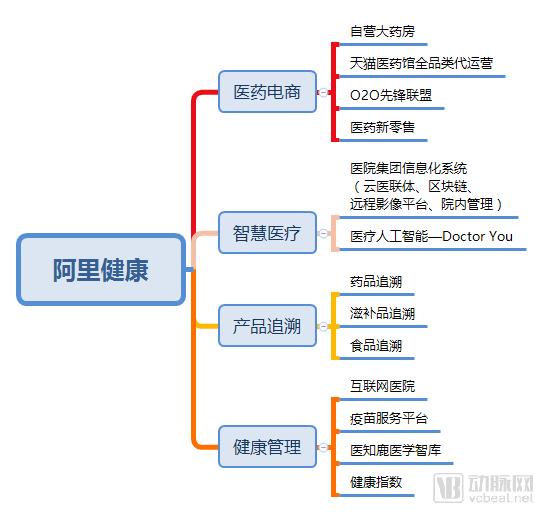
Since its inception, AliHealth has enriched its business layout through group resource injection, self-development, partnerships, and investments, forming four core business lines—pharmaceutical e-commerce, smart healthcare, product traceability, and health management—and establishing a closed-loop “Internet + Healthcare” ecosystem.
AliHealth's Core Business Areas
Since the beginning of this year, AliHealth has taken a series of strategic moves, including leadership changes, the acquisition of Tmall’s medical device business, and investments in Shuyu Civilian Pharmacy and Chinese Health. These developments have come one after another, continuously intensifying industry discussions and scrutiny surrounding AliHealth.
Where Has AliHealth Come From, and Where Is It Headed? VCBeat (WeChat ID: vcbeat) plans to comprehensively review AliHealth’s past initiatives to reconstruct its growth trajectory, and, in light of the policy and industrial landscapes of “Internet + Healthcare,” assess the future direction of AliHealth’s business operations.
On June 25–26, 2018, AliHealth announced two consecutive investments: first, it formally signed a capital increase agreement with Shuyu Pingmin Pharmacy, investing RMB 454 million for a 9.34% equity stake; second, it entered into a strategic cooperation agreement with Huaren Health to deepen its presence in the regional pharmaceutical retail market.
The two companies in which AliHealth made strategic investments and established partnerships are both leading regional pharmaceutical retail chains. Shuyu Pingmin, deeply rooted in the Shandong market, operates over 1,000 stores, achieved sales of RMB 2.86 billion in 2017, and ranked 11th on the Top 100 Pharmaceutical Retailers list. Huaren Health, deeply rooted in the Anhui market, owns Guosheng Pharmacy with over 500 stores, making it one of the largest pharmaceutical retail enterprises in Anhui Province.
AliHealth’s investments in Shuyu Pingmin and Hua Ren Health mark its first entry into the regional pharmaceutical retail market through capital investment. Previously, AliHealth initiated the “Pharmaceutical O2O Pioneer Alliance,” while Ant Financial, an affiliate of Alibaba Group, partnered with Zhang Zhongjing Pharmacy to develop “Future Pharmacies,” opening up Ant Financial’s capabilities in marketing, payments, and credit services to pharmacies. This round of investment signifies a deeper penetration by Alibaba and AliHealth into the pharmaceutical retail sector, paving the way for increased opportunities for collaboration at both the capital and business levels.
According to VCBeat, market factors also played a role in AliHealth’s recent investment in regional pharmacy chains. Beyond AliHealth’s investments, listed leading pharmacy chains, pharmaceutical manufacturers, industrial capital, and cross-industry investors have been actively acquiring stakes in pharmacy chains, with regional chain leaders being particularly sought-after by capital.
Shuyu Civilian entered into a strategic partnership with Huatai Health Fund on the eve of New Year’s Day this year and submitted a new IPO application; Hua Ren Health secured its Series A financing round on August 28 last year, led by Huatai Securities’ Health Fund. Both companies are backed by the same investor, reflecting strong capital interest in chain pharmacies.
AliHealth’s investments in regional retail pharmacies resemble securing a “ticket” for the capitalization journey of chain drugstores. More appealing than mere capital injection is AliHealth’s deep engagement in the pharmaceutical retail market, which enables more effective synergy with its investment targets. This partnership holds significant potential for growth in areas such as new pharmaceutical retail models, pharmaceutical O2O (online-to-offline) services, and the outflow of prescription medications, allowing both parties to strengthen their market position through collaboration. From this perspective, AliHealth may invest in more leading regional pharmaceutical retail enterprises in the future, establishing a synergistic model that combines “capital plus business operations.”
Strictly speaking, AliHealth is the first listed company in China’s “Internet + Healthcare” sector. In January 2014, Alibaba Group, together with Yunfeng Capital, made a strategic investment of US$170 million (approximately RMB 1.037 billion) in CITIC 21st Century, a Hong Kong-listed company, acquiring a 54.3% stake. In October 2014, CITIC 21st Century was renamed “AliHealth,” while its stock code, 00241, remained unchanged, marking the official establishment of AliHealth.
It’s easy to find shade under a big tree. AliHealth started from an exceptionally high vantage point, launching through strategic investments without any pre-existing operational entities. This not only demonstrated Alibaba’s financial muscle and boldness but also signaled a “money-for-time” strategy—building an in-house business system would have made a rapid launch difficult. Moreover, the investment of over RMB 1 billion underscored Alibaba’s determination to establish a presence in the healthcare sector.
In April 2015, AliHealth announced that it would acquire assets from Ali JK Investment and other parties for HK$19.448 billion, with the acquisition to be paid for through the issuance of shares and convertible bonds. The announcement stated that the target businesses injected into AliHealth involved an online trading platform for product sales via an online pharmacy, and expressed the intention to expand the group into Alibaba Group’s flagship healthcare platform.
At the same time, AliHealth reached an agreement with Alibaba. Under the agreement, Alibaba Group will transfer the operational rights of Tmall’s online pharmaceutical business to AliHealth in exchange for newly issued shares and convertible bonds from AliHealth. At that time, the Tmall platform indirectly held the pilot license for China’s first third-party internet drug sales qualification certificate (the 95095 platform) through Hebei Huiyan, allowing it to sell medicines to individual consumers via merchants stationed on the platform. This aligns closely with AliHealth’s positioning as a pharmaceutical e-commerce platform.
During this period, AliHealth’s core businesses included the electronic drug supervision code system, pharmaceutical e-commerce platforms, internet hospitals, and online-to-offline (O2O) pharmaceutical services. Notably, AliHealth was among the first companies in the industry to pilot the “outflow of prescription” model. In February 2015, AliHealth reached an agreement with Winning Health Technology Group to collaborate on the development of internet hospitals and the sharing of electronic prescriptions.
The e-prescription sharing model involves AliHealth connecting with hospital HIS systems to obtain prescription information and relay it to pharmacies, thereby enabling compliant out-of-hospital purchases of prescription drugs. This model was first piloted in Hebei Province but was quickly shelved due to immature policies.
As we can see, AliHealth sought to create a “closed loop” by integrating various aspects of healthcare through online hospitals, electronic prescriptions, and pharmaceutical e-commerce platforms, thereby achieving an integrated service model for diagnosis, treatment, and medication procurement—a model that is already highly advanced.
2016 was a year of continuous turmoil for AliHealth. At the beginning of the year, a pharmacy in Hunan Province sued the China Food and Drug Administration (CFDA), alleging that its delegation of the operation of the electronic supervision code system to AliHealth lacked legal basis. In February 2016, the CFDA officially issued an announcement deciding to temporarily suspend the drug electronic supervision code system and revoke the agency’s operational rights.
Following the drug supervision code incident, AliHealth decided to build an open, market-oriented third-party traceability platform. Leveraging its experience and technical capabilities in establishing traceability systems, AliHealth aims to collaborate with regulatory authorities, pharmaceutical companies, industry organizations, third-party technology service providers, and the public to construct a traceability ecosystem designed to prevent counterfeit drugs.
The new platform will be fully compatible with the technical standards of the “China Drug Electronic Supervision Code,” while providing free access to medical institutions and pharmaceutical enterprises originally registered on the former China Drug Electronic Supervision Network. Product traceability has now become a key business line for AliHealth. In addition to its original traceability functions, the platform has incorporated marketing and interactive features, attracting some health supplement and traditional Chinese medicine manufacturers to join the product traceability platform.
In May 2016, the China Food and Drug Administration (CFDA) halted the pilot program for third-party online drug trading platforms (Pilot A License) and stipulated that third-party platforms such as Tmall Pharmacy were temporarily prohibited from selling any over-the-counter (OTC) products. AliHealth adopted a transitional strategy combining platform services with self-operated sales. In August 2016, AliHealth acquired Guangzhou Wunian Pharmaceutical Chain Co., Ltd., which held the Class C Internet Drug Transaction Service Qualification Certificate, for RMB 16.8 million, thereby launching its B2C pharmacy business.
Prior to this, AliHealth joined forces with 65 chain pharmacies, including Baijiahui Suhe, Deshengtang, and Baicaotang, to jointly announce the establishment of the “China Pharmaceutical O2O Pioneer Alliance,” thereby strengthening its pharmaceutical O2O platform business.
In September 2016, the service agreement between AliHealth and Tmall was approved by 100% of the votes at the shareholders’ meeting. AliHealth obtained exclusive operational rights for Tmall’s pharmaceutical business and will provide a full suite of outsourcing and value-added services to the Tmall Medicine Pavilion, assisting Tmall in developing its e-commerce business for pharmaceuticals and healthcare products in exchange for fees.
Throughout 2016, AliHealth experienced a year marked by continuous turbulence. Influenced by policy and industry dynamics, the company undertook business adjustments, laying the foundation for its subsequent operations.
2017 was a pivotal year for AliHealth, during which its business model largely took shape. By deepening its focus across several business lines, the company essentially finalized its commercial model and revenue structure.
After obtaining the operational rights for Tmall’s pharmaceutical business, AliHealth formally signed a share subscription agreement with Alibaba Group on May 19, 2017. Under the agreement, Alibaba Group injected its online “Blue Hat” health food business on the Tmall platform into AliHealth, further expanding AliHealth’s e-commerce pharmaceutical footprint.
Smart healthcare services emerged as a key focus for AliHealth in 2017: On July 7, at the signing ceremony of the strategic cooperation framework agreement between AliHealth and the Yuhang District Health and Family Planning Bureau, Alibaba announced that it would help Yuhang District implement its “Medical Brain” to assist physicians in clinical decision-making, enable residents to purchase medications online based on electronic prescriptions, and have these orders delivered to their doorsteps by professional logistics providers.
That same month, AliHealth launched its first medical AI system, “Doctor You,” which includes a clinical medical research and diagnostic platform, a medical auxiliary detection engine, and a physician competency training system.
In October, at the Smart Healthcare Special Session of the Apsara Conference, AliHealth publicly disclosed its latest advancements for the first time—signing agreements with three hospitals, namely The First Affiliated Hospital, Zhejiang University School of Medicine; The Second Affiliated Hospital, Zhejiang University School of Medicine; and Xinhua Hospital, Shanghai Jiao Tong University School of Medicine, to accelerate the implementation of smart healthcare solutions.
In 2017, AliHealth made significant strides in its vaccine business: On August 15, AliHealth partnered with GlaxoSmithKline to launch the “Online Appointment HPV Vaccine” service; on November 6, online appointments for HPV vaccination were opened in first-tier cities including Beijing, Shanghai, Guangzhou, Shenzhen, and Hangzhou; in December, AliHealth announced a strategic partnership with China National Biotec Group (CNBG), the largest vaccine enterprise in China, marking CNBG’s official entry onto AliHealth’s first adult vaccine service platform.
Throughout 2017, AliHealth continued to consolidate and enrich its business layout. Internally, its business lines became more clearly defined; externally, partnerships were further expanded, establishing strong connections with hospitals, pharmaceutical companies, and pharmacies. By integrating the entire healthcare service process, AliHealth built a closed-loop “Internet + Healthcare” service ecosystem.
As its business layout continues to improve, AliHealth’s revenue structure has become increasingly sound, with self-operated product sales as the primary driver and e-commerce platform revenue as a supplementary source, supporting its sustained growth.
AliHealth's Historical Revenue
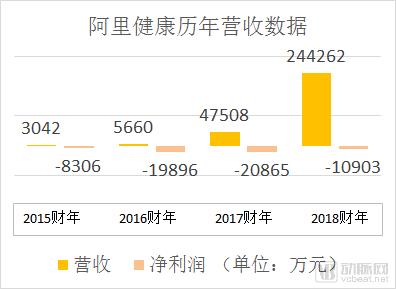
Note: AliHealth’s fiscal year runs from April 1 of the preceding year to March 31 of the following year; for example, the 2018 financial report covers the period from April 1, 2017, to March 31, 2018. Hong Kong dollar amounts in the annual reports have been converted into Renminbi and rounded according to standard rounding rules.
As can be seen, AliHealth’s revenue has grown rapidly, increasing from RMB 30.42 million in fiscal year 2015 to RMB 2.443 billion in fiscal year 2018, while its losses have also been narrowing.
In fiscal year 2017, AliHealth’s revenue surged by 739.4% to RMB 475 million, primarily driven by its pharmaceutical e-commerce business, which generated RMB 379 million in revenue, accounting for 80% of the total. Revenue sources included the self-operated AliHealth Pharmacy, Tmall Pharmaceutical operation services, and pharmaceutical O2O services.
In fiscal year 2018, AliHealth continued to maintain rapid growth in its performance, with revenue reaching RMB 2.443 billion, a year-on-year increase of 414.2%. “The strong growth in revenue and gross profit was mainly due to the rapid expansion of health product sales and e-commerce platform service income during the year.” Revenue from health product sales and e-commerce platform services reached RMB 2.149 billion and RMB 171 million respectively, accounting for approximately 95% of total revenue.
Notably, AliHealth’s profit for fiscal year 2018, excluding share-based compensation expenses, reached RMB 8 million, marking its first return to profitability. This indicates that, barring any unforeseen circumstances, AliHealth has emerged from its loss-making phase.
To further integrate its pharmaceutical e-commerce operations and diversify revenue streams, AliHealth announced on May 29, 2018, that it planned to acquire Tmall’s medical device and health supplement, adult product, and medical and health service businesses for approximately 1.828 billion AliHealth shares, valued at HK$10.6 billion. Industry observers believe this move will further optimize its revenue structure.
Official data show that as of March 31, 2018, the annual gross merchandise volume (GMV) of Tmall’s medical device business had reached RMB 20.561 billion, involving 85.5 million active buyers and more than 3,300 registered merchants, including well-known brands such as Omron, Yuwell, Johnson & Johnson, Bausch + Lomb, and Durex.
The combined gross merchandise value (GMV) of Tmall’s pharmaceutical categories operated by AliHealth and the e-commerce platform service business for health food products acquired by AliHealth exceeded RMB 30 billion. Revenue from e-commerce platform services reached RMB 171 million, representing a year-on-year increase of 324.1%.
This indicates that AliHealth controls the gateway to an e-commerce market for pharmaceuticals, medical devices, and health supplements valued at over RMB 50 billion. Coupled with its self-operated pharmacy business, this positions the company for substantial future revenue growth potential.
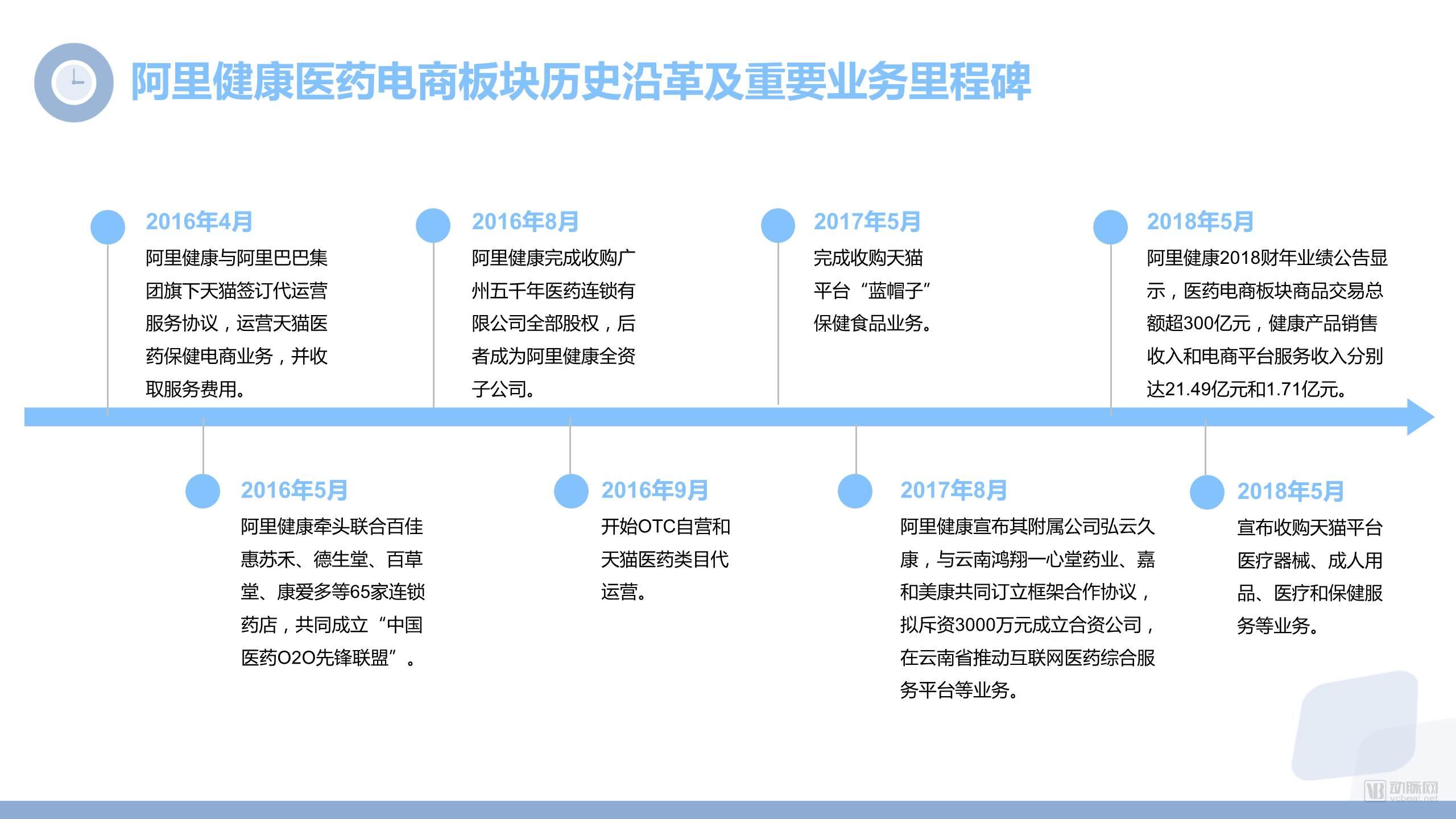
Since Alibaba Group’s strategic capital injection, AliHealth’s growth trajectory has been broadly divided into four stages:
Phase I: Capital Injection and Launch Phase, with business focused on electronic supervision codes and e-commerce services;
Phase II: Business Adjustment Period, piloting internet hospitals, pharmaceutical O2O, and self-operated e-commerce businesses;
Phase III: Business Maturation Stage, where the business landscape gradually stabilizes, forming four business lines: pharmaceutical e-commerce, product traceability, smart healthcare, and health management;
Phase IV: Period of Sustained Deepening. After several years of exploration, AliHealth has established its position within the industry and secured stable revenue streams. Moving forward, it will continue to deepen its industry engagement by implementing incremental improvements to its existing business operations.
Within the business framework of AliHealth, attention should also be paid to its potential future “synergy” with the overall healthcare and medical layout of the Alibaba ecosystem. As previously outlined by VCBeat, the Alibaba ecosystem’s healthcare footprint includes “proprietary” businesses such as AliHealth, Ant Financial, Alibaba Cloud, and Taobao, covering areas like medical payments, healthcare IT services, and health service entry points. These elements could integrate effectively with AliHealth’s operations.
Alibaba’s Healthcare Industry Landscape
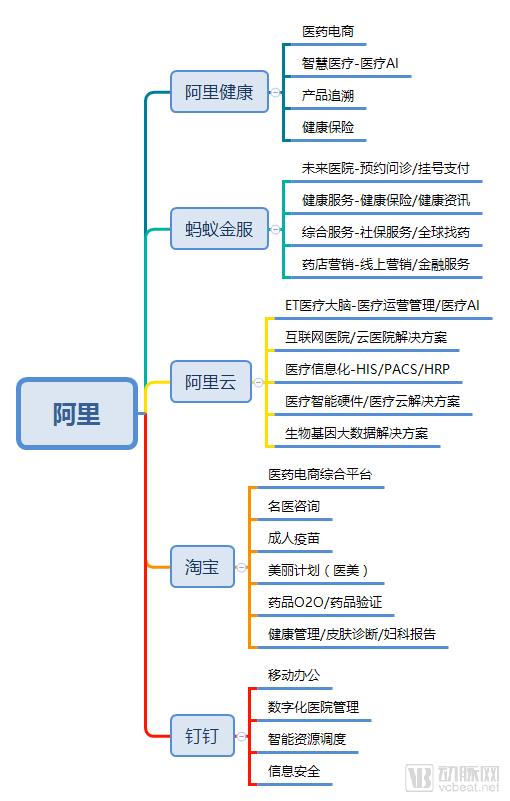
Meanwhile, Alibaba-affiliated capital has invested in companies such as Wanli Cloud, Jiahe Meikang, BGI Genomics, Sinopharm Online, WuXi Biologics, Medlinker, and Yitu Technology. These entities may also collaborate with AliHealth to create synergistic resource complementarity, which serves as a positive development for AliHealth’s future growth.
AliHealth’s growth trajectory is, in fact, a microcosm of the broader “Internet + Healthcare” industry. In the early stages, many players entered the market with the determination to transform and upgrade the industry; however, due to policy restrictions and entrenched interest barriers, numerous projects failed to succeed.
As our understanding of the industry deepens, we are gradually transitioning from being a “disruptor” to an “enabler,” exploring how to leverage internet and information technologies to empower the healthcare industry, address existing challenges, improve industrial efficiency, and enhance user experience. In this process, we have also realized both our social and commercial value.
AliHealth’s growth trajectory serves as an excellent case study for examining the development of the “Internet + Healthcare” industry. Key questions that new entrants must consider include how to rapidly iterate through trial and error, how to identify sustainable profit models to support business expansion, how to strike a balance between regulatory policies and industry interests, and how to continuously optimize product and service structures to meet evolving industry demands.
"Shade is best under a large tree; to forge iron, one must be strong oneself." Resources are merely the first step; an excess of resources can even become a limiting factor. AliHealth has provided valuable experience for tech giants entering the "Internet + Healthcare" industry. It is expected that as policies are further rolled out, more large enterprises will seek to enter this market through resource injection and strategic transformation.