

Guangzhou Medical University and KingMed Diagnostics Co-Found China's First Medical Testing Integration Alliance with Over 500 Institutions
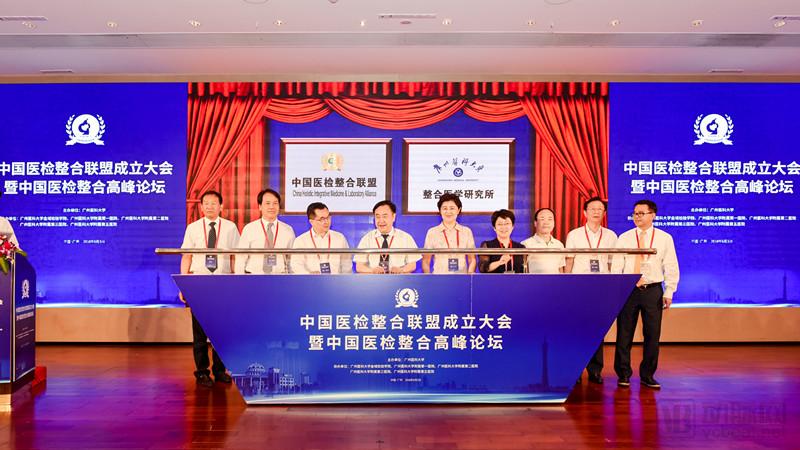
Figure: China's first integrated medical testing alliance announced its establishment (Source: Company-provided image)
On June 3, 2018, the Inaugural Conference of the Chinese Alliance for Integration of Medicine and Laboratory Testing, along with the China Summit Forum on Integration of Medicine and Laboratory Testing, was grandly held in Guangzhou. Advocated by Academician Fan Daiming of the Chinese Academy of Engineering, and jointly initiated by Guangzhou Medical University and Guangzhou KingMed Diagnostics Group, China’s first Alliance for Integration of Medicine and Laboratory Testing was officially established. Academician Fan Daiming serves as Honorary Chairman, Academician Lin Dongxin as Chairman, while Academician Zhong Nanshan of the Chinese Academy of Engineering and Professor Shang Hong, President of the Branch of Laboratory Physicians of the Chinese Medical Doctor Association, serve as Advisors.
The Alliance is voluntarily composed of more than 500 medical colleges and universities, research institutes, healthcare institutions, enterprises, industry associations (societies), and experts., aiming to implement the “Healthy China” development strategy and promote the integrated development of medicine and laboratory science in China through an integrated model encompassing industry, academia, research, government, healthcare, and testing. By pooling domestic and international superior resources, building a platform for collaborative innovation and sharing, and cultivating high-caliber professionals in integrated medicine and laboratory science, we will comprehensively advance interdisciplinary integration and collaborative innovation. We strive to establish the “China Alliance for Integrated Medicine and Laboratory Science,” which aligns with national strategic priorities, reflects China’s advantages and characteristics, and possesses international influence, thereby contributing to the protection of human health.
Academician Fan Daiming, Professor Shang Hong, President of the Laboratory Physicians Branch of the Chinese Medical Doctor Association, Fu Wei, Director of the Health Development Research Center of the National Health and Family Planning Commission, Gu Zhongpeng, Party Group Member and Chief Inspector of the Guangzhou Municipal Education Bureau, Ouyang Ziwen, Party Group Member and Deputy Director of the Guangzhou Municipal Health and Family Planning Commission, Chen Wenxiang, Director of the National Center for Clinical Laboratories of the National Health and Family Planning Commission, Professor Ran Pixin, Party Secretary of Guangzhou Medical University, Wang Xinhua, President of Guangzhou Medical University, and Liang Yaoming, Chairman and CEO of KingMed Diagnostics Group, attended the alliance’s founding ceremony.
“People’s health is an important indicator of national prosperity and the strength of the country.” The report to the 19th National Congress of the Communist Party of China proposed “implementing the Healthy China Strategy” and stated that “we should improve national health policies and provide comprehensive health services to the people.”
To this end, China is embracing the concepts of “big health” and “comprehensive health,” shifting the focus from disease treatment to people’s health, and continuously improving the health and well-being of the population.
As a key strategic initiative to benefit public health, China is vigorously advancing the Chinese Precision Medicine Initiative, aiming to achieve personalized and precise treatment for diseases and specific patients through the accuracy and accessibility of precision medicine, thereby enhancing the effectiveness of disease diagnosis, treatment, and prevention.
To achieve precision medicine, the key prerequisite is precise diagnosis. However, with advances in medicine, accurate diagnosis of a disease often requires the coordinated application and integration of multiple clinical disciplines, platforms, and technologies. Therefore, achieving precise diagnosis demands high-level integration, interaction, and collaboration among industry, academia, research institutions, government, healthcare providers, and diagnostic laboratories.
Against this backdrop, Academician Fan Daiming of the Chinese Academy of Engineering, founder of integrative medicine, has vigorously advocated for the establishment of the “China Alliance for Integration of Medicine and Laboratory Medicine,” a non-governmental, academic, public-welfare, and open social organization composed of domestic and international medical universities, research institutes, healthcare institutions, enterprises, and industry associations (societies) that are actively concerned with and engaged in the integration of medicine and laboratory medicine. This initiative aims to better implement the “Healthy China” development strategy and promote the integrated development of medicine and laboratory medicine.
“The Alliance for the Integration of Medicine and Laboratory Testing was born in response to the global trend in medical development,” stated Fan Daiming. He noted that medicine has evolved from the eras of empirical and scientific medicine into a new era of integrative medicine. Integrative medicine offers comprehensive, whole-course innovative approaches, therapies, and models for human health. As an integral component of medicine, or as a secondary discipline within the medical field, laboratory medicine will inevitably embrace the paradigm of integrative medicine.
On June 3, the “China Medical and Laboratory Integration Alliance” was officially unveiled and established. The alliance is voluntarily formed by more than 500 medical colleges and universities, research institutes, healthcare institutions, enterprises, industry associations (societies), and experts. It is reported to be the first such alliance in China, as well as the largest and most prestigious one of its kind to date.
The Alliance is affiliated with Guangzhou Medical University. Following the election of its organizational structure, Lin Dongxin, an academician of the Chinese Academy of Engineering, Director of the Department of Etiology and Carcinogenesis at the Cancer Hospital of the Chinese Academy of Medical Sciences, and Chairman of the Professional Committee on Tumor Etiology of the China Anti-Cancer Association, was elected as Chairman. Wang Xinhua, President of Guangzhou Medical University, and Liang Yaoming, Chairman and CEO of KingMed Diagnostics, were elected as Executive Vice Chairmen. Chen Wenxiang, Director of the National Center for Clinical Laboratories (NCCL) under the former Ministry of Health; Wang Zhiguo, Deputy Director of the NCCL; and Pan Baishen, Director of the Department of Laboratory Medicine at Zhongshan Hospital, Fudan University, among others, were elected as Vice Chairmen.
Fu Wei stated that with the advancement of medical science and the development of the healthcare industry, clinical laboratory testing has increasingly become a critical foundation and essential tool for disease diagnosis. On one hand, the public’s growing demand for comprehensive, full-lifecycle, diverse, and personalized health services has raised higher expectations for laboratory medicine, necessitating the continuous development, translation, and application of novel testing methods and technologies. On the other hand, given the relative insufficiency of overall healthcare and health resources and the imbalanced regional distribution, it is particularly crucial to strengthen workforce development, improve testing quality, and innovate service delivery models.
The establishment of the Medical-Laboratory Integration Alliance has created a shared platform for collaborative innovation. This initiative not only comprehensively promotes interdisciplinary integration and collaborative innovation across various disciplines and expands the application of high-end, advanced laboratory testing technologies, but also better leverages the Alliance’s radiating and driving influence to advance the development of specialized medical consortiums in laboratory medicine. By facilitating the downward distribution of high-quality resources to meet the needs of primary care services, it aims to provide the public with more equitable, accessible, systematic, and continuous health services.
As the host institution of the China Medical Laboratory Integration Alliance, Ran Pixin stated that Guangzhou Medical University will fully leverage its role in communication and coordination to jointly build the brand of the Medical Laboratory Integration Alliance. He expressed hope that, by leveraging this alliance platform and integrating multidisciplinary resources, the university will coordinate member needs and resource advantages, establish a superior disciplinary system for medical laboratory integration, conduct relevant research, and cultivate outstanding professionals in this field.
Entrusted by Wang Dong, Deputy Mayor of Guangzhou, Gu Zhongpeng extended a warm welcome on behalf of the Guangzhou Municipal Education Bureau to all leaders, experts, and representatives attending the conference. He pointed out that the launch of the Medical Laboratory Integration Alliance represents a new initiative in the reform of China’s education and healthcare sectors. For Guangzhou, this is both a significant and beneficial development, whether viewed from the practical needs of higher education development or the broader perspective of medical education. The alliance will pool advantageous resources from home and abroad, establish a collaborative platform for innovation and sharing, cultivate high-quality professionals in integrated medical laboratory sciences, comprehensively promote interdisciplinary integration and collaborative innovation, and thereby accelerate and improve the development of medical education and healthcare services in China.
According to reports, the Alliance will implement the spirit of the 19th National Congress of the Communist Party of China, support the implementation of the Healthy China strategy, and innovate new mechanisms for the integration of medicine and laboratory testing. It aims to establish a knowledge system and service system for integrated medicine and laboratory testing that promote human health and facilitate disease diagnosis, treatment, and prevention. By promoting an integrated model involving industry, academia, research, government, healthcare, and laboratory testing, the Alliance will drive the development of China’s integrated medicine and laboratory testing sector. It is committed to building itself into the “China Alliance for Integrated Medicine and Laboratory Testing,” which aligns with national strategic priorities, reflects China’s advantages and characteristics, and exerts international influence, thereby contributing to the safeguarding of human health.
Going forward, the Alliance will adhere to a people-centered approach and the integration of medicine and laboratory diagnostics, establishing an early screening and diagnostic system for major diseases to enhance the feasibility and effectiveness of disease prevention and control. In response to diseases arising from biological, social, psychological, and ecological factors, it will comprehensively and systematically integrate clinical medicine, laboratory medicine, social medicine, and network information technology. By developing new theories, concepts, and pathways for integrated medical and diagnostic practices, the Alliance aims to provide improved theoretical guidance on health and a more robust health service system for the entire population, across the full life course, and throughout the entire spectrum of disease progression.
Furthermore, the Alliance will establish multiple platforms, including an information dissemination and exchange platform, a public service platform, and a technology transfer service platform for integrated medical and laboratory achievements. These initiatives aim to facilitate information interchange and resource sharing among member units, align clinical needs with scientific research resources, and connect technological achievements with industrial resources and capital, thereby promoting the translation of scientific and technological achievements in the field of medical-laboratory integration. In terms of talent development, the Alliance will focus on exploring new models for cultivating professionals in this integrated field, aiming to train high-quality, interdisciplinary medical and laboratory specialists who possess humanistic values, a global perspective, innovative spirit, and practical skills.
At the first meeting of the Alliance’s inaugural Council, Wang Xinhua stated that he hoped Alliance members would: gain a clear understanding of the current situation, build consensus, and strengthen their sense of responsibility and mission; accurately define their roles, enhance services, and fulfill their function as a bridge and link; improve institutional frameworks, strengthen management, and bolster cohesion and influence; promote academic prosperity, lead innovation, and elevate academic quality and disciplinary development.
As one of the founding organizations of the alliance, Liang Yaoming, Chairman and CEO of KingMed Diagnostics, stated that KingMed Diagnostics is clinical- and disease-oriented, continuously seeking the organic integration of medical diagnostics with the upstream and downstream segments of the clinical and healthcare service industry chain, thereby enhancing KingMed’s core competitiveness and sustainable development capabilities. In terms of talent development, KingMed established the “KingMed School of Laboratory Medicine at Guangzhou Medical University” in collaboration with Guangzhou Medical University in its early years, integrating industry, academia, research, and social resources to provide systematic professional training for undergraduates, master’s students, doctoral candidates, and postdoctoral fellows. Moving forward, under the guidance and support of the alliance, KingMed will continue to pursue the integrated path of industry, academia, research, and healthcare.