

Zixun AI's NLP-Powered Smart Triage System: Integrating WeChat-Based and On-Site Robots to Alleviate Hospital Crowd Pressure – A Grassroots Case Study
Zixun AI was founded in Shenzhen in 2016. From healthcare and industry to finance, Zixun believes that AI can bring about a different future.
Since its inception, Zixun Artificial Intelligence has continuously identified industry gaps, dedicated itself to developing proprietary technologies in natural language processing, computer vision, and data processing, and remained steadfast in its commitment to self-driven innovation.
After nearly two years of exploration and accumulation, Zixun has decided to place part of its core business in the medical field and develop a one-stop intelligent customer service solution and an intelligent tumor diagnosis robot.
Image provided by Zixun AI
Zixun AI’s founding team comprises top-tier talent from various industries. The co-founders include Professor Zhao (name withheld), Liu Dongping, Wang Bin, and Liu Xiang.
Professor Zhao earned his Ph.D. from the Institute of Physics, Chinese Academy of Sciences, and subsequently conducted postdoctoral research at McGill University in Canada and the University of Hong Kong. Liu Dongping obtained his Ph.D. from the Institute of Logistics, Chinese Academy of Sciences, and also served as a postdoctoral fellow at McGill University in Canada. Wang Bin received his Ph.D. from the Department of Physics at the University of Hong Kong and was selected as a Category B talent under the “Peacock Plan.” Liu Xiang earned his Ph.D. from the Center for Southwest Ethnic Education and Research at Southwest University and completed his postdoctoral work at the Institute of Chinese Language and Literature Documents at Southwest University.
Team COO Chen Haotian holds an MBA from the University of Melbourne. He previously founded Heywines, an intelligent wine recommendation system that shares similar functionalities with Zixun’s products. Luo Kangjin, Senior Business Manager at VCBeat Institute, formerly served as a Senior Business Manager at Saiyi Technology, bringing three years of experience in providing integrated hardware and software solutions.
Zixun AI has previously launched offline intelligent triage robots, primarily deployed in hospital lobbies to provide consultation services for first-time patients. Patients can access information such as appointment registration and payment by interacting with the corresponding interface.
However, the shortcomings of such robots are also quite evident. Zixun AI has found in practice that, due to economic and spatial constraints, most hospitals deploy only a few intelligent triage robots. On one hand, this limited quantity fails to meet the demands of high patient traffic; on the other hand, hospitals currently serve a predominantly elderly population, whose limited technical proficiency hinders their ability to quickly adapt to these systems. As a result, such products struggle to fulfill their core functions in hospital settings and often serve merely as superficial initiatives aimed at enhancing patients’ perception of the hospital.
In the broader context of “Internet + Healthcare,” Zixun AI believes that intelligent triage robots can serve as a springboard, enabling greater internet accessibility for more people through simple modifications.
Accordingly, Zixun AI has launched an intelligent triage robot on WeChat. Leveraging NLP algorithms developed by the Institute of Consulting and integrated with a professional medical semantic database, the robot effectively analyzes both text and voice inputs to provide appropriate responses.
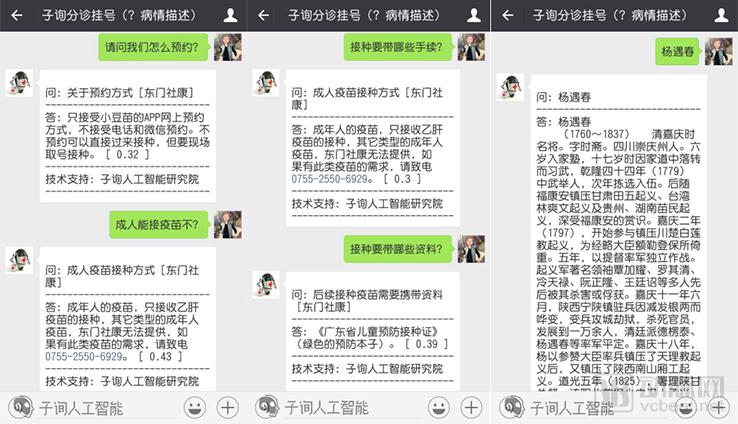
Image provided by Zixun AI
Zixun AI’s COO, Chen Haotian, told VCBeat: “Although there are many companies developing NLP systems on the market, few possess distinct professional advantages. We have built a specialized medical information semantic database, which is integrated into our WeChat-based triage chatbot. After patients access the system, their location is first identified via geolocation to find hospitals within a suitable distance. Then, based on information provided by the patient—such as symptom descriptions and personal preferences—the system directs them to the most appropriate hospital and department.”
“To a certain extent, it is more practical than the in-hospital triage robots, with broader applicability. Patients can access various information in advance from home, eliminating the need to queue for triage after arriving at the hospital.”
“The system integration process is also very straightforward. We plan to place WeChat QR codes next to the intelligent triage robots within hospitals, allowing users to access our services simply by scanning the code and following the official account. Given WeChat’s extensive user base, our market reach is equally broad. Moreover, both young and elderly individuals can easily obtain the information they need through simple operations. I believe this market holds significant promise.”
Facilitating Hospital Operations
Patient triage is not only a demand from patients but also a requirement for hospitals. Reasonable patient flow management can significantly enhance hospital efficiency, freeing physicians from having to provide directional guidance while delivering medical care. Meanwhile, value-added services can improve the hospital’s reputation, thereby increasing its intrinsic value. Therefore, this represents a win-win situation for hospitals.
It is difficult to charge users for this type of software; hospitals, as vested stakeholders, have both the obligation and willingness to pay for it. This represents a future revenue model for Zixun’s WeChat-based intelligent triage chatbot.
Currently, Zixun AI has partnered with dozens of hospitals across various regions, including Shenzhen, Chengdu, and Hefei. As the project remains in its practical implementation phase, extensive collaborations will accelerate Zixun AI’s market assessments.
According to Chen Haotian, “The Zixun WeChat-based triage chatbot has already achieved a semantic recognition accuracy of 95%, indicating that the product is now mature. This demonstrates that the solutions we have implemented and the data we have collected in the healthcare sector over the past two years have been highly valuable.”
In the future, Zixun AI will continue to adhere to its development path in the medical field. The next phase of development will maintain a focus on the research and development of medical devices, while strengthening research into hardware-software interaction, such as integrating hardware with image recognition for medical imaging, which can be applied to disease screening across multiple scenarios. This direction is consistent with Zixun AI’s previously developed intelligent diagnostic robot for tumors.
Zixun AI is still under development, with the aim of improving efficiency for more primary healthcare institutions through its products. We also welcome greater participation from relevant talent and enterprises in product and technological exchanges as we continue to grow.