

Big Pharma Embraces AI: What Billion-Dollar Deals Between Johnson & Johnson, Pfizer and AI Startups Signal for the Future of Drug Discovery
A review of recent industry forums on medical AI reveals that nearly all have incorporated discussions on commercial implementation into their agendas. As medical AI products undergo iterative refinement and pilot trials in hospitals, commercialization has become the primary concern for investors, enterprises, and other stakeholders. However, since most next-generation medical AI products are positioned as auxiliary diagnostic tools and have not yet received approval from the National Medical Products Administration (NMPA), their commercialization remains at the stage of exploratory attempts, precluding large-scale promotion and deployment.
The application of AI in new drug development primarily focuses on areas such as drug discovery, safety assessment, and efficacy testing. The main barriers to these applications are technical rather than regulatory. Given that the lengthy development cycles and high costs associated with new drug development have become significant pain points for the industry, the deployment of mature AI-driven drug discovery solutions will not be particularly difficult.
VCBeat (WeChat ID: vcbeat) has recently learned that over the past two years, pharmaceutical giants have begun leveraging AI technologies to accelerate drug R&D and partnering with healthcare AI startups to expedite this process. For instance, collaborations have been established between AstraZeneca and Berg Health, Johnson & Johnson and BenevolentAI, Merck and Atomwise, Takeda Pharmaceutical and Numerate, Sanofi and GSK with Exscientia, Pfizer and IBM Watson, as well as Pfizer and XtalPi. VCBeat has compiled an overview of these partnerships to examine their scope and content.
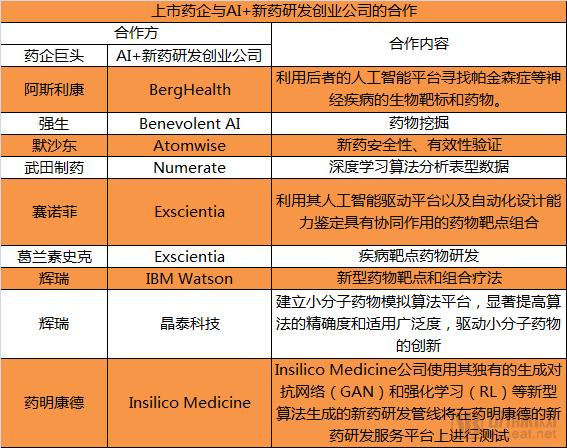
In May 2018, XtalPi, an AI-driven pharmaceutical R&D company dedicated to algorithmic innovation, announced a strategic research and development partnership with Pfizer. By integrating quantum physics with artificial intelligence, the collaboration established a small-molecule drug simulation algorithm platform that significantly enhanced both the accuracy and broad applicability of its algorithms, thereby driving innovation in small-molecule therapeutics.
Drug simulation technology is widely used in drug discovery and design, enabling scientists to study and predict the biological and pharmaceutical properties and reactions of drugs at the atomic level. In this collaboration, XtalPi will leverage its technological advantages in quantum mechanics, artificial intelligence, and cloud-based high-performance scientific computing to improve and break through existing drug simulation technologies, allowing the platform to cover a broader chemical space and generate more accurate drug molecule models.
Building on this foundation, the platform will also enable accurate prediction of several key properties of drug candidates, further empowering critical stages in drug discovery and development. The establishment of this strategic R&D collaboration builds upon the strong existing partnership between XtalPi and Pfizer. Pfizer has favored XtalPi’s crystal form prediction technology, and this drug simulation algorithm platform will further enhance both parties’ technical capabilities in computer-aided drug design and solid-state screening.
To facilitate technical exchanges among industry, academia, and research institutions, a portion of the molecular mechanics parameters derived from public databases will be open-sourced to the academic community following the successful completion of this R&D effort, thereby promoting and supporting continuous progress and innovation in related fields.
On June 11, 2018, Insilico Medicine, a next-generation artificial intelligence company in the United States, announced that it had signed a cooperation agreement with WuXi AppTec, a leader in China’s pharmaceutical research and development services industry.
According to the agreement, Insilico MedicineThe new drug development pipeline, generated using proprietary novel algorithms such as generative adversarial networks and reinforcement learning, will be tested on WuXi AppTec’s new drug research and development service platform.. The two companies have established a series of milestone plans aimed at leveraging next-generation artificial intelligence technologies to develop ideal preclinical drug candidate molecules for novel and challenging biological targets, such as those with unknown crystal structures or ligands.
Since 2016, Insilico Medicine has published multiple research papers demonstrating its ability to generate novel drug molecules with desired properties using artificial intelligence technologies such as Generative Adversarial Networks (GANs) and Reinforcement Learning (RL), and has identified some of the most promising pipeline candidates through preliminary experimental validation.This collaboration with WuXi AppTec will enable the company to rapidly conduct further experimental validation of its discovered drug candidate molecules, while simultaneously generating valuable data to advance the development of its artificial intelligence technology.
In 2017, AstraZeneca established a partnership with BERG, a Massachusetts-based startup, to leverage the latter’s artificial intelligence platform for identifying biological targets and developing drugs for neurological disorders such as Parkinson’s disease.
How to Leverage Artificial Intelligence? Niven R. Narain, CEO of BERG, stated that the first step is to “return to biology.” Tissue samples are collected from both healthy individuals and patients, subjected to various molecular analyses, integrated with clinical data, and then processed through BERG’s artificial intelligence platform to identify therapeutic targets.
Narain stated that BERG avoids “public databases” when conducting data analysis. He said, “We use Bayesian methods rather than neural networks. It is not as simple as feeding a batch of data into a model to derive certain correlations. Instead of starting with a predetermined hypothesis, we input all the data into the system and allow the data to generate hypotheses on its own.”
As early as October 2016, Berg Health and the U.S. Department of Defense announced a collaboration to leverage artificial intelligence in new drug development. The initiative aims to identify treatment options for invasive breast cancer that is unresponsive to existing medications, by screening up to 250,000 samples to discover novel biological indicators and biomarkers for early-stage cancer.
In November 2016, BenevolentAI entered into a collaboration with Johnson & Johnson, whereby Johnson & Johnson transferred certain experimental small-molecule compounds to BenevolentAI for new drug development.
BenevolentAI’s technology platform leverages artificial intelligence to extract knowledge capable of driving drug discovery from vast amounts of unstructured data, generating novel, testable hypotheses that accelerate the drug development process. This platform is called JACS (Judgment Augmented Cognition System). For details, see: “BenevolentAI: Europe’s largest AI-driven drug discovery company sold two drugs in development for $800 million》
In 2015, Merck & Co. partnered with Atomwise, a U.S.-based company, leveraging its pioneering AtomNet technology platform. This platform employs logical reasoning akin to that of human medicinal chemists and utilizes powerful deep learning algorithms alongside supercomputing tools to analyze millions of potential therapeutic candidates daily, thereby accelerating the drug discovery and development process. The primary focus is on predicting the efficacy and safety of new drug candidates.
In May 2018, Atomwise secured $45 million in financing, with participation from Baidu Venture Capital and Tencent. Atomwise’s pioneering software technology, AtomNet, leverages powerful deep learning algorithms and high-performance computing to analyze tens of millions of molecules daily for potential drug candidates, mirroring the capabilities of human chemists. Over the past two years, Atomwise has experienced rapid growth, establishing partnerships with ten of the largest pharmaceutical companies in the United States, numerous biotechnology firms, and more than 40 leading research universities. Currently, over 50 R&D projects are underway. Atomwise has formed collaborations with four major pharmaceutical companies, including Merck, and maintains close ties with many other biotechnology companies, research institutions, and universities.
In June 2017, Numerate Inc. formally signed an agreement with Takeda Pharmaceutical Company to collaborate on leveraging Numerate’s artificial intelligence (AI) technology for the discovery of small-molecule drugs in oncology, gastroenterology, and central nervous system disorders.
Numerate CEO Guido Lanza stated that they apply AI to every stage of chemical design. In collaboration with Takeda, based in Tokyo, Numerate screens target molecules, designs and optimizes compounds, and models absorption, distribution, metabolism, excretion, and toxicity (ADMET) to provide Takeda with clinical trial candidates. The financial terms and royalties of the agreement were not disclosed.
In Japan, companies such as Takeda Pharmaceutical, Fujifilm, and Shionogi & Co. will leverage artificial intelligence (AI) to advance new drug development. Approximately 50 companies, including IT firms like Fujitsu and NEC, are participating in this initiative. The project aims to collaborate with the RIKEN Center for Advanced Intelligence Project and Kyoto University to develop AI systems for pharmaceutical research, enabling the rapid identification of candidate compounds for new drugs. Currently, new drug development entails enormous costs, with a success rate of only 1 in 20,000 to 30,000. The use of AI is expected to enhance development efficiency and strengthen competitiveness in the fiercely global landscape of new drug discovery.
A consortium comprising corporations and research institutions is set to launch in the near future. Participation is expected not only from within Japan but also from overseas IT and pharmaceutical companies. The initiative aims to popularize AI-driven new drug development, targeting widespread adoption within three years. Japan’s Ministry of Education, Culture, Sports, Science and Technology (MEXT) will allocate an additional ¥2.5 billion in its fiscal 2017 budget request to support the project, with the total funding expected to reach approximately ¥10 billion.
In May 2017, according to a report on the GEN website, Sanofi and Exscientia entered into a collaboration and licensing deal with a potential value of €250 million (approximately $276 million). The agreement aims to develop bispecific small-molecule drugs targeting metabolic diseases.
Exscientia will leverage its artificial intelligence (AI)-driven platform and automated design capabilities to identify synergistic drug target combinations, and then utilize its lead-finding platform to discover bispecific small-molecule drugs targeting these pairs.
Exscientia will be responsible for all compound design, while Sanofi will provide chemical synthesis. In addition, Sanofi retains the option to license “related compounds” and will bear the costs of future preclinical and clinical development. Exscientia will receive research funding for the identification of “target pairs” and priority candidates, and will be eligible for future non-clinical, clinical, and sales-related milestone payments.
Exscientia’s drug discovery “engine” is built on an AI platform. The company leverages this platform to design and evaluate new compounds, assessing parameters such as potency, selectivity, and ADME properties. Exscientia is utilizing this platform to establish partnerships for the development of small-molecule drugs targeting single targets, as well as bispecific small-molecule candidates directed against target combinations.
In addition to this new deal, Exscientia entered into an immuno-oncology collaboration with Germany’s Evotec in April 2016. At last month’s AACR Annual Meeting, the two parties disclosed details of a selective adenosine 2A receptor antagonist and a bispecific small-molecule drug targeting A2AR and CD73.
Exscientia’s partner, Sanofi, also has a collaboration with Evotec. The two companies entered into a partnership in 2015, which included the development of beta cell-based therapies for diabetes.
In July 2017, pharmaceutical giant GlaxoSmithKline announced a deal worth approximately $43 million with the UK-based AI company Exscientia.
Exscientia will leverage its artificial intelligence platform to assist GlaxoSmithKline in the research and development of 10 drug candidates. Exscientia will receive payments based on R&D milestones, totaling £33 million (approximately $43 million).
Exscientia CEO Hopkins stated that the company’s AI system can generate new drug candidates in just one-quarter of the time and at one-quarter of the cost required by traditional methods.
Exscientia also signed an agreement with Sanofi in May. Other major pharmaceutical companies, including Merck, Johnson & Johnson, and Sanofi-Aventis, are also exploring the potential of artificial intelligence to help streamline drug development processes.
These pharmaceutical companies aim to leverage modern supercomputers and machine learning systems to predict how various molecules in drug candidates will behave and assess the likelihood of their success, thereby avoiding the time and financial costs associated with unnecessary testing.
IBM Watson and Pfizer have entered into a new agreement to leverage the former’s supercomputing capabilities for cancer drug development. Pfizer will utilize Watson for Drug Discovery’s machine learning, natural language processing, and other cognitive reasoning capabilities to identify new drugs in immuno-oncology, as well as to develop combination therapies and patient selection strategies.
Watson for Drug Discovery is a new cloud platform designed to help life scientists identify novel drug targets and alternative drug indications.
According to Pfizer, many researchers believe that the future of immuno-oncology lies in combinations targeting unique tumor characteristics, which will transform the cancer treatment paradigm and enable more cancer patients to receive therapy. Immuno-oncology is a cancer treatment approach that harnesses the human immune system to help fight cancer.
The value of these collaborations exceeds tens of millions of US dollars.
In June 2017, VCBeat reviewed 16 companies engaged in AI-driven new drug R&D. Today, more than eight of these companies have established business collaborations with pharmaceutical giants, with known deal sizes ranging from tens of millions to hundreds of millions of U.S. dollars.
For example, the deal between GlaxoSmithKline and Exscientia was valued at $43 million. BenevolentAI partnered with a U.S. pharmaceutical company to sell two Alzheimer’s disease drug candidates currently in development; these compounds were at the stage of evaluating nominated candidate compounds. The total value of this transaction reached $800 million, with BenevolentAI receiving a $400 million upfront payment.
Based on current understanding, the revenue of domestic medical AI companies positioned for assisted diagnosis still primarily comes from research grants, technical services, or other business activities; it will take time before they can achieve large-scale revenue.
Strangely, the domestic enterprises engaged in AI-driven new drug R&D are primarily XtalPi and Calcite Biosciences. Given that several Chinese medical AI companies already have hundreds of researchers on staff, it is worth considering whether they should expand into new drug development—a strategic question deserving careful consideration by their founding teams.
The AI Era May Present a Prime Opportunity for the Rise of New Pharmaceutical Companies
According to the 2017 financial reports of foreign pharmaceutical companies, the top ten pharmaceutical companies by revenue were Pfizer, Novartis, Roche, GlaxoSmithKline (GSK), Merck & Co., Johnson & Johnson, Sanofi, AbbVie, Eli Lilly, and Amgen.
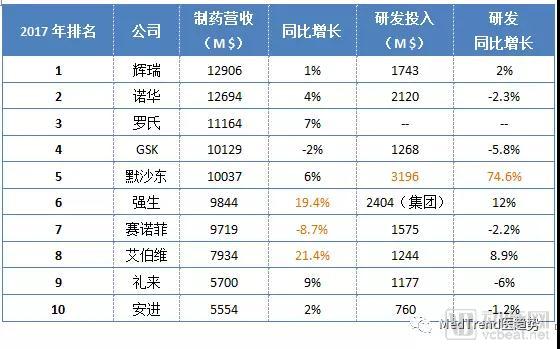
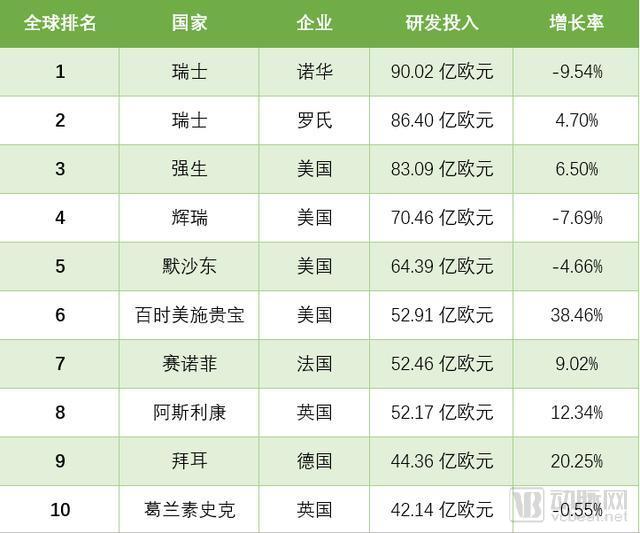
Top 10 Global Pharmaceutical Companies by R&D Investment
The list of the top ten pharmaceutical companies has seen little change in recent years. This is because their R&D investments will support future revenue. Without new technologies and the transformations they bring, this landscape will not be easily disrupted.
Taking Japan as an example, the National Institutes of Biomedical Innovation, Health and Nutrition (NIBIOHN) planned to begin using existing artificial intelligence to identify new drug candidates starting in fiscal year 2017. According to VCBeat, the newly developed AI for drug discovery not only improves accuracy by learning from various datasets but also helps trace the mechanisms underlying the effects of drug candidates, thereby facilitating their clinical application.
Takeda, the largest pharmaceutical company in Japan, ranks only 17th globally in the pharmaceutical industry (its ranking is expected to enter the top ten following Takeda’s acquisition of the Irish pharmaceutical giant Shire). In terms of scale, it lags behind pharmaceutical giants such as Pfizer in the United States and Novartis in Switzerland. Its R&D expenditure is also less than half that of major pharmaceutical companies like Pfizer. Without leveraging artificial intelligence to enhance R&D efficiency, Japanese pharmaceutical companies will be unable to compete successfully on the global stage.
In its recently released report, “A Ten-Year Outlook for China’s Innovative Drugs,” CICC stated that by 2030, China’s contribution to global pharmaceutical innovation, measured by the number of newly developed active ingredients, will rise from the current 2% to 12%, placing it in the second tier globally. The share of global pharmaceutical R&D spending accounted for by Chinese companies will increase from the current 5% to 20%, surpassing the United Kingdom to rank second worldwide. China is expected to produce 1–2 first-in-class new drugs annually. Over the next decade, 3–5 blockbuster drugs with global annual sales exceeding US$1 billion will emerge. Twenty percent of sales from innovative drugs will come from overseas markets.
The vast application prospects of artificial intelligence in drug R&D will shorten the development timeline and reduce costs, offering innovative pharmaceutical companies a potential pathway to disrupt the existing market landscape. However, domestic pharmaceutical enterprises should also note that international traditional pharmaceutical giants have already made deep inroads into the medical AI sector. It is therefore imperative for China’s pharmaceutical industry to leverage AI to accelerate drug development and avoid missing out on this wave of technological dividends.
It is worth noting that medical AI will make traditional Chinese medicine (TCM) more reliable. Many people distrust TCM because most TCM formulations lack clearly defined molecular pharmacological mechanisms and documented toxic side effects. The application of AI-driven drug discovery technologies to TCM research would represent a significant milestone in its development. By employing deep learning to construct neural networks, AI can incorporate known organic chemical reactions, interact with drug molecules, and ultimately elucidate their pharmacological mechanisms.
Thus, AI-assisted new drug R&D may present a significant opportunity for the rise of emerging pharmaceutical companies.