Internet Healthcare: A Real Dream Files IPO Prospectus
About the Author: Liu Huiguang, Co-founder of VCBeat, currently oversees the VCBeat Future Healthcare Academy division. He has dedicated many years to reporting, research, and consulting focused on industries and enterprises.
A couple of days ago, Ms. Xiaochun, one of VCBeat’s earliest readers, said in VCBeat’s first entrepreneurship WeChat group: “Recently, several friends have expressed interest in launching internet healthcare ventures. I recommended your WeChat Official Account to them and also reminisced about the lively atmosphere this group once had.”
In 2014, the Chinese public was captivated by the novel concept of internet healthcare. Star companies such as Chunyu Doctor, WeDoctor, and DXY were highly sought after, while numerous related internet healthcare projects launched and secured financing.
For instance, Jin Xing, founder of So-Young, and Liu Di, founder of Gengmei—both of which later became the two giants in the medical aesthetics industry—were members of VCBeat’s inaugural startup community. The most entertaining aspect back then was that whenever either company secured a new round of financing, its founder would rush into the group chat to distribute large red envelopes, sharing the joy with fellow entrepreneurs.
At that time, the prevailing vision centered on how the Internet could transform healthcare and create a better world for all. Although we were aware that entrepreneurship would inevitably involve numerous hardships, only through firsthand experience did we truly come to appreciate how challenging innovation is and how high the failure rate remains:
Of the startups we have reported on, 50% may face dissolution or transformation;
Of the traditional companies whose transformations we have reported on or are aware of, 70% either failed to successfully transform or abandoned their transformation efforts;
Only a handful of companies manage to survive and thrive, a process that is inevitably arduous.
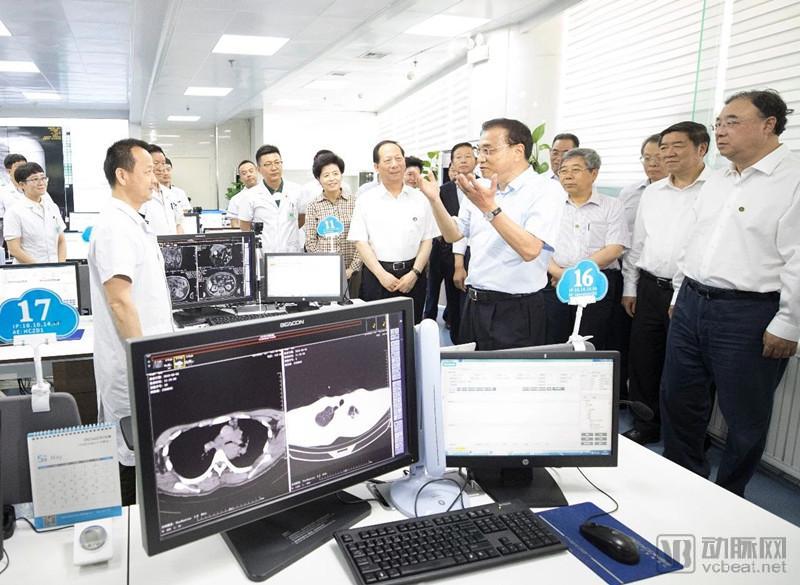
(Image source: WeChat account of the Chinese Government Network)
Yes, internet healthcare has recently regained momentum, with the most representative case being the “A Song of Ice and Fire” surrounding Yinchuan Internet Hospital. In April last year, just as Yinchuan Internet Hospital was gaining traction and a large number of enterprises were flocking to Yinchuan, the sudden release of the “Administrative Measures for Internet Diagnosis and Treatment (Trial) (Draft for Comments)” brought everything to an abrupt halt.
At that time, many perspectives within the industry remain vivid in my memory, as if they occurred just yesterday. However, these viewpoints are not important; whether one is bullish or bearish is also inconsequential.
We believe that industry development follows its own inherent laws. In the face of the sweeping emergence of new developments, the fluctuations and adjustments in policy are inevitable experiences. Policymakers are human too; they require extensive experience and observation before making firm decisions.
Since April this year, key national leaders and institutions have increasingly focused on internet healthcare and internet hospitals. From Shanghai to Yinchuan, from first-tier cities to remote areas, and from personal inspections by leaders to the official issuance of policy documents, internet healthcare has reached a true turning point within the past year.
Everyone must have noticed the continuous coverage of Haodaifu Yinchuan Internet Hospital in recent days. Yes, it is an advertisement, but we like such advertisements.
Because we know all too well what Haodaifu, Yinchuan-based companies, and countless other internet healthcare entrepreneurs have gone through over the past year:
WeDoctor was the first to introduce the concept of the Wuzhen Internet Hospital, exploring numerous policy and business boundaries, and has established internet hospitals as its flagship business.
Haodafu has just staked its entire fortune on the internet hospital; it can be said that in all its years of operation, Haodafu has never gone “all in” like this before, only to suddenly face a halt.
At that time, Medlinker was in the midst of investing in the development of its internet hospital. Upon reviewing the document, they later described the situation as their “darkest hour.”
……
VCBeat reporters have been present in relevant Yinchuan-based groups, witnessing the shift from bustling excitement to sudden silence. It closely resembles cinematic scenes where rain begins to fall as situations deteriorate. Numerous events were canceled, and many reports were withdrawn. Everyone had only one word: wait.
Yet we know that the vast majority have not given up; they have simply adopted a lower profile, quietly optimizing user experience. Within constrained spaces, they strive to deliver the best possible products, firmly believing that favorable opportunities will eventually arise.
Through ongoing engagement with and observation of the industry, VCBeat has continuously distilled sector-wide insights and introduced the “Impossible Trinity of Healthcare” model at the 2017 Future 100 Forum. VCBeat firmly believes that the incremental value generated by technological innovation is the most effective means of resolving this Impossible Trinity, with internet hospitals representing one such approach. However, the full-scale boom of internet hospitals will only materialize alongside concurrent advancements in technology, societal acceptance, policy frameworks, and other key areas.
So, does the inspection by the Premier and other officials mean that internet healthcare has truly ushered in an explosion? We do not think so. It can only be said that internet healthcare has passed another hurdle and welcomed new development opportunities, but this does not mean that the road ahead will be smooth.
What have we gained in this process?
Major transformations in every historical era are invariably accompanied by numerous anomalies that can be repeatedly reflected upon in hindsight.
In 2016, Jack Ma introduced the concept of “Five New and One Fair” at the Yunqi Conference, referring to New Retail, New Manufacturing, New Finance, New Technology, New Energy, and a Fair Environment. Since then, the “Five New” have become a new major trend, with Alibaba’s forte—New Retail—undergoing profound transformations. At the core of these changes is the shift in social relationships driven by technology, which has redefined the interactions among suppliers, stores, and consumers, giving rise to new business models.
In 2018, the chip war between China and the United States will propel China firmly onto the path of becoming a technological powerhouse, with no more hesitation or reliance on luck.
Let us reflect on the journey of internet healthcare in recent years.
When we reported on internet healthcare in 2014, the focus was on apps, with the prevailing belief that any product delivered via an app represented new technology. Today, however, apps have become infrastructure akin to the mobile internet and smartphones, and the focus has shifted back to the intrinsic value delivered by the products themselves.
In 2014, startups focused on educating the market about what apps are and how to use them when promoting their products. Today, doctors, hospitals, and other relevant stakeholders have long become heavy users of apps.
Technological revolutions often stem not from disruptive breakthroughs, but from the subtle yet profound shift in mass behavioral patterns. Take mobile payments, for instance: this has been the most significant change in recent years. It was not a revolutionary technological leap, but rather a transformation of the most resistant force—human habit.
When Zhang Kun, CEO of Chunyu Yisheng (Spring Rain Doctor), encountered Alibaba’s Hema Fresh, it sparked some fascinating associations. The evolving relationship between stores and customers in the new retail era is closely intertwined with the changing dynamics between hospitals and patients. After reading Zhang Kun’s article, I promptly called him, as there were numerous points of convergence with the topic of digital healthcare transformation that we have been closely monitoring recently.
We can boldly imagine:
Future healthcare will inevitably bid farewell to the incidental encounters among hospitals, doctors, and patients, and will instead forge tighter connections through technological means;
A large volume of medical services will evolve into acquaintance-based and online services;
Technology is the only way to reshape the “impossible triangle” of healthcare. When internet, mobile internet, Internet of Things (IoT), and related technologies reach a certain level of maturity, disruptive reform will naturally follow; prior to such disruption, changes occur gradually.
Internet healthcare represents the most fundamental type of transformation. It is neither explosive nor a technological revolution; rather, it simply changes behavioral habits, much like e-commerce. While it may not extend life to a hundred years, it is effective, practical, and widely accessible. Consequently, its market is vast enough to support substantial aspirations.
In fact, most of us can foresee these developments, as many are already gradually becoming a reality. The true challenge lies in determining exactly when the tipping point will arrive.
How Difficult Is It to Make a Decision, and How Many People Can Truly Understand?
Clayton Christensen, who twice topped the list of the “World’s 50 Most Influential Business Thinkers,” wrote in his book The Innovator’s Prescription, which has influenced countless healthcare entrepreneurs: “The vast majority of innovators lack the tools to bring about revolutionary change in the system; they can only achieve results in cost control and efficiency improvements targeting specific parts of the system. Few of these individuals possess the visionary leadership and power necessary to rearchitect the elements of the system.”
Entrepreneurs, especially founders, may be the most peculiar breed among humans. Whether they are just starting out or have built publicly listed companies—or even reached the stature of Jack Ma, Pony Ma, and Robin Li of the BAT giants—they inevitably face difficult moments and tough decisions.
The difficulty of decision-making lies, on one hand, in the pervasive fog of information; even at senior levels within BAT, there is never sufficient data to make fully informed decisions. On the other hand, every decision entails a cost—be it success, failure, or even death.
This is why entrepreneurs are so valuable, and why they are a powerful force for changing the world. Because they may face a 50% chance of failure every day as they make various decisions, yet they must appear calm and composed to their colleagues.
Looking at the broader landscape, Jack Ma may well be the only person in China who has made bold decisions without fear of being labeled a fraud or a madman, and yet still achieved success.
Apart from the technological flair that cannot compare with that of the “madman” abroad, Elon Musk, every business innovation by Jack Ma demonstrates exceptional strategic vision and decisiveness—a rarity indeed. This is because the vast majority of companies achieve success not through grand design, but by taking one step at a time and seizing opportunities as they arise.
I believe that for business owners or CEOs who are often plagued by uncertainty about their company’s next move, knowing what step to take next could be the most gratifying thing in the world.
This is precisely what VCBeat is doing by establishing the Future Healthcare Academy, where we aim to address two key issues:
1. Break down information asymmetry, enabling innovators to align on the same wavelength and share global perspectives, mindsets, resources, and methodologies.
2. Identify like-minded partners, establish trust-based relationships, and collectively integrate into the innovative healthcare supply chain ecosystem.

Alibaba’s digital ecosystem will become the central theme of future life and a key driver propelling medical innovation.
The Future Healthcare Academy made its official debut by co-hosting a comprehensive course on digital transformation in healthcare with Alibaba Cloud University. During this period, I visited Alibaba multiple times, including its headquarters in Hangzhou and Beijing, to engage in repeated discussions on these issues:Why has Alibaba consistently maintained a strategic lead over its competitors for years? What is the relevance of Alibaba Cloud’s technology and its digital future roadmap to our medical innovations? Will the “future hospital” envisioned by Jack Ma truly come into existence?
All these questions found their answers as we delved deeper into Alibaba, answered in a distinctly “Alibaba-style” manner. Today, we are partnering with Alibaba to address these challenges:
Is Internet Healthcare Really About to Take Off?
We Are a Traditional Enterprise: Should We Transform?
We are also paying attention to artificial intelligence and big data. What should we do?
How Should We Approach Digitalization, Cloud Computing, and Big Data?
What Exactly Is the Vision of New Healthcare?
This course will be held entirely at Alibaba’s headquarters, taught by Alibaba’s core team members and industry experts. The key objective is to immerse healthcare professionals in Alibaba’s internal environment, allowing them to experience the company’s innovation, strategic evolution, and challenges over the years.
We are targeting those who make tough decisions every day, as well as aspiring decision-makers and individuals seeking to push themselves to their limits, to join us at Alibaba’s headquarters in Hangzhou for an experience of learning and networking.
Therefore, we hope that you are:
Founders, CEOs, or Senior Executives of Listed Companies
Founders, CEOs, or senior executives of non-listed companies that have reached a certain scale and are facing transformation
Founder and Head of Medical Institutions
Founder and CEO of a startup
Investors, etc.
For more details, please scan the QR code below. We look forward to having you join us!