

Stryker to Acquire Boston Scientific in $110 Billion Deal, Creating a Global MedTech Powerhouse
VCBeat (WeChat ID: vcbeat) has learned that, according to a report by The Wall Street Journal on June 11 (Eastern Time), medical device manufacturer Stryker and its competitor Boston Scientific have reached an acquisition agreement.
If completed, this deal would create a medical device giant with a valuation exceeding $110 billion. Reportedly, Boston Scientific currently has a market valuation of approximately $44 billion, while Stryker’s valuation is close to $67 billion.

However, The Wall Street Journal stated that it remains unclear whether Boston Scientific will ultimately accept Stryker’s acquisition offer. At present, representatives from both Stryker and Boston Scientific have declined to comment on the report.
At 3:11 p.m. New York time on the 11th, Boston Scientific’s stock price rose 8% to $34.50, while Stryker’s stock price fell 4% to $171.81. Trading in both stocks was temporarily halted during Monday’s session on the New York Stock Exchange.
In fact, the two companies had collaborated years ago. Stryker acquired Boston Scientific’s neurovascular business for $1.5 billion in 2010.
About Boston Scientific
Boston Scientific is one of the largest medical device companies in Minnesota, United States., with manufacturing facilities in Arden Hills, Maple Grove, and Minnetonka. As of 2016, the company employed more than 7,000 people in the state,Primarily responsible for the design and manufacture of medical devices, including cutting-edge stents, pacemakers, and urological devices for men.

Although Boston Scientific has consistently emphasized to investors its capacity for technological innovation, the company has relied on acquisitions to drive growth for many years. For instance, in March 2018, Boston Scientific announced its intention to acquire NxThera, a Maple Grove-based company dedicated to minimally invasive therapies for benign prostatic hyperplasia (BPH), a condition characterized by an enlarged prostate.
Boston Scientific lags behind Edwards Lifesciences and Medtronic in the rapidly growing heart valve replacement market. The company has pinned its hopes on an improved version of its Lotus transcatheter heart valve, the original version of which was withdrawn from the European market last year, with the upgraded model scheduled for launch in 2019.
About Stryker
Stryker Corporation, founded in 1941, is one of the world’s largest orthopedic and medical technology companies., headquartered in Kalamazoo, Michigan, USA, with 14 production, R&D, and sales branches worldwide and a workforce of over 16,000 employees.
The product portfolio covers joint replacement, trauma, craniomaxillofacial, spine, surgical equipment, neurosurgery, otolaryngology, interventional pain management, minimally invasive surgery, navigated surgery, smart operating rooms and network communications, biotechnology, medical beds, and emergency stretchers.
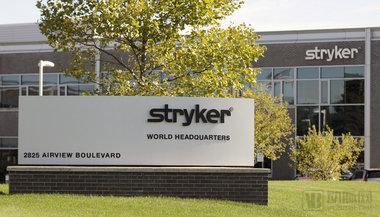
In 2016, the orthopedics business generated $5.176 billion in revenue (orthopedics + spine), ranking third globally in the orthopedics sector.
Due to its strong performance, Stryker Corporation was ranked among the Fortune 500 by the renowned U.S. magazine *Fortune* and listed as one of the Top 50 Healthcare Companies in the United States by *Business Week*.
Stryker enjoys an excellent clinical reputation in the Chinese market. In recent years, it has been highly active in global capital markets, continuously acquiring medical device manufacturers to expand its product portfolio and market share, reflecting its positive outlook on the future of the global medical device market.
A Powerful Alliance Gives Rise to a $110 Billion Medical Device Giant
The merger between Stryker and Boston Scientific will combine Stryker’s expertise in orthopedics, neurotechnology, and spinal surgery with Boston Scientific’s cardiovascular and cardiac rhythm management businesses to develop implantable devices that monitor the heart and deliver electrical therapy to treat cardiac abnormalities.
“If accurate, this news would create a medical device company with a valuation exceeding $110 billion, second only to Medtronic and Johnson & Johnson,” said Lawrence Biegelsen, a securities analyst at Wells Fargo Securities, in a research report.
If the deal is completed, Stryker will acquire Boston Scientific’s cardiac device portfolio, including stents used to prop open blocked arteries, defibrillators that correct dangerous heart rhythms, and the Watchman device, which prevents blood clots from circulating around the heart.
All of these devices can reduce the risk of stroke. In other words, Stryker will hold a strong position in cardiac products for stroke prevention.
In recent years, large-scale merger and acquisition transactions in the medical device sector have been progressing slowly.
“For all medical technology companies, it is crucial to offer a more comprehensive product portfolio in order to remain and become the most valuable supplier to hospital clients. This product portfolio can be sold to ‘hospitals across various specialties,’ said Debbie Wang, an analyst at Morningstar.”
At the beginning of last year, Abbott completed its $25 billion acquisition of St. Jude Medical, acquiring its chronic pain management business and strengthening its cardiovascular device portfolio, including devices for treating atrial fibrillation.
Among the largest transactions in the medical device sector, Medtronic completed its approximately $43 billion acquisition of Covidien in early 2015. In 2014, Zimmer acquired Biomet for $13.3 billion. This landmark merger between two suppliers of orthopedic, surgical, and dental products successfully established Zimmer Biomet Holdings.