

Five U.S. Companies Leading Innovation in Dry Eye Disease Treatment Amid Global Market Surge
On National Eye Care Day in June 2018, the National Health Commission held a press conference to introduce the status of myopia prevention and control. It also released the Guidelines for Myopia Prevention and Control, the Guidelines for Diagnosis and Treatment of Amblyopia, and the Guidelines for Diagnosis and Treatment of Strabismus. At the conclusion of the press conference, Professor Long Qin from the Department of Ophthalmology at Peking Union Medical College Hospital particularly emphasized that dry eye disease among adolescents remains an underappreciated issue in myopia prevention and control, with inappropriate treatment still prevalent.
However, in clinical practice, dry eye disease has become the second most common ocular condition after refractive errors. Relevant data indicate a surge in the number of patients with dry eye disease in China, growing at an annual rate of 10%. The prevalence of dry eye disease in developed countries is approximately 15%–16%, whereas in China, it stands at 21%.
While dry eye disease has not yet garnered sufficient attention in China, VCBeat (WeChat ID: vcbeat) has observed that related treatments are gaining significant traction in overseas markets. R&D efforts for associated drugs and devices can quickly attract acquisition or partnership offers from pharmaceutical giants within a short timeframe. A substantial influx of capital is also pouring into the sector, further driving research and development.
Dry eye disease is categorized into pathological dry eye and dry eye caused by poor eye-use habits. The initial symptom of dry eye disease is ocular dryness. Without timely and effective treatment, it can easily progress to refractory dry eye disease, leading to keratitis and corneal ulcers, and even causing blindness. In the United States, there are approximately 340 million patients with chronic dry eye disease. However, there are few medications available for its treatment. Artificial tears can only remain on the ocular surface and are completely drained within 15 minutes.
When Shire launched the ophthalmic drug Xiidra (lifitegrast ophthalmic solution) for the treatment of dry eye disease in 2016, it became the first new drug approved by the U.S. Food and Drug Administration (FDA) for dry eye disease in the U.S. market in the previous 13 years, and immediately emerged as the first prescription eye drop available in the United States. With technological advancements, treatment modalities for dry eye disease are no longer limited to topical eye drops; a substantial number of new drugs and devices have emerged in international markets.
VCBeat (WeChat ID: vcbeat) has identified five startups addressing dry eye disease through solutions ranging from medical devices to pharmacological treatments. The findings reveal that the dry eye R&D market is not only attracting numerous new drug developers but also seeing major industry players enter the fray by acquiring startups with mature technologies.
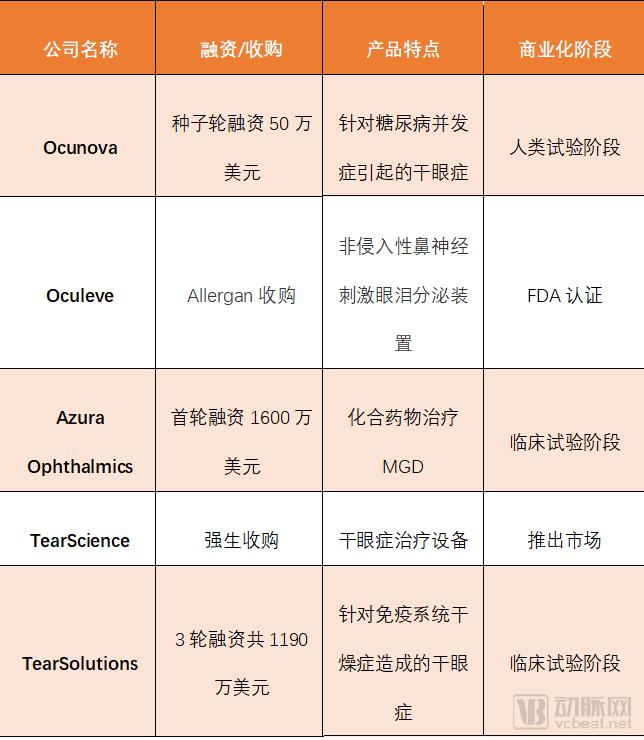
On June 6, biotech startup Ocunova secured $500,000 in seed funding to support clinical trials for a drug treating diabetic dry eye disease. The therapy involves an FDA-approved medication originally indicated for managing alcohol and opioid dependence, now innovatively repurposed for the treatment of diabetic dry eye disease. By leveraging the new application of an already FDA-approved drug, Ocunova has garnered significant attention abroad.
Chronic dry eye disease affects 20 million patients with diabetes in the United States and 50 million worldwide. Current treatment options are limited to over-the-counter eye drops that provide only temporary relief, or two types of prescription anti-inflammatory medications. However, these drugs merely delay disease progression and are associated with certain side effects, thereby limiting patient adherence.
Unlike the lubricants and artificial tear moisturizers commonly used to treat dry eye disease, as well as anti-inflammatory drugs, Ocunova’s medication is specifically targeted at patients with diabetes-associated dry eye. Ocunova’s novel eye drops are patent-protected.
The eye drops have passed safety tests in various animal studies, and the next step is to further evaluate the safety and efficacy of OCU-01 in human clinical trials. This is also the intended application direction for this seed funding round.
Beyond product innovation, the investment was secured because the investment department favors the local innovation ecosystem embodied by Ocunova.
When discussing the rationale behind investing in the company, Dr. Mel Billingsley, President and CEO of LSGPA, one of the investors, stated, “This investment is a prime example of Pennsylvania’s innovation ecosystem. Ocunova was founded by local entrepreneurs, and its core technology represents world-class innovations developed by researchers at Penn State College of Medicine.” LSGCP is a national technology commercialization organization that also collaborates with other institutions to explore and develop support mechanisms for life sciences companies.
Michael Shine, CEO of Ocunova, previously served as Chief Consultant at Novanta and as Vice President at Wyeth Pharmaceuticals, which has since been acquired by Pfizer.RuiAcquisition.
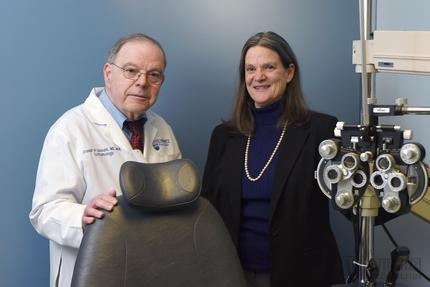
Two Professors in Ocunova's Core Team
TearSolutions claims to offer a natural remedy for dry eye disease. The company’s treatments for dry eye primarily target dry eye caused by early-stage Sjögren’s syndrome. The treatment aims to restore the health of the ocular surface and alleviate symptoms such as dryness, burning, and discomfort associated with primary Sjögren’s syndrome-related dry eye. This includes repairing corneal nerves to stimulate increased tear production by the brain. It can also stabilize the tear film.
Primary Sjögren's syndrome is an immune system disorder that has become a common autoimmune disease in the United States, where approximately 4 million people are currently affected. While there is no complete cure at present, treatment can alleviate various symptoms and prevent complications.
Lacripep™, a product offered by TearSolutions, is a component found in normal human tears but deficient in the tears of patients with dry eye disease. In clinical trials, Lacripep™, developed by TearSolutions, has demonstrated the ability to restore tear secretion and ocular health. Currently, TearSolutions is recruiting patients for clinical trials to evaluate the safety and efficacy of Lacripep™.
The TearSolutions founding team boasts a more impressive track record than its products. The founders’ multiple successful entrepreneurial ventures, combined with their executive experience at major pharmaceutical companies, provide greater assurance for investors.
TearSolutions Chairman Tom R. Gadek’s previous company as CEO, SARcode, was acquired by Shire for $160 million in 2013. In 2016, following the acquisition of SARcode, Shire launched Lifitegrast, its core product for dry eye disease, under the brand name Xiidra, establishing it as a leading therapy for dry eye disease on the market.
Executive Chairman Mark B. Logan is the former chairman of VISX, a global pioneer in excimer laser technology for vision correction. The founding team also includes Gordon W. Laurie, a professor of cell biology and ophthalmology at the University of Virginia. After three rounds of financing, the total funding raised amounted to $11.9 million.
Azura Ophthalmics: Advancing Dry Eye Disease Treatment to the Next Stage
Azura Ophthalmics is a clinical-stage biotechnology company headquartered in Yavne, Tel Aviv District, Israel. Azura Ophthalmics is developing an innovative combination of compounds to advance the treatment of meibomian gland dysfunction (MGD), the primary cause of dry eye disease.
Since Gutgesell et al. first proposed the concept of meibomian gland dysfunction (MGD) in 1982, it has gradually gained widespread recognition. Although clinically prevalent, MGD is often overlooked, and existing therapies demonstrate limited efficacy.
The founder claims to have incubated multiple projects that were acquired by industry giants, and the current management team possesses extensive marketing experience. Founder Dr. Yair Alster previously co-founded ForSight Vision4, a company established by the ophthalmology incubator ForSight Labs and acquired by Genentech (Roche) in 2017. He later co-founded ForSight Vision5, which was ultimately acquired by Allergan, mirroring the exit of his previous venture. CEO Marc Gleeson served as Vice President of Global Ophthalmology Marketing at Allergan for 14 years prior to joining Oculeve.
Series A financing, securing $16 million in funding. Major investors included OrbiMed and TPG Biotech; Brandon Capital co-led the round, with Ganot Capital also participating.
Like Azura Ophthalmics, TearScience also targets the meibomian glands to improve dry eye disease. This differs from the three aforementioned companies that treat dry eye disease through pharmacological interventions. TearScience enhances meibomian gland function via medical devices.
According to the official website, TearScience’s therapeutic devices include three dry eye disease treatment and imaging systems: LipiFlow, LipiScan, and LipiView II.
LipiFlow employs a drug-free mechanism to deliver heat and pressure to the eyelids, helping to clear blocked glands. VTP™ utilizes unique thermal and massage therapies to enhance gland function. LipiScan and LipiView II leverage non-contact surface illumination and high-definition transillumination to provide accurate visualization of gland morphology. TearScience was acquired by Johnson & Johnson last year.
Johnson & Johnson stated that, following the acquisition of TearScience, it aims to integrate the company with its existing ophthalmology portfolio to better address consumers’ broader vision care needs.
According to the company’s official website, TearScience offers meibomian gland imaging devices and thermal pulse instruments for dry eye disease treatment. 86% of dry eye patients experience improved meibomian gland function and relief from dry eye symptoms after a single LipiFlow® procedure. The Meibomian Gland Evaluator™ (MGE) provides standardized, reproducible assessment of meibomian gland function. LipiScan™ and LipiView II® deliver high-definition meibography™ with dynamic meibomian gland imaging.
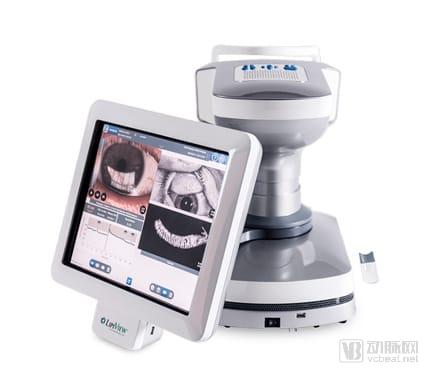
TearScience Ocular Imaging Device
The dry eye disease market is quite active. In addition to the innovations in pharmacological therapies mentioned above, there is also a compact and versatile therapeutic device. This non-invasive nasal neurostimulation device is named OD-01.
Oculeve was incubated from a biodesign project at Stanford University. It developed a device that stimulates the nasolacrimal nerve to increase tear production and secured investment from Kleiner Perkins Caufield & Byers, Bayer, New Enterprise Associates (NEA), and Versant Ventures. Allergan acquired Oculeve for $125 million in 2015, aiming to strengthen its leading position in the global ophthalmic market. In April last year, Oculeve’s product received FDA approval for commercialization.
David Nicholson, Executive Vice President of Allergan, stated, “Allergan is committed to developing a portfolio of innovations to help patients address dry eye disease.”
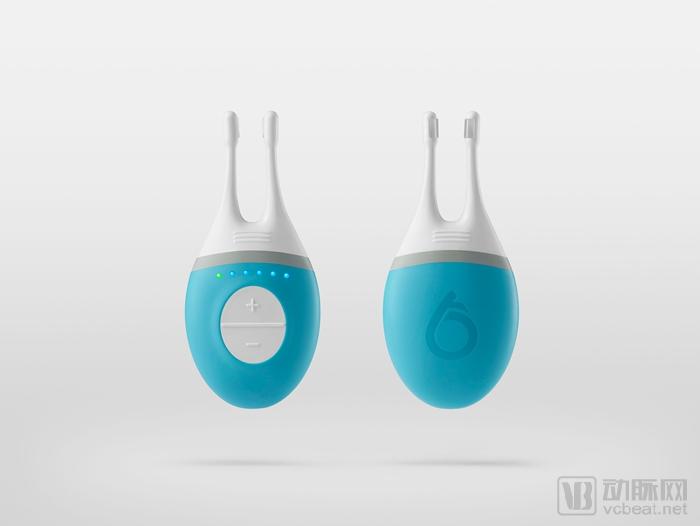
At the time of its acquisition, Oculeve had completed four clinical studies of OD-01 in more than 200 patients, demonstrating the device’s favorable safety and efficacy. Allergan then joined prior to submitting the FDA application and conducted two pivotal trials.
It is evident that, from a technical standpoint, capital investors and industry giants favor mature, certified technologies for the treatment of dry eye disease. Although the current market for dry eye disease treatments is monopolized by artificial tears and a few pharmaceutical agents, the most effective strategy for market entry is to develop drugs targeting dry eye disease caused by specific etiologies. In China, there have been reports of patients developing corneal disorders due to the direct purchase of over-the-counter Japanese eye drops. Additionally, adolescents are prone to misdiagnosing dry eye disease as conjunctivitis, thereby exacerbating their symptoms.
Collaborating with research institutions to commercialize cutting-edge technologies makes it easier to secure support. An analysis of the founding teams of several startups reveals that most adopt a model combining former CEOs of large pharmaceutical companies with scientific research teams. In addition to ensuring R&D capabilities for new drugs or devices, exceptional marketing prowess is indispensable for achieving technological commercialization; seasoned professionals are often able to accelerate technology deployment and monetization.
Meanwhile, there remains considerable scope for exploration in the field of dry eye disease, as previously noted by relevant FDA officials., dry eye disease is more common in children, while the safety and efficacy of many new drugs have not been studied in patients under 17 years of age.