

DE Health AI Secures Series B Funding Led by Fosun Pingyao to Advance AI-Enabled Ultrasound and 3D Visualization Technologies
Recently, VCBeat (WeChat ID: vcbeat) held the Second 2018 Primary Healthcare Forum in Hangzhou, themed around “New Structure.” Zhejiang Deshang Yunxing Imaging Technology Co., Ltd. (hereinafter referred to as “Deshang Yunxing”) announced the completion of its Series B financing round, led by Shanghai Fosun Pingyao Investment Management Co., Ltd., a subsidiary of Fosun Pharma, with Huagai Medical Fund participating as a co-investor. Hu Hairong, General Manager of Deshang Yunxing, stated in an interview with VCBeat that the amount of this financing round and the company’s valuation could not be disclosed at this time.
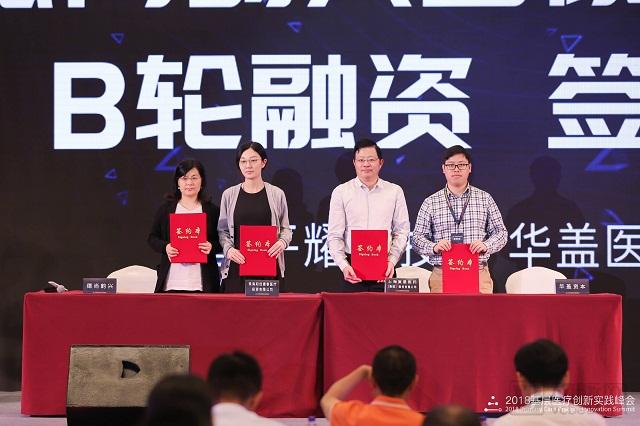
The proceeds from this financing round will be used to promote the market commercialization of existing products, drive technological innovation and R&D for projects under development, and advance the company’s business growth in the field of medical artificial intelligence, with a particular focus on accelerating the R&D and clinical implementation of AI-enhanced ultrasound solutions.
Zhejiang Deshang Yunxing Imaging Technology Co., Ltd., established in 2013, is dedicated to technologies such as AI-assisted diagnostic systems for medical imaging, 3D visualization-based precise preoperative planning, intraoperative navigation, and postoperative assessment. The company’s independently developed product, the “Intelligent AI-Assisted Diagnostic System for Thyroid Nodules via Ultrasound,” is at a world-leading level.
Hu Hairong believes that Deshang Yunxing has gained recognition from Fosun Pingyao and Huagai Medical mainly due to the following aspects:
First,Self-developed AI Deep Learning Framework. Deyun Shangxing’s R&D team, with backgrounds in applied mathematics, has independently developed a lightweight and flexible AI deep learning framework that delivers high computational efficiency and low power consumption.
As the deep learning framework is self-developed, they can freely modify models and adjust parameters when developing AI products for different diseases, thereby optimizing the models to better suit product development.
Second,The company entered the AI+ultrasound sector, which boasts a large market size.. According to IHS statistics, the global market size for medical ultrasound diagnostic equipment reached approximately $6.2 billion in 2014 and is projected to reach $7.4 billion by 2019, with a compound annual growth rate (CAGR) of 3.6%.
In 2014, the market for ultrasound diagnostic equipment in China reached RMB 6.9 billion. Driven by the release of rigid demand, equipment upgrades and replacements, and the continuous implementation of favorable policies, the Chinese ultrasound equipment market is poised for rapid growth. The market size for medical ultrasound diagnostic equipment in China is projected to reach RMB 9.1 billion by 2019, representing a compound annual growth rate (CAGR) of 5.7%. Ultrasound-assisted diagnostic systems can significantly alleviate the shortage of ultrasound physicians at primary healthcare facilities.
Third,The intelligent AI-assisted diagnostic system for thyroid nodules based on ultrasound can directly determine whether the nodules are benign or malignant and generate an imaging analysis report.. Its accuracy far exceeds that of ordinary physicians, and its product performance has been endorsed by clinicians with supporting data.
Fourth,The company’s team predominantly possesses a background in the integration of medicine and engineering, with expertise in both clinical needs and IT algorithms., so Deshang Yunxing’s product positioning is very clear, and its R&D features align well with physicians’ clinical needs.
Fifth,Deshang Yunxing’s investor, Hejia Shares, focuses on hospital solutions and oncology solutions., they have signed contracts with over 10,000 primary care hospitals, and these resources can help Deshang Yunxing rapidly deploy its own products.
Tendency to Choose Industrial Capital
VCBeat has learned that in 2015, the company introduced strategic investor Zhuhai Hejia Medical Equipment Co., Ltd. during its Series A financing round. As one of the leading healthcare resource platforms in China, Zhuhai Hejia focuses on three major sectors of the healthcare industry: medical equipment, healthcare services, and healthcare informatics, while also building two major healthcare resource platforms for mobile health and healthcare finance.
In alignment with its corporate strategic positioning and overall development plan, the company introduced Shanghai Fosun Pingyao Investment Management Co., Ltd. and Huagai Medical & Health Industry Venture Capital (Wenzhou) Partnership as strategic investors in its Series B financing round in June 2018.
This strategic investment aims to leverage the investors’ experience and resources in the healthcare industry to accelerate the market commercialization of Deshang Yunxing’s existing products, drive technological innovation and R&D for its projects under development, and advance the company’s business growth in the field of medical artificial intelligence.
Fosun Pingyao is a wholly-owned subsidiary of Shanghai Fosun Pharmaceutical (Group) Co., Ltd., a listed company. It focuses on investment and M&A in the fields of biopharmaceuticals, medical devices, and healthcare services.
Huagai Healthcare Fund, spearheaded by Huagai Capital, is an equity investment fund dedicated to the healthcare industry. It focuses on sectors such as biopharmaceuticals, medical devices, and healthcare services, with a particular emphasis on industry M&A consolidation within the healthcare sector and investment opportunities in high-tech enterprises experiencing rapid growth during their early to mid-stages.
With cumulative assets under management totaling billions of RMB, the fund was jointly established by more than 30 listed companies in the healthcare and medical sectors, multiple large financial and insurance institutions, funds of funds, and government guidance funds. Among these, the Huagai Pharmaceutical and Healthcare Fund, under Huagai Medical, was co-led and established by Huagai Medical together with listed companies in Zhejiang Province. It is the first venture capital guidance fund in Zhejiang Province to receive support from both national and provincial governments. The fund focuses on investing in high-growth, high-tech enterprises in the healthcare and medical sectors within Zhejiang Province, particularly those in early-to-mid stages and start-up phases. Investment areas include biopharmaceuticals, medical devices, and related fields.
Two Mature Product Lines
Desun Yunxing has two mature product systems: one is the AI + ultrasound system, and the other is the 3D visualization, surgical planning, and surgical navigation system.
Deshang Yunxing is best known for its Intelligent Ultrasound-Assisted Diagnostic System for Thyroid Nodules.
The system is divided into two components: training and scoring. The training mechanism is based on deep learning technology, utilizing over 100,000 labeled ultrasound image samples to train the computer.
Traditional machine learning relies on manually defined features, such as whether the margins of a nodule are regular and what its echogenicity is, which also incorporate physicians’ subjective criteria. However, with deep learning, such manual feature definition is unnecessary.
Annotated samples are divided into two major categories: benign and malignant. The neural network analyzes and extracts features specific to benign and malignant nodules, respectively, based on the annotations; this process is more detailed than visual inspection by the human eye.
Upon completion of the training, Deshang Yunxing packaged the algorithm and network parameters into a software application, namely a scoring system. This system can be deployed online or configured as a standalone version running on conventional computers, thereby enabling hospitals to utilize it for auxiliary diagnosis.
For the diagnosis of thyroid nodules, the average accuracy rate among physicians at tertiary hospitals currently stands at 60%–70%, with even lower rates at primary care institutions. In contrast, the Deshang Yunxing AI-assisted diagnostic system currently achieves an accuracy rate of approximately 85%.
Hu Hairong told VCBeat,The Jiangcun Subdistrict Community Health Service Center in Xihu District, Hangzhou, is the first pilot unit in the city to establish an AI-assisted diagnosis and treatment center. Since the center became operational in December 2017, approximately 1,500 residents underwent thyroid examinations in the AI-enabled ultrasound consultation rooms by April 2018, with around 20 testing positive. In the future, Deshang Yunxing will continue to develop and deploy additional AI-assisted diagnostic systems to support primary care physicians and facilitate tiered diagnosis and treatment.。
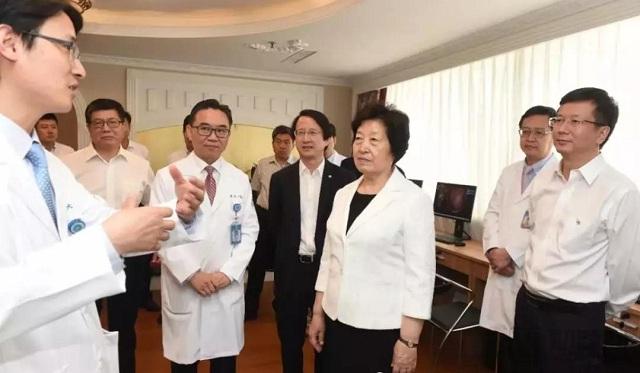
Vice Premier Sun Chunlan conducted an on-site inspection of the Demetics Ultrasound Diagnostic Robot – Intelligent Auxiliary Diagnosis System for Thyroid Nodules, deployed at the First Affiliated Hospital of Zhejiang University School of Medicine. Two patients were randomly selected for examination; the robot automatically analyzed and indicated that their nodules were benign, consistent with the physicians’ interpretations. Vice Premier Sun Chunlan gave full affirmation to the system.
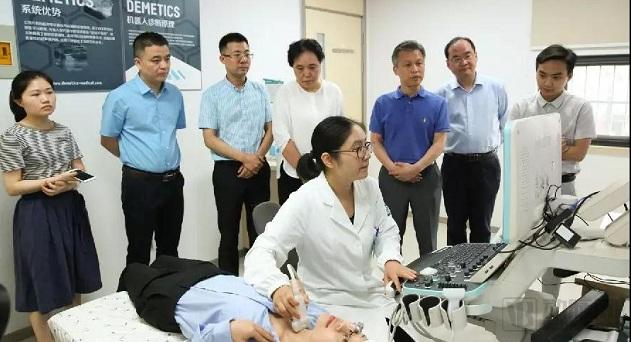
In addition, Yang Aiping, Director of the National Health and Family Planning Commission’s Center for Capacity Building and Continuing Medical Education, and Ma Zhaoyi, Director of the Big Data Office at the same center, along with other officials, conducted on-site visits to the Jiangcun Subdistrict Community Health Service Center. They inspected the “Zhejiang Society of Mathematical Medicine – AI-Assisted Diagnostic and Therapeutic Center for Medical Imaging” established at the facility and acknowledged the role of Deshang Yunxing’s products in facilitating tiered diagnosis and treatment.
In addition to AI-assisted diagnostic products, Deshang Yunxing’s technological offerings—such as 3D visualization-based precise preoperative planning, intraoperative navigation, and postoperative assessment—are also relatively mature. Hu Hairong stated that the company’s products ranked among the top in international competitions in 2012. After six years of research and development, the speed of 3D reconstruction and segmentation has increased tenfold. Currently, these products are being trialed at multiple Grade A tertiary hospitals, and regulatory approval is expected in the second half of this year.
Challenges to Be Overcome in the Development of Medical AI Products
AI-Assisted Diagnostic System for Medical Imaging leverages large-scale, expert-annotated datasets to learn and inherit clinical expertise. It can achieve diagnostic accuracy surpassing that of attending physicians at tertiary hospitals within a short period, helping primary-care physicians shorten their learning curve and rapidly improve diagnostic capabilities, thereby supporting the national tiered diagnosis and treatment system.
Hu Hairong told VCBeat that although artificial intelligence in medical imaging offers significant advantages, three key issues must be addressed before it can be effectively implemented in clinical practice:
Strong government support, particularly in the area of data: AI training requires large volumes of high-quality data, but hospitals currently operate as data silos, and patient privacy concerns prevent such data from being readily shared.
Reasonable approval guidelines for artificial intelligence products need to be introduced regarding CFDA certification. Currently, the National Medical Products Administration (NMPA) has not yet issued specific approval guidelines and remains in the research and discussion phase. Without CFDA certification, companies cannot generate sales, which is detrimental to their development.
Market education requires robust promotional efforts from the government, media, and enterprises. As AI-based medical imaging diagnosis is an emerging field, most physicians are unfamiliar with its underlying diagnostic principles. The high cost of market education hinders the pace of product promotion by enterprises. Moreover, relying solely on enterprises to educate the market yields low efficiency. Therefore, coordinated publicity campaigns involving the government and media are essential to accelerate the commercialization of AI diagnostic products.