

China's National Health Commission Issues Guidelines to Promote Chain and Group Operations of Independent Medical Institutions
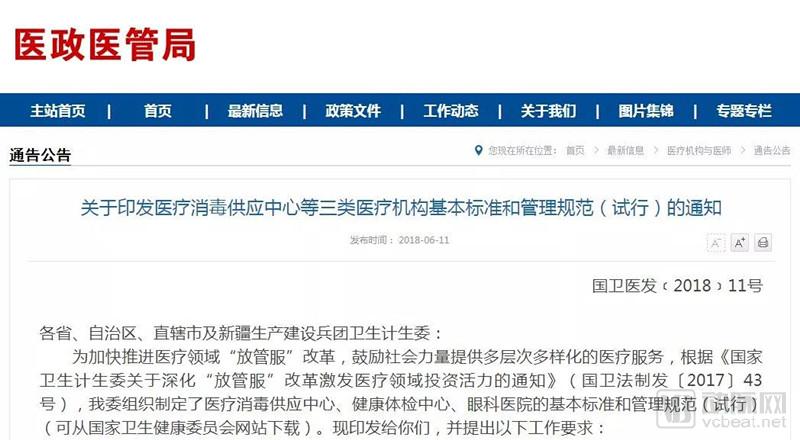
According to VCBeat (WeChat ID: vcbeat), on June 11, the National Health Commission issued the “Notice on Issuing the Basic Standards and Management Specifications (Trial) for Three Types of Medical Institutions, Including Medical Sterile Supply Centers” (hereinafter referred to as the “Notice”), which clearly stipulates the basic standards and management specifications for medical sterile supply centers, health examination centers, and ophthalmic hospitals.
Yesterday, the National Health Commission issued the “Notice on Issuing the Basic Standards and Management Specifications (Trial) for Three Types of Medical Institutions, Including Medical Sterile Supply Centers” (hereinafter referred to as the “Notice”). To accelerate the advancement of the “delegation, regulation, and service” reforms in the healthcare sector and encourage non-governmental entities to provide multi-level and diversified medical services, the “Notice” encourages chain and group-based operations for the aforementioned three types of independent medical institutions, establishing standardized and normative service and management models.
The “Notice” explicitly states that medical sterilization supply centers, health examination centers, and ophthalmic hospitals are independently established medical institutions that shall independently bear civil liability in accordance with the law. Meanwhile, health administrative departments at all levels shall strengthen planning guidance for independently established medical institutions, encourage the chain and group-based operation of medical sterilization supply centers, health examination centers, and ophthalmic hospitals, and establish standardized service and management models.
While encouraging development, the National Health Commission is also strengthening quality and safety management for three categories of independent medical institutions. The Notice stipulates that health administrative departments at all levels shall incorporate medical sterile supply centers, health examination centers, and ophthalmic hospitals into the local medical quality and safety management and control system, enhance the prevention and control of healthcare-associated infections and quality and safety management, strictly implement relevant management specifications and regulations, and ensure medical quality and safety.
The “Notice” recommends that medical sterilization supply centers, health examination centers, and ophthalmic hospitals establish collaborative relationships with other comprehensive hospitals in their respective regions, streamline referral channels, strengthen technical collaboration, and continuously improve the quality of medical services.
The "Notice" requires that relevant sterilization supply institutions complete the corresponding adjustments and obtain the "Medical Institution Practice License" by June 1, 2019.
The National Health Commission has issued the following regulations for three categories of independently established medical institutions regarding departmental setup, staffing, and equipment configuration:
In terms of departmental setup, the Notice states that a medical sterilization supply center shall at least establish a sterilization supply room and functional departments for hospital infection management, quality and safety management, engineering and technical management, and information management.
In terms of staffing, the Quality and Safety Management Department shall be equipped with full-time quality and safety management personnel who hold professional technical titles at the intermediate level or above, possess relevant professional knowledge, and have work experience, to be responsible for quality and safety management and control.
The Notice explicitly specifies the equipment that must be provided for cleaning rigid surgical instruments, cleaning flexible instruments, cleaning flexible endoscopes, quality testing, and informatization.
The “Notice” points out that, in terms of diagnostic and treatment specialties, health examination centers shall at least establish departments of internal medicine, surgery, obstetrics and gynecology (gynecology specialty), ophthalmology, otorhinolaryngology, stomatology, medical laboratory, and medical imaging. In principle, health examination centers shall not carry out clinical treatment services (except for emergency resuscitation).
In terms of departmental setup, the Health Examination Center should include Internal Medicine, Surgery, Gynecology, Ophthalmology, Otorhinolaryngology (ENT), Stomatology, Clinical Laboratory, Radiology, Ultrasound Department, and Electrocardiogram (ECG) Room, as well as departments for Quality and Safety Management, Health Management, Hospital Infection Control, Medical Record Management for Health Examinations, Information Technology, Equipment Management, and Sterile Supply.
In terms of personnel and equipment, the health examination center shall have at least two licensed physicians with associate senior or higher professional technical titles in internal medicine and surgery, who have been trained and assessed as qualified by the health administrative department at the level of a city divided into districts or above, and are responsible for reviewing and signing health examination reports.
The “Notice” stipulates that the total number of beds in an ophthalmology hospital shall be between 20 and 79 (including day observation beds).
In terms of departmental structure, an ophthalmic hospital must have at least the following clinical departments: Ophthalmology and Emergency Room; at least the following medical technology departments: Treatment Room, Operating Room, and Examination Room; and at least the following administrative departments: Medical Quality and Safety, Hospital Infection Control, and Medical Records (Statistics).
Regarding staffing requirements, the Notice mandates that ophthalmic hospitals maintain a minimum nurse-to-physician ratio of 1:1 and employ at least one nurse with three or more years of experience in specialized ophthalmic nursing.
In terms of equipment configuration, the "Notice" stipulates that each bed unit in ophthalmic hospital wards shall be equipped to the same standard as those in general hospitals of the same tier. Meanwhile, communication and computer equipment must be provided, and information systems compatible with the delivery of diagnostic and therapeutic services shall be installed.