

Shenzhen IMSight Medical Secures RMB 100 Million Series A Funding to Advance AI-Powered Healthcare Leadership
Recently, VCBeat (WeChat ID: vcbeat) learned at the earliest opportunity that VisionAI, a leading company in the AI healthcare industry, has completed its Series A financing round.Additional financing; the investor is China Merchants Venture Capital.In March 2018, Shijian Technology completed its Series A financing round, led by Shenzhen Capital Group.. With this, Shijian Technology has completed its Series A financing round, raising a total of RMB 100 million.。
It is reported that Shijian Technology’s current round of financing will continue to focus on product R&D, with sustained additional investment in team building and product portfolio expansion, while accelerating the exploration of clinical application scenarios to drive the company’s rapid growth.
The investor in this round is China Merchants Innovation Investment Management Co., Ltd. (CMII), established in 2015 as a wholly-owned subsidiary of China Merchants Group. Its investment focus lies in “Internet Plus” and technological innovation, encompassing the integration of the internet with China Merchants Group’s core industries such as finance, real estate, and logistics and transportation, as well as innovative sectors including big health, consumption upgrading, and artificial intelligence.
Yang Hongkai, Senior Investment Manager at China Merchants Venture Capital, stated, “The big health industry is one of the key sectors prioritized for development by China Merchants Group. We are optimistic about the application prospects of AI in the medical field, particularly in the practical implementation of medical imaging. VisionTech possesses industry-leading scientific research capabilities and a strong technical team, with rapid progress in market expansion. Its operations can be closely integrated with China Merchants’ existing and future business layouts in the big health sector, fostering synergistic development.”
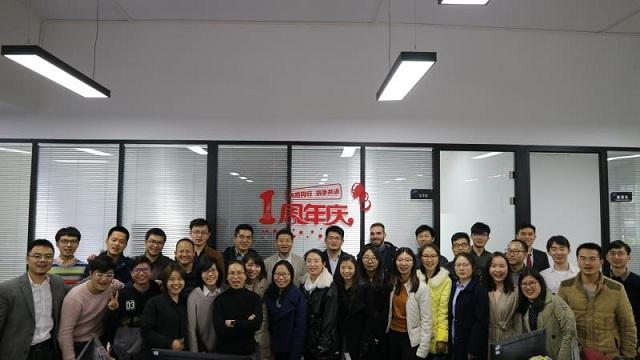
Vision Technology Team
The Team Has Repeatedly Attracted Government Capital
According to the VCBeat database, in July 2017, Visionary Technology announced that it had secured a grant of several million Hong Kong dollars from the Innovation and Technology Commission of Hong Kong, as well as its first round of financing amounting to nearly RMB 20 million, led by Legend Capital.
In March 2018, Visionary Technology announced the completion of its RMB 60 million Series A financing round, led by Shenzhen Capital Group.
Shijian Technology’s latest funding round came less than three months after its previous investment by Shenzhen Capital Group, and the fact that it has attracted government-backed capital with a relatively conservative investment style for two consecutive rounds has added significant credibility to this round of financing.“. On the one hand, this demonstrates that over the past year since its establishment, Shijian Technology’s team, products, and market progress have gained full recognition from the capital market,” introduced Dr. Chen Hao, founder of Shijian Technology. “On the other hand, the true large-scale implementation and application of artificial intelligence in the healthcare sector will still require a considerable amount of time. From technical, product, market, and policy perspectives, we are entering a critical phase that demands perseverance and the abandonment of impetuousness. With the support of capital, we can devote ourselves more wholeheartedly to advancing R&D and product development, while simultaneously exploring additional clinical application scenarios.”
Imaging AI Develops Rapidly, Clinical Applications Enter a New Phase
“Although AI has been applied in healthcare for only a short time, its development speed has been astonishing, particularly in the field of radiological imaging, which boasts relatively strong digital and informational infrastructure,” said Xiao Xiang, COO of VisionAI.
In early 2017, most radiologists had limited knowledge of medical AI; by the end of the year, however, the majority of Grade A tertiary hospitals had developed a deep understanding of AI technologies and their applications.
Particularly since 2018, China’s top-tier AI companies have successively launched relatively mature products and engaged in varying degrees of collaboration and clinical trials with major hospitals. Some well-known Grade A tertiary hospitals have even trialed AI products from more than 10 vendors.
On the one hand, this demonstrates the healthcare industry’s growing acceptance of AI; on the other hand, it places companies’ products in direct competition.
Taking the most prevalent AI application in radiology departments—pulmonary nodule detection—as an example, beyond competing on metrics such as sensitivity and false-positive rates for nodule detection, physicians also prioritize more practical functionalities. These include the development of features for differentiating between benign and malignant nodules and supporting follow-up monitoring, as well as seamless integration with hospital clinical workflows.
“Lung-sight, the AI-assisted diagnostic product for pulmonary imaging developed by Visionary Technology, seamlessly integrates with hospital information systems to automatically acquire data and return diagnostic results. Its structured reports can be imported into hospital reporting systems with a single click, truly enhancing physicians’ workflow efficiency,” said Xiao Xiang. “In addition to further functional enhancements, expanding coverage to include more imaging modalities, anatomical regions, and disease-specific modules is key to the next stage of clinical deployment for AI-based imaging products. The Visionary Technology team’s years of technical accumulation provide a solid foundation for future product development. Currently, Visionary Technology offers a portfolio of radiology AI products covering multiple anatomical sites, including orthopedics, breast, prostate, and liver.”
Pathology AI Is Poised for Takeoff: Cervical Cancer Screening May Become the Breakthrough
Compared to the rapidly evolving field of AI in medical imaging, progress in digital pathology has been relatively slow, with a significant gap in both the number of participating companies and product maturity. Once again, VisionAI has positioned itself at the forefront of the pathology industry.The “Cervical-sight” liquid-based cytology screening system for cervical cancer, developed by Shijian Technology, can automatically detect lesion cells across the entire slide, provide diagnostic results with 14 classifications, and automatically generate structured TBS reports, fully meeting the demands of the cervical cancer screening market.
At the Annual Conference of the Pathology Branch of the China International Exchange and Promotive Association for Medical and Health Care, held in conjunction with the Digital Pathology and Artificial Intelligence Conference this May, the organizers specially designed a human-machine competition featuring intelligent screening for cervical cancer cytology as the contest category. Visionary Technology’s “Cervical-sight” system made its debut at the conference. As one of the three participating companies, Visionary Technology’s diagnostic results received high recognition from attending experts. Notably, a primary-care physician invited to the scene used the Visionary Technology system to assist in diagnosis; after becoming familiar with the system, the physician completed the diagnosis of 40 cervical cytology slides in just 50 minutes, achieving results comparable to expert-level performance.
“Human-machine competitions are not the goal; human-machine collaboration is the future,” introduced Chen Hao. “There are fewer than 10,000 registered pathologists in China, with a shortage exceeding 100,000. Therefore, the demand for AI in pathology is even more urgent. Vision Technology is one of the few AI companies with deep technical expertise and product layouts in both medical imaging and pathology. The combined development of imaging and pathology offers greater practical value for clinical practice. With the rapid advancement of digital pathology, its application value will become increasingly evident.”
Professional Team, Technology-Driven: Building the Leader in AI-Empowered Healthcare
Founded in February 2017, VisionTech has established R&D and business development teams in Hong Kong, Shenzhen, Beijing, and Chengdu. Its core technical team originates from a group of professors and PhDs at The Chinese University of Hong Kong. The team has been dedicated to the field of medical imaging research for over 20 years.With deep expertise accumulated across multiple domains including radiology, pathology, radiation therapy, endoscopy, and ultrasound, it has secured championships in sixteen international medical imaging AI recognition challenges, outperforming strong competitors from leading enterprises and research institutions., and has published more than 50 papers in top-tier journals and conferences such as CVPR, ICCV, AAAI, MICCAI, MIA, and JAMA. Team members have received the Best Paper Award three times. Currently, 80% of the team members are R&D personnel. The team has established joint laboratories with institutions such as the Shenzhen Research Institute of the Chinese University of Hong Kong and partnered with over 100 hospitals across China to promote in-depth collaboration among industry, academia, research, and healthcare.