

Recursion Pharmaceuticals Files IPO Prospectus to Advance Pipeline Targeting 100 Monogenic Diseases Following $75 Million in Annual Funding

Recursion
Clinical-stage biopharmaceutical R&D company

In many cases, the final therapeutic effects of drugs diverge from their original design objectives. For instance, Viagra, developed by Pfizer, was initially intended to treat cardiovascular diseases but gained widespread market popularity due to its entirely different efficacy. If pharmaceutical companies could take the lead in upgrading robotic microscopy technology and image processing software, while simultaneously identifying potential new drug targets through experiments, the benefits for precision medicine would be undeniable.
Recursion Pharmaceuticals is a company that utilizes computer vision technology to process cellular images, evaluating the post-treatment responses of diseased cells by analyzing their characteristics.
They leverage advanced imaging and artificial intelligence technologies to conduct high-throughput cell model experiments, aiming to screen thousands of candidate drugs across cellular models of hundreds of diseases, ultimately identifying novel therapeutics for various conditions.
According to VCBeat (WeChat ID: vcbeat),The company can perform extraordinarily detailed examinations of cells. They utilizeThe software measures thousands of cellular features, such as the size and shape of the nucleus or the distances between different intracellular regions. This precise cellular research not only advances the medical industry’s understanding, exploration, and diagnosis of diseases but also accelerates the transformation of pharmaceutical development models, greatly benefiting patients.
It is not uncommon for companies to leverage microscopic cellular image features for drug screening. What sets Recursion Pharmaceuticals apart is its integration of machine automation and artificial intelligence to conduct multiple experiments in parallel on a massive scale. Currently, Recursion’s laboratories can perform 30,000 experiments per week. Dr. Chris Gibson, CEO of Recursion, believes that in the near future, they will be able to carry out hundreds of thousands of experiments weekly.
Studies show that approximately 10% of Americans are affected by rare diseases, with the majority of these conditions stemming from a lack of corresponding treatments.
Recursion Pharmaceuticalsstated that they have identified 15 candidate drugs for treating rare diseases (defined as conditions affecting fewer than 200,000 patients in the United States). Most of these diseases are genetic disorders, and nearly 7,000 rare diseases are currently registered.
Recursion PharmaceuticalsFounded in Salt Lake City, Utah, USA in 2013. In June 2018, the company secured a $20 million credit facility from Square 1 Bank.
Team Power Enables Precision Medicine
Recursion PharmaceuticalsDr. Gibson, Co-founder and CEO, stated that the company is striving to achieve precision medicine through collaborations. He firmly believes that conducting highly controlled and well-organized collection and application of biological data is central to achieving this goal.
2005In [year], Chris Gibson earned a Bachelor of Arts in Management Studies and a Bachelor of Science in Bioengineering and Biomedical Technology from Rice University in the United States. In 2009, he began his doctoral studies in Bioengineering and Medicine at the University of Utah in the United States, and received his degree in 2013.
During his research period, Dr. Gibson primarily conducted cardiovascular studies at the intersection of engineering and biology. With the assistance of his mentor, Dr. Dean Li, he developed an analytical system designed to enhance the efficiency of novel biological identification, laying the groundwork for the subsequent founding of Recursion Pharmaceuticals.
2013In [Year], Dr. Gibson earned the Ignite Certificate from the Stanford Graduate School of Business. The Stanford Ignite Certificate is an academic program designed for entrepreneurs, business professionals, and entrepreneurial leaders, enabling participants to acquire business-related skills and gain experience in commercializing new ventures.
Furthermore, Dr. Gibson serves as a member of the Board of Directors of CureHHT. HHT, short for Hereditary Hemorrhagic Telangiectasia, is a genetic disorder that causes vascular malformations in multiple organs. The CureHHT Foundation is also the world’s only advocacy organization dedicated to patients with this condition.
As one of the scientific advisors to Recursion Pharmaceuticals, Dr. Yoshua Bengio stated: “Recursion has leveraged deep learning to analyze millions of high-resolution cellular images, unlocking potential and impact sufficient to drive biological discovery on a scale previously unseen in medicine.”
Yoshua BengioDr. [Name] is a computer scientist from Quebec, Canada, who is dedicated to research in artificial neural networks and deep learning, aiming to understand the principles underlying the emergence of artificial intelligence. As of September 2017, his research outputs had garnered more than 80,000 citations on Google Scholar.
BengioHe received his Ph.D. in Computer Science from McGill University in Canada in 1991 and served as a postdoctoral fellow at the Massachusetts Institute of Technology (MIT) and AT&T Bell Labs. Together with British cognitive psychologist Geoffrey Hinton and Yann LeCun, head of Facebook AI Research, he is regarded as one of the “Big Three” in the field of neural networks.
Since 1993, he has served on the faculty at the University of Montreal, dedicating himself to academia with the aim of training thousands of scientists and engineers. He is also the Scientific Director of the Montreal Institute for Learning Algorithms (MILA) and Co-Director of the Machine Learning and Brain program at the Canadian Institute for Advanced Research.
2017In that year, Dr. Bengio was appointed as an Officer of the Order of Canada and elected as a Fellow of the Royal Society of Canada. The Order of Canada is one of the branches of the Canadian honours system, primarily awarded to members of society who have made outstanding contributions and provided exceptional service to the people of Canada. In the same year, he also received the Quebec Prix Marie-Victorin.
BengioDr. [Name] currently serves as an Editor for Machine Learning Research Journal, Associate Editor for Neural Computation Journal, Editor for Foundations and Trends in Machine Learning, and Associate Editor for both the Journal of Machine Learning and IEEE Transactions on Neural Networks.

Recursion’s Strategy and Partnerships
As Co-Founder and CEO of Recursion Pharmaceuticals, Dr. Chris Gibson has formulated the company’s business strategy: to actively advance innovative drug development by continuously identifying and investigating medications taken by patients with rare diseases, thereby capturing corresponding commercial value.
GibsonThe Ph.D. stated, “The integration of experimental biology and bioinformatics enables us to work more efficiently. Meanwhile, we are striving to establish more partnerships in the pharmaceutical sector with the aim of rapidly realizing Recursion Pharmaceuticals’ business strategy.”
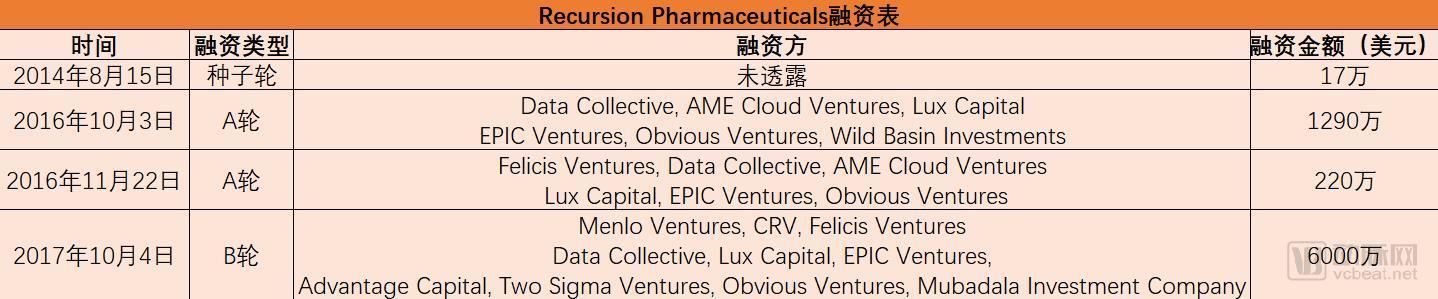
In November 2016, Recursion Pharmaceuticals secured $15 million in Series A funding from Felicis Ventures, Data Collective, AME Cloud Ventures, Lux Capital, EPIC Ventures, and Obvious Ventures.
According to Recursion, this financing will assist the company in developing “Platform 2.0.” On one hand, the number of rare diseases studied by researchers annually can increase from dozens in the past to thousands. On the other hand, the new platform can help them gain insights into known drugs, bioactive compounds, and shelved pharmaceutical assets in the field of rare diseases.
In October 2017, Recursion Pharmaceuticals secured $60 million in Series B financing, led by Data Collective and joined by nine other venture capital firms.
Dr. Gibson stated that the Series B financing has strongly supported the company’s continued progress in its drug targeting journey. The company will leverage these funds to establish partnerships with major pharmaceutical companies, build an internal therapeutic pipeline, and expand into emerging therapeutic areas. Dr. Gibson firmly believes:“Recursion will continue to generate large, high-dimensional datasets for hundreds of millions of biological perturbation problems. Meanwhile,“We will also be well-prepared to conduct reliable bioanalyses of the trillions of relationships among genes, proteins, and chemicals.”
2017In November, Recursion Pharmaceuticals announced a formal partnership with Splunk. Recursion leverages Splunk’s technology to integrate biological sciences with machine learning, enabling the analysis and comparison of data generated from hundreds of thousands of cell culture images and trillions of DNA strands. Recursion Pharmaceuticals aims to deliver treatments for 100 monogenic diseases by 2025.
Splunk ITRick Fitz, Senior Vice President of Marketing, stated that Splunk is honored to help Recursion transform machine data into therapies for genetic diseases. Splunk incorporates machine learning capabilities into its solutions to fully unlock the value of data, empowering enterprises to solve problems and, in some cases, even save lives.
How to Apply AI Imaging Technology to Discover New Drugs and Develop Novel Therapies?
Although Recursion Pharmaceuticals currently has no products on the market, it has 15 therapies targeting rare diseases in its drug development pipeline. Dr. Gibson, Co-founder and CEO, stated that they have found some potential therapies are already being used in clinical trials by other pharmaceutical companies.
“From a profitability standpoint, this is discouraging; however, from a scientific perspective, it validates the efficacy of Recursion’s technology,” stated Dr. Gibson. “We are able to leverage our proprietary image analysis to effectively develop new therapies in the medical field.”
RecursionThe company’s technology platform leverages cutting-edge biotechnology to construct hundreds of cellular models that simulate rare diseases, and captures images of these models using advanced imaging techniques. Just as patients with rare diseases exhibit clinical symptoms, the cellular models display specific structural characteristics, which can be identified from microscopic images.
During the study period, Recursion’s image analysis software analyzes nearly 1,000 cellular structural features in micrographs to identify cell characteristics associated with disease. The software then leverages these cellular features to help researchers identify therapies capable of correcting these abnormalities from a database containing 2,000 known compounds.
1. Chemical Drugs Lead the Pharmaceutical Industry
Recursion Pharmaceuticals stated that its drug discovery efforts focus on identifying compounds capable of reversing complex phenotypes and maintaining activity in orthogonal, disease-specific assays. Leveraging its proprietary technologies, the company has developed a “smart library” with the primary objectives of maximizing functional diversity and enabling efficient parallel screening. The screening process is as follows:
- Recursion scans the company’s parent library to identify various cell types capable of generating high-dimensional phenotypic signals, while simultaneously elucidating cellular motility mechanisms and assessing changes in toxicity.
- Establish an “intelligent drug library” based on the maximization of phenotypic/functional diversity, comprising a small subset of parent libraries, with the primary objective of enhancing drug screening efficiency.- Screened cells for the “Intelligent Drug Library” across hundreds of disease models, and conducted research and in-depth testing on them.- Collaborate with partners to develop strategies for the joint optimization of cell lines exhibiting high-dimensional and toxicity signals.
2. With Drug Discovery as the Ultimate Goal
Recursion Pharmaceuticals conducts objective, genome-wide gene suppression screens to provide its partners with expert biological insights across hundreds of disease models. Recursion’s molecular biologists and computational teams integrate functional genomics with advanced AI technologies in research projects aimed at meeting partner needs, carrying out relevant target identification and validation.
“There is considerable hype in the current AI landscape, and many of the promises made will not come to fruition,” emphasized Dr. Gibson, Co-founder and CEO. “However, there are genuine opportunities within the industry that can enhance and facilitate its evolution. By leveraging computational engines, the sector will experience rapid development and advancement.”
The current wave of progress is exhilarating. Dr. Gibson anticipates that the success rate of new drugs in clinical trials will quadruple by the time he turns 60. Such successes will further propel new business models, creating a virtuous cycle within the pharmaceutical industry.