

Opdivo Becomes First PD-1 Inhibitor Approved in China for Second-Line Treatment of Non-Small Cell Lung Cancer
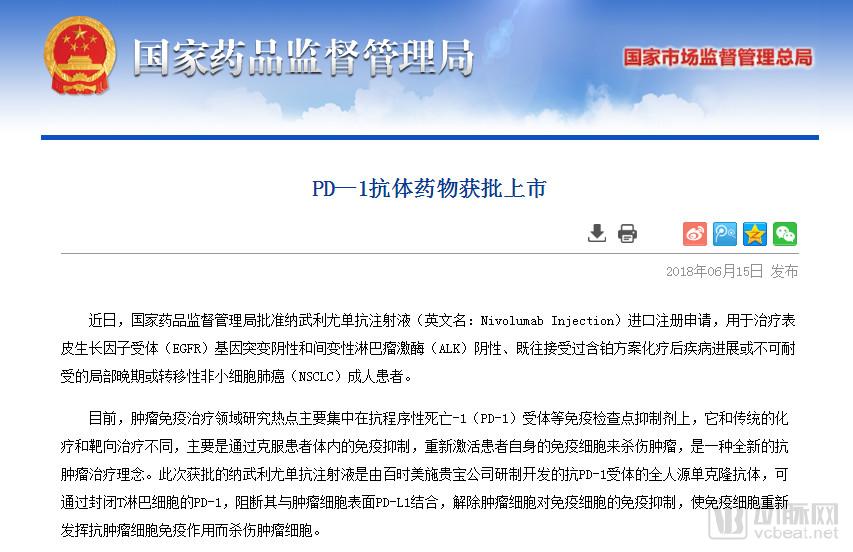
Image source: National Medical Products Administration
On June 15, 2018, it was reported by VCBeat (WeChat ID: vcbeat) that the National Medical Products Administration had officially approved Bristol-Myers Squibb’s application for market launch of its PD-1 monoclonal antibody drug, Opdivo, in China for the second-line treatment of non-small cell lung cancer.
This is the first PD-1 monoclonal antibody drug approved for marketing in China. It is reported that the drug was officially accepted by the CDE for review in November 2017, making it the first PD-1/PD-L1 inhibitor to submit a marketing application in China.
Given that Opdivo is an innovative drug with significant clinical benefits, the National Medical Products Administration (NMPA) granted it priority review status. The entire process, from submission to approval, took less than seven months.
Opdivo was first approved in Japan in July 2014, becoming the world’s first PD-1 inhibitor to gain regulatory approval. Subsequently, Bristol Myers Squibb has obtained approvals for multiple indications, including melanoma, non-small cell lung cancer, renal cell carcinoma, classical Hodgkin lymphoma, head and neck cancer, and bladder cancer.
The first to obtain regulatory approval inevitably gains a first-mover advantage. Leveraging Opdivo, Bristol-Myers Squibb has maintained a leading position in the PD-1/PD-L1 field. Naturally, this multi-million-dollar market has not gone unnoticed; besides Bristol-Myers Squibb, pharmaceutical giants such as Merck & Co., Roche, and AstraZeneca have successively entered the arena.
Merck & Co. is Bristol-Myers Squibb’s biggest competitor. Shortly after Opdivo was approved in Japan, Merck’s PD-1 monoclonal antibody Keytruda received FDA approval, becoming the first PD-1 inhibitor approved for marketing in the United States.
Merck & Co. officially submitted its marketing application in China in February 2018, slightly later than Bristol-Myers Squibb. However, as early as 2016, Keytruda had passed the drug-use environment inspection conducted by the Hainan Entry-Exit Inspection and Quarantine Bureau and was introduced into the Chengmei International Medical Center of Hainan Cancer Hospital.
Currently, Merck & Co.’s Keytruda is in the “under regulatory review and approval” stage. In addition, three Chinese companies—Innovent Biologics, Hengrui Medicine, and BeiGene—are also in the “under regulatory review and approval” stage.