

Alibaba's Healthcare Ecosystem: Roles of AliHealth, Alibaba Cloud, Ant Group, and DingTalk

AliHealth
Medical and Health Services Network Service Provider
We tend to view a large corporation as an organic whole, assuming that its strategic deployments in a particular field exhibit a certain “synergy” or that its actions are sequentially interconnected. This “labeling” approach facilitates our understanding and retention of the strategic layouts adopted by industry leaders.
From a corporate strategy perspective, this view holds water. However, within particularly large enterprises, there is also room for trial-and-error and exploration, especially in non-core businesses. When such exploratory and trial-and-error activities do not impact core operations, large companies demonstrate significant proactiveness in innovative ventures. This proactive approach to innovation not only generates compelling narratives but also lays the foundation for sustained high growth should these new initiatives succeed.

Over the past few years, VCBeat (WeChat: vcbeat) has consistently reported on “what” Alibaba and its affiliates have been doing in the healthcare sector. Now that Alibaba’s healthcare footprint has reached a certain scale, exerted notable industry influence, and taken shape as a distinct “landscape” or “vision,” we believe it is an appropriate time to comprehensively map out Alibaba’s healthcare strategy and elucidate “why” it pursued this path.
Going a step further, from phenomena to patterns and from appearances to essence, if Alibaba’s strategic logic in its healthcare business has remained consistent, we aim to use a “model” to predict what it will “do next” in the healthcare sector.
The expansion of China’s internet supergiants, Alibaba and Tencent, into the healthcare sector exhibits both “synergy” and “exploration.”
Tencent’s core strategy is “connectivity,” with its primary businesses being social networking and gaming; Alibaba’s core strategy is “platform,” with its primary businesses being e-commerce platforms and payment services. Nevertheless, both companies have made notable strides in the healthcare sector.
Such as Tencent’s ventures in “Smart Hospitals,” “Smart Pharmacies,” commercial health insurance, medical AI, and medical cloud services; and Alibaba’s initiatives in pharmaceutical e-commerce, product traceability, “Future Hospitals,” medical cloud services, and medical AI. In other words, the strategic layouts of these two tech giants in the healthcare sector exhibit a high degree of similarity.
The beauty of business lies in the interplay between strategically rational planning and the highly uncertain feedback from the market—that is, the journey from strategy to execution and ultimately to market outcomes. This process demands the dedication and ingenuity of entrepreneurs and professional managers, while also unlocking endless possibilities for commercial progress.
In retrospect, examining Alibaba’s strategic layout in the healthcare and medical sector, we aim to identify a clear central thread or framework to comprehend the underlying logic of its strategy, thereby abstracting from mere phenomena to uncover patterns. Simultaneously, we seek to discover hidden narratives or foreshadowing beyond this central thread, which may yield unexpected insights.
The “Double H” strategy—Health & Happiness, proposed by Mr. Ma, serves as the primary driver behind Alibaba’s expansion in the healthcare sector. In other words, Alibaba’s future strategic core will revolve around “health” and “happiness,” with health taking precedence over happiness.
Looking further back, it is also worth contemplating why Mr. Ma emphasized “health” and “happiness.” Chinese entrepreneurs, having achieved fame and success, have always regarded giving back to society as their duty, aspiring to “bring joy to all the disadvantaged scholars under heaven.” The healthcare industry possesses an inherent “gene” for social responsibility, as it is fundamentally rooted in the mission of healing the sick and saving lives, upholding the principle of “benevolent heart and skilled practice.” We also have a tradition and exemplars of benevolence in serving the world, leaving us with idioms such as “hanging the pot to help the world” and “the apricot grove filled with spring,” which praise high medical ethics.
Of course, commercial viability cannot rely solely on ethics and quality. As a “perennial sunrise industry,” healthcare is an excellent investment target, being less affected by economic cycles and business fluctuations, making it suitable for long-term investment. Furthermore, while Alibaba has successfully brought a “technological revolution” to the retail sector, reshaping the landscape of e-commerce, the healthcare industry remains relatively distant from the internet and has not yet been significantly transformed by internet technologies, leaving opportunities for tech giants to enter. The capital, technology, and operational models of these giants will find vast potential in the healthcare sector.
Alibaba has an internal concept known as the “Caterpillar Track Strategy,” whereby different business segments within the Alibaba ecosystem take turns leading the group’s growth at different stages. This approach fosters tiered development and organic coordination, with companies advancing one after another in a cyclical manner: one steps forward, then recedes, allowing another to take its place. Previously, key drivers within the Alibaba ecosystem included e-commerce, payments, and cloud computing. Clearly, healthcare and entertainment businesses are poised to assume critical roles in the future.
Another point worth noting is that Mr. Ma proposed the “Double H” strategy in 2015. At that time, Alibaba had just completed its initial public offering in the United States, and the articulation of this core strategy also helped investors understand the future direction of its business.
In summary, this explains why Alibaba has entered the healthcare industry: driven by its corporate values and social responsibility, while also recognizing healthcare as a high-quality investment sector.
After the strategy was determined, Alibaba gradually began to lay out its presence in the healthcare sector. The first step it took was to establish a “flagship platform”—AliHealth: In January 2014, Alibaba, together with Yunfeng Capital, made a strategic investment totaling US$170 million (approximately RMB 1.037 billion) in Hong Kong-listed CITIC 21st Century, acquiring a 54.3% stake in the company.
The establishment of AliHealth marks that Alibaba now has a core “fresh force” in the healthcare sector, enabling it to better support the Group’s strategic layout in healthcare and medical services.
Since its establishment, AliHealth has primarily focused on two key initiatives within the Alibaba Group: first, continuously integrating pharmaceutical e-commerce-related businesses, including the operated services for Tmall Pharmacy, the “Blue Hat” certified health supplement business, and the recently incorporated medical device e-commerce segment; second, providing access points for its services on platforms such as Taobao and Alipay, thereby facilitating the integration and conversion of internal resources.
Notably, the impact of resource injection has been most pronounced, driving AliHealth’s revenue to sustain robust growth—surging from RMB 30.42 million in fiscal year 2015 to RMB 2.442 billion in fiscal year 2018. With the integration of its medical device e-commerce business, future revenue growth is expected to be even stronger.
Most notably, AliHealth has effectively become the “leading player” in China’s pharmaceutical e-commerce sector. Annual report data show that in fiscal year 2018, the combined gross merchandise volume (GMV) of Tmall’s pharmaceutical categories operated by AliHealth and the e-commerce platform services for health food products acquired by AliHealth exceeded RMB 30 billion, while the annual GMV of Tmall’s medical device business reached RMB 20.561 billion.
This indicates that AliHealth controls the entry point to an e-commerce business for pharmaceuticals, medical devices, and health supplements valued at over RMB 50 billion. As the “Internet + Healthcare” policy is further implemented, AliHealth’s pharmaceutical e-commerce segment promises even greater prospects.
Beyond its e-commerce operations, AliHealth’s smart healthcare, product traceability, and health management businesses are also noteworthy. The company’s smart healthcare division has developed the “Doctor You” medical AI system, which has been deployed in multiple hospitals. Its product traceability business has expanded beyond basic tracking capabilities to include marketing and interactive features, attracting manufacturers of health supplements and traditional Chinese medicine patent drugs to join the platform. Meanwhile, the health management division has partnered with several smart device companies to monitor and manage user health through intelligent devices, while also extending its services into the commercial health insurance sector.
If the establishment of AliHealth can be described as “building a platform,” then the healthcare initiatives undertaken by other companies within the Alibaba ecosystem represent “strategic extension.” Leveraging their robust technological advantages and extensive user base, these entities are well-positioned to expand into the healthcare sector and generate synergistic effects. Business lines that align with this “extension” logic include Alipay, Alibaba Cloud, Taobao-Tmall, and DingTalk.
An Overview of Alibaba's Core Healthcare Business Layout
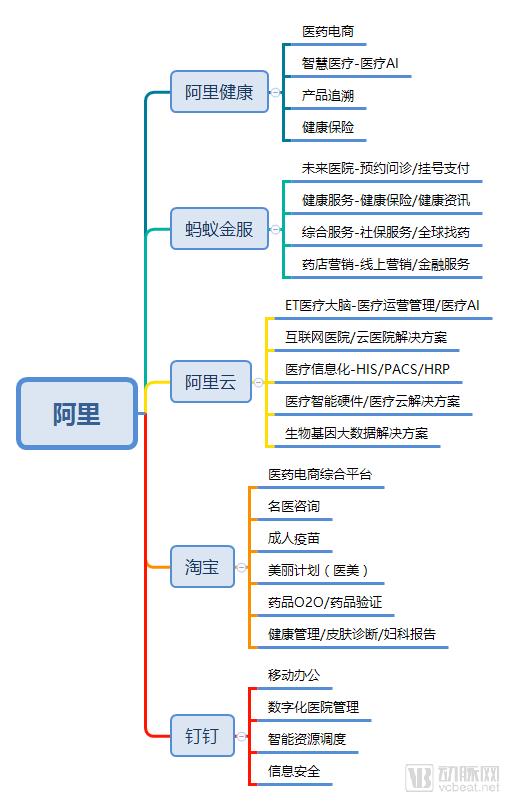
Below is a brief introduction to key companies in Alibaba’s healthcare and medical business layout.
AliHealth: The Flagship Platform of Alibaba’s Healthcare Strategy
AliHealth is the flagship platform of Alibaba’s healthcare strategy, primarily comprising four business segments: pharmaceutical e-commerce, smart healthcare, product traceability, and health management.
Since Alibaba’s capital injection in 2014, AliHealth has roughly undergone four development stages: the initial investment phase, with businesses primarily focused on electronic supervision codes and e-commerce services; the business adjustment phase, during which it piloted internet hospitals, pharmaceutical O2O (online-to-offline), and self-operated e-commerce, among other ventures;
During the business stabilization phase, the operational landscape gradually took shape, forming four business lines: pharmaceutical e-commerce, product traceability, smart healthcare, and health management. In the subsequent phase of sustained deepening, after several years of exploration, AliHealth has established its position within the industry and secured stable revenue streams. Moving forward, it will continue to deepen its industry engagement by implementing incremental improvements to its existing businesses.
In terms of revenue, AliHealth’s performance announcement for the 2018 fiscal year (April 1, 2017–March 31, 2018) showed that the company achieved revenues of RMB 2.443 billion and a gross profit of RMB 653 million this year, representing substantial year-on-year increases of 414.2% and 248.7%, respectively. The announcement also revealed that AliHealth’s profit, excluding share-based compensation expenses, reached RMB 8 million, marking its first return to profitability.
AliHealth’s continued improvement in profitability will help facilitate substantial future investments in medical artificial intelligence–related fields, while increasing investment and strategic positioning in forward-looking, innovative businesses such as smart healthcare, internet-based healthcare, and personal health management.
Ant Financial: Building the “Hospital of the Future” with Payment and Credit Services
Ant Financial’s presence in the healthcare sector is primarily manifested through Alipay. Alipay’s “Future Hospital” initiative optimizes the allocation of existing medical resources, enhances the healthcare service system, facilitates patient access to medical care, and improves hospitals’ internal management efficiency, thereby driving service upgrades across the healthcare industry through an integrated online-offline model.
At the application level, it has launched an Alipay-based electronic health card. This electronically verified card facilitates patient access while ensuring real-name medical consultations. Both the electronic social security card and the health card serve as platforms for delivering “Internet + Human Resources and Social Security” and “Internet + Healthcare” services.
Access the hospital’s official lifestyle account via the Smart Hospital homepage under “City Services” in Alipay. Appointment registration, consultations, payments, waitlist inquiries, report retrieval, and inpatient deposit payments can all be completed with just a few taps. Real-name and identity verification significantly reduce ticket scalping and ensure the security of users’ personal information.
Frictionless payment, credit-based medical services, and credit-based equipment rentals are also key strategic directions for Alipay’s “Future Hospital” initiative. At hospitals where Alipay has integrated with both public medical insurance and commercial health insurance, and enabled password-free payments for out-of-pocket expenses, the billing system automatically deducts medical fees from the patient’s Alipay account within seconds upon bill confirmation, delivering a “frictionless payment” experience. Additional offerings include Huabei’s advance payment coverage for pharmaceutical expenses, and the borrowing and returning of convenience devices and medical equipment based on Zhima Credit scores.
Overall, the Alipay mobile app integrates nearly 30 healthcare and medical services, including appointment registration, maternal and infant care, health information, and drug verification, enabling hundreds of millions of Alipay users to access convenient medical services through this platform.
In summary, Alipay’s “Future Hospital” leverages its core capabilities in “payment” and “credit” to optimize traditional healthcare processes, thereby realizing the integration of healthcare with the Internet. As the healthcare sector becomes more open, Alipay is expected to deepen its penetration into medical workflows and may continue to launch additional applications in the future.
Additionally, Alipay has opened up multidimensional capabilities—including marketing, financial services, and credit systems—to pharmacies, aiming to build “Future Pharmacies,” which will also transform the business models of the retail pharmacy industry.
Alibaba Cloud: Empowering Healthcare with a Powerful Brain
As the most successful cloud computing company in China, Alibaba Cloud holds nearly half of the public cloud services market share, with the healthcare industry being a key sector it serves. Alibaba Cloud has launched a variety of products and services for the healthcare industry, including Internet Hospital/Cloud Hospital solutions, healthcare informatization solutions, intelligent medical hardware, and medical cloud solutions.
Leveraging Alibaba Cloud’s cloud computing and big data capabilities, Alibaba Cloud can provide hospitals with data security, technical assurance, and personalized services.
Furthermore, at the Apsara Conference Shenzhen Summit held in March 2017, ET Medical Brain was officially launched. ET will be equipped with a range of medical capabilities, serving as a “physician’s assistant” across multiple domains, including disease risk prediction, medical imaging diagnosis, precision treatment planning, drug efficacy mining, new drug research and development, disease surveillance, and health management.
Alibaba Cloud aims to build industry “foundational platforms” and “infrastructure,” and as its technological capabilities mature, it is delivering more solutions to the healthcare sector. In the future, Alibaba Cloud’s services will gradually cover the entire health and medical landscape, including industrial manufacturers, distributors, retailers, and hospitals, with an increasingly diverse product portfolio.
Taobao: Building a “Super Portal” for C-End Users
AliHealth has launched the “My Health” card in Taobao’s user center, providing access to a range of services including consultations with renowned physicians, adult vaccinations, beauty programs, and home medication delivery. Taobao has thus become a major gateway for health services.
From a service logic perspective, Taobao itself boasts massive traffic and is simultaneously launching various services and content to retain users, shifting their behavior from merely purchasing items to “browsing Taobao.” This creates an opportunity for Taobao to provide healthcare services to its users. In other words, Taobao’s transactional nature is no longer the primary means of attracting users; rather, it is the diversified services it offers that serve this purpose.
We also note the functional overlap between the Alipay Medical Health channel and the “My Health” card on Taobao, indicating that Alibaba is consciously integrating platform entry points. This may further drive the integration of account systems across the three platforms, enabling a deeper understanding of users and the delivery of more precise services.
After Taobao became the “super gateway” for consumer health products and medical services, it not only provided a source of traffic for AliHealth’s medical services within the Alibaba ecosystem, but also increased user dwell time and stickiness on Taobao, helping to further consolidate the user base and capture health consumption data.
DingTalk: Smart Hospital Management Tool and Enterprise User Portal
As a star product in the domestic enterprise office market, DingTalk serves as a key entry point for hospital management. It provides four core capabilities for “Smart Hospital” management: mobile office solutions, digital hospital management, intelligent resource scheduling, and information security.
If a hospital is viewed as an enterprise, the DingTalk office platform can be used to manage internal administrative, human resources, and logistics operations. Hospital directors and department heads can leverage DingTalk for digital hospital management. Additionally, internal resources such as beds, patients, and pharmaceutical services can also be managed through DingTalk.
Moreover, corporate healthcare represents an untapped market with urgent development potential. If DingTalk can integrate medical services to provide health and medical care for its vast base of enterprise users, the resulting market opportunity would be substantial.
In fact, DingTalk is also seeking to provide health management services to B-side enterprise customers. On April 25 this year, AliHealth announced that it would integrate its service capabilities in the health sector, including physical examinations, online medical consultations, and medication purchases, to offer one-stop health solutions for enterprise users through an online “Ali Clinic.” On the same day, AliHealth launched the “Ali Clinic” on the DingTalk Enterprise Service Market, providing services such as health check-ups to more than 5 million enterprises and organizations on DingTalk.
Going forward, “AliHealth Clinic” will also offer services such as oral care, vaccination appointment scheduling, and psychological counseling for corporate employees. By integrating the LBS (Location-Based Services) functionality of its mobile app, it aims to better serve users through a new retail model and enhance the corporate health experience.
This also indicates that Alibaba is already coordinating and integrating internal resources to deliver medical services and products.
Multi-Platform Collaboration: Effective Conversion of Alibaba Ecosystem Resources
In addition to the aforementioned AliHealth, Alipay, Alibaba Cloud, Taobao, and DingTalk, other business segments within the Alibaba ecosystem will also serve as entry points or service providers for medical services, delivering healthcare solutions to both enterprise and consumer (C-end) customers.
For instance, Ele.me provides pharmaceutical O2O services, UC Browser delivers health information, and Youku offers health-related video content. With its extensive product portfolio and strong service penetration capabilities, the Alibaba ecosystem can comprehensively cover consumer-end users. If these resources are integrated and interconnected, they will create a “super entry point” for medical and healthcare services, enabling more comprehensive and precise healthcare delivery.
“Broad Investment”: Alibaba-affiliated Capital Has Become a Major Force in Healthcare Investment
By leveraging the two strategies of “building platforms” and “extending services,” Alibaba has secured control over both the entry points to healthcare services and the core technological capabilities of “Internet Plus.” For sectors characterized by high entry barriers, long investment cycles, or asset-heavy models, Alibaba has opted to enter through strategic investments. Consequently, capital from the Alibaba ecosystem has become a significant force in healthcare and medical investments.
Overview of Alibaba’s Capital Investment Portfolio
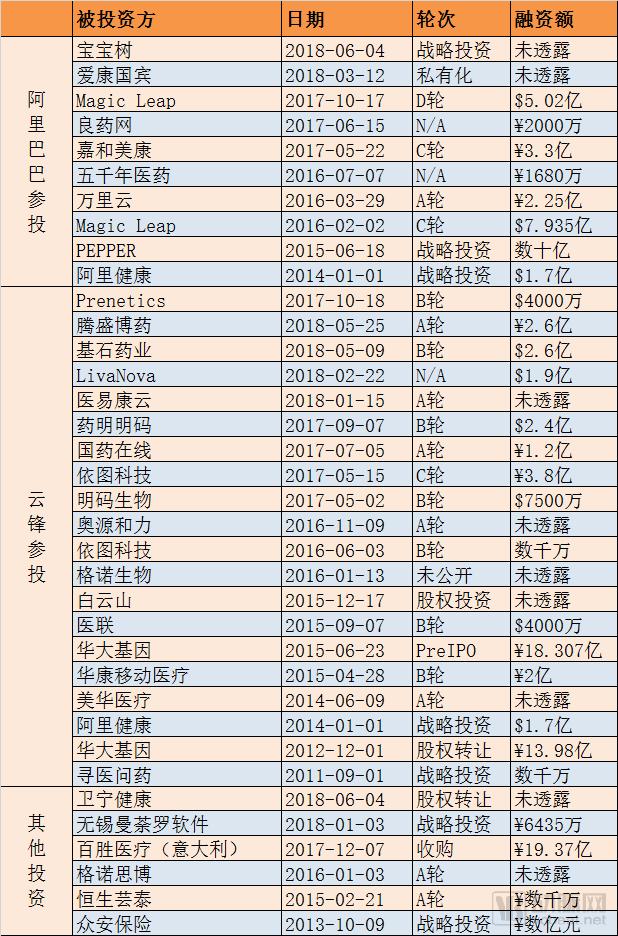
As can be seen, Alibaba-affiliated capital has made extensive investments in the healthcare sector, covering both domestic and international targets. These investments span pharmaceuticals, genomics, healthcare informatics, pharmaceutical retail, consumer healthcare, insurance, health check-ups, and medical big data. Notable portfolio companies include Bestway Medical (Italy), BGI Genomics, Baiyunshan, ZhongAn Insurance, and iKang Guobin.
At present, it is difficult to distill a core logic from the Alibaba ecosystem’s capital investments in the healthcare and medical sector. Most investment decisions are driven by strategic considerations, covering a diverse range of tracks. As Alibaba’s healthcare layout takes shape, high-quality resources can be integrated into its healthcare portfolio, creating a comprehensive, end-to-end healthcare ecosystem. For instance, iKang Guobin’s health examination services can be incorporated into “Ali Clinic,” while Winning Health’s capabilities and resources in healthcare informatization can generate synergies with “Future Hospital” initiatives and medical payment businesses.
Alibaba’s healthcare business has achieved scale and systematization through a strategic layout combining “in-house development,” “extension,” “partnerships,” and “investment,” with the initial framework of its ecosystem now taking shape.
A vivid metaphor for AliHealth’s business layout is a “sandwich cookie.” The entire ecosystem is divided into three layers: the support layer, the business layer, and the output layer. The support and output layers serve as the bottom and top of the cookie, respectively, while the core business layer in the middle constitutes the rich “filling.”
AliHealth’s “Sandwich” Model for Its Healthcare Layout
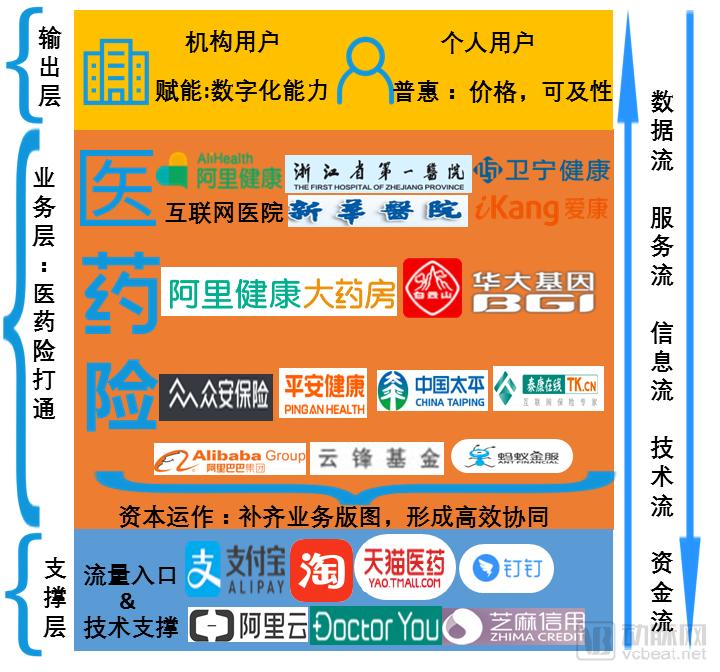
The support layer provides technical capabilities and traffic entry points, such as Alibaba Cloud’s Internet Hospital/Cloud Hospital solutions, healthcare informatization capabilities, and the user traffic generated by platforms like Alipay, Taobao, Tmall, and DingTalk. Technology and traffic form the foundation of the entire ecosystem, driving its efficient operation.
The business layer comprises the diverse products and services offered by Alibaba-affiliated healthcare enterprises, such as AliHealth’s internet hospital, pharmaceutical e-commerce, and health management operations, as well as Alipay’s online appointment registration, payment, and credit-based medical treatment services. Additionally, strategic investments are leveraged to continuously expand the business portfolio and foster efficient resource synergy.
The output layer targets both enterprise and individual users. For enterprise users, the focus is primarily on digital “empowerment,” such as upgrading hospitals to “Smart Hospitals” and providing online medical services and team-based healthcare solutions for general enterprises. Individual users are categorized into healthy individuals and patients. Services for healthy individuals include insurance and health management, while services for patients encompass medical care, pharmaceuticals, and medical devices. By innovating service delivery models, we aim to reduce the cost of high-quality medical services, enhance accessibility, and achieve “inclusive healthcare.”
Based on the “sandwich cookie” model, we can easily understand the logic behind Alibaba’s layout in the healthcare sector and categorize its previous moves in this field one by one. For instance, the initial purpose of establishing AliHealth was to integrate the pharmaceutical, medical, and insurance business lines and achieve synergy with other companies within the ecosystem.
Within the AliHealth medical and healthcare business ecosystem, bidirectional flows of technology, capital, information, services, and data have accumulated rich datasets, enabling the system to autonomously adjust or optimize its services.
Mr. Ma, known for his business acumen, also proposed the “Five New” strategy—New Retail, New Manufacturing, New Finance, New Technology, and New Energy. The introduction of these strategies reflects not only Alibaba’s own business interests but also broader reflections on technological transformation and economic trends. Together, the “Five New” and “Double H” strategies form the overarching framework of Alibaba’s corporate strategy, serving as key guides for its future business direction and investment priorities.
As Alibaba’s healthcare business layout continues to expand, it has effectively unveiled a vision of “New Healthcare.” This vision can be broadly described as follows: Centered on users, it provides healthcare services and products through both online and offline channels. The medical consultation process is optimized to the utmost extent, with artificial intelligence technologies integrated throughout the entire journey—from initial triage to subsequent patient education and post-discharge management. This significantly frees up physicians’ time, enabling more efficient utilization of their professional expertise.
Healthcare insurers and enterprises will deepen their adoption of information technology tools and applications, optimizing products and services through data analysis of market feedback. On the user side, high-quality health services will be readily accessible through various channels, with a greater emphasis on health management and an enhanced health service experience.
To some extent, “New Healthcare” is effectively synonymous with “Value-Based Healthcare,” as both emphasize the application of technology and model innovation to deliver more valuable services to users. This approach is similar to “New Retail,” which has not only broken down information and channel barriers between consumers and goods but also given rise to a C2B personalized production model. Once validated, this logic is likely to prove equally effective in the healthcare sector.
Five Predictions for Alibaba’s Healthcare Business Layout
Based on the foregoing discussion, we believe that Alibaba will continue to invest in the healthcare sector, further enriching its strategic layout and gradually penetrating into healthcare providers, pharmaceutical companies, insurance firms, and medical service processes. If Alibaba maintains consistency in its strategic logic for healthcare operations, we consider the following five initiatives to be its key priorities for the future:
1. Continue to strengthen investment in hospital-based products or services, as hospitals remain the core of healthcare delivery. In particular, with the implementation of policies such as medical consortia and tiered diagnosis and treatment, the role of high-tier hospitals within the healthcare system will be further reinforced, positioning them as distribution hubs for patients, services, and products. Securing partnerships with tiered hospitals represents the optimal entry point for “Internet + Healthcare” businesses; once these institutions are engaged, rapid coverage of primary care facilities can also be achieved.
2. Collaborations with or investments in healthcare IT enterprises will increase. The healthcare IT market is already highly mature, with a number of listed companies emerging. From the perspective of financial investment, healthcare IT vendors combined with the concept of smart healthcare are expected to yield favorable returns. Meanwhile, leveraging the resources and technological accumulation of healthcare IT vendors, Alibaba-affiliated products and services can be rapidly deployed in hospitals and integrate payment processes, thereby establishing a model that links in-hospital and out-of-hospital services.
3. Develop management tools and marketing services for pharmaceutical and medical device companies. At this stage, the penetration of Alibaba’s “Internet+” products into pharmaceutical and medical device enterprises is not yet significant. However, mature products or services already exist in the market, such as research support, research data, research process management tools, and sales performance management tools. These products or services should serve as Alibaba’s entry point into the wave of digital transformation in the pharmaceutical and medical device sectors, with market entry achieved through either partnerships or independent development.
4. Enhance the services of pharmaceutical e-commerce platforms. The pharmaceutical e-commerce services referred to herein include not only online sales platforms for pharmaceuticals, medical devices, and health supplements, as well as self-operated health product retail services, but also integrated online-to-offline (O2O) prescription extension and external prescription dispensing services. The sales of pharmaceuticals and medical devices represent one of the most mature models within the current “Internet + Healthcare” ecosystem and possess strong revenue-generating capabilities. This segment will serve as the “cash cow” business, supporting investment in and the development of other business lines.
5. Moderately expand its footprint in commercial medical insurance and high-end private healthcare services. Driven by rising income levels, an aging population, and consumption upgrades, the market size for commercial medical insurance and high-end healthcare services continues to grow. However, the sector lacks unified access points and service standards. If Alibaba can enter this market and convert its vast consumer base, its service model would set a benchmark for establishing industry standards, thereby guiding the healthy development of the sector.