

BodyPlus Technology Highlights Pre- and Post-Hospital Wearable Solutions with Data-Driven Services at 2018 Primary Healthcare Innovation Summit

Gao Xiangdong, Founder and CEO of BodyPlus
Conference: 2018 Summit on Innovative Practices in Primary Healthcare
Location: Landison Plaza Hotel, Hangzhou, Zhejiang
Presenter: Gao Xiangdong, Founder and CEO of BodyPlus
From June 9 to 10, the “New Structure – 2018 Summit on Innovative Practices in Primary Healthcare,” co-hosted by the National Engineering Laboratory for Internet Medical Systems and Applications, Sir Run Run Shaw Hospital affiliated with Zhejiang University School of Medicine, the Internet Medical Health Industry Alliance, and VCBeat, was grandly held in Hangzhou. The event featured six specialized forums, bringing together more than 1,000 top experts, scholars, industry talents, and investors from across China, and attracted attention from over 30 industry media outlets.
Gao Xiangdong, Founder and CEO of BodyPlus, attended the summit at invitation and delivered a keynote speech titled “Health Big Data Entry Point via Smart Clothing” at the Frontier Subforum on Chronic Disease and Health Management.Key Points:
1. Wearable devices currently face certain challenges in being adopted within hospital settings, with most applications focused on pre-hospital and post-discharge care;
2. Devices should not merely inform users of the problem; instead, they should assist users in resolving it;
3. The greatest challenges in transitioning from consumer-grade products to medical-grade ones are data accuracy and obtaining endorsement from authoritative professional institutions or experts;
4. ECG monitoring products are difficult for end-users to use directly, unless they have a medical background. BodyPlus does not deliver services through its products; instead, it creates value by empowering its partners.
Based on the guest’s speech and post-event exclusive interview, VCBeat (WeChat ID: vcbeat) has compiled the following:
9 Major Application Scenarios of Wearable Devices in the Healthcare Sector
VCBeat's research report shows that,The application market for wearable devices in the healthcare sector can be categorized chronologically according to the medical process into pre-onset, onset, and post-onset stages. In terms of professional medical standards, these devices are classified into consumer-grade (health-grade) and medical-grade. Based on the sequence of the medical workflow, their application scenarios can be divided into nine major categories: activity monitoring, disease prevention, early intervention, definitive diagnosis, continuous monitoring, assisted diagnosis and treatment, personalized therapy, efficacy evaluation, and chronic disease management.
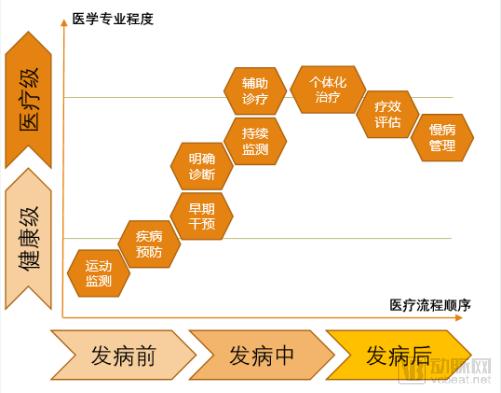
9 Major Applications of Wearable Devices in Healthcare (Image source: VCBeat)
More health management is conducted in the pre-hospital setting. In traditional wearable device products, such as those for activity monitoring, the focus is increasingly shifting toward disease prevention and early intervention.As the required level of medical expertise for products continues to deepen, the challenges in product research and development are also escalating.
Given the current trajectory of wearable device development, direct adoption within hospital settings still presents certain challenges. Consequently, applications are more heavily concentrated in pre-onset and post-onset scenarios, including pre-hospital health management and chronic disease screening, as well as post-discharge follow-up and monitoring.
According to VCBeat's research,Potential hotspots may emerge in the fields of assisted diagnosis and treatment, personalized medicine, and chronic disease management.
For common wearable devices on the market, whether they are wristbands, watches, blood pressure monitors, or smart clothing, they can basically be categorized asThree Major Functional Directions:
1. Information Collection. Often, sensors—whether placed on the body surface or implanted internally—are used to collect human physiological data;
Second, information processing.Store the collected data on the local device or upload it to the cloud after structured processing;
Third is feedback interaction.Such a design requires the device to have computational capabilities, where data is collected, stored, processed, and used for interactive feedback within the device. After data collection, diagnosis and intervention should follow; often, data should not be collected merely for the sake of collection. Data acquisition must be meaningful and should contribute to subsequent diagnostic and therapeutic outcomes.
Many wearable devices merely present data to users, alerting them to potential health issues; however, Chinese consumers’ willingness to pay is typically contingent upon the provision of accompanying services.In other words, merely “knowing” what health issues they have does not help users. Companies need to do more by telling users how to resolve these issues or assisting them in doing so, thereby creating a closed-loop service.The device not only needs to provide feedback and interaction, but also needs to propose solutions after data presentation.
BodyPlus: Focusing on Healthcare, with Extensions into Sports and Industrial Applications
BodyPlus develops wearable technology integrated into clothing. Its core team hails from the electronics industry, bringing extensive experience in electronic measurement instruments as well as hardware and software research and development. When the company was founded three years ago, driven by the growing public emphasis on personal health, the team sought to develop a product that would help people lead healthier lives.
The decision to use clothing as the medium stems from the team’s experience that wearable devices such as wristbands and smartwatches fail to meet the requirements for long-term, continuous data collection. During hospital visits, electrocardiogram (ECG) results are often normal; however, patients may still experience cardiac discomfort at home, where monitoring capabilities are lacking, leading to a frequent absence of out-of-hospital data.
Long-term data collection faces challenges in device sustainability, requiring 24/7 usability. Hospitals commonly use “Holter” monitors (24-hour ambulatory ECG) for long-term data acquisition; however, these devices rely on wet electrodes, which can cause allergic reactions and detachment due to sweating. Furthermore, the service experience is suboptimal. The process of visiting a hospital to be fitted with a Holter monitor exemplifies the “three longs and one short” issue prevalent in healthcare services.
In this context, many researchers are investigating the application of dry electrodes. The primary challenge with dry electrodes lies in the stability of data acquisition. Bioelectric signals on the human body surface are extremely weak; if electrical noise in daily movement scenarios overwhelms these signals, the acquired data becomes meaningless.
BodyPlus's products have achieved two breakthroughs:1. The successful development of flexible sensors.After two years of collaboration, BodyPlus and DuPont (USA) have jointly launched flexible printed sensors capable of printing sensor arrays on clothing based on the user’s body shape and spatial positioning, achieving electrical performance that makes them the “dry electrodes closest to wet electrodes.”
2. Miniaturization of monitoring devices.Hospital Holter monitors are often equipped with complex wiring. For users, the inability to conceal wearable medical devices during long-term monitoring leads to progressively declining usage rates. Therefore, from the perspective of device development, it is crucial to create high-precision, miniaturized data acquisition devices that achieve low power consumption and high-precision data collection within a very compact form factor.
For practical implementation scenarios, BodyPlus’s slogan is “Focus on Healthcare, Extend to Sports and Industry.”
In medical applications, after achieving wearable data collection from the human body through clothing, there is also a demand for collecting human physiological data in sports and specialized industry scenarios.
Undeniably, exercise intensity and safety impose stringent requirements on human health. BodyPlus provides intelligent solutions for physical fitness monitoring and assessment in sports training. For institutions in the mass sports sector, it offers smart cloud platform solutions.
There are three prominent application scenarios in specialized industries: one related to training, one to on-site monitoring, and one to health management.
BodyPlus provides reliable positioning and vital signs monitoring solutions for specialized sectors, including fire services, public security, armed police, special forces, and wilderness search and rescue teams.
Firefighters, armed police, and public security personnel all undergo extensive daily training. For these specialized professions, effective monitoring during training—including on-duty vital signs monitoring—is of critical importance.
For example, under the “Police Care” initiative proposed by the Ministry of Public Security, police officers use BodyPlus products for health and safety management during training and duty.
Additionally, in the realm of health management, BodyPlus is collaborating with a Japanese company to develop health management devices tailored for firefighters. Beyond monitoring vital signs such as heat stroke during fireground operations, data from the U.S. Fire Administration indicates that cardiovascular issues are the leading cause of firefighter line-of-duty deaths and injuries. In the United States, cardiovascular-related incidents account for 45% of such cases among firefighters, compared to 22% for police officers and 11% for medical personnel. Underlying cardiovascular conditions pose significant risks, particularly during intense physical exertion.
The reason why this figure is relatively low in China is that many of our firefighters are armed police soldiers, who are in their physical prime. This is not a significant issue at present; however, with the ongoing professionalization of the national fire service, the average age of firefighters is expected to increase in the future.
Health management tailored to industry-specific characteristics holds significant market potential. The physical health of Chinese public security police officers aged 40 and above is showing a declining trend, making occupational diseases associated with these special professions worthy of attention.
Not serving end-users directly through products, but rather partnering with healthcare institutions.
Currently, BodyPlus’s primary business model is not that of a company delivering services directly through its own products and operating an offline closed-loop system. Instead, it focuses more on empowering partners such as medical institutions, health management organizations, and physician groups by providing them with its product platform, while the subsequent medical services are delivered by these partners.
Data collected by smart clothing is transmitted to the cloud platform, enabling physicians to review their patients’ data via the backend system and facilitate post-discharge follow-up. Meanwhile, BodyPlus’s data can be integrated with the data platforms of third-party partner institutions in the cloud, thereby achieving data interoperability.
The final user health management report is issued by partner medical institutions. BodyPlus provides data to its partners, who generate the reports, thereby completing the service workflow.
BodyPlus Smart ECG Vest Management System is an intelligent tool for physicians to screen and manage follow-up care for patients with chronic cardiovascular diseases. It addresses challenges such as difficulties in data collection and limited interpretation capabilities at primary healthcare facilities. By enhancing diagnostic accuracy in primary care institutions, it also boosts public trust in grassroots medical services, thereby truly realizing a healthcare model where minor ailments are managed at the primary level while serious conditions are referred to hospitals.
Q&A
VCBeat: What is the origin of BodyPlus’s connection to the healthcare industry?
Gao Xiangdong: In fact, we have been determined to enter the medical industry from the very beginning. However, given the long development cycles and high barriers to entry in the healthcare sector, we believed it would be beneficial to initially launch phased products for use in the fitness market. Therefore, we explored the fitness market. We have been continuously iterating our products to enhance their comfort, reliability, and durability through the sports and fitness market. Once the product iterations are optimized, we will open up certain functionalities and enter the medical market.
VCBeat: What are the challenges in evolving from consumer-grade devices to medical-grade devices?
Gao Xiangdong: If BodyPlus’s products enter the market as standalone consumer goods, directly facing end-users, they will be ineffective. Unlike blood glucose monitoring, electrocardiogram (ECG) readings are not easily interpretable by most users, who generally cannot understand the information conveyed by ECG results. Therefore, we cannot effectively target the consumer (C-end) market directly; instead, we must collaborate with business clients (B-end).
The focus of B2B collaboration lies in addressing the specific needs of hospital physicians and the health management requirements of health management institutions. The greatest challenge remains ensuring data accuracy, enabling benchmarking against hospitals’ Holter systems.
VCBeat: Who are BodyPlus's partners?
Gao Xiangdong: We are collaborating with specialists at tertiary hospitals to conduct clinical trials in the Department of Cardiovascular Medicine at Beijing Anzhen Hospital. Our partners include the Heart Alliance, which has established atrial fibrillation screening centers in conjunction with Medlinker, covering a wide range of primary healthcare institutions. BodyPlus serves as the provider of product technology.