

Tencent Launches China's First Open AI-Assisted Diagnosis Platform, Aiming to Become a 'Toolkit' for Hospitals and Healthcare IT Providers
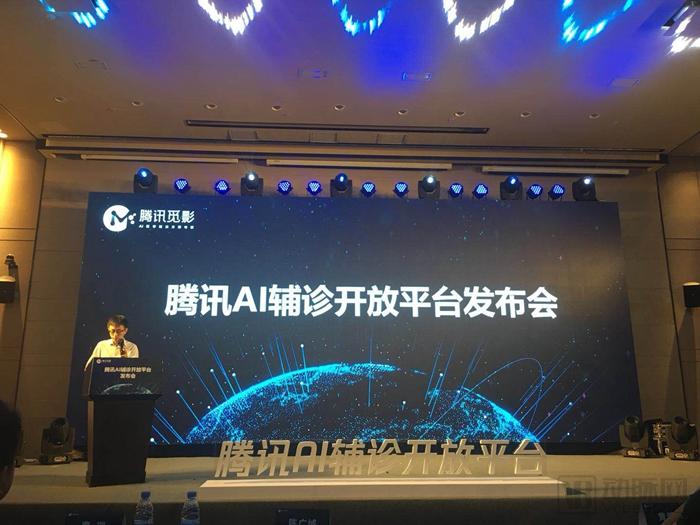
VCBeat (WeChat ID: vcbeat) has learned that on June 21, Tencent officially launched its first open AI-assisted medical diagnosis and treatment platform (hereinafter referred to as the “AI-Assisted Diagnosis Open Platform”), announcing the opening of the AI-assisted diagnosis engine behind its inaugural AI-plus-healthcare product, “Tencent Miying.” This initiative aims to facilitate the intelligent upgrading of hospital information systems (HIS) and internet-based medical services, thereby building a smart healthcare ecosystem that covers pre-diagnosis, intra-diagnosis, and post-diagnosis stages.
“Tencent Miying”’s AI-assisted diagnostic engine has also become the first open medical AI engine in China. Chen Guangyu, Vice President of Tencent, stated that he hopes “Tencent Miying” can serve as a “toolbox” for hospitals and healthcare IT vendors, helping the medical industry build a “super brain” for next-generation intelligent healthcare services.
Cao Rui, Vice President of Nanfang Hospital, Southern Medical University; Xu Zhong, Executive Dean of the Internet Hospital of the First Affiliated Hospital of Xiamen University; Sun Zhijian, Vice President of Shandong Provincial Hospital; Han Shibin, Chairman of Donghua Yiwei; Mei Guozeng, Chairman of Zhiye Software; Yin Zhiguo, General Manager of Kingdee Medical; Min Neng, General Manager of Guangzhou Haici; Wang Ming, Co-founder of Health 160; Xie Jun, General Manager of Shandong Shunneng; as well as Chen Guangyu, Vice President of Tencent; Zheng Yafeng, General Manager of Tencent’s Operations Management Department; Zhou Xuan, Deputy General Manager of Tencent’s Internet + Healthcare Product Center; and Yang Wei, Technical Director of Tencent AI Lab, jointly launched the Tencent AI-Assisted Diagnosis Open Platform.
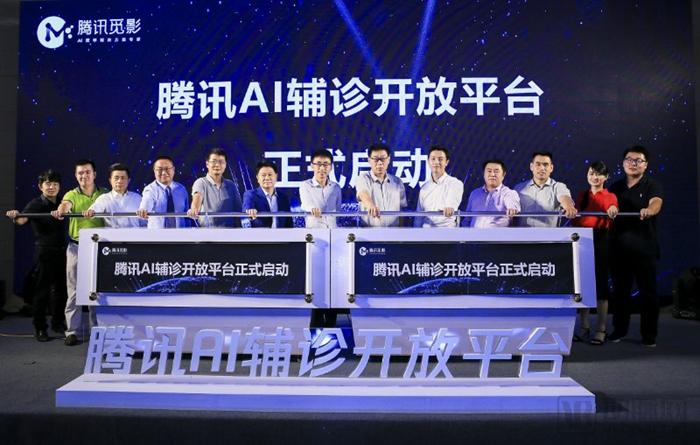
Image provided by Tencent Miying
Meanwhile, Tencent has separately signed strategic AI cooperation agreements with healthcare IT vendors such as Zhiye Software, Shandong Shuneng, Guangzhou Haici, Kingdee Medical, and Health 160, as well as with medical institutions including the First Affiliated Hospital of Xiamen University, Shandong Provincial Hospital, the Second People’s Hospital of Anhui Province, Shenzhen Hospital of Southern Medical University, The University of Hong Kong-Shenzhen Hospital, Bao’an Traditional Chinese Medicine Hospital Group, Shenzhen Samii Medical Center, Shenzhen Hospital of the University of Chinese Academy of Sciences, Bao’an District Maternity and Child Healthcare Hospital, and Longgang District Maternity and Child Healthcare Hospital.
As Tencent’s first product to apply artificial intelligence technology in the medical field, “Tencent Miying” features AI medical imagingWith two core capabilities—analysis and AI-assisted diagnosis and treatment—it has established collaborations with more than 100 top-tier Grade A tertiary hospitals in China. Building on the breakthroughs achieved by Tencent Miying in the exploration of AI + healthcare, the Ministry of Science and Technology has explicitly designated Tencent to lead the construction of the National Next-Generation Artificial Intelligence Open Innovation Platform.
With the launch of its first AI-assisted diagnosis open platform, Tencent has announced for the first time the opening of the “Tencent Miying” AI-assisted diagnosis engine, following the initial release of “Tencent Miying”’s AI-assisted diagnostic capabilities on November 13 last year. In the future, hospitals and medical informatics vendors will be able to leverage the “Tencent Miying” AI-assisted diagnosis engine via open APIs to customize intelligent medical services covering pre-diagnosis, intra-diagnosis, and post-diagnosis stages.
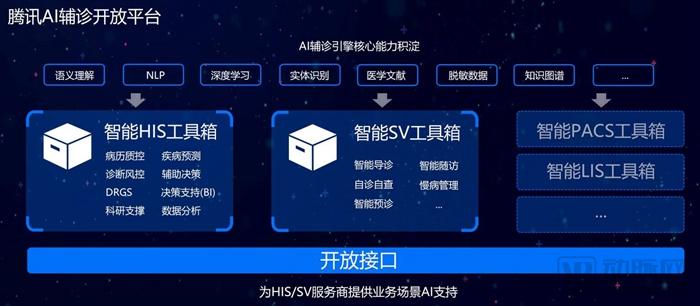 “Tencent Miying” AI-Assisted Diagnostic Engine Provides Intelligent Toolkits for HIS and SV Vendors
According to reports, the “Tencent Miying” AI-assisted diagnostic engine simulates physicians’ professional development and accumulates medical diagnostic capabilities, enabling it to assist doctors in diagnosing and predicting more than 700 diseases across all specialties, covering 90% of high-frequency diagnoses in hospital outpatient settings. Similar to the learning trajectory of human physicians, the “Tencent Miying” AI-assisted diagnostic engine follows a comparable learning process: just as medical students progress through stages of accumulating knowledge by extensively studying medical literature, enhancing diagnostic skills during clinical internships, and gaining extensive clinical experience as practicing physicians before becoming medical experts.
The AI-assisted diagnostic capabilities of “Tencent Miying” have evolved through three stages to provide professional decision support for physicians: First, by leveraging artificial intelligence technologies such as natural language processing and deep learning—widely applied across Tencent’s services—through its AI Lab, the system learns, understands, and synthesizes medical information from authoritative medical textbooks, literature, clinical practice guidelines, and electronic health records, thereby automatically constructing a “medical knowledge graph.” Second, diagnostic models are established based on reasoning derived from electronic health record retrieval and knowledge graph inference. Finally, the diagnostic models are optimized under the validation of human medical experts.
Since the initial release of its AI-assisted diagnostic capabilities on November 13 last year, the “Tencent Miying” AI-assisted diagnostic engine has undergone significant upgrades. It now boasts a repository of approximately 500,000 medical terms, over 200,000 annotated medical datasets, more than 1 million terminological relationship rules, upwards of 10 million health knowledge entries, over 80 million high-quality medical knowledge records, and more than 100 million open-access medical encyclopedia data points, thereby covering the vast majority of publicly available authoritative medical knowledge bases.
The open “Tencent Miying” AI-assisted diagnostic engine will serve as a toolkit for the intelligent transformation of medical services. Through open APIs, healthcare IT vendors can integrate the “Tencent Miying” AI-assisted diagnostic engine with hospital Hospital Information Systems (HIS), empowering HIS with AI-assisted diagnostic capabilities, facilitating the sharing and interoperability of data and applications within hospitals, and achieving the intelligent upgrade of hospital HIS.
Among these, Clinical Decision Support Systems (CDSS), empowered by AI-assisted diagnostic capabilities, will assist physicians in improving the accuracy and efficiency of diagnosing common diseases. Furthermore, they provide decision-support services such as intelligent consultation, reference diagnoses, treatment plan recommendations, intent analysis, auxiliary knowledge bases, and structured electronic medical records.
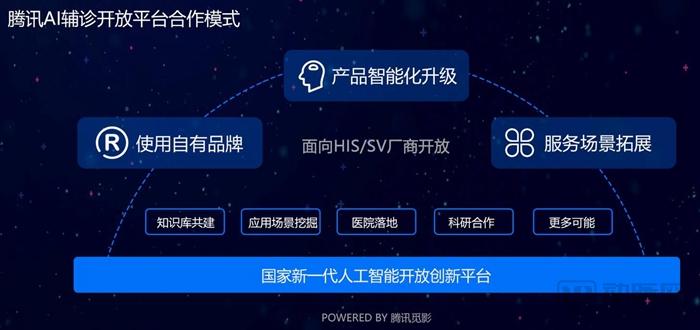
By opening its engine, Tencent launches the “POWERED BY Tencent Miying” partnership model.
Leveraging the “Tencent Miying” AI-assisted diagnostic engine and the WeChat Smart Hospital ecosystem, hospitals and healthcare IT vendors can achieve intelligent upgrades in mobile medical services. By employing AI-guided consultation and AI triage with pre-diagnosis before visits, they enhance the accuracy and efficiency of pre-consultation information collection. Additionally, new application scenarios such as post-visit AI follow-ups enable intelligent communication between doctors and patients beyond the consulting room.
“Dr. Xiao Jia,” the intelligent triage service launched by Zhiye Software and Xiamen University’s First Affiliated Hospital, is among the first batch of intelligent applications “POWERED BY Tencent Miying”: patients only need toGuanFollow the WeChat official account “The First Affiliated Hospital of Xiamen University Internet Hospital,” select [Intelligent Triage] from the [Medical Services] menu, and describe your symptoms via voice or text input. Within just a few seconds, “Dr. Xiao Jia” will accurately match you with the appropriate department and recommend qualified specialists, making appointment registration easy.
At the launch event of Tencent’s AI-Assisted Diagnosis Open Platform, Tencent also signed strategic artificial intelligence cooperation agreements with healthcare IT vendors—including Zhiye Software, Shandong Shunneng, Guangzhou Haici, Kingdee Medical, and Health 160—as well as their partner medical institutions.
It is reported that the aforementioned five medical informatics vendors serve nearly 1,000 healthcare institutions and hold a leading position in the domestic market for Hospital Information Systems (HIS) and mobile medical services. As part of this multi-party cooperation agreement, the following institutions will become partner healthcare organizations of Tencent’s AI-Assisted Diagnosis Open Platform: The First Affiliated Hospital of Xiamen University, Shandong Provincial Hospital, The Second People’s Hospital of Anhui Province, Shenzhen Hospital of Southern Medical University, The University of Hong Kong-Shenzhen Hospital, Bao’an Traditional Chinese Medicine Hospital Group, Shenzhen Samii Medical Center, Shenzhen Hospital of the University of Chinese Academy of Sciences, Bao’an District Maternal and Child Health Hospital, and Longgang District Maternal and Child Health Hospital.
In the future, through the Tencent AI-Assisted Diagnosis Open Platform, the AI-assisted diagnostic capabilities of “Tencent Miying” will help hospitals and medical informatics vendors achieve intelligent transformation, build their own “Medical Super Brain,” and establish a smart healthcare ecosystem covering pre-diagnosis, during-diagnosis, and post-diagnosis stages.