

Healgoo Interactive Files IPO Prospectus: Empowering Diabetic Retinopathy Screening with 12 AI Prediction Models from the Grassroots Level
Healgoo Interactive was established in September 2013, co-founded by several senior scholars in the medical field and artificial intelligence experts. During their work in treating eye diseases, they recognized the value of AI and began research and development efforts. After nearly four years of accumulation, they launched the Healgoo AI diagnostic system in 2017, followed by the ophthalmology-specific version, Deep Fundus, in June 2018.
Deep learning represents one of the most significant breakthroughs in the field of artificial intelligence (AI) in recent years, offering new promise for the commercialization of AI. Since AlexNet’s victory in the 2012 ImageNet Large Scale Visual Recognition Challenge (ILSVRC), convolutional neural networks (CNNs) within deep learning have demonstrated remarkable performance in computer vision. Accordingly, Hegu Interactive has established its technical development direction toward using deep learning algorithms to predict diseases from fundus photographs.
Currently, HeGu Interactive has grown into a team of 36 members, equipped with comprehensive strategic thinking and a stable revenue model, fully dedicated to research in medical big data and AI-driven diagnostic technologies. To date, HeGu Interactive has secured multiple invention patents, including those for intelligent fundus cameras, and its research papers on deep learning algorithms have been published in the international core journal *Ophthalmology*.
The key projects at Hego Interactive are currently led by co-founder and CTO Meng Wei. Previously, Mr. Meng served as a Microsoft Technical Expert and HIPAA Security Specialist overseas, and he holds the UK NHS-certified Diabetic Retinopathy Grading credential. He has conducted in-depth research in the field of artificial intelligence.
Another senior ophthalmologist on the team, Robert Chang from Stanford University in the United States, has long been engaged in surgeries for glaucoma, cataracts, and other conditions. He specializes in the application of novel techniques and minimally invasive procedures, and has achieved significant accomplishments in the innovation of ophthalmic medical technologies and artificial intelligence.
Chief Scientist Professor Mingguang He serves as a Professor at the Zhongshan Ophthalmic Center, Sun Yat-sen University, and as a Professor of Ophthalmology at the University of Melbourne, Australia. He is a recipient of the National Science Fund for Distinguished Young Scholars, recognized as a Leading Talent under the National “Ten Thousand Talents Program,” and honored as a Leading Talent in Scientific and Technological Innovation among Middle-aged and Young Researchers by the Ministry of Science and Technology. Professor He’s research interests encompass clinical and genetic epidemiology of eye diseases, randomized controlled trials, twin studies, imaging technologies, artificial intelligence, and big data analytics. His work has garnered extensive recognition from the international peer community.
It is evident that this team represents a complementary synergy between technology and clinical medical practice. Professor He Mingguang identified applications for artificial intelligence from the frontier of ophthalmology research and provided specialized ophthalmic medical support for the AI development. Professor Robert Chang designed the top-level algorithms for the AI and empirically validated their rationality during operation. The concrete implementation of the algorithms and system was carried out by the technical team led by Meng Wei.
Since 2013, Hego Interactive has been dedicated to research on deep learning algorithms. Through relentless efforts and experimentation, Hego Interactive has independently developed a preprocessing algorithm specifically optimized for fundus photographs, as well as a high-performance convolutional neural network, HG-Net. This has led to remarkable achievements in the disease grading of fundus images. The core technologies have been granted national invention patents and published in international academic journals.
As is well known, data plays a critically important role in the field of deep learning. On one hand, training deep learning models requires substantial data support to develop a model with strong robustness; insufficient datasets often lead to overfitting or underfitting. On the other hand, dataset annotations must be accurate, as inaccurate labeling significantly hinders improvements in model accuracy. Generally speaking, data and features determine the upper bound of a model’s performance, while algorithm optimization and tuning merely serve to approach this upper limit.
To enhance the accuracy of disease annotation in fundus photographs, HeGu Interactive has specially developed a data annotation platform called Label Me. On this platform, professional ophthalmologists annotate each fundus photograph, with multiple doctors reviewing each image; only those images with consistent annotations are used for training. The team at HeGu Intelligence includes several experts with extensive experience in the field of ophthalmology, providing significant advantages in the disease annotation of fundus photographs.
These efforts have given Helu Intelligent a leading advantage in technology and data, accumulating extensive experience in disease prediction from fundus photographs, thereby providing strong support for the market penetration of the Deep Fundus and Healgoo AI platforms.
How Large Is the Ophthalmology Market? According to official data from the National Health Commission, China’s ophthalmology market was valued at RMB 46.1 billion in 2012. This figure was updated to RMB 82.7 billion in 2016. Experts predict that the domestic ophthalmology market will reach RMB 159 billion by 2021.
Specifically, as of 2015, China had approximately 110 million patients with diabetes mellitus; based on this figure, it is estimated that there were about 27 million patients with diabetic retinopathy in the country.
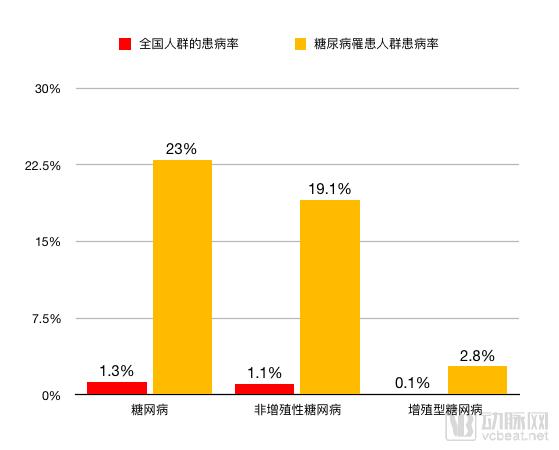
Incidence of Diabetic Retinopathy in China
During the diagnosis of patients with eye diseases, doctors at River Valley Interactive discovered that their limited energy could not meet the demands of a large number of patients. Given the high requirements for ophthalmic diagnosis and the potential of emerging AI technology to significantly improve work efficiency, they collaborated with professionals to develop AI technology, resulting in the creation of Deep Fundus, the River Valley AI-Assisted Diagnostic System for Eye Diseases.
Deep Fundus is designed to assist physicians in clinical examinations, offering 12 AI prediction models online. It is not only capable of screening for diabetic retinopathy but also applicable to glaucoma, cataracts, macular edema, and macular degeneration, enabling the simultaneous screening of multiple ocular diseases from a single fundus image. Statistical results show that the overall accuracy of this AI system ranges from 0.986 to 0.995, with sensitivity exceeding 95% and specificity exceeding 91%. In contrast, the mean accuracy of diabetic retinopathy graders trained by the NHS is 75%.
This AI system utilizes algorithms independently developed by Hego Interactive. It was trained on a curated dataset of 200,000 fundus photographs, with an additional 70,000 fundus photographs selected as a validation set, achieving an overall accuracy of 99.0%. Furthermore, the AI underwent independent validation using 18,000 samples at the Royal Victorian Eye and Ear Hospital in Australia, demonstrating diagnostic accuracies of 98.9% for diabetic retinopathy, 98.6% for glaucoma, 99.1% for cataracts, and 99.5% for macular degeneration.
Primary care hospitals often fail to deliver optimal service outcomes due to factors such as the limited clinical experience of their medical staff. The Hego AI-Assisted Diagnostic System for Ocular Diseases can support primary care physicians by improving diagnostic accuracy; furthermore, physicians can learn from the AI’s analytical results to enhance their professional competence.
In high-volume imaging environments such as township screening programs and health examination centers, this AI system can simultaneously screen for four types of eye diseases, significantly improving the examination rate. Patients can print their reports on-site, eliminating the various costs associated with multiple hospital visits, while health examination centers can reduce operational costs and expand their billable service offerings.
For individuals requiring pre-diagnostic screening for diabetes, this AI can rapidly generate reports on diabetic retinopathy status, addressing the inconvenience of ophthalmology referrals and enabling more effective chronic disease management.
In response to the reluctance of some Grade A tertiary hospitals in China to connect their systems to the internet or migrate data to the cloud, HeGu Interactive has launched corresponding offline systems to ensure the security of hospital data.
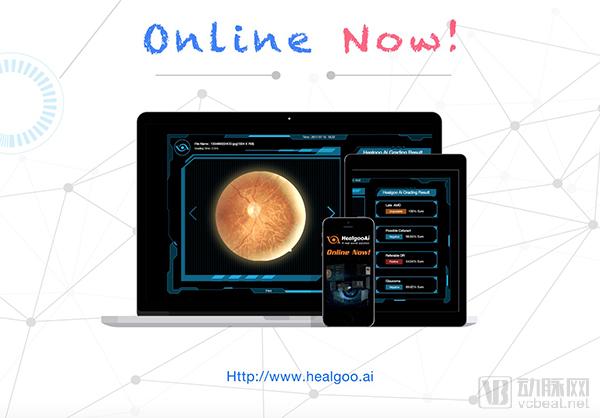
VCBeat learned from interviews that the HeGu AI-assisted diagnostic system for eye diseases is currently being used in more than 300 hospitals across China, screening over 100,000 patients annually. The HeGu AI triage robot has already covered dozens of medium and large cities, including Beijing, Shanghai, Shenzhen, and Chongqing, and is expanding to other central cities. Meanwhile, HeGu Interactive is continuously exploring overseas markets, with collaborative partnerships established in countries such as the United States, India, Malaysia, and Singapore.
Even though the HeGu AI-assisted diagnostic system for eye diseases has already achieved a high level of accuracy, researchers at HeGu Interactive continue to optimize the algorithms and strive to extract more information from fundus photographs, correlating them with other diseases to expand the system’s user coverage.
Meanwhile, HeGu Interactive is continuously deepening its research in artificial intelligence. The company has developed the Healgoo ML platform to address general image classification problems, enabling any user with image data to create their own AI models through this platform. Currently, the platform is still in beta testing and is scheduled to launch its web version in July.
As early as 2016, Hegu Interactive secured RMB 10 million in financing. With its products now mature, the company is actively expanding its market presence. Hegu Interactive seeks to engage with more experts in ophthalmology and artificial intelligence to jointly enhance capabilities in ophthalmic image screening.